Daily Digest
UPSC · Civil Services Examination
Current Affairs · Monday, 26 January 2026
Current affairs curated and edited by Anantam IAS faculty — pulled from The Hindu, PIB, IDSA, Foreign Affairs and the ministries. Read, annotate, revise.
Old Rajinder Nagar · Delhi 110005 · anantamias.com
77th Republic Day 2026: ‘150 Years of Vande Mataram’ Theme, Tableaux and Symbolism
Introduction
The 77th Republic Day, observed on 26 January 2026, marks the seventy-sixth anniversary of the day the Constitution of India came into force in 1950 and the moment a colony formally completed its passage into a sovereign democratic republic. The Government of India has set the theme for the 2026 commemoration as “150 Years of Vande Mataram”, a tribute to the song Bankim Chandra Chatterjee composed in 1875 and embedded eight years later in his Bengali novel Anandamath. The choice of theme stitches together two anniversaries: the constitutional anniversary that produces the parade itself, and the cultural-political anniversary of a song that arguably did more than any speech to give the freedom movement a singable, reproducible emotional vocabulary. For the UPSC aspirant, the day opens onto Paper I modern Indian history and art and culture, Paper II constitutional adoption and the parliamentary calendar, and Paper IV ethics around symbols, dissent and inclusive nationalism, while supplying a dense corpus of Prelims-grade dates, names and articles.
The Republic Day parade down Kartavya Path — the renamed Rajpath — proceeds from Vijay Chowk to the Red Fort and is preceded by the President of India‘s ceremonial unfurling of the national flag, a 21-gun salute, and the playing of Jana Gana Mana. Tableaux from states, union territories and central ministries this year are choreographed around the Vande Mataram sesquicentennial, and the Beating Retreat ceremony on 29 January closes the four-day arc that begins on Republic Day eve. This article unpacks the day’s programme, the deep history of Vande Mataram from Anandamath through the 1937 Tagore-Nehru sub-committee compromise to its constitutional placement, the sociology of the tableaux, the comparative perspective against other republican national days, and the criticisms that have shadowed the song’s elevation into a national symbol.
Quick Facts at a Glance
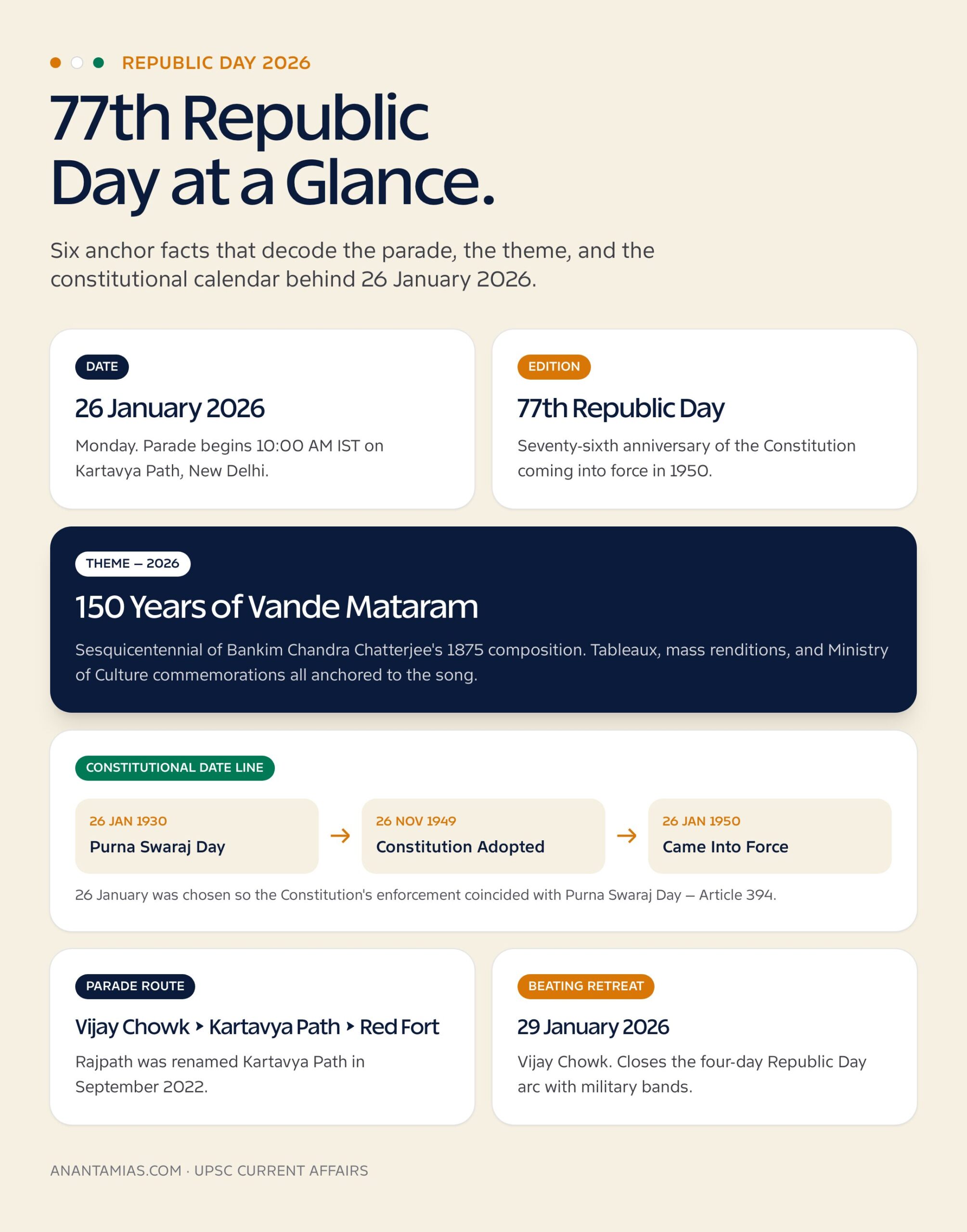
| Indicator | Value | Source |
|---|---|---|
| Republic Day 2026 — edition | 77th Republic Day | Ministry of Defence, Government of India |
| Date and venue of parade | 26 January 2026, Kartavya Path, New Delhi | Ministry of Defence, GoI |
| Theme, 2026 | “150 Years of Vande Mataram” | Ministry of Culture / PIB |
| Vande Mataram — year of composition | 1875 (by Bankim Chandra Chatterjee) | Sahitya Akademi; Anandamath, 1882 |
| Constitution adopted | 26 November 1949 (Constitution Day) | Constituent Assembly Debates, Vol. XII |
| Constitution came into force | 26 January 1950 | Article 394, Constitution of India |
| National Song — formal status conferred | 24 January 1950 (Constituent Assembly statement by Dr Rajendra Prasad) | Constituent Assembly Debates, 24 Jan 1950 |
| National Anthem | Jana Gana Mana (Rabindranath Tagore, 1911) | Constituent Assembly statement, 24 Jan 1950 |
| Chief Guests, Republic Day 2026 | António Costa (President of the European Council) and Ursula von der Leyen (President of the European Commission) — first-ever invitation of the EU’s top leadership as joint chief guests | Ministry of External Affairs / PIB |
| Beating Retreat ceremony | 29 January 2026, Vijay Chowk | Ministry of Defence, GoI |
Background and Historical Context
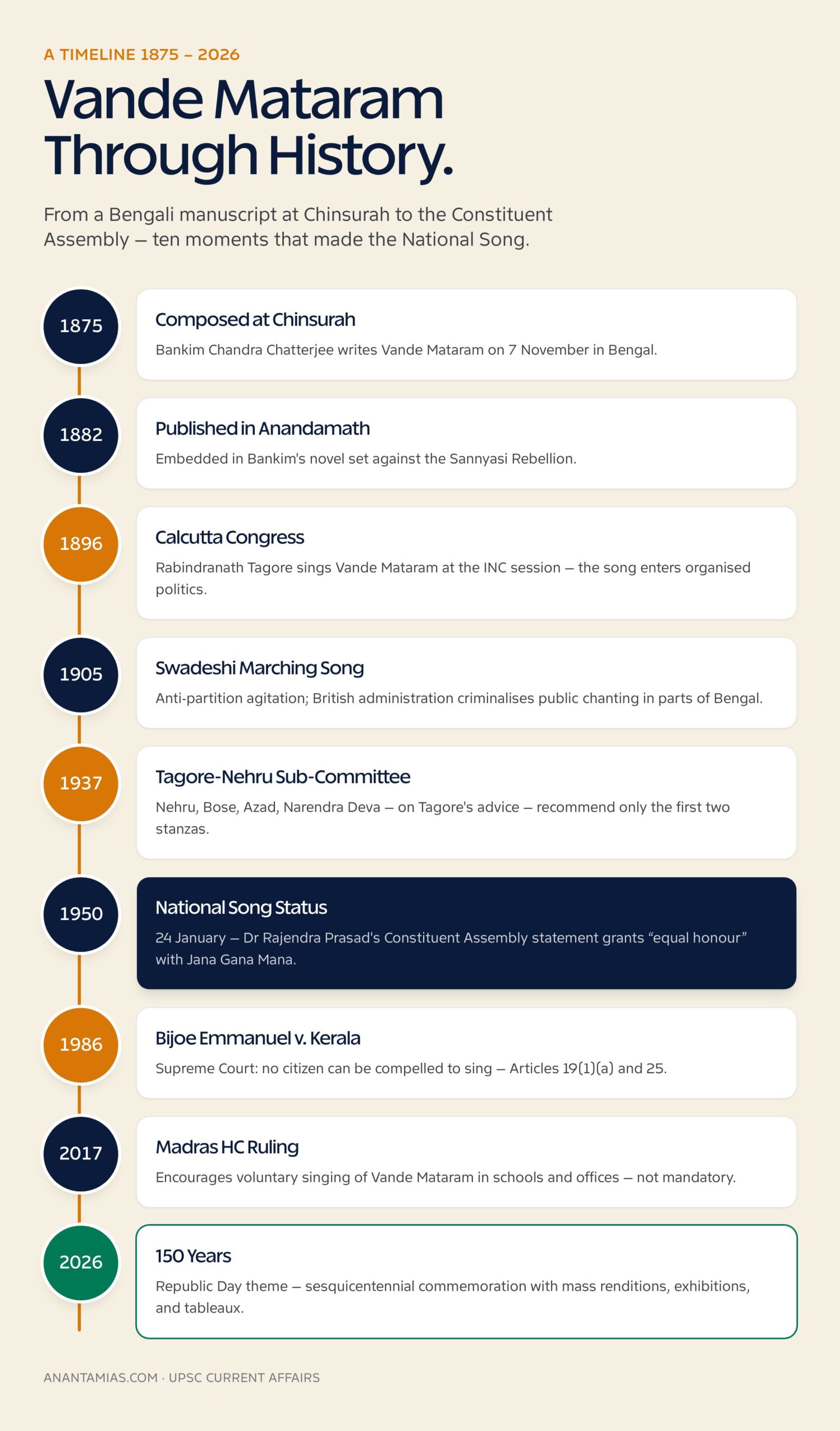
Vande Mataram was written by Bankim Chandra Chatterjee at Chinsurah in Bengal on 7 November 1875, six years before he wove it into the fabric of Anandamath, the 1882 novel set against the backdrop of the late-eighteenth-century Sannyasi Rebellion. The song’s first two stanzas — the portion that would later become the national song — are an invocation of the motherland in Sanskritised Bengali: “Vande Mataram, Sujalam, Suphalam, Malayaja sheetalam, Sasyashyamalam, Mataram”. The remaining stanzas personify the motherland progressively as the goddesses Durga, Lakshmi and Saraswati. This mythopoetic structure, which gave the song its emotional charge during the freedom movement, would later become the seed of the controversy that determined how much of it the Constituent Assembly was willing to canonise.
The song entered organised political life through the Indian National Congress. Rabindranath Tagore sang Vande Mataram at the 1896 Calcutta session of the Congress, and during the Swadeshi movement against the 1905 partition of Bengal it became, in the literal sense, the marching song of the protest — chanted at boycotts of British cloth, sung at processions, and printed at the masthead of nationalist newspapers. The British administration responded by criminalising its public chanting in parts of Bengal during the agitation, which only deepened its symbolic charge. By the time of the Non-Cooperation and Civil Disobedience movements, Vande Mataram and Bharat Mata ki Jai functioned as the two universally legible slogans of the freedom struggle, transcending region and party line.
The song’s status was formalised twice. First, on 26 January 1930, the Congress observed Purna Swaraj Day after the Lahore session of December 1929 had declared complete independence as the goal — and it is precisely this 1930 anchor that explains why the framers chose 26 January 1950 as the date for the Constitution to come into force, even though it had been adopted on 26 November 1949. Second, in 1937, a Congress sub-committee comprising Jawaharlal Nehru, Subhas Chandra Bose, Maulana Abul Kalam Azad and Acharya Narendra Deva — set up after objections from sections of the Muslim community to the song’s later stanzas — recommended that only the first two stanzas be sung at official Congress functions. Rabindranath Tagore was consulted by Nehru and gave his written opinion that the opening stanzas were unobjectionable while the later goddess imagery posed a genuine problem for non-Hindu Indians. This Tagore-Nehru compromise became the template that the Constituent Assembly inherited, and on 24 January 1950 President Dr Rajendra Prasad‘s statement to the House gave Vande Mataram the formal status of the National Song with “equal honour” to Jana Gana Mana, the National Anthem composed by Tagore in 1911 and first sung at the Calcutta session of the Congress in 1911.
Key Features of Republic Day 2026
Republic Day 2026 — Theme and Programme
The Ministry of Defence, which orchestrates the parade, has aligned the 2026 edition with the “150 Years of Vande Mataram” theme set by the Ministry of Culture, and the choreography of the day reflects the dovetailing. The day begins at Amar Jawan commemoration at the National War Memorial, followed by the President’s arrival at Vijay Chowk, the unfurling of the National Flag, the playing of Jana Gana Mana, a 21-gun salute rendered by the ceremonial battery using indigenous 105 mm Indian Field Guns, and the awarding of gallantry decorations including the Param Vir Chakra, Ashoka Chakra and Vir Chakra. The marching contingents from the three services, paramilitary forces, NCC and school bands proceed down Kartavya Path — renamed from Rajpath in September 2022 — past India Gate to terminate at the Red Fort. The flypast by the Indian Air Force closes the parade, and the day’s events end with the At Home reception at Rashtrapati Bhavan.
150 Years of Vande Mataram — The Song’s Journey
The sesquicentennial commemorates a song that travelled from a literary exercise to a political weapon to a constitutional symbol in the span of seventy-five years. Bankim Chandra Chatterjee composed it on 7 November 1875, published it in the magazine Bangadarshan and embedded it in Anandamath in 1882. The song was first set to music by Jadunath Bhattacharya; the version most commonly sung today draws on the rendition popularised by Rabindranath Tagore‘s 1896 performance at the Calcutta Congress and the later orchestration by Pandit Vishnu Digambar Paluskar. The Ministry of Culture’s commemorative programme for 2025-26 includes mass renditions in schools, a digitisation project for early manuscripts and gramophone recordings, exhibitions at the National Archives and the Indira Gandhi National Centre for the Arts, and a sustained campaign on Doordarshan and All India Radio tracing the song’s biography from Chinsurah to the Constituent Assembly.
National Song vs National Anthem — The Constitutional Distinction
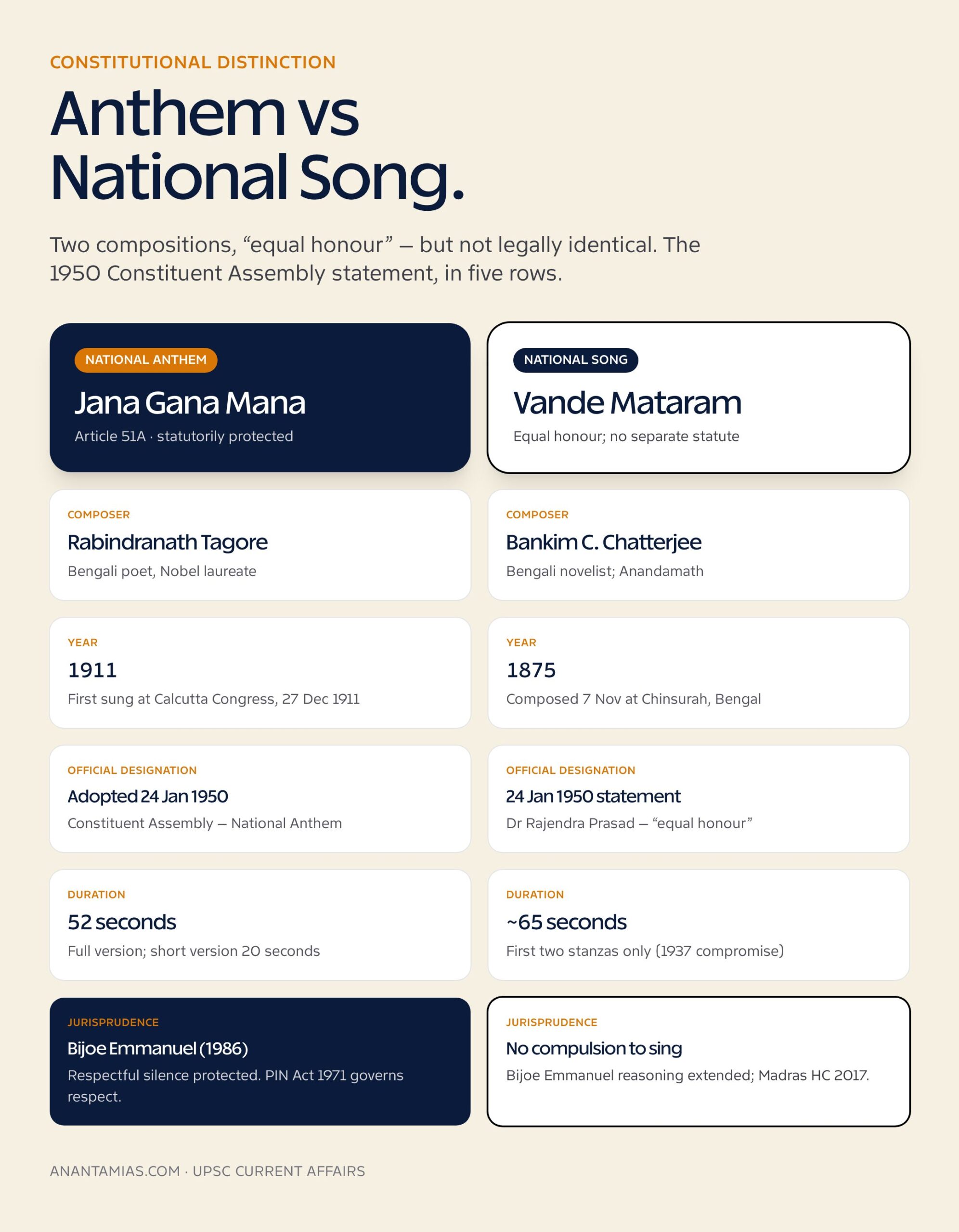
The Indian Republic gives Jana Gana Mana the status of National Anthem and Vande Mataram the status of National Song, and the two statuses are not legally identical. Jana Gana Mana, written by Rabindranath Tagore in 1911 and first sung at the Calcutta session of the Congress on 27 December 1911, was adopted as the National Anthem by the Constituent Assembly on 24 January 1950; its rendition is regulated by the Prevention of Insults to National Honour Act, 1971, and Article 51A(a) makes respect for the Anthem and the Constitution a fundamental duty. Vande Mataram, by contrast, has no separate statute governing its rendition. The Supreme Court in Bijoe Emmanuel v. State of Kerala (1986) held that no citizen can be compelled to sing the National Anthem, and successive courts have extended that reasoning to Vande Mataram, treating respectful silence as constitutionally protected.
Tableaux — A Choreography of Federal India
The jhanki or tableau procession is the parade’s most-watched element and its most political. Each year, the Ministry of Defence invites proposals from states, union territories and central ministries; an expert committee comprising members from the worlds of art, architecture, choreography, music and sculpture screens the entries through several rounds before approving the final list of about fifteen state and ten ministry tableaux. For 2026 the brief is to interpret the Vande Mataram sesquicentennial through state-specific cultural idioms — West Bengal on Bankim Chandra and the Bengal Renaissance, Maharashtra on Tilak’s Kesari and the song’s role in the Bal-Lal-Pal phase, Tamil Nadu on Subramania Bharati‘s Tamil rendering, Punjab on the Ghadar movement, and so on. The tableaux are at once federalism made visible and a federally curated narrative, and the screening process — periodically the source of state-level grievance about exclusions — is itself a window onto how the centre frames the national story.
Significance for UPSC and General Knowledge
- Direct GS-I syllabus hit on modern Indian history — the freedom struggle, Bengal Renaissance, Swadeshi movement, and the role of cultural nationalism.
- GS-I Art and Culture overlap on Bankim Chandra Chatterjee, Bengali literature, Tagore, and the musical history of Indian classical and devotional traditions.
- GS-II anchor on the constitutional adoption sequence, Article 394, Article 51A fundamental duties, and Constituent Assembly procedure.
- Prelims static fodder on dates (1875, 1882, 1896, 1930, 1937, 1949, 1950, 1971, 1986), articles, named acts and named personalities.
- Essay paper data bank on themes such as Indian symbols, plural nationalism, the meaning of citizenship, and constitutional patriotism.
- GS-IV ethics linkage on tolerance, dissent, the Bijoe Emmanuel jurisprudence, and the ethics of compelled speech.
- Interview-stage current affairs material on national symbols, the chief guest tradition as instrument of foreign policy, and tableaux federalism.
Detailed Analysis: Republic Day as Constitutional Pageantry and Public Memory
To read Republic Day as merely a parade is to miss what the day is doing. The parade is the operative ritual of constitutional patriotism — a phrase the political theorist Rajeev Bhargava has used to describe the form of belonging that a republic of strangers can plausibly demand of its citizens. Where the United States invokes a founding revolution and France invokes the storming of a prison, India invokes the coming-into-force of a written document. The choice of 26 January 1950 as that date was deliberate: the Constituent Assembly had adopted the Constitution on 26 November 1949, but waited two months so that the date of operation would coincide with Purna Swaraj Day, observed since 1930 to mark the Lahore Congress’s resolution of complete independence. The parade therefore folds three temporalities: the 1929-30 declaration, the 1949-50 enactment, and the present-tense rehearsal of the republic’s military, federal and cultural strength.
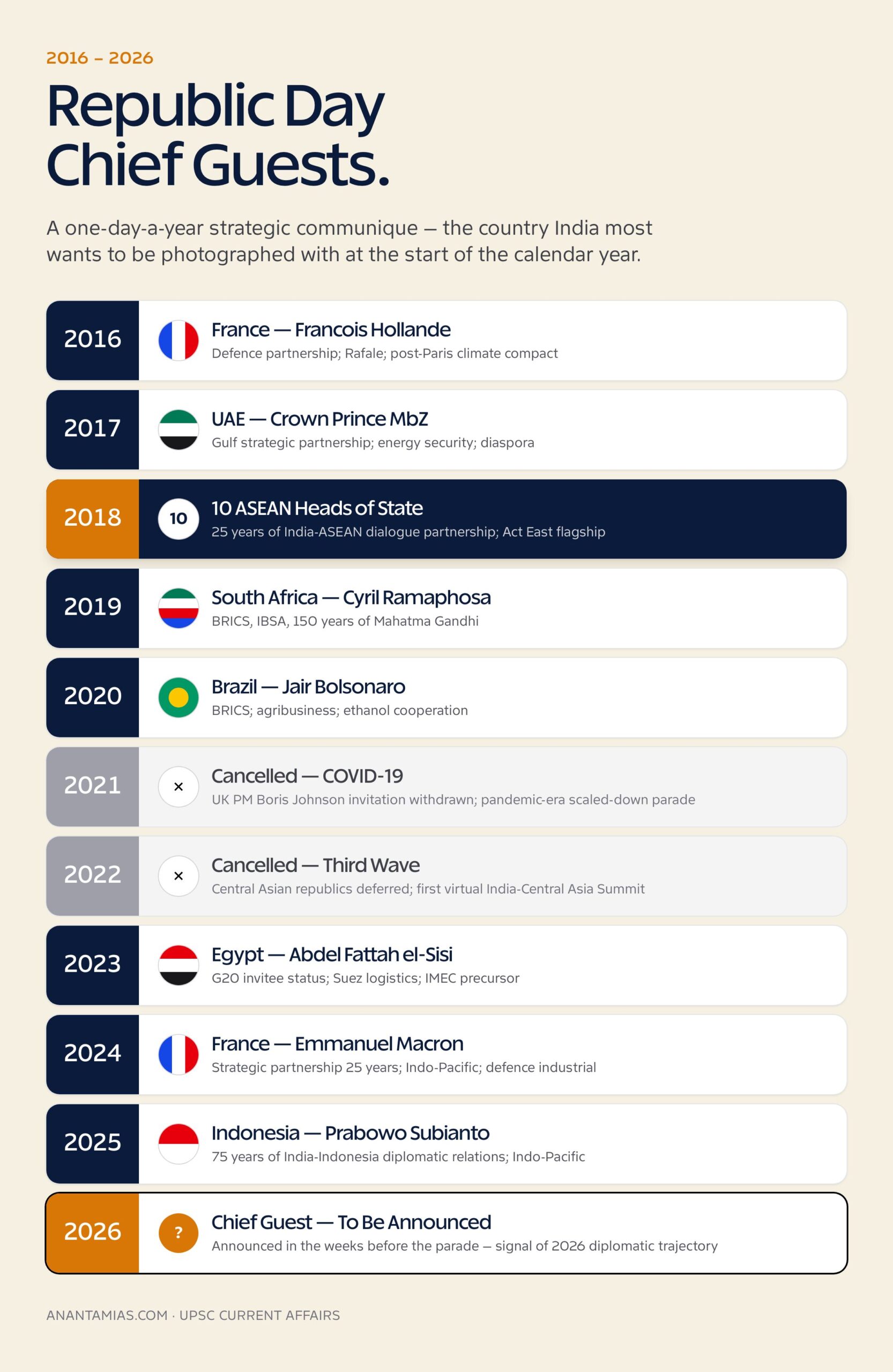
The chief guest tradition is the parade’s foreign-policy instrument. The first Republic Day in 1950 hosted President Sukarno of Indonesia — a deliberate Asian-solidarity signal at a moment when both states were finding their feet. Since then, the choice of chief guest has functioned as a one-day-a-year strategic communique, telegraphing where the host country wishes to anchor its diplomacy in the year ahead. The list below condenses the recent decade and the strategic logic behind each invitation.
| Year | Chief Guest | Strategic Significance |
|---|---|---|
| 2016 | President Francois Hollande, France | Defence partnership, Rafale negotiations, climate compact post-Paris |
| 2017 | Crown Prince Mohammed bin Zayed, UAE | Gulf strategic partnership, energy security, Indian diaspora |
| 2018 | Ten ASEAN heads of state/government | 25 years of India-ASEAN dialogue partnership; Act East flagship |
| 2019 | President Cyril Ramaphosa, South Africa | BRICS, IBSA, and 150 years of Mahatma Gandhi |
| 2020 | President Jair Bolsonaro, Brazil | BRICS, agribusiness, ethanol cooperation |
| 2021 | None (COVID-19; UK PM Boris Johnson’s invitation cancelled) | Pandemic-era scaled-down parade, no foreign chief guest |
| 2022 | None (COVID-19 third wave; Central Asian republics invitation deferred) | Pandemic; first virtual India-Central Asia Summit instead |
| 2023 | President Abdel Fattah el-Sisi, Egypt | Egypt’s G20 invitee status, Suez logistics, IMEC precursor |
| 2024 | President Emmanuel Macron, France | Strategic partnership 25 years; Indo-Pacific, defence industrial cooperation |
| 2025 | President Prabowo Subianto, Indonesia | 75 years of India-Indonesia diplomatic relations; Indo-Pacific |
| 2026 | António Costa (President, European Council) & Ursula von der Leyen (President, European Commission), European Union | First-ever EU joint leadership invitation; signal on India-EU strategic partnership and FTA negotiations |
What the table reveals is the consistency of a doctrine rather than the caprice of a guest list. France appears twice in a decade (2016, 2024), Indonesia bookends the period (2025, with Sukarno in 1950), and the ASEAN bloc invitation in 2018 was the largest single diplomatic statement embedded in the parade in recent memory. The chief guest is, in effect, the country with whom India most wishes to be photographed at the start of the calendar year — a soft-power complement to the harder choreography of joint exercises, summits and trade negotiations that follow through the rest of it.
The military dimension of the parade is its most visible, but the analytical interest lies in what is being signalled. The display of indigenous platforms — the Tejas light combat aircraft in flypast, the Pinaka multi-barrel rocket launcher, the Akash air defence system, the Arjun main battle tank, the Dhanush howitzer, the BrahMos cruise missile, the K-9 Vajra self-propelled artillery and, in recent years, indigenous unmanned systems — is a public audit of the Atmanirbhar Bharat defence-industrial push. The all-women contingents, expanded steadily since 2015 and centre-stage from 2024, are themselves a deliberate statement, as is the steady increase in the share of marching contingents drawn from the Central Armed Police Forces and the National Disaster Response Force. The semiotics is layered: a state announcing what kind of state it intends to be.
The cultural choreography is at least as deliberate. The tableaux on Kartavya Path — fifteen or so from states, ten or so from ministries — are screened over four to five rounds by an expert committee, with an explicit brief tying them to the year’s theme. The 2024 parade carried the theme of “Viksit Bharat”; 2025 commemorated the diamond jubilee of the Constitution under the theme “Swarnim Bharat: Virasat aur Vikas”; the 2026 brief on “150 Years of Vande Mataram” places states in the position of interpreting a single literary-political text through their own regional cultural grammar. This is what the political scientist Sunil Khilnani has called the “idea of India” performed annually — a federation telling itself a single story in twenty-five different accents.
The closing element of the four-day arc is the Beating Retreat on the evening of 29 January at Vijay Chowk. Its origins are explicitly British military — a ceremony marking the end of a day’s hostilities, with troops returning to camp at sundown — but the Indian adaptation has become a showcase for indigenous military music and bagpipe bands of the three services, the police and CAPFs. The 2022 edition controversially dropped “Abide With Me”, a hymn that had been a staple since the 1950s and a Mahatma Gandhi favourite, in favour of “Aye Mere Watan Ke Logo”. The decision drew critique from cultural commentators including historian Mukul Kesavan, who treated it as a needless break with a syncretic tradition. That episode is itself instructive: the parade and its companion ceremonies are layered with choices that look ceremonial but encode substantive contests about what the republic is, has been and is becoming.
Comparative Perspective
Most modern republics anchor a national day on either an event of constitutional founding or a moment of revolution. The choice of anchor encodes the kind of polity each republic wants to remember itself as. India’s anchor is constitutional adoption; France’s is the storming of the Bastille; the United States’s is the Declaration of Independence; Singapore’s is independence from Malaysia. The format that follows the anchor is similarly distinctive: India and France both use a military parade; the United States privileges a fireworks-and-civic-celebration model with no central state ceremony; Singapore stages a stadium-based National Day Parade that has become an exercise in choreographed civic pageantry.
| Country / Day | Anchor Event | Format and Focus |
|---|---|---|
| India — Republic Day, 26 January | Constitution came into force, 1950 (and Purna Swaraj Day, 1930) | Military parade on Kartavya Path; foreign chief guest; state tableaux; flypast; Beating Retreat on 29 January |
| France — Bastille Day, 14 July | Storming of the Bastille, 1789 | Military parade down the Champs-Elysees reviewed by the President; flypast by the Patrouille de France; foreign troop contingents in some years |
| United States — Independence Day, 4 July | Declaration of Independence, 1776 | Decentralised civic celebrations; fireworks; parades organised at city level; no central military parade tradition |
| Singapore — National Day, 9 August | Independence from Malaysia, 1965 | National Day Parade alternating between the Padang and the National Stadium; mass display, military and civic, with strong choreographed civic component |
The structural insight is that India’s Republic Day is institutionally closer to Bastille Day than to the American Fourth of July: both are state-led, military-anchored, capital-centric, and explicitly international in their guest choreography. Where India differs is in the sheer prominence of state tableaux as a federal performance — neither the French nor the Singaporean parades give comparable annual visibility to sub-national units. That federal layer is one of the underrecognised strengths of the Indian format: every year, on national television, fifteen states get to tell the country who they are.
Challenges and Criticisms
The Vande Mataram question has shadowed the song since the 1930s and has not gone away. The objections have moved through three registers. The first is theological: the later stanzas of the song personify the motherland as the goddesses Durga, Lakshmi and Saraswati, and sections of the Indian Muslim community, drawing on a strict reading of monotheistic doctrine that rejects the worship of any entity beside God, have argued from the early twentieth century that the song’s full text is incompatible with Islamic practice. The Muslim League articulated this position formally in the 1930s, and it was specifically to address this concern that the 1937 Congress sub-committee chaired by Jawaharlal Nehru with Subhas Chandra Bose, Maulana Azad and Acharya Narendra Deva, after consultation with Rabindranath Tagore, recommended that only the first two stanzas be sung at official Congress functions. The Constituent Assembly inherited that compromise: the National Song status conferred on 24 January 1950 applied to the song’s first two stanzas alone.
The second register is constitutional. Granville Austin, in The Indian Constitution: Cornerstone of a Nation, treated the Constituent Assembly’s parallel placement of Jana Gana Mana and Vande Mataram as a deliberate act of accommodation rather than ranking — both were given “equal honour” precisely because either alone would have been read by some constituency as exclusion of the other. The contemporary jurisprudence has hardened around this accommodation. The Supreme Court in Bijoe Emmanuel v. State of Kerala (1986), on a challenge by Jehovah’s Witness students who declined to sing the anthem, held that respectful standing in silence does not constitute disrespect, and that compelled singing violates Article 19(1)(a)‘s freedom of speech and Article 25‘s freedom of conscience. The Court has consistently extended that reasoning to Vande Mataram, including in the Shyam Narayan Chouksey proceedings of 2016-18, where the original direction making the National Anthem mandatory in cinemas was modified in 2018 to make it optional.
The third register is sociological. Political theorists including Rajeev Bhargava have argued that a plural republic should distinguish between symbols of sovereignty (which the state may lawfully require respect for) and symbols of cultural-religious affiliation (which require voluntary embrace, not legal mandate). The recurring controversies — orders by individual high courts, executive instructions in particular states requiring schools to sing Vande Mataram, episodic public demands that public servants demonstrate the song aloud — sit precisely on the line that the 1937 sub-committee, the 1950 Assembly statement and the 1986 Bijoe Emmanuel reasoning all sought to draw. The 2026 commemoration, framed around the song’s sesquicentennial, will be judged not by the scale of its events but by whether it can stage that celebration without retracing those fault lines — without, in other words, turning a song that was once the universally legible chant of an anti-colonial movement into a litmus test of belonging in the republic the movement built.
Prelims Pointers
- 26 January 2026 marks the 77th Republic Day of India.
- Theme of Republic Day 2026: “150 Years of Vande Mataram”.
- Vande Mataram was composed by Bankim Chandra Chatterjee on 7 November 1875 at Chinsurah, Bengal.
- The song was first published in the magazine Bangadarshan and embedded in the novel Anandamath (1882).
- Vande Mataram was first sung at the 1896 Calcutta session of the Indian National Congress by Rabindranath Tagore.
- The 1937 Congress sub-committee on Vande Mataram comprised Jawaharlal Nehru, Subhas Chandra Bose, Maulana Azad and Acharya Narendra Deva.
- The Constitution of India was adopted on 26 November 1949 (Constitution Day) and came into force on 26 January 1950 under Article 394.
- 26 January was chosen because it was Purna Swaraj Day, observed since 1930 after the Lahore Congress resolution of December 1929.
- On 24 January 1950, President Dr Rajendra Prasad’s statement gave Vande Mataram National Song status with “equal honour” to Jana Gana Mana.
- Jana Gana Mana, the National Anthem, was composed by Rabindranath Tagore in 1911 and first sung at the Calcutta Congress on 27 December 1911.
- Article 51A(a) makes respect for the National Anthem and the Constitution a fundamental duty.
- The Prevention of Insults to National Honour Act was enacted in 1971.
- Bijoe Emmanuel v. State of Kerala (1986) held that no one can be compelled to sing the National Anthem.
- Rajpath was renamed Kartavya Path in September 2022.
- Beating Retreat is held annually on 29 January at Vijay Chowk; the chief guest of the 1950 Republic Day was President Sukarno of Indonesia.
Mains Practice Questions
- “The choice of 26 January 1950 as the date the Constitution came into force was an act of memory as much as of law.” Discuss with reference to the Lahore Congress, Purna Swaraj Day and the Constituent Assembly’s working calendar. (15 marks)
- Trace the journey of Vande Mataram from Bankim Chandra Chatterjee’s 1875 composition to its formal status as the National Song in 1950. What does this trajectory tell us about the relationship between literature and political mobilisation in colonial India? (15 marks)
- Examine the constitutional and judicial distinction between the National Anthem and the National Song. How has the Supreme Court reconciled symbols of sovereignty with the freedoms guaranteed under Articles 19(1)(a) and 25? (10 marks)
- The 1937 Congress sub-committee on Vande Mataram produced a compromise that the Constituent Assembly later codified. Critically evaluate this compromise as an early instance of accommodative secularism. (15 marks)
- Republic Day tableaux are a federal performance as much as a cultural display. Discuss with examples how the screening process and thematic choices shape the annual narration of Indian federalism. (10 marks)
- Compare India’s Republic Day with Bastille Day in France and Independence Day in the United States. What does the Indian format reveal about its conception of constitutional patriotism? (15 marks)
- “The Republic Day chief guest is a one-day-a-year strategic communique.” Examine this proposition with reference to the choices made over the past decade. (10 marks)
- Discuss the role of Rabindranath Tagore in the making of independent India’s national symbols, including the National Anthem and the framing of the Vande Mataram compromise. (15 marks)
Conclusion
What the 77th Republic Day reveals, read alongside the Vande Mataram sesquicentennial, is the layered work that a national day has to do in a plural republic. The parade is the visible part — marching contingents, indigenous platforms, the flypast, the tableaux, the chief guest seated to the President’s left. The invisible part is the decision-architecture behind the spectacle: which song is sung, in how many stanzas, by whom, with what statutory backing, with which dissents constitutionally protected, and which states get to tell their version of the year’s theme on a national stage. The 2026 commemoration foregrounds a song that travelled from Chinsurah in 1875 to Anandamath in 1882, to the 1896 Calcutta Congress, to the 1905 Swadeshi streets, to the 1937 sub-committee compromise, to the Constituent Assembly statement of 24 January 1950, and into the Bijoe Emmanuel jurisprudence of 1986 — a single object refracting through every consequential moment of the republic’s making.
For the year ahead, three watchpoints follow from the day. The first is the texture of the commemorative programme — whether the Ministry of Culture’s events stay anchored to the song’s first two stanzas, the portion that the 1937-1950 sequence canonised, or whether the sesquicentennial frame is used to revisit the boundary the framers set. The second is the pattern of state participation in the 2026 tableaux: which states make the cut, whose proposals are returned, and which regional readings of Vande Mataram are foregrounded. The third is what the 2026 chief-guest choice itself signals: by inviting António Costa, President of the European Council, and Ursula von der Leyen, President of the European Commission, as joint chief guests — the first time the EU’s top leadership has been hosted in this capacity — the Modi government has placed the India-EU strategic partnership, including the long-pending Free Trade Agreement and the technology and security tracks, at the centre of the year’s diplomatic calendar.
For the aspirant, the line worth carrying into the answer booklet is that the Indian Republic is the rare modern polity that anchors its national day on a constitutional document rather than a battle — and that the 2026 theme reminds us the document was preceded by a song.
Frequently Asked Questions
Who was the chief guest at Republic Day 2026?
Republic Day 2026 had two joint chief guests for the first time in the parade’s history: António Costa, President of the European Council, and Ursula von der Leyen, President of the European Commission. The invitation reflected the deepening India-EU strategic partnership and the conclusion of the India-EU FTA shortly afterwards.
What was the theme of Republic Day 2026?
The 77th Republic Day was themed 150 Years of Vande Mataram, marking the 1875 composition of the song by Bankim Chandra Chatterjee. The Kartavya Path tableaux from states and ministries reflected the song’s history, the freedom struggle, and India’s constitutional adoption of it as the national song with status equal to the national anthem.
Why is Republic Day celebrated on 26 January?
26 January marks two events: the Indian National Congress declared Purna Swaraj on 26 January 1930 in Lahore, and the Constitution of India came into force on 26 January 1950. The framers chose the date to commemorate the Purna Swaraj resolution. The Constitution had been adopted earlier on 26 November 1949.
Who composed Vande Mataram?
Vande Mataram was composed by Bankim Chandra Chatterjee at Chinsurah, Bengal, on 7 November 1875. It was first published in his Bengali novel Anandamath in 1882. Rabindranath Tagore set the song to music and sang it at the 1896 Calcutta session of the Indian National Congress.
Is Vande Mataram the national anthem of India?
No. Jana Gana Mana is the national anthem, adopted by the Constituent Assembly on 24 January 1950. Vande Mataram is the national song with equal status, also formally recognised by the Constituent Assembly the same day. The 1937 Tagore-Nehru sub-committee had recommended that only the first two stanzas be officially used.
What is the Bijoe Emmanuel verdict?
Bijoe Emmanuel v. State of Kerala (1986) is a Supreme Court verdict holding that no person can be compelled to sing the national anthem if it offends their religious belief. The Court held that respectful silence does not violate the Prevention of Insults to National Honour Act 1971. The same reasoning extends to the national song.
How does Republic Day differ from Independence Day?
Independence Day on 15 August commemorates India’s freedom from British rule in 1947 — the Prime Minister hoists the flag at the Red Fort. Republic Day on 26 January marks the Constitution coming into force in 1950 — the President takes the salute at the Kartavya Path parade. The first is national, the second is constitutional.
Why is Republic Day important for UPSC?
Republic Day is high-yield for GS-I Modern History and GS-II Polity: it tests the Purna Swaraj resolution (1930), the Constitution-making process, the national symbols (anthem, song, emblem), and the federal pageantry of the parade. Art and Culture questions often trace Vande Mataram’s literary origins; Prelims tests dates, names and articles.
Source: https://anantamias.com/current-affairs/77th-republic-day-2026-vande-mataram/