3D Concrete Printing: What a Rural Housing Pilot Must Prove
Why in News?
The Ministry of Rural Development reported that the foundation stone for a 177-house 3D concrete printing pilot in Andhra Pradesh was laid on October 4, 2026.
- The pilot covers Burripalem and Obulnayudupalem; laying its foundation does not mean the houses have been completed or occupied.
- The announcement anticipates faster construction and lower costs, but provides no measured completed-project comparison establishing these benefits.
- Claims of greater durability remain expectations requiring technical validation and experience over time, rather than results demonstrated by the launch.
- Rural housing needs habitable homes, including safe structures and working services; faster wall construction addresses only part of that requirement.
- A public pilot can test whether a promising manufacturing method works reliably under actual site and maintenance conditions.
UPSC Relevance
Prelims Relevance
- Additive manufacturing: building an object through successive material deposition.
- Extrusion: forcing a suitable cementitious mixture through a nozzle.
- Buildability: fresh layers retaining shape while supporting further deposition.
- Layer interface: the contact zone between successive printed layers.
- Hydration: cement reactions with water that contribute to hardening.
Mains Relevance
GS Paper 3
- Technology adoption in construction and performance-based assessment.
- Productivity gains balanced against structural safety and maintenance.
GS Paper 2
- Public housing pilots, procurement accountability and beneficiary protection.
Essay
- Innovation becomes public value when demonstrated performance replaces promises.
Background and Context
How Layer Deposition Builds a Wall
Concrete printing changes how material is placed, while the finished building still needs an integrated design and construction process suited to its intended use.
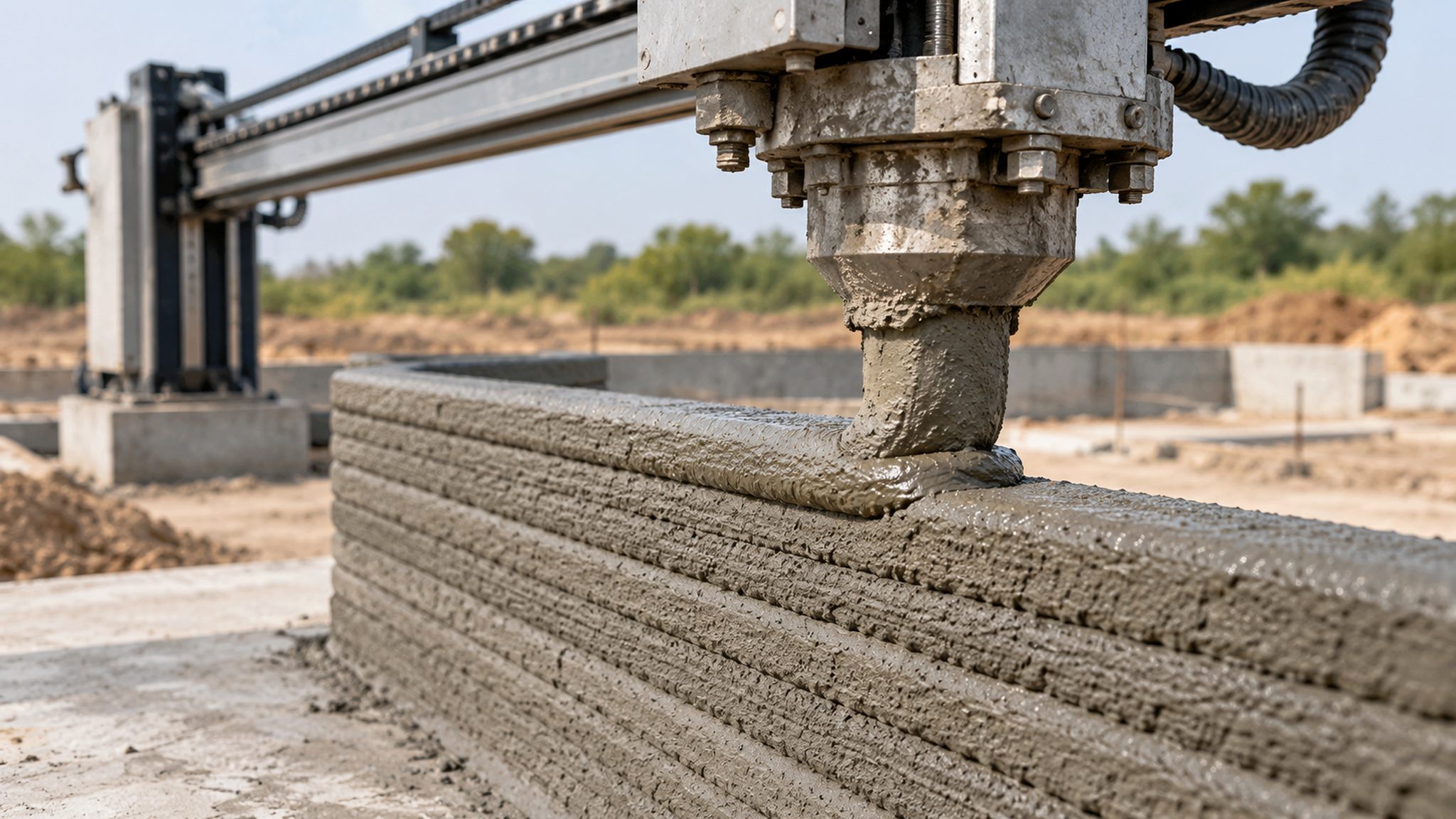
- Extrusion-based printing uses a computer-controlled nozzle to deposit cementitious material along a planned path, repeating the operation in successive layers until the intended wall shape emerges from the deposited material.
- Printability combines two competing needs: the mixture must move through the delivery system, yet remain sufficiently stable after placement. A material that flows easily does not automatically form a reliable wall.
- Buildability concerns fresh layers holding their shape as additional material is deposited above them. This makes the timing of deposition and the changing condition of the mixture part of construction quality.
- Hydration and flow behavior influence how quickly the material gains stiffness and how layers bond. The NIST research program examines these links between material properties, printing and structural performance.
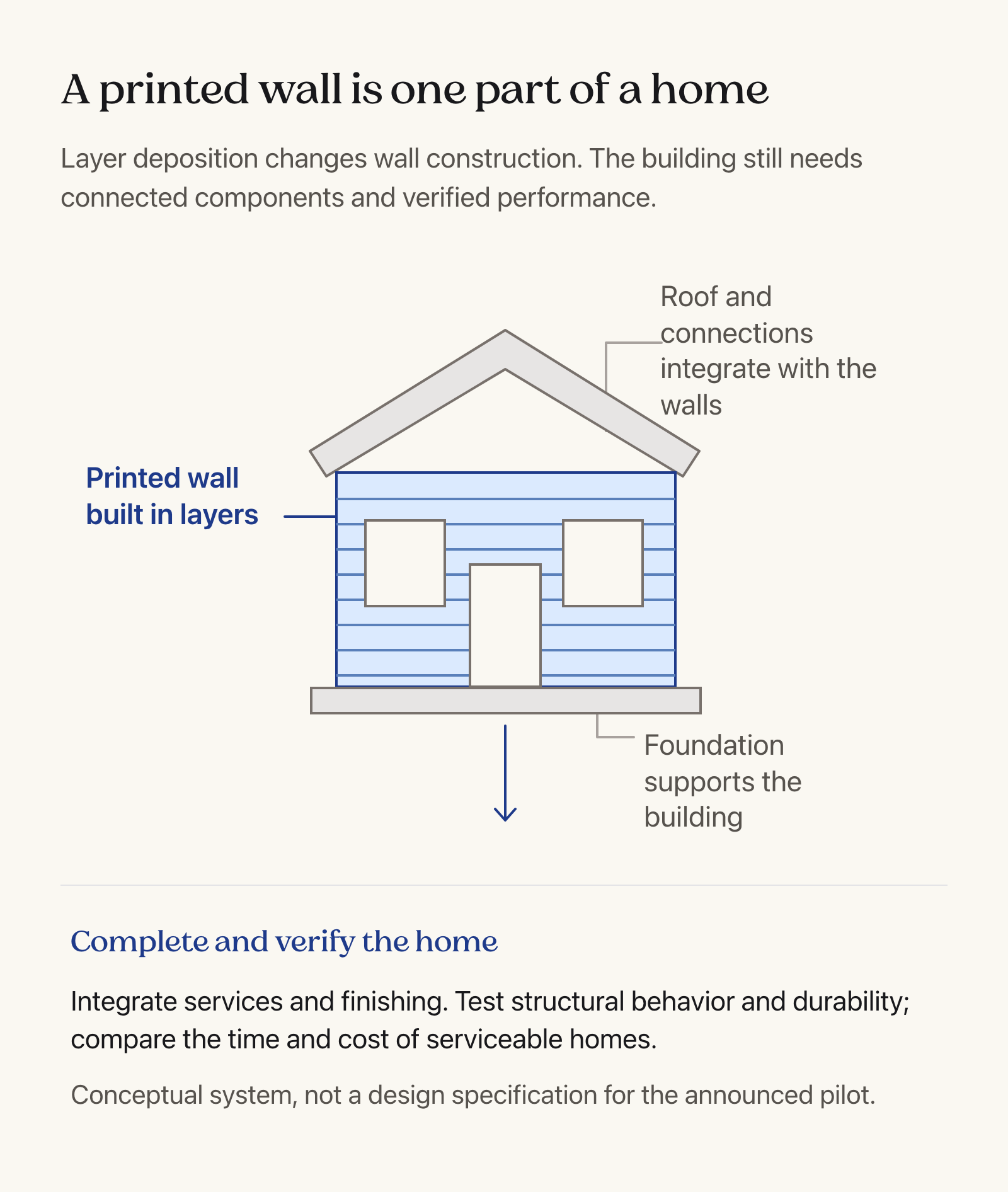
- Printing a wall is different from delivering a complete house. Foundations, roof connections, openings and services must form a workable building system; the pilot announcement does not specify their detailed engineering solutions.
Why Interfaces and Testing Matter
A layered wall must perform as a structural element over time, making the joints between deposited layers central to evaluating the technology and its practical limits.
- Interlayer bonding connects successive deposits. NIST identifies layer interfaces as important to mechanical performance and durability, so a visually regular surface alone cannot establish that a printed element meets its intended performance.
- Directional behavior matters because the layered process can create different properties in different directions. Testing must represent the printed structure, rather than assuming that ordinary cast specimens capture all relevant behavior.
- Structural interfaces also include where the wall meets other building elements. Their adequacy depends on the actual design, loads and construction details; no universal reinforcement prescription follows from the term printed house.
- Representative testing should examine material and structural behavior. NIST’s long-term performance research investigates how tests and sampling can detect important interface variation without simply assuming conventional methods transfer unchanged.
- Durability concerns performance throughout service, including environmental exposure and deterioration. Finishing a wall quickly is a production result; demonstrating that it remains suitable for use requires a different body of evidence.
What the Rural Pilot Should Establish
The useful comparison is between completed, serviceable homes built under comparable conditions, rather than between machine printing time and the entire schedule of conventional construction.
- Total delivery time should cover preparation, printing, curing, roofing, services and finishing. Reporting only nozzle operating hours would leave essential work outside the comparison and exaggerate what a household actually receives.
- Whole-project cost should include equipment, material supply, trained operation, testing and maintenance. A lower wall-production expense would not by itself demonstrate that the completed home costs less to build or maintain.
- Site reliability should be assessed through documented interruptions, rejected work and repairs. These records would show whether the process can be repeated consistently beyond a carefully managed demonstration at a selected location.
- Worker capability should be evaluated through training and supervision requirements. Automation changes the tasks involved in construction; its effects on employment and safety need observation rather than an assumption that workers become unnecessary.
- Beneficiary experience should inform decisions about expansion through feedback on usability, comfort and repair access. Public reporting should distinguish the announced pilot, completed construction and verified performance instead of treating these stages as interchangeable.
Way Forward
Make Expansion Conditional on Evidence
- Publish comparable results for finished homes, including delivery time, full cost and the basis of technical acceptance.
- Require independent assessment appropriate to the actual design and site conditions, with clear responsibility for defects and repairs.
- Track occupant feedback and maintenance needs before scaling the approach across different locations and construction teams.
Conclusion
- 3D concrete printing offers a different way to manufacture building elements, but a launch announcement cannot prove cheaper, faster or longer-lasting housing. The rural pilot should make those claims testable through transparent evidence.
- For an answer on technology adoption, separate production capability from public-service outcomes: explain the printing mechanism, identify interfaces requiring validation, and judge success by complete homes that remain safe, usable and maintainable.
UPSC Practice Questions
Prelims MCQ 1
With reference to extrusion-based 3D concrete printing, consider the following statements:
- Material is deposited in successive layers.
- The bonding between layers can affect structural performance.
- Printing a wall automatically completes roofing and electrical services.
How many of the above statements are correct?
(a) Only one (b) Only two (c) All three (d) None
Answer: (b) Only two
Explanation:
The first two statements are correct. Layer deposition and interlayer bonding are central features, while a complete house also requires integrated construction and services.
Prelims MCQ 2
Which comparison best evaluates the affordability claim of a rural 3D-printed housing pilot?
(a) Nozzle operating time against all conventional construction time (b) The purchase price of the printing machine alone (c) Total costs of comparable completed homes, including testing and maintenance (d) The number of layers printed in an hour
Answer: (c) Total costs of comparable completed homes, including testing and maintenance
Explanation:
Affordability concerns the complete housing outcome. A partial cost or printing-speed measure cannot establish whether a finished home is more economical.
UPSC Mains Questions
- Explain the working principle of extrusion-based 3D concrete printing. Why do material properties and layer interfaces require attention before its wider use in housing?
- How should governments evaluate construction technology pilots in public housing? Discuss the evidence needed to balance innovation, affordability and beneficiary protection.
Sources: PIB, Ministry of Rural Development and NIST.
Frequently Asked Questions
Has the Andhra Pradesh pilot already delivered its houses?
No. The October 4 announcement reports the laying of a foundation stone for a 177-house pilot. It does not establish completed construction, occupation or independently verified performance of those homes.
What does buildability mean in concrete printing?
Buildability is the ability of freshly deposited material to retain its shape while supporting further layers. It concerns behavior during printing, which is different from the strength and durability of the hardened wall.
Why are layer interfaces important?
Successive deposits must bond adequately. Their interfaces can influence strength, cracking and deterioration, making representative testing important. An orderly printed appearance is insufficient evidence that the element will perform as intended.
Does 3D printing remove the need for other construction work?
No. Printing building elements is part of delivering a house. Foundations, roofing, services and connections still need appropriate design and execution; the exact arrangement depends on the selected construction system.
Are lower cost and longer lifespan proven for this pilot?
The announcement presents these as expected benefits. Establishing them requires comparable finished-project costs, suitable technical assessment and evidence about performance over time. Foundation laying alone cannot demonstrate either outcome.