Daily Digest
UPSC · Civil Services Examination
Current Affairs · Thursday, 4 June 2026
Current affairs curated and edited by Anantam IAS faculty — pulled from The Hindu, PIB, IDSA, Foreign Affairs and the ministries. Read, annotate, revise.
Old Rajinder Nagar · Delhi 110005 · anantamias.com
Cabinet approves ₹10,000 crore ATF Price Stabilisation Fund
Why in News?
The Union Cabinet approved a one-time Price Stabilisation Fund of up to ₹10,000 crore to shield scheduled Indian airlines from sharp fluctuations in aviation turbine fuel (ATF) prices amid the ongoing West Asia crisis.
| UPSC Relevance: GS-3 Economy: Infrastructure, Civil Aviation, Energy Security Prelims: Aviation Turbine Fuel (ATF), Price Stabilisation Fund, UDAN Scheme, SAF |
What is Aviation Turbine Fuel (ATF)?
- ATF, also called jet fuel, is a specialised kerosene-based fuel used to power aircraft turbine engines.
- Key Features:
- Derived from crude oil through refining.
- High energy density and low freezing point.
- Prices are linked to international crude oil markets.
- ATF prices in India are revised on the 1st of every month by state-owned Oil Marketing Companies, based on the average of international benchmark rates and foreign exchange rates.
- ATF is not included under GST and instead attracts VAT levied by individual states (ranging from 1% to 30%), making it one of the most heavily taxed fuels in India.
- ATF accounts for nearly 40% of an airline’s operating costs and can rise to 60% during periods of extreme fuel price volatility.
Major Triggers:
- West Asia Geopolitical Crisis: Escalating tensions in West Asia disrupted global energy markets, causing a spike in crude oil and jet fuel prices.
- Sharp Rise in ATF Prices: ATF prices increased nearly 2.5 times within two months:
- March 2026: ₹60.50/litre
- May 2026: ₹142/litre
- Closure of Pakistan’s Airspace: Indian carriers flying to Europe and North America have been forced to take longer routes, resulting in:
- Higher fuel consumption
- Increased flight times
- Higher operating costs
- Reduced profitability on long-haul routes.
- Rising Cost Burden: Normally, ATF accounts for around 40% of airline operating expenses. During extreme fuel volatility, the share can rise to 60%, threatening airline viability.
What is the ATF Price Stabilisation Fund?
- The ATF Price Stabilisation Fund is a temporary financial mechanism that cushions airlines against extraordinary fuel price spikes.
- Corpus: ₹10,000 crore
- Nature of Support: Interest-free advances from the Central Government to OMCs.
- Beneficiaries: Scheduled Indian airlines operating Domestic services & International services.
- Duration: 36 months. Subject to annual review.
How will the Mechanism Work?
- Benchmark Price: A benchmark ATF price will be fixed under the scheme.
- Compensation to OMCs: When international import-parity ATF prices exceed the benchmark:
- OMCs will absorb part of the cost.
- Government support will compensate OMCs through the fund.
- Fixed-Price Fuel Supply: Participating airlines will:
- Enter agreements with OMCs.
- Purchase fuel exclusively from state-owned OMCs.
- Receive greater price certainty for up to three years.
- Recovery Mechanism: When global ATF prices decline:
- OMCs will recover the benefit extended.
- The recovered amount will be returned to the Consolidated Fund of India.
Thus, the scheme functions as a revolving stabilisation fund rather than a permanent subsidy.
Governance and Oversight:
- A Monitoring Committee will supervise implementation.
- Composition: Representatives from:
- Ministry of Civil Aviation
- Ministry of Petroleum and Natural Gas
- Department of Expenditure
- Responsibilities: Claim verification, Auditing, Reconciliation and settlement, and annual review of the scheme.
Expected Benefits:
- Airlines: Predictable fuel costs, improved financial planning, and reduced risk of route cancellations.
- Passengers: Reduced fare volatility and protection from sudden ticket price hikes.
- Regional Connectivity: The mechanism is expected to limit the impact of fuel price shocks on passengers and support connectivity to remote, regional, Tier-II and Tier-III cities. This is particularly important for routes under the UDAN (Ude Desh ka Aam Naagrik) regional connectivity scheme.
- Employment: The policy is aimed at protecting approximately 77 lakh jobs across airlines, airports, travel agencies, ground handling, and the hospitality sector.
- OMCs: Compensation for losses incurred from selling below import parity prices.
Concerns and Challenges:
- Risk of Market Distortion: Government intervention in fuel pricing may dilute market signals and reduce incentives for operational efficiency.
- Fiscal Burden: Although recoverable, the fund temporarily locks up public resources amounting to ₹10,000 crore.
- Moral Hazard: Repeated support measures could encourage expectations of future bailouts during crises.
- Limited Structural Reform: The scheme addresses short-term volatility but not long-standing issues such as high taxation on ATF, Airport charges, Infrastructure bottlenecks, and dependence on imported crude oil.
- Exclusive Procurement Requirement: Mandatory procurement from state-owned OMCs may reduce competitive fuel sourcing options available to airlines.
Way Forward:
- Rationalise ATF Taxation: Bringing ATF under the GST framework could reduce cascading taxes and lower operating costs.
- Promote Sustainable Aviation Fuel (SAF): Increasing domestic production of SAF can reduce dependence on imported petroleum products.
- Strengthen Fuel Hedging: Indian airlines should develop sophisticated fuel-risk management and hedging strategies.
- Enhance Energy Security: Diversification of crude oil import sources and expansion of strategic petroleum reserves can reduce vulnerability to external shocks.
- Improve Operational Efficiency: Investments in Fuel-efficient aircraft and air traffic management. & Green airport infrastructure can lower fuel consumption over the long term.
India’s Fairwood Nuclear & South Korea’s SK Securities sign Small Reactor Project pact
Why in News?
India’s Fairwood Nuclear Pvt. Ltd. and South Korea’s SK Securities Co. Ltd. have signed a strategic collaboration agreement to support the development, financing, and commercialisation of Small Modular Reactors (SMRs) and Micro Modular Reactors (MMRs) in India.
| UPSC Relevance: GS-3 Science and Technology: Nuclear Technology Prelims & Mains: Small Modular Reactors (SMRs), Micro Modular Reactors, Nuclear Energy, India’s Nuclear Energy Programme |
What are Small Modular Reactors (SMRs)?
- Small Modular Reactors are advanced nuclear reactors with an electrical output generally ranging from less than 30 MW to about 300 MW per unit, significantly smaller than conventional nuclear reactors, which often exceed 700-1000 MW.
Key Features:
- Small: Generate a fraction of the power produced by conventional nuclear reactors.
- Modular: Major components can be manufactured in factories and transported to installation sites.
- Scalable: Multiple modules can be added according to energy requirements.
- Enhanced Safety: Incorporate passive safety systems that rely on natural processes such as gravity, convection, and pressure differences rather than active human intervention.
- Flexible Deployment: Suitable for remote areas, industrial clusters, mines, islands, and defence installations.
What are Micro Modular Reactors (MMRs)?
- Micro Modular Reactors are even smaller nuclear reactors, generally producing up to 10-20 MW of electricity, though definitions vary.
- Applications:
- Remote military bases
- Arctic and island communities
- Data centres
- Mining operations
- Hydrogen production facilities
Their compact design enables transport by road, rail, or ship and allows operation in areas where conventional power infrastructure is weak.
Key Features of the Fairwood Nuclear-SK Securities Agreement:
- Project Development: The partnership will collaborate on the technical and commercial development of SMR and MMR projects in India.
- Investor Mobilisation: SK Securities will leverage its network in South Korea and international financial markets to attract institutional and private investors.
- Technology Ecosystem Access: The agreement facilitates engagement with global nuclear technology stakeholders and advanced reactor ecosystems.
- Make in India Focus: Fairwood Nuclear aims to develop a privately financed indigenous reactor platform aligned with the “Make in India” initiative.
- Duration: The initial agreement is valid for three years, extendable by mutual consent.
Why are SMRs gaining Global Importance?
The global energy transition is increasing demand for reliable, low-carbon electricity that complements renewable energy sources.
- Climate Change Mitigation: SMRs generate electricity with minimal greenhouse gas emissions and can support net-zero commitments.
- Energy Security: They provide dependable baseload power independent of weather conditions.
- Electrification of Emerging Sectors: SMRs can support:
- Artificial Intelligence data centres
- Green hydrogen production
- Industrial decarbonisation
- Electric mobility infrastructure
- Replacement of Coal Plants
Many countries are exploring SMRs as substitutes for ageing coal-fired power stations by utilising existing grid infrastructure.
Significance for India:
- Supporting India’s Net-Zero Goal: India aims to achieve Net Zero emissions by 2070. Expanding nuclear power is essential for decarbonising the electricity sector.
- Meeting Rising Power Demand: India’s electricity demand is projected to grow substantially due to industrialisation, urbanisation, AI infrastructure, and electric mobility.
- Energy Transition: SMRs can provide continuous power while complementing intermittent renewable energy sources such as solar and wind.
- Decentralised Energy Generation: SMRs can be deployed in Remote regions, Border areas, Industrial corridors, & Island territories.
- Strengthening Domestic Manufacturing: The collaboration could help build indigenous capabilities in Reactor manufacturing, Nuclear supply chains, Advanced materials and Nuclear engineering services
India’s Push Towards Small Modular Reactors:
India has recently increased emphasis on SMR development.
- Policy Support: The Union Government is accelerating India’s transition to a 100 GW nuclear capacity by 2047 through the newly enacted SHANTI Act, 2025. This legislation ends the state monopoly on nuclear operations, enabling private sector and foreign participation, and is backed by a ₹20,000 crore budgetary push for Small Modular Reactors (SMRs).
- Bharat Small Reactor (BSR): India is developing the Bharat Small Reactor (BSR) concept based on indigenous Pressurised Heavy Water Reactor (PHWR) technology to support industrial decarbonisation and captive power generation.
Advantages of SMRs:
- Lower Initial Capital Requirement: SMRs require lower upfront investment compared to large nuclear power plants.
- Faster Construction: Factory fabrication reduces on-site construction time and project delays.
- Enhanced Safety: Passive safety systems reduce the probability of severe accidents.
- Grid Flexibility: They can be integrated into smaller grids and can operate alongside renewable energy sources.
- Reduced Land Requirement: SMRs typically occupy less land than large conventional nuclear power stations.
- Long Refuelling Cycles: Many designs can operate for several years before refuelling, reducing operational interruptions.
Challenges Associated with SMRs:
- High Cost per Unit of Electricity: Despite lower upfront costs, SMRs may face higher electricity generation costs because economies of scale are limited.
- Nuclear Waste Management: SMRs continue to generate radioactive waste requiring safe long-term storage and disposal.
- Technology Maturity: Many SMR designs globally remain at demonstration or early commercialisation stages.
- Financing Risks: Investors may remain cautious until large-scale commercial deployment demonstrates economic viability.
- Regulatory Framework: India’s nuclear regulatory system is primarily designed for large reactors and may require adaptation for advanced reactor technologies.
Way Forward:
- Accelerate development of indigenous SMR technologies.
- Create a dedicated regulatory framework for advanced reactors.
- Encourage public-private partnerships in nuclear energy.
- Develop robust spent-fuel and waste-management systems.
- Promote international cooperation for financing and technology transfer.
- Integrate SMRs into India’s broader clean-energy and industrial decarbonisation strategy.
The Fairwood Nuclear–SK Securities partnership reflects growing international confidence in India’s emerging advanced nuclear energy sector.
Mountbatten Plan at 79: June 3 Declaration
Why in News?
June 3, 2026, marked the 79th anniversary of the announcement of the Mountbatten Plan (June 3, 1947), which laid down the framework for the partition of British India into the two independent dominions of India and Pakistan.
| UPSC Relevance: GS-1 Modern Indian History: Freedom Struggle; Partition of India; Constitutional Developments Prelims & Mains: Mountbatten Plan, Indian Independence Act 1947, Partition of India, Boundary Commission |
By early 1947, British India was witnessing unprecedented political deadlock and communal violence. The failure of the Cabinet Mission Plan (1946), the Muslim League’s demand for Pakistan, and widespread riots convinced British policymakers that maintaining a united India had become increasingly difficult.
In February 1947, British Prime Minister Clement Attlee announced that power would be transferred to Indian hands by June 1948.
To oversee the transition, Lord Louis Mountbatten arrived in India on 22 March 1947 as the last Viceroy.
What was the Mountbatten Plan?
Announced on 3 June 1947, the Mountbatten Plan accepted the partition of British India and outlined the mechanism for creating two sovereign dominions: India and Pakistan.
Major Provisions:
1. Partition of British India: British India would be divided into India and Pakistan. Both would become self-governing dominions under the British Commonwealth.
2. Division of Punjab and Bengal: The Legislative Assemblies of Punjab and Bengal were to vote separately on whether: (i) the provinces should remain united. (ii) They should be partitioned between India and Pakistan. Both provinces ultimately voted for partition.
3. Referendum in NWFP: A referendum was to be conducted in the North-West Frontier Province (NWFP) to determine whether it would join India or Pakistan. The province voted in favour of Pakistan.
4. Referendum in Sylhet: The Muslim-majority district of Sylhet in Assam was given the option through a referendum to join East Bengal (Pakistan). The majority voted to join Pakistan.
5. Sindh Assembly Decision: The Sindh Legislative Assembly was empowered to decide whether Sindh would join Pakistan. It voted in favour of Pakistan.
6. Boundary Commission: A Boundary Commission headed by Sir Cyril Radcliffe was constituted to demarcate the borders of Punjab and Bengal. This led to the Radcliffe Line, announced on 17 August 1947.
7. Princely States: The approximately 565 princely states were advised to accede either to India or Pakistan, taking into account: Geographical contiguity & Administrative convenience. The option of complete independence was not formally encouraged by the British.
8. Early Transfer of Power: The transfer of power was advanced from June 1948 to 15 August 1947, leaving only about ten weeks for implementation.
Why did Congress accept Partition?
The Congress leadership had long opposed partition. However, by 1947, several factors influenced its decision.
- Escalating Communal Violence: The communal riots in Calcutta (1946), Noakhali, Bihar, and Punjab created fears of a civil war. Congress leaders believed that an immediate transfer of power was necessary to prevent further bloodshed.
- Desire for a Strong Central Government: Leaders such as Sardar Vallabhbhai Patel felt that a united India with a permanently obstructive Muslim League would weaken governance. A smaller but politically cohesive India was viewed as a more practical option.
- Failure of Congress-League Cooperation: The experience of coalition functioning under the Interim Government convinced leaders like Jawaharlal Nehru that effective cooperation with the Muslim League had become nearly impossible.
- Avoiding Balkanisation: Congress was particularly concerned about the earlier “Plan Balkan”, which could have allowed provinces to become independent entities. Partition appeared preferable to the fragmentation of the entire subcontinent.
Why did the Muslim League accept the Plan?
For the Muslim League, acceptance of the plan represented the achievement of its principal objective.
- Realisation of Pakistan: The plan officially recognised the creation of Pakistan, a demand that had been advanced since the Lahore Resolution (1940).
- Fear of Political Marginalisation: The League argued that Muslims would become a permanent minority in a united India and therefore required a separate homeland to safeguard their political interests.
- Strategic Acceptance: Although Muhammad Ali Jinnah opposed the partition of Punjab and Bengal, he accepted the plan because it guaranteed Pakistan’s creation.
Consequences of the Mountbatten Plan:
1. Positive Outcomes:
- End of British Rule: The plan paved the way for independence after nearly two centuries of British colonial rule.
- Establishment of Sovereign States: It enabled the creation of two independent nations, India & Pakistan.
- Transfer of Power: The transition occurred peacefully at the constitutional level without prolonged colonial conflict.
2. Negative Outcomes:
- Humanitarian Catastrophe: Partition triggered one of the largest forced migrations in human history. Around 14-18 million people crossed borders. Estimates suggest between 200,000 and 1 million people lost their lives.
- Communal Violence: Punjab, Bengal, Delhi, Sindh and other regions witnessed widespread massacres and displacement.
- Kashmir Dispute: The hurried partition process left unresolved territorial issues, particularly Jammu and Kashmir, which became the source of enduring India-Pakistan tensions.
- Administrative Chaos: The rapid timeline left inadequate time for Border demarcation, Division of assets, Rehabilitation planning, and security arrangements.
Criticism of the Mountbatten Plan:
- Excessive Haste: Historians argue that advancing independence from June 1948 to August 1947 left insufficient time for orderly implementation.
- Inadequate Preparation: The Radcliffe Boundary Award was announced only after independence, creating confusion and panic among populations.
- Underestimation of Migration: British authorities underestimated the scale of population movement and violence that partition would unleash.
- Failure to Protect Minorities: No effective mechanism was created to guarantee minority rights during the transition.
Thus, the Mountbatten Plan permanently reshaped the geopolitical landscape of the Indian subcontinent.
Mains Practice Question:
Q. The Mountbatten Plan was a political compromise that secured independence, but at the cost of partition and immense human suffering. Critically examine.
Source: https://anantamias.com/current-affairs/mountbatten-plan-at-79-june-3-declaration/
Russia delivers fourth squadron of S-400 Air Defence System
Why in News?
India has received the fourth squadron of the Russia-made S-400 air defence system, strengthening the country’s long-range air defence network.
The delivery is part of a $5.43 billion agreement signed between India and Russia in 2018 for the acquisition of five S-400 regimental systems. Three S-400 squadrons have already been inducted into service; the fourth has now arrived.
| UPSC Relevance: GS-3 Science and Technology: Defence Technology Prelims & Mains: S-400 Air Defence System |
What is the S-400 Air Defence System?
- S-400 Triumf is considered one of the world’s most advanced air defence systems that can simultaneously track and neutralise a range of incoming objects over very long ranges.
- Developed by Russia. S-400 is a successor to the S-300 system.
- The surface-to-air missile system can provide air interception against:
- fighter aircraft, stealth aircraft, AWACS aircraft
- airborne missile strategic carriers
- unmanned aerial vehicles
- ballistic missiles and cruise missiles
- The S-400 is fully mobile. Capable of firing four types of missiles to create a layered defence net for up to 40 km, 120 km, 250 km and a maximum range of 400 km.
- Altitude: It can destroy targets at a height of 10 metres to 30 Kilometres. The different ranges and varying altitudes create a layered air defence net.
- Each system has a 3D phased array acquisition radar that can track around 300 targets, a command and control centre, automatic tracking and targeting systems, launchers and support vehicles.
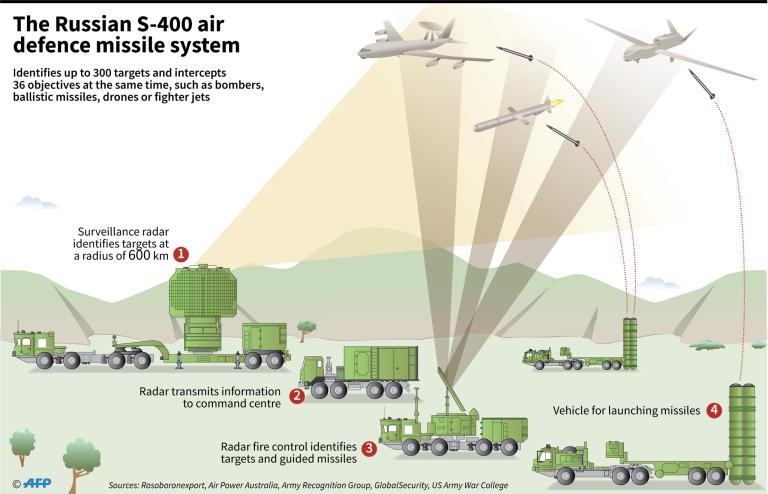
- India signed a $5.43 billion deal with Russia in 2018 for five squadrons of the S-400 system. Russia has delivered four units- deployed in Pathankot (Punjab), Rajasthan, and Gujarat, and one recent unit.
- One remaining unit will be delivered to India by 2026. Despite the fear of sanctions from the US under the Countering America’s Adversaries Through Sanctions Act (CAATSA), India and Russia signed a contract.
- Indian Defence Ministry’s Defence Procurement Council has approved the purchase of five more Russian S-400 long-range air defence systems.
Why is the S-400 important for India?
S-400 has been named ‘Sudarshan Chakra’, inspired by the mythological weapon of Lord Krishna.
- Proven layered air defence system: The S-400 system has already demonstrated its operational effectiveness. During Operation Sindoor (2025), the deployed systems played a critical role in intercepting and neutralising incoming missiles and drones, significantly bolstering India’s air defence capabilities.
- Complements India’s indigenous Ballistic Missile Defence system developed by the Defence Research and Development Organisation (DRDO).
- Fills gaps in the Indian Air Force (IAF): The S-400 would make up for its falling fighter aircraft squadrons in the medium term.
- Strong deterrence: Given its long range, the system can track the movements of Pakistan Air Force aircraft. Enhances India’s strategic deterrence against China.
The S-400 can be seamlessly integrated into the country’s existing air defence network, thereby strengthening national security against evolving aerial threats.
Practice MCQ:
Q. Consider the following statements regarding the S-400 air defence system:
1. It is a long-range surface-to-air missile system developed by Russia.
2. It can engage aircraft, cruise missiles and ballistic missiles.
3. It is a submarine-launched missile system.
Which of the statements given above is/are correct?
(a) 1 and 2 only
(b) 2 only
(c) 1 and 3 only
(d) 2 and 3 only
Answer: (a)
UPSC Mains PYQ (2021)
Q. How is the S-400 air defence system technically superior to any other system presently available in the world?
UPSC PYQ (2014)
Q. Which reference to Agni-IV Missile, which of the following statements is/are correct?
(1) It is a surface-to-surface missile.
(2) It is fuelled by liquid propellant only.
(3) It can deliver one-tonne nuclear warheads about 7500 km away.
Select the correct answer using the code given below.
(a) 1 only
(b) 2 and 3 only
(c) 1 and 3 only
(d) 1, 2 and 3
Answer: (a)
Source: https://anantamias.com/current-affairs/russia-delivers-fourth-squadron-of-s-400-air-defence-system/
US proposes an additional 12.5% tariff on India over Forced Labour Concerns
Why in News?
The United States Trade Representative (USTR) has proposed an additional 12.5% tariff on imports from India and 53 other economies under a Section 301 investigation.
The U.S. alleges that these countries have failed to adequately prohibit the import of goods produced through forced labour, thereby creating unfair competition for American workers.
India has strongly denied the claim while urging the issue to be resolved through ongoing bilateral trade negotiations.
| UPSC Relevance: GS-2 International Relations; GS-3 Economy: External Sector Prelims: Special 301 Report of the United States Trade Representative |
What is the U.S. Proposal?
- The USTR initiated investigations into 60 economies under Section 301 of the U.S. Trade Act, 1974, examining whether these countries effectively prohibit the import of goods produced through forced labour.
- Proposed Tariff Structure:
- 12.5% Tariff: Applies to 54 economies deemed to lack sufficient enforcement, including India, China, Japan, Brazil, the UK, and Vietnam.
- 10% Tariff: Applies to 6 economies with partial or weaker enforcement, such as the European Union, Canada, Mexico, and Pakistan.
Section 301 of the U.S. Trade Act & India:
- Section 301 of the US Trade Act of 1974 is a key legal tool that allows the US to investigate and respond to foreign trade practices that it considers unfair or harmful to American commerce. USTR can launch such investigations on its own initiative.
- According to the USTR:
- India has allegedly failed to impose and effectively enforce restrictions on imports produced through forced labour.
- Such practices are considered to burden U.S. commerce and disadvantage American workers.
- Sectors Identified by USTR: Cotton and textiles, Steel, Aluminium, Automobiles and auto parts, Electronics and Agriculture-related supply chains.
The USTR argues that these sectors may contain inputs linked to forced labour, particularly through complex global supply chains.
India’s Response:
- India has rejected the allegations and termed the investigation unjustified. India remains committed to labour rights protections and international obligations.
- Forced labour issues are already governed by international labour standards and multilateral trade rules.
- Trade disputes should be addressed through established international mechanisms rather than unilateral tariffs. India remains committed to labour rights protections and international obligations.
India’s Legal and Institutional Framework Against Forced Labour:
Constitutional Provisions
- Article 23: Prohibits trafficking in human beings, beggary, and forced labour.
Major Laws:
- Bonded Labour System (Abolition) Act, 1976
- Child and Adolescent Labour (Prohibition and Regulation) Act, 1986
- Minimum Wages Act, 1948
- Code on Wages, 2019
- Occupational Safety, Health and Working Conditions Code, 2020
International Commitments:
India has ratified:
- International Labour Organisation Forced Labour Convention, 1930 (Convention No. 29)
- International Labour Organisation Abolition of Forced Labour Convention, 1957 (Convention No. 105)
These conventions require member states to eliminate forced labour in all forms.
Potential Implications for India:
- Trade Impact: The United States remains one of India’s largest export destinations. Additional tariffs could affect the competitiveness of Indian products in the U.S. market.
- Impact on Bilateral Trade Talks: The proposal may complicate negotiations for the India-U.S. trade framework agreement by introducing a new area of contention.
Challenges in the USTR Approach:
- Unilateralism versus Multilateralism: Critics argue that unilateral tariff actions may undermine the rules-based trading system. Circumvent dispute-settlement mechanisms of the World Trade Organisation and increase trade uncertainty.
- Supply Chain Complexity: Determining the exact origin of labour inputs in modern global supply chains remains difficult, especially where intermediate goods pass through multiple countries.
- Risk of Protectionism: Some countries view labour-related tariffs as a form of disguised protectionism that can be used to restrict imports under non-trade justifications.
The proposed U.S. tariffs represent the latest instance of labour standards becoming intertwined with international trade policy. It highlights the growing importance of supply-chain transparency and labour compliance in global commerce.
Also Read: https://anantamias.com/current-affairs/ustr-section-301-investigation-on-india/