Daily Digest
UPSC · Civil Services Examination
Current Affairs · Sunday, 5 October 2025
Current affairs curated and edited by Anantam IAS faculty — pulled from The Hindu, PIB, IDSA, Foreign Affairs and the ministries. Read, annotate, revise.
Old Rajinder Nagar · Delhi 110005 · anantamias.com
ECI’s 17 Electoral Reforms 2025: Booth, Tech, and Voter-Awareness Overhaul
Introduction
On 5 October 2025, the Election Commission of India (ECI) unveiled a sweeping package of 17 procedural and technological reforms ahead of the Bihar Legislative Assembly election cycle, marking the most consolidated overhaul of polling logistics since the post-Seshan reform wave of the 1990s. The package — announced from Nirvachan Sadan by Chief Election Commissioner Gyanesh Kumar alongside Election Commissioners Sukhbir Singh Sandhu and Vivek Joshi — covers booth-level redistribution, voter awareness applications, EVM and VVPAT logistics, streamlining of Forms 6, 7 and 8, and a refreshed Systematic Voters’ Education and Electoral Participation (SVEEP) blueprint.
For UPSC aspirants, the announcement is more than a procedural footnote: it sits at the intersection of Polity and Governance, electoral integrity debates, and the constitutional architecture of Article 324. Bihar — with roughly 7.64 crore electors spread across 243 constituencies — has historically been a stress test for the Commission’s logistical and ethical machinery. The 2025 reforms thus represent both a technical upgrade and a normative response to mounting concerns over Special Intensive Revision (SIR) exercises, EVM scepticism, and the integrity of the electoral roll.
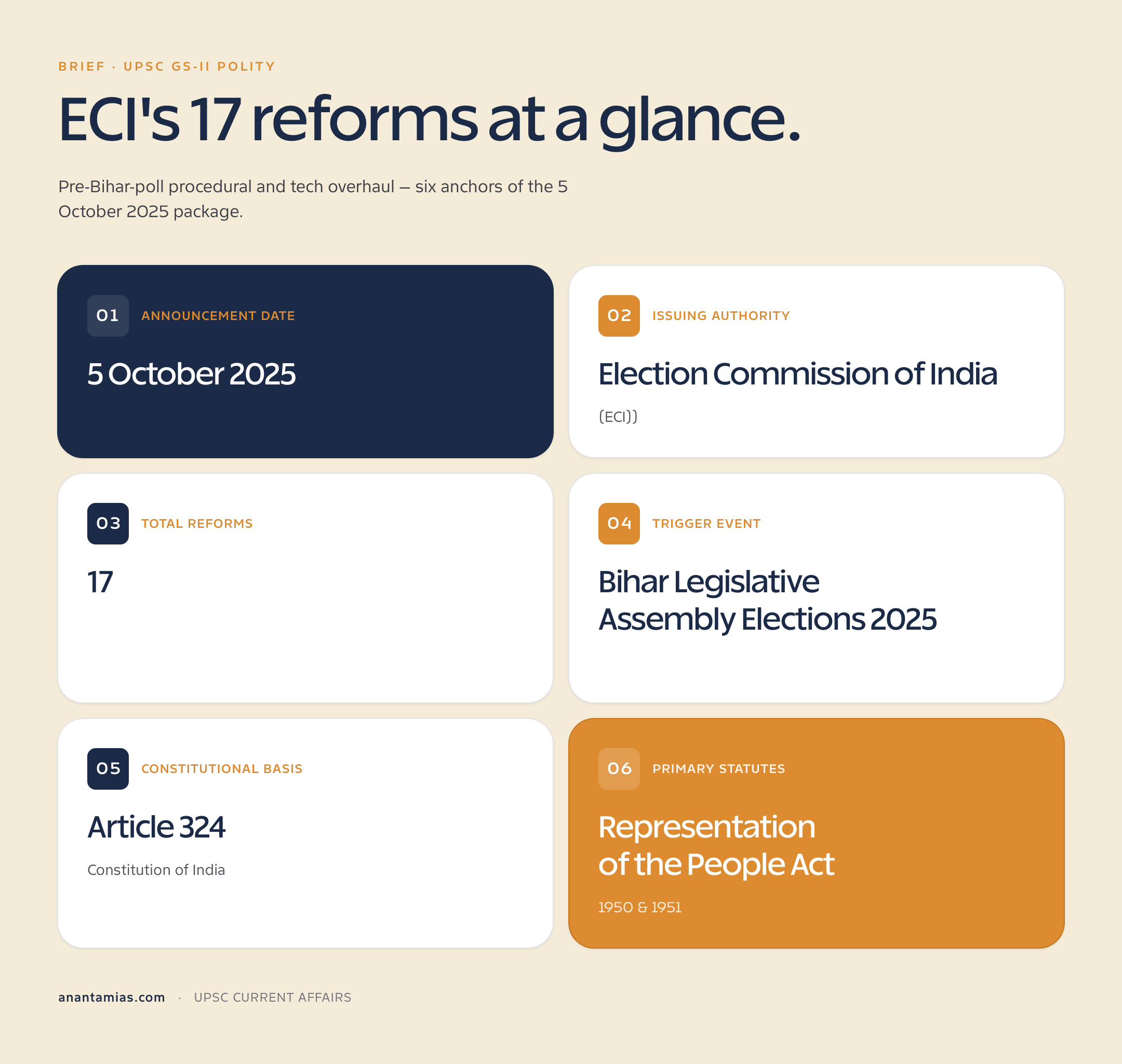
Quick Facts at a Glance
| Parameter | Detail |
|---|---|
| Announcement Date | 5 October 2025 |
| Issuing Authority | Election Commission of India (ECI) |
| Total Reforms | 17 |
| Trigger Event | Bihar Legislative Assembly Elections 2025 |
| Constitutional Basis | Article 324, Constitution of India |
| Primary Statutes | Representation of the People Act, 1950 & 1951 |
| Bihar Electors (approx.) | 7.64 crore |
| Bihar Constituencies | 243 Assembly seats |
| Maximum Electors per Booth | 1,200 (revised down from 1,500) |
| Key Apps Refreshed | Voter Helpline, cVIGIL, Saksham, KYC |
Background and Historical Context
The ECI was constituted on 25 January 1950 under Article 324 of the Constitution, which vests in the Commission the “superintendence, direction and control” of elections to Parliament, State Legislatures, and the offices of President and Vice-President. The article confers vast plenary powers — a feature the Supreme Court reaffirmed in Mohinder Singh Gill v. Chief Election Commissioner (1978), holding that Article 324 is a “reservoir of power” enabling the Commission to act in situations not explicitly covered by statute.
The two governing statutes are the Representation of the People Act, 1950 (allocation of seats, delimitation, electoral rolls) and the Representation of the People Act, 1951 (conduct of elections, disqualifications, election disputes). Together they translate the constitutional mandate into operational rules — including Form 6 (new voter registration), Form 7 (objection or deletion), and Form 8 (correction or transposition) under the Registration of Electors Rules, 1960. Detailed primers on the framework are maintained by PRS Legislative Research.
Reform-mindedness has been an episodic feature of the Commission. The transformative T.N. Seshan tenure (1990–1996) operationalised the Model Code of Conduct (MCC), enforced expenditure ceilings, and introduced photo identity cards. Subsequent milestones include the introduction of Electronic Voting Machines (EVMs) at scale from 2004, the Voter Verifiable Paper Audit Trail (VVPAT) rollout following the Supreme Court’s directive in Subramanian Swamy v. ECI (2013), the NOTA option after PUCL v. Union of India (2013), and 100% VVPAT deployment from 2019. The Election Laws (Amendment) Act, 2021 linked Aadhaar with electoral rolls voluntarily and harmonised qualifying dates. Against this lineage, the 2025 package is best read as an incremental but consequential next step.
Highlights of the 17 ECI Reforms
Voter-side reforms
The first cluster centres on the elector’s experience. The Commission has mandated upgraded Form 6/7/8 workflows through the Voter Helpline App and the ECINet portal, with auto-validation against Aadhaar (consent-based) and reduced turnaround for entries. A revamped Voter Information Slip (VIS) now carries booth coordinates, queue management QR codes, and accessibility flags for Persons with Disabilities (PwD). The Saksham app, the Commission’s accessibility portal for PwD electors and senior citizens, has been integrated with home-voting requests for those above 85 and PwDs with 40%+ benchmark disability — a continuation of provisions under Section 60(c) of the RP Act, 1951.
SVEEP, the Commission’s flagship voter literacy programme launched in 2009, gets a youth-and-first-time-voter overlay tailored to Bihar’s demographic — nearly 14 lakh new electors aged 18–19 in the 2025 roll. Booth Awareness Groups (BAGs) — community volunteers attached to each polling station — will conduct hyperlocal outreach, with KPIs tracked on the ECINet dashboard.
Polling-station logistics
The second cluster reorganises the booth itself. The maximum electors per polling station has been revised down from 1,500 to 1,200, mirroring the COVID-era benchmark and intended to compress queuing time. Auxiliary booths are mandated wherever electors exceed the cap. Each booth receives a refreshed Booth Level Officer (BLO) toolkit, a tactile ballot guide, ramp specifications, drinking water, restrooms, shaded waiting areas, and creches at Pink Booths (women-managed polling stations). Model Booths — at least one per Assembly Constituency — will showcase end-to-end accessibility.
The Commission has also tightened EVM-VVPAT first-level checking (FLC), randomisation, and commissioning protocols, with 120% strong-room buffer stock, GPS-tracked transport, and party-agent-witnessed seal logs uploaded in near real time. Webcasting coverage rises from earlier samples to over 90% of booths, with feeds channelled to district control rooms and the central Integrated Election Expenditure Monitoring System (IEEMS).
Technology and transparency
The third cluster is the most novel. cVIGIL, the citizen-reporting MCC violation app, now offers a 100-minute SLA with auto-geo-tagging and immutable audit logs. The Suvidha portal simplifies candidate permission requests for rallies, vehicles, and loudspeakers. Encore, the result-transmission backbone, has been hardened with two-factor authentication and tamper-evident logging. Affidavit data filed under Union of India v. ADR (2002) rulings is now machine-readable and downloadable in bulk via the ECI website. Finally, an AI-assisted social media misinformation cell, working with the Press Information Bureau (PIB) Fact Check Unit, will issue rapid clarifications during the 48-hour silent period — coordinated through pib.gov.in.
Significance for UPSC
- GS-II — Polity: Direct linkages to Article 324, RP Acts of 1950 and 1951, and the constitutional independence of the ECI.
- Electoral integrity: Adds operational depth to the recurring debate on EVM/VVPAT trustworthiness post the 2024 Lok Sabha cycle.
- Governance and Accountability: Demonstrates institutional learning — booth caps revised, accessibility codified, transparency portals expanded.
- Technology in Public Administration: cVIGIL, ECINet, Encore, and the AI misinformation cell illustrate digital-governance trends germane to governance reforms.
- Inclusion: Saksham and Pink Booth integration speak to gender, disability, and senior-citizen inclusion under the Constitution’s equality jurisprudence.
- Federal context: Bihar — a key Hindi-belt state — lets aspirants link reforms to broader debates on cooperative federalism and state-level electoral administration covered in our current affairs hub.
Detailed Analysis: ECI Reform Map and Bihar Context
The 17 reforms can be mapped against the dimensions of the electoral cycle — registration, campaign, polling, counting, and post-poll. The table below summarises each reform and its primary objective.
| # | Reform | Cluster | Brief Description |
|---|---|---|---|
| 1 | Form 6/7/8 Streamlining | Voter | Single-window submission with Aadhaar-linked auto-validation under Election Laws (Amendment) Act 2021. |
| 2 | Voter Helpline App 3.0 | Voter | Refreshed UI; integrates VIS, polling slot estimator, and complaint tracker. |
| 3 | Saksham Integration | Voter | Home-voting for 85+ and PwD electors with end-to-end videography. |
| 4 | SVEEP-Bihar Overlay | Voter | Targets first-time and migrant voters; vernacular outreach. |
| 5 | Booth Awareness Groups | Voter | Community volunteer cells per polling station for door-to-door literacy. |
| 6 | 1,200-Elector Booth Cap | Logistics | Reduced from 1,500; auxiliary booths created where breached. |
| 7 | Model and Pink Booths | Logistics | Accessibility-first design; women-managed booths in every AC. |
| 8 | BLO Toolkit Refresh | Logistics | Standardised checklist, tactile aids, and feedback forms. |
| 9 | EVM-VVPAT FLC Hardening | Logistics | 120% strong-room buffer; GPS-tracked transport; agent-witnessed seals. |
| 10 | 90%+ Webcasting | Logistics | Booth feeds streamed to district and state control rooms. |
| 11 | cVIGIL 100-Minute SLA | Tech | MCC complaints geo-tagged and resolved within 100 minutes. |
| 12 | Suvidha Portal Upgrade | Tech | One-stop candidate permissions with calendar and clash detection. |
| 13 | Encore Hardening | Tech | 2FA, tamper-evident logs for results-transmission pipeline. |
| 14 | Machine-Readable Affidavits | Tech | Bulk download for civil society, journalists, researchers. |
| 15 | AI Misinformation Cell | Tech | Rapid response with PIB Fact Check Unit during silent period. |
| 16 | IEEMS Expansion | Tech | Real-time expenditure monitoring linked to flying squads. |
| 17 | Postal Ballot Tracking | Voter+Tech | Service voters and election duty staff get unique track IDs. |
Bihar offers a rigorous testbed because of its scale (over 70,000 polling stations), demographic youthfulness (median age below the national average), and history of booth-capturing concerns predating the EVM era. The reforms also implicitly respond to the controversial Special Intensive Revision (SIR) of the Bihar electoral roll undertaken in 2025, which became the subject of public interest litigation before the Supreme Court — a thread aspirants should track via our judiciary updates.
Challenges and Criticisms
The opposition INDIA bloc, civil society groups including the Association for Democratic Reforms (ADR), and several legal commentators have raised three principal objections. First, on EVM-VVPAT scepticism, critics argue the Supreme Court’s April 2024 ruling in ADR v. ECI — which declined to mandate 100% VVPAT slip counting — left a transparency gap that the 2025 reforms only partially address. The court did, however, direct that symbol-loading units be sealed for 45 days post-poll and that candidates may request burnt-memory verification, a process the new commissioning protocols claim to operationalise.
Second, the SIR exercise in Bihar — which sought to verify roll entries through door-to-door enumeration — was criticised for tight timelines, alleged disproportionate deletions in minority-dense constituencies, and inadequate appellate windows. While the 17-reform package strengthens Form 7 procedures going forward, it does not retrospectively audit the SIR. Third, opposition parties have flagged the composition of the Selection Committee for the CEC and ECs under the Chief Election Commissioner and Other Election Commissioners (Appointment, Conditions of Service and Term of Office) Act, 2023, which replaced the Chief Justice of India with a Union Cabinet Minister — diluting, in their view, the spirit of the Supreme Court’s Anoop Baranwal (2023) judgment. None of the 17 reforms touch the appointment architecture, leaving a structural critique unanswered.
Operationally, the BLO workforce — drawn largely from school teachers and panchayat staff — faces capacity strain. The AI misinformation cell raises legitimate due-process questions: what constitutes “misinformation,” who adjudicates, and what are the remedies if a takedown is contested? These are open questions the Commission will need to answer through transparent SOPs.
Prelims Pointers
- The ECI was constituted on 25 January 1950; National Voters’ Day commemorates the date.
- Article 324 vests “superintendence, direction and control” of elections in the Commission.
- RP Act 1950 governs electoral rolls and seat allocation; RP Act 1951 governs the conduct of elections.
- Forms 6, 7, 8 relate respectively to new registration, objection/deletion, and correction/transposition.
- VVPAT was introduced after Subramanian Swamy v. ECI (2013); 100% rollout from 2019.
- NOTA was introduced after PUCL v. Union of India (2013).
- The CEC and ECs Act, 2023 redesigned the appointment Selection Committee.
- Maximum electors per polling station revised from 1,500 to 1,200 for Bihar 2025.
- cVIGIL handles MCC violations with a 100-minute response SLA under the 2025 reforms.
- Saksham app serves PwD and elderly electors; Pink Booths are women-managed polling stations.
Mains Practice Questions
- “Article 324 is a reservoir of power, not merely a procedural enabler.” Critically examine in light of the ECI’s 2025 reform package ahead of the Bihar elections. (15 marks, 250 words)
- Discuss how technology has reshaped the conduct of elections in India since 2004. To what extent does the 2025 ECI reform package address persistent concerns over electoral integrity? (10 marks, 150 words)
- Evaluate the Election Commission’s handling of the Special Intensive Revision exercise in Bihar. What institutional safeguards would you recommend to balance roll accuracy with the right to vote? (15 marks, 250 words)
- “Independence of the Election Commission is more a matter of practice than design.” Comment with reference to the CEC and ECs Act, 2023. (10 marks, 150 words)
Conclusion
The 17-point reform package announced ahead of Bihar 2025 is neither a wholesale reinvention nor a cosmetic refresh — it is a calibrated consolidation of a decade’s worth of process learning, judicial direction, and digital experimentation. By reducing booth densities, hardening machine logistics, expanding accessibility, and embedding faster grievance loops, the Election Commission has answered several of the operational critiques accumulated since 2019. Yet the deeper questions — appointment architecture, EVM auditability beyond random VVPAT samples, the chilling effects of an AI-led misinformation cell, and the trust deficit produced by the SIR — remain on the table. For UPSC aspirants, Bihar 2025 is therefore a live case study in how administrative competence, constitutional design, and democratic legitimacy interact under stress. The exam-relevant takeaway is not that elections in India are now perfect, but that the institutional capacity to learn — visible in this package — is itself a hallmark of a maturing democracy.
Frequently Asked Questions
Q1. What are the 17 ECI reforms announced in October 2025?
They cover Form 6/7/8 streamlining, the Voter Helpline App, Saksham, SVEEP-Bihar, Booth Awareness Groups, a 1,200-elector booth cap, Model and Pink Booths, BLO toolkit refresh, EVM-VVPAT FLC hardening, 90%+ webcasting, cVIGIL 100-minute SLA, Suvidha portal upgrade, Encore hardening, machine-readable affidavits, an AI misinformation cell, IEEMS expansion, and postal ballot tracking.
Q2. Under which constitutional provision does the ECI operate?
Article 324 of the Constitution vests in the Election Commission the “superintendence, direction and control” of all elections to Parliament, State Legislatures, and the offices of President and Vice-President.
Q3. What is the difference between RP Act 1950 and RP Act 1951?
The Representation of the People Act, 1950 deals with seat allocation, delimitation, and electoral rolls. The Representation of the People Act, 1951 governs the actual conduct of elections, qualifications, disqualifications, and election disputes.
Q4. What are Forms 6, 7, and 8?
Form 6 is for new voter registration; Form 7 is for objection or deletion of an existing entry; Form 8 is for correction of details, transposition within a constituency, or marking of disability status.
Q5. What is the Booth Awareness Group?
A community volunteer cell attached to each polling station, tasked with door-to-door voter education, dispelling rumours, and assisting first-time and vulnerable electors during the run-up to polling day.
Q6. How does cVIGIL work under the new SLA?
cVIGIL lets any citizen photograph or record a Model Code of Conduct violation; the geo-tagged complaint is auto-routed to a flying squad and resolved within 100 minutes, with the citizen receiving a real-time status update.
Q7. What did the Supreme Court rule on EVM and VVPAT in 2024?
In ADR v. ECI (April 2024) the Court declined to mandate 100% VVPAT slip counting, but directed that symbol-loading units be sealed for 45 days post-poll and that candidates ranked second and third may request burnt-memory verification of EVMs at their cost.
Q8. Why is the T.N. Seshan era important for UPSC?
T.N. Seshan (CEC, 1990–1996) operationalised the Model Code of Conduct, enforced expenditure ceilings, and introduced photo identity cards — establishing the activist template of the ECI invoked again in the 2025 reform package.
Source: https://anantamias.com/current-affairs/eci-bihar-2025-electoral-reforms/