Daily Digest
UPSC · Civil Services Examination
Current Affairs · Tuesday, 7 October 2025
Current affairs curated and edited by Anantam IAS faculty — pulled from The Hindu, PIB, IDSA, Foreign Affairs and the ministries. Read, annotate, revise.
Old Rajinder Nagar · Delhi 110005 · anantamias.com
ILO State of Social Justice 2025: Decent Work, Inequality, and India’s Labour Codes
Introduction
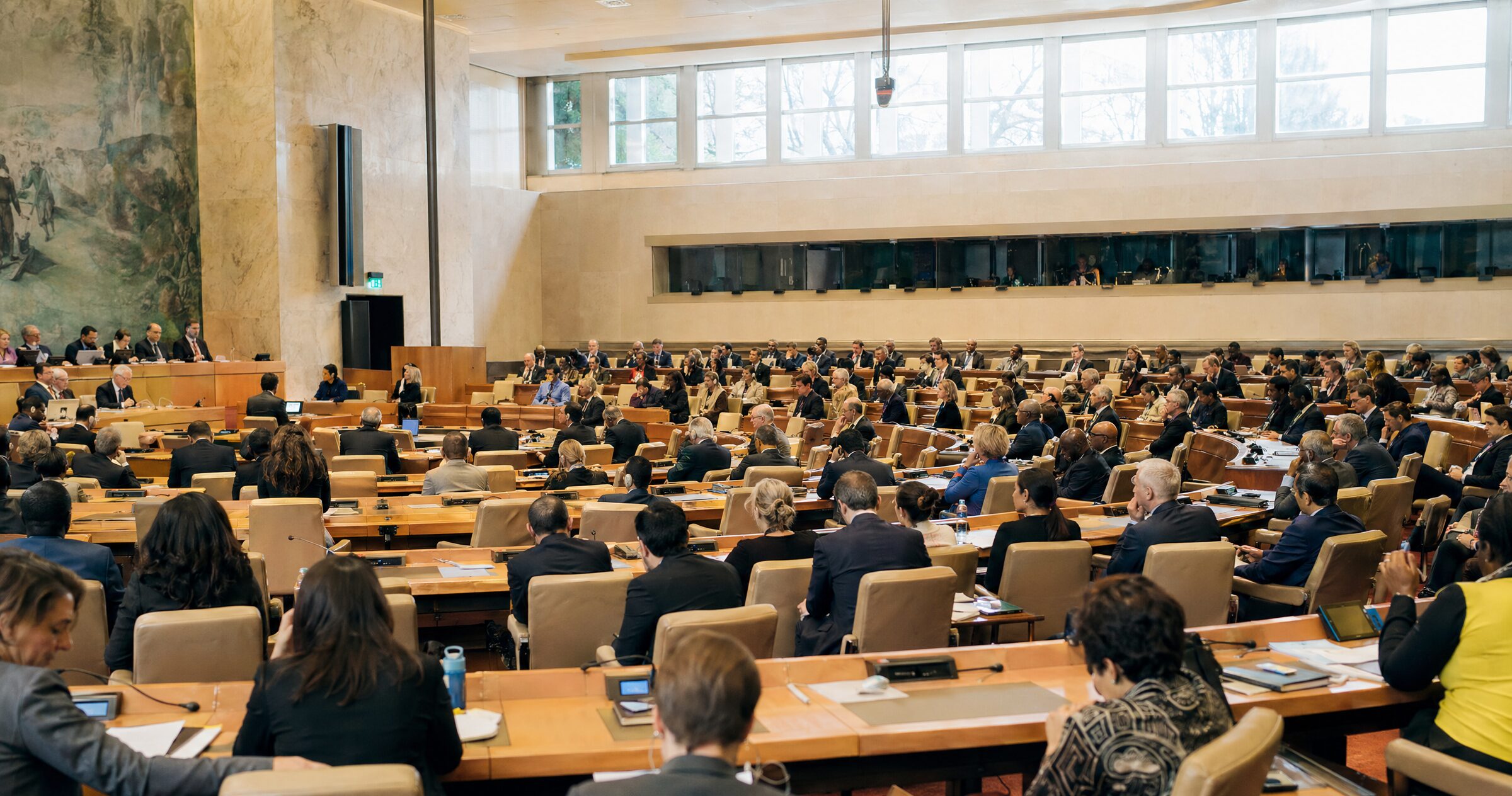
The International Labour Organization (ILO) released its flagship State of Social Justice 2025 report on 7 October 2025, presenting a comprehensive global stocktake of decent work, inequality, social protection coverage, and the progress of the Global Coalition for Social Justice. Published from the ILO headquarters in Geneva, the report arrives at a moment when global labour markets are confronting overlapping crises — slowing economic growth, technological disruption from artificial intelligence, climate-induced job displacement, and persistent informal employment. For India, which is mid-stream in implementing its four labour codes and scaling the e-Shram portal, the assessment offers a benchmark for measuring domestic reforms against international labour standards. The report also serves as a critical reference for UPSC aspirants preparing for GS-II (international institutions and reports) and GS-III (Indian economy and labour) (ILO).
Quick Facts
| Parameter | Detail |
|---|---|
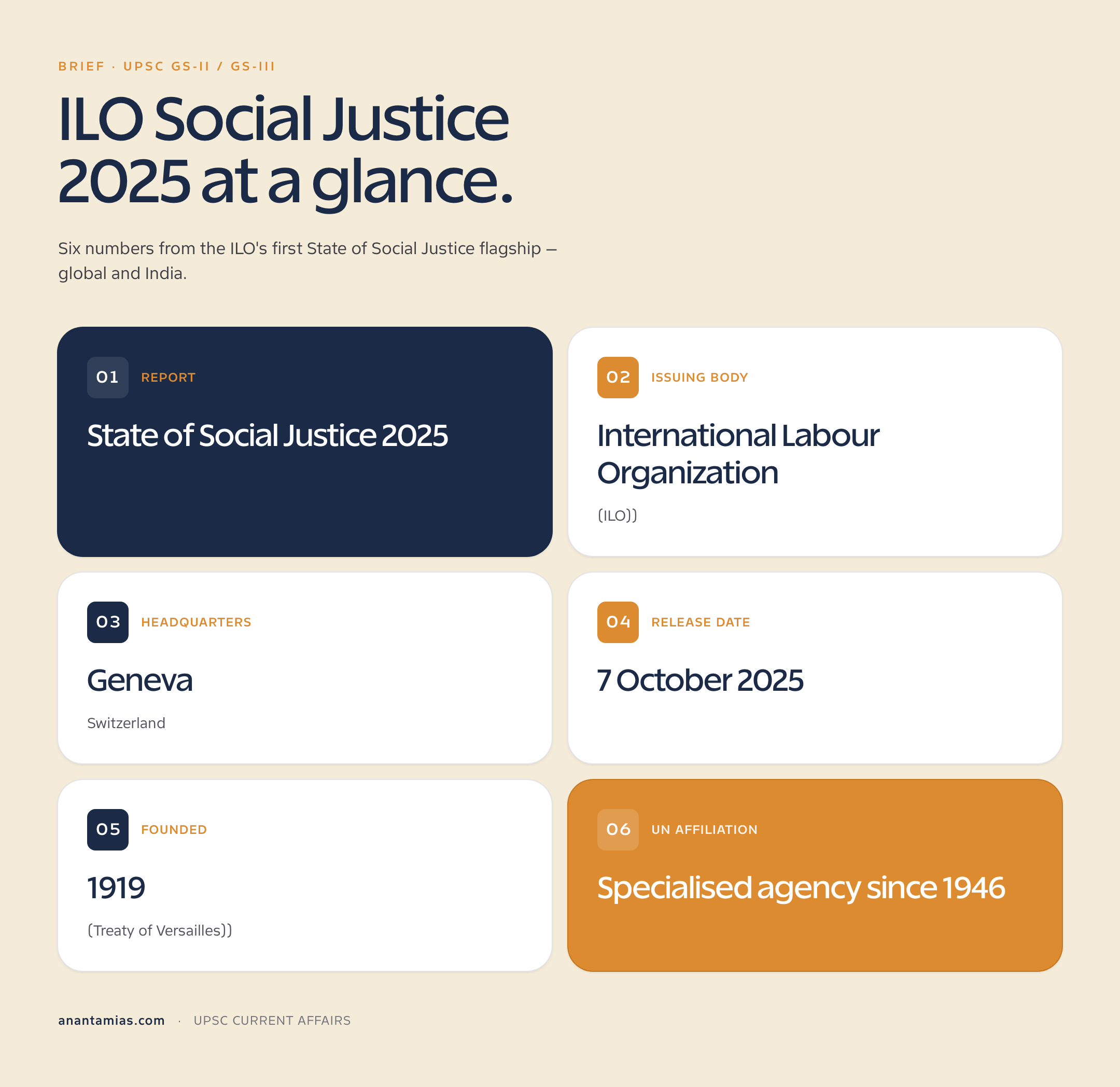
| Report | State of Social Justice 2025 |
| Issuing body | International Labour Organization (ILO) |
| Headquarters | Geneva, Switzerland |
| Release date | 7 October 2025 |
| Founded | 1919 (Treaty of Versailles) |
| UN affiliation | Specialised agency since 1946 |
| Members | 187 member states |
| Structure | Tripartite (governments, employers, workers) |
| Director-General | Gilbert F. Houngbo |
| Anchor instrument | ILO Centenary Declaration for the Future of Work, 2019 |
| Linked SDGs | SDG 8 (Decent Work), SDG 10 (Reduced Inequalities), SDG 1 (No Poverty) |
| Coalition partners | Global Coalition for Social Justice (350+ partners) |
Background
The ILO was established in 1919 under Part XIII of the Treaty of Versailles on the conviction that “universal and lasting peace can be established only if it is based upon social justice”. After the Second World War, the Declaration of Philadelphia (1944) reaffirmed this mandate and the organization became the first specialised agency of the United Nations in 1946. The most recent doctrinal milestone is the ILO Centenary Declaration for the Future of Work (2019), which embedded the Decent Work Agenda — employment creation, social protection, rights at work, and social dialogue — as the four pillars of policy.
In 2023, the ILO launched the Global Coalition for Social Justice as a multi-stakeholder platform bringing together governments, employers’ organizations, trade unions, multilateral institutions, civil society, and academia. India became a founding partner and has used the coalition to showcase initiatives such as the e-Shram portal and the PM Vishwakarma scheme. The State of Social Justice report is the coalition’s annual flagship — the 2025 edition is the second in the series and the first to integrate India-specific dashboards on informal employment and gender labour gaps (ilo.org).
Key Features of the Report
Decent Work Deficits Persist Globally
The report finds that nearly 2 billion workers — almost 58% of the global workforce — remain in informal employment without written contracts, social security, or paid leave. Working poverty (workers earning below the international poverty line of USD 2.15 per day in 2017 PPP) has stagnated at around 6.9%, with the highest concentration in sub-Saharan Africa and South Asia. Global unemployment edged up to 5.2% in 2025, while youth NEET (Not in Employment, Education or Training) rates exceeded 20% in low-income countries. The report stresses that without targeted intervention, the world will miss SDG 8 targets on full and productive employment by 2030.
Social Protection Coverage Gaps
Only 52.4% of the global population is effectively covered by at least one social protection benefit, leaving roughly 3.8 billion people without any safety net. The ILO highlights wide regional asymmetries — Europe and Central Asia record around 84% coverage, while Africa lags at 19.1%. The report calls for a global financing facility to help low-income countries build national social protection floors, building on ILO Recommendation No. 202 on Social Protection Floors (2012). India’s Code on Social Security 2020 is cited as a notable consolidation that brings gig and platform workers within the formal protection architecture for the first time, although implementation remains uneven across states (labour.gov.in).
Gender, AI, and the Just Transition
Three thematic spotlights anchor the 2025 edition. First, the gender labour gap remains stubbornly wide — global female labour-force participation stands at 47.4% against 72.2% for men, a 24.8 percentage-point gap that has narrowed by less than 1 point in a decade. Second, the report devotes a full chapter to generative AI, estimating that 25% of jobs globally are exposed to automation by large language models, with clerical and administrative roles facing the highest substitution risk. Third, it advances the Just Transition framework, projecting that climate action could create 100 million net new jobs by 2030 if reskilling investments scale appropriately.
Significance for UPSC Aspirants
- GS-II International Institutions: The report deepens understanding of the ILO’s tripartite governance model and its role within the UN system, useful for questions on global labour governance.
- GS-II Reports & Indices: It joins the canon of must-know flagship reports alongside Human Development Report (UNDP), World Development Report (World Bank), and Global Wage Report (ILO).
- GS-III Indian Economy: Provides international benchmarks against which India’s four labour codes, e-Shram registrations (over 30 crore as of 2025), and PM Shram Yogi Maandhan can be evaluated.
- GS-III Inclusive Growth: Supplies quotable statistics on informal employment, working poverty, and social protection coverage for Mains answer-writing.
- Essay Paper: Themes of social justice, dignity of labour, and the future of work map directly to recurring essay topics.
- Ethics (GS-IV): The Decent Work Agenda intersects with constitutional values of dignity (Article 21) and the Directive Principles (Articles 39, 41, 43).
Detailed Analysis: Headline Indicators and India’s Position
The report’s data appendix offers a granular comparison between global averages and India’s labour-market indicators. India shows a paradoxical picture — strong employment generation in absolute numbers but persistently low formal-sector share and a wide female participation gap. The table below distils the headline indicators highlighted in the 2025 edition.
| Indicator | Global Average | India |
|---|---|---|
| Informal employment share | 57.8% | ~88% (PLFS 2023-24) |
| Working poverty (USD 2.15/day) | 6.9% | ~10% (estimated) |
| Social protection coverage | 52.4% | 48.8% (ILO World Social Protection Report 2024-26) |
| Female labour-force participation | 47.4% | 41.7% (PLFS 2023-24) |
| Youth NEET rate | 20.4% | 23.5% |
| Unemployment rate | 5.2% | 3.2% (PLFS 2023-24, usual status) |
| Workers in agriculture | 26.5% | 45.8% |
| Gig & platform workers | ~12% growth p.a. | ~7.7 million (NITI Aayog 2022) |
| e-Shram registrations | — | Over 30 crore (October 2025) |
| SDG 8 progress | Off-track | Partial progress |
India’s relatively low headline unemployment rate masks a high share of low-productivity, informal, and self-employed work. The Periodic Labour Force Survey (PLFS) 2023-24, released by the National Statistical Office, reported a Worker Population Ratio of 58.2% — improving on a decadal basis but still well below East Asian peers. The ILO report endorses India’s consolidation of 29 central labour laws into four codes — Wages, Industrial Relations, Social Security, and Occupational Safety — but flags slow notification of rules at the state level as a critical implementation gap (pib.gov.in).
Challenges Identified
The report flags structural and emerging challenges that threaten the social justice agenda. The financing gap for universal social protection in low-income countries is estimated at USD 308.5 billion per year — equivalent to 52% of their GDP — and cannot be bridged through domestic revenue alone. Wage stagnation in advanced economies, combined with rising cost-of-living, has driven real wages below their 2019 baseline in several G20 countries. Algorithmic management and platform-mediated work create accountability gaps because employment relationships fall outside traditional labour-law definitions.
For India specifically, the report flags four pressure points — the persistent informality despite a growing economy, declining female participation in rural areas (linked partly to mechanisation), uneven state-level implementation of the labour codes, and limited portability of social benefits across states for migrant workers. The Multidimensional Poverty Index shows that while 415 million Indians escaped multidimensional poverty between 2005-06 and 2019-21 (UNDP-OPHI), the next leg of progress will depend on quality of employment, not just access to it (read more on inequality and poverty trends).
Prelims Pointers
- ILO was founded in 1919 under the Treaty of Versailles and became the first UN specialised agency in 1946.
- ILO is headquartered in Geneva, Switzerland; its Director-General is Gilbert F. Houngbo (since October 2022).
- ILO has a unique tripartite structure — governments, employers, and workers participate as equal partners.
- India is a founding member of the ILO and has ratified 47 ILO Conventions, including 6 of the 8 fundamental conventions.
- The Global Coalition for Social Justice was launched in November 2023.
- The ILO Centenary Declaration for the Future of Work was adopted in 2019.
- The Decent Work Agenda has four pillars — employment, rights at work, social protection, social dialogue.
- SDG 8 deals with Decent Work and Economic Growth; SDG 10 addresses Reduced Inequalities.
- India’s Code on Social Security 2020 is one of the four labour codes consolidating 29 central laws.
- e-Shram is the national database for unorganised workers, launched by the Ministry of Labour & Employment in 2021.
- The ILO awarded the Nobel Peace Prize in 1969 for its work on social justice.
- ILO Recommendation No. 202 (2012) sets out the framework for national Social Protection Floors.
Mains Practice Questions
- Discuss how the findings of the ILO State of Social Justice 2025 report can be used to evaluate the effectiveness of India’s four labour codes. (GS-III, 250 words)
- “Social justice is the foundation of lasting peace.” Examine the relevance of this ILO mandate in the era of artificial intelligence and platform economies. (GS-II, 150 words)
- Analyse the gap between social protection coverage in India and the global average. Suggest measures to bridge this gap, drawing from international best practices. (GS-III, 250 words)
- Evaluate the role of the Global Coalition for Social Justice in advancing the Decent Work Agenda. How can India leverage this platform? (GS-II, 150 words)
- Critically examine the persistent gender gap in labour-force participation in India. What policy interventions are required to align with ILO benchmarks? (GS-I/III, 250 words)
Conclusion
The State of Social Justice 2025 report reaffirms that economic growth alone cannot deliver social justice — it must be accompanied by deliberate investments in formal employment, universal social protection, and a just transition for workers displaced by technology and climate action. For India, the report is both a recognition of the architectural reforms underway and a reminder that the harder work — implementation, portability, and quality of employment — lies ahead. As the country pursues its Viksit Bharat 2047 ambition, embedding ILO benchmarks into the labour-policy roadmap will determine whether growth translates into dignity for the working population. For UPSC aspirants, the report is an indispensable reference for connecting global frameworks with domestic policy outcomes (explore more current affairs analysis).
Frequently Asked Questions
What is the ILO State of Social Justice 2025 report?
It is the ILO’s annual flagship report released on 7 October 2025 that provides a global stocktake of decent work, inequality, social protection coverage, and the Global Coalition for Social Justice’s progress toward SDG 8 and SDG 10.
Who is the current Director-General of the ILO?
Gilbert F. Houngbo of Togo has served as the 11th Director-General of the International Labour Organization since 1 October 2022. He is the first African to hold the position.
What is the Decent Work Agenda?
The Decent Work Agenda, anchored in the ILO Centenary Declaration 2019, rests on four pillars — employment creation, rights at work, social protection, and social dialogue — and forms the basis for SDG Target 8 of the 2030 Agenda.
What is the Global Coalition for Social Justice?
Launched by the ILO in November 2023, the Global Coalition for Social Justice is a multi-stakeholder platform of over 350 partners — governments, employers, workers, multilateral institutions, and civil society — that advances policy action on decent work and reduced inequality.
How does India’s Code on Social Security 2020 align with ILO standards?
The Code on Social Security 2020 consolidates nine central laws and, for the first time, brings gig and platform workers within the social-security architecture, partially aligning with ILO Recommendation No. 202 on national Social Protection Floors. Full alignment requires universal coverage and adequate benefit levels, which remain in progress.
What does the e-Shram portal do?
e-Shram is a national database for India’s unorganised workers, launched in August 2021 by the Ministry of Labour & Employment. As of October 2025, more than 30 crore workers have registered, and the portal serves as the gateway for delivering social-security benefits to the informal workforce.
What is global social protection coverage as per the report?
According to the State of Social Justice 2025, only 52.4% of the world’s population is effectively covered by at least one social protection benefit, with roughly 3.8 billion people excluded — and Africa recording the lowest coverage at 19.1%.
Why is the report important for UPSC preparation?
The report supplies up-to-date global benchmarks and quotable statistics for GS-II (international institutions and reports), GS-III (Indian economy and labour reforms), and Essay paper themes around social justice, dignity of labour, and the future of work.
Source: https://anantamias.com/current-affairs/ilo-state-of-social-justice-report-2025/