Daily Digest
UPSC · Civil Services Examination
Current Affairs · Friday, 9 January 2026
Current affairs curated and edited by Anantam IAS faculty — pulled from The Hindu, PIB, IDSA, Foreign Affairs and the ministries. Read, annotate, revise.
Old Rajinder Nagar · Delhi 110005 · anantamias.com
PARAM Rudra at IIT Bombay: National Supercomputing Mission and Indigenous HPC
IIT Bombay inaugurated a 3 PetaFLOPS PARAM Rudra high-performance computing facility in January 2026. The system is built on indigenous Rudra servers and belongs to the wider National Supercomputing Mission ecosystem.
For UPSC, this is a clean example of why compute capacity is now strategic infrastructure. Supercomputers are not only for physics departments. They support climate models, drug discovery, materials research, AI, defence simulations, weather forecasting and industrial design.
This article explains PARAM Rudra as a current-affairs issue, but the deeper static anchor is India’s attempt to build sovereign compute capacity under the National Supercomputing Mission.
Quick Facts
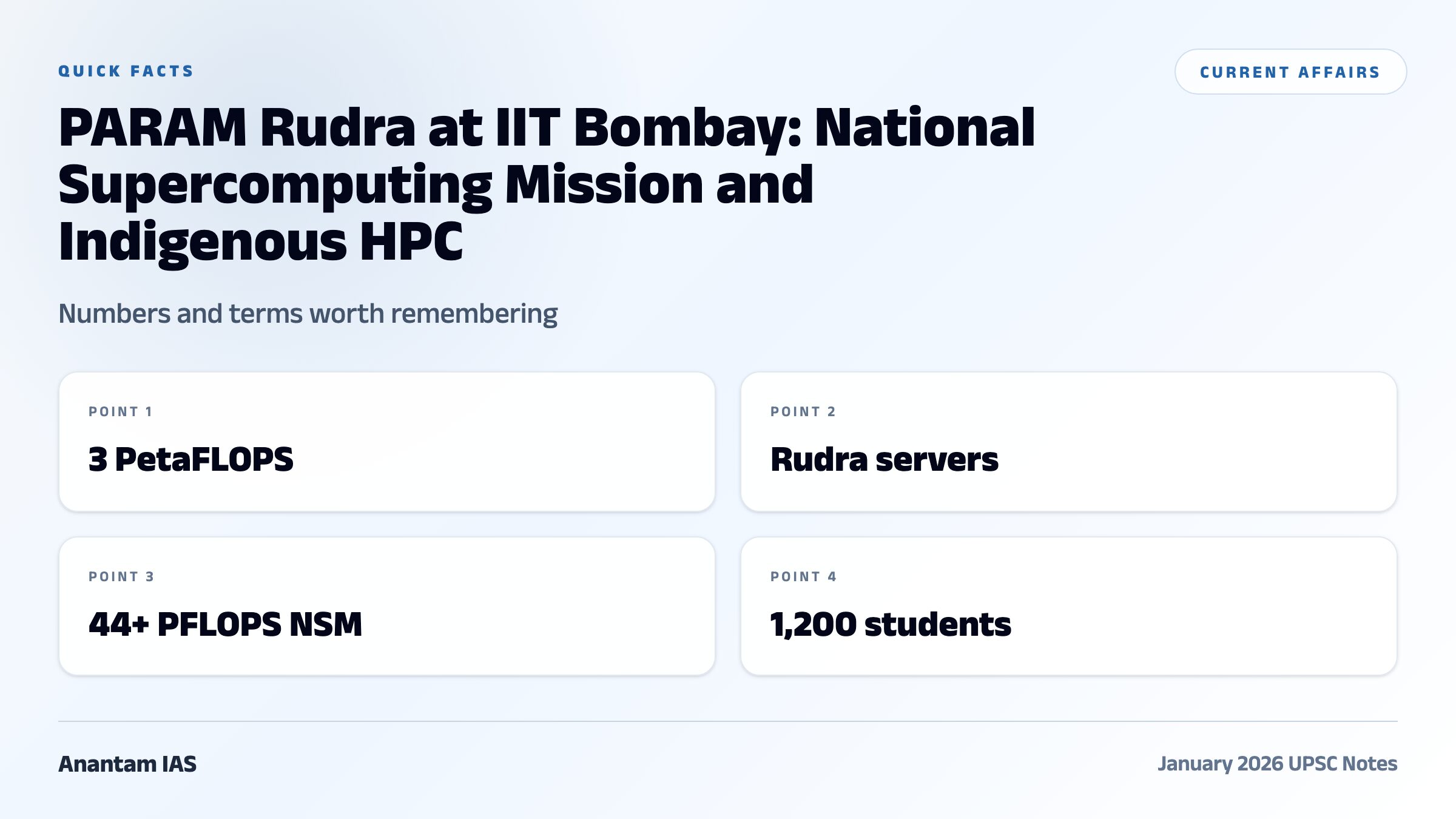
- PARAM Rudra at IIT Bombay has 3 PetaFLOPS peak computing capacity.
- It uses indigenous Rudra servers developed through India’s high-performance computing ecosystem.
- The facility includes a Data Center Level Cooling system.
- More than 200 faculty members and 1,200 students are expected to use the facility.
- The National Supercomputing Mission has deployed dozens of systems with combined capacity above 44 PetaFLOPS.
- Key institutions include C-DAC, IISc, MeitY and the Department of Science and Technology.
- Official source: PIB, Ministry of Science and Technology.
What Just Happened
IIT Bombay inaugurated its PARAM Rudra supercomputing facility, adding a high-capacity compute node for academic and applied research. The system expands India’s supercomputing grid and demonstrates progress in indigenous server design.
The facility matters because compute demand is rising across disciplines. Modern science increasingly depends on simulations and data-intensive analysis. A university without serious compute infrastructure is constrained in climate, materials, health, AI and engineering research.
The inauguration also sharpened the policy message behind NSM: India must reduce dependence on imported high-end compute stacks while still integrating with global research networks.
Background and Historical Context
India’s supercomputing journey is often traced to the PARAM series developed by C-DAC after technology-denial pressures in the late 1980s. That experience shaped a long-running belief that high-performance computing is a sovereignty issue.
The National Supercomputing Mission was launched to build a national network of supercomputers across academic and research institutions. It aims to move India from merely buying machines to building hardware, software, cooling, interconnect and application capacity.
The current era adds a new layer: AI. High-performance computing and AI computing are not identical, but both depend on advanced chips, energy-efficient data centres, software stacks and skilled talent.
Key Features of PARAM Rudra and NSM
The core policy architecture can be read through these features.
- Indigenous design: Rudra servers show movement toward domestic hardware capability.
- PetaFLOPS capacity: the system can perform quadrillions of floating-point operations per second.
- Research access: faculty and students can use compute for advanced simulations and data-heavy work.
- Cooling architecture: data-centre-level cooling is essential because HPC systems consume significant energy.
- Institutional network: NSM links premier institutions instead of concentrating compute in one location.
- Application focus: weather, climate, genomics, materials, aerospace and AI benefit directly.
Why It Matters
This is a high-yield UPSC topic because it joins current news with durable syllabus themes.
- It gives GS-III material on science policy, indigenisation and digital infrastructure.
- It connects to AI, climate modelling, health research and defence technology.
- It shows how technology denial can push domestic capability building.
- It gives Essay material on technological sovereignty.
Detailed Analysis: Science and Tech Lens
Compute is the new laboratory. Many discoveries now begin with simulation before they move to physical testing. If Indian researchers lack compute access, their research frontier narrows.
Indigenisation is about the stack, not just the machine. Servers matter, but so do processors, accelerators, networking, cooling, operating systems, compilers and application software.
Access governance will decide impact. A supercomputer delivers public value only when researchers can use it efficiently, queue times are fair and technical support is strong.
Comparative Perspective
A comparison helps prevent the answer from becoming a one-dimensional news summary.
- United States: leads in exascale systems and AI accelerators, supported by national labs and private firms.
- China: has built large supercomputing capacity as part of strategic technology competition.
- European Union: EuroHPC coordinates cross-border supercomputing infrastructure.
- India: NSM seeks a distributed, institution-linked model with rising domestic capability.
Challenges
The policy or institutional promise runs into recurring constraints.
- High-end chips and accelerators remain import-dependent.
- Power and cooling costs can limit expansion.
- Software optimisation skills are scarce.
- Research groups need training to use HPC efficiently.
- AI compute demand may outpace traditional HPC planning.
Prelims Pointers
- FLOPS means floating-point operations per second.
- PetaFLOPS refers to 10^15 floating-point operations per second.
- C-DAC developed India’s PARAM line of supercomputers.
- NSM is implemented by MeitY and DST through C-DAC and IISc.
- Supercomputers support weather, climate, materials, genomics, AI and defence simulations.
- Cooling and energy efficiency are central to HPC infrastructure.
Mains Questions
- High-performance computing has become strategic infrastructure. Discuss in the context of India’s National Supercomputing Mission. (GS Paper III, 250 words)
- What does technological sovereignty mean in the age of AI and supercomputing? (GS Paper III, 150 words)
- Evaluate the role of public research institutions in building India’s advanced computing capacity. (GS Paper III, 250 words)
- Indigenisation in computing requires an ecosystem, not only machines. Analyse. (GS Paper III, 250 words)
Way Forward
India should pair supercomputer deployment with training programs for researchers, not only hardware procurement.
The next frontier is ecosystem depth: domestic accelerators, system software, secure supply chains, cooling innovation and open access to compute for problem-solving in public sectors.
PARAM Rudra is a strong signal, but the exam answer should be balanced: India is building capacity, yet advanced chips, energy efficiency and software talent remain the difficult pieces.
The examiner is unlikely to reward a bare fact dump here. The better answer connects the January 2026 event to institutional design, implementation capacity and India’s long-term development priorities.
Frequently Asked Questions
What is PARAM Rudra?
PARAM Rudra is an indigenous high-performance computing system developed within India’s supercomputing ecosystem. IIT Bombay inaugurated a 3 PetaFLOPS facility in January 2026.
What is the National Supercomputing Mission?
NSM is India’s mission to deploy supercomputers across institutions and develop domestic capability in high-performance computing.
What does PetaFLOPS mean?
It refers to one quadrillion floating-point operations per second.
Why is supercomputing important for UPSC?
It links science policy with AI, climate models, weather forecasting, drug discovery, materials, defence and technological sovereignty.
Which institutions implement NSM?
MeitY and DST implement NSM through institutions such as C-DAC and IISc.
What is the main limitation for India?
Advanced chip dependence, power cost, cooling, software talent and scale are the main constraints.
Source: https://anantamias.com/current-affairs/param-rudra-supercomputer-iit-bombay-2026/
Samagra Shiksha 3.0: School Education Reform and Foundational Learning
Samagra Shiksha 3.0 came into the January 2026 current-affairs cycle as the government highlighted the next phase of India’s integrated school-education program. The scheme remains central to the implementation of NEP 2020 at school level.
For UPSC, Samagra Shiksha is a high-yield welfare-governance topic because it combines funding, learning outcomes, teacher capacity, inclusion, digital learning and federal delivery.
This article explains Samagra Shiksha 3.0 as a policy instrument for school reform rather than as a scheme-name to memorise.
Quick Facts
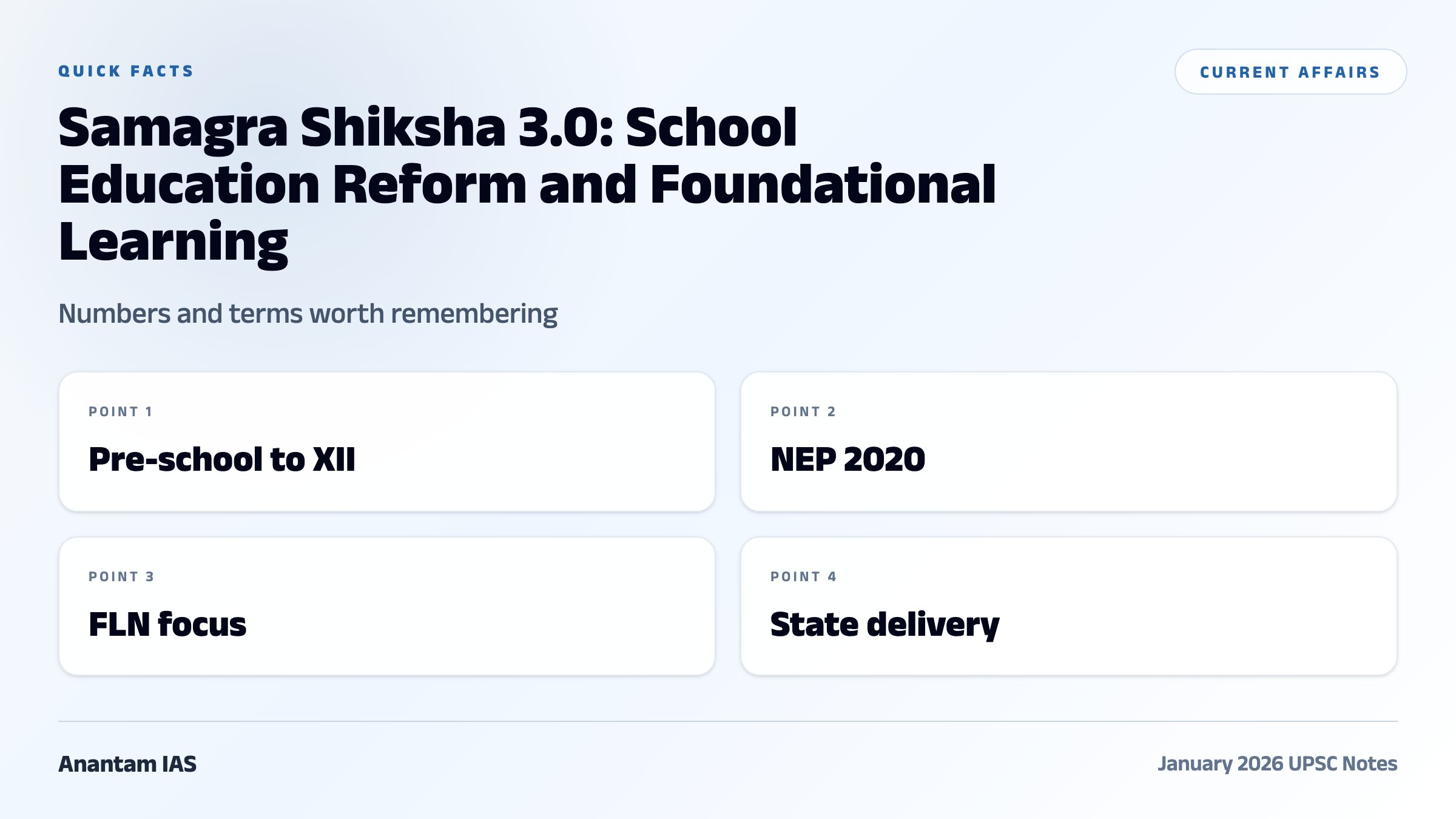
- Samagra Shiksha integrates school education from pre-school to Class XII.
- It supports implementation of NEP 2020 priorities.
- Core themes include access, equity, quality, teacher training and learning outcomes.
- Foundational literacy and numeracy remain central through NIPUN Bharat links.
- School education is a concurrent governance space with strong state implementation.
- Official source: PIB Ministry of Education release dated 9 January 2026.
- Official source: PIB, Ministry of Education.
What Just Happened
The Ministry of Education highlighted Samagra Shiksha 3.0 as a renewed school-education reform platform.
The update matters because school policy is moving from enrolment alone toward learning, inclusion, digital access, teacher capacity and holistic development.
For aspirants, this is useful for GS-II answers on education, human capital and the implementation challenges of centrally sponsored schemes.
Background and Historical Context
Samagra Shiksha was launched by subsuming Sarva Shiksha Abhiyan, Rashtriya Madhyamik Shiksha Abhiyan and teacher-education components into one integrated framework.
NEP 2020 emphasises foundational literacy and numeracy, early childhood care, flexible curriculum, mother-tongue education, teacher development and assessment reform.
India has achieved high enrolment in many areas, but learning outcomes, dropout transitions, digital divide and teacher quality remain major concerns.
Key Features of Education Policy
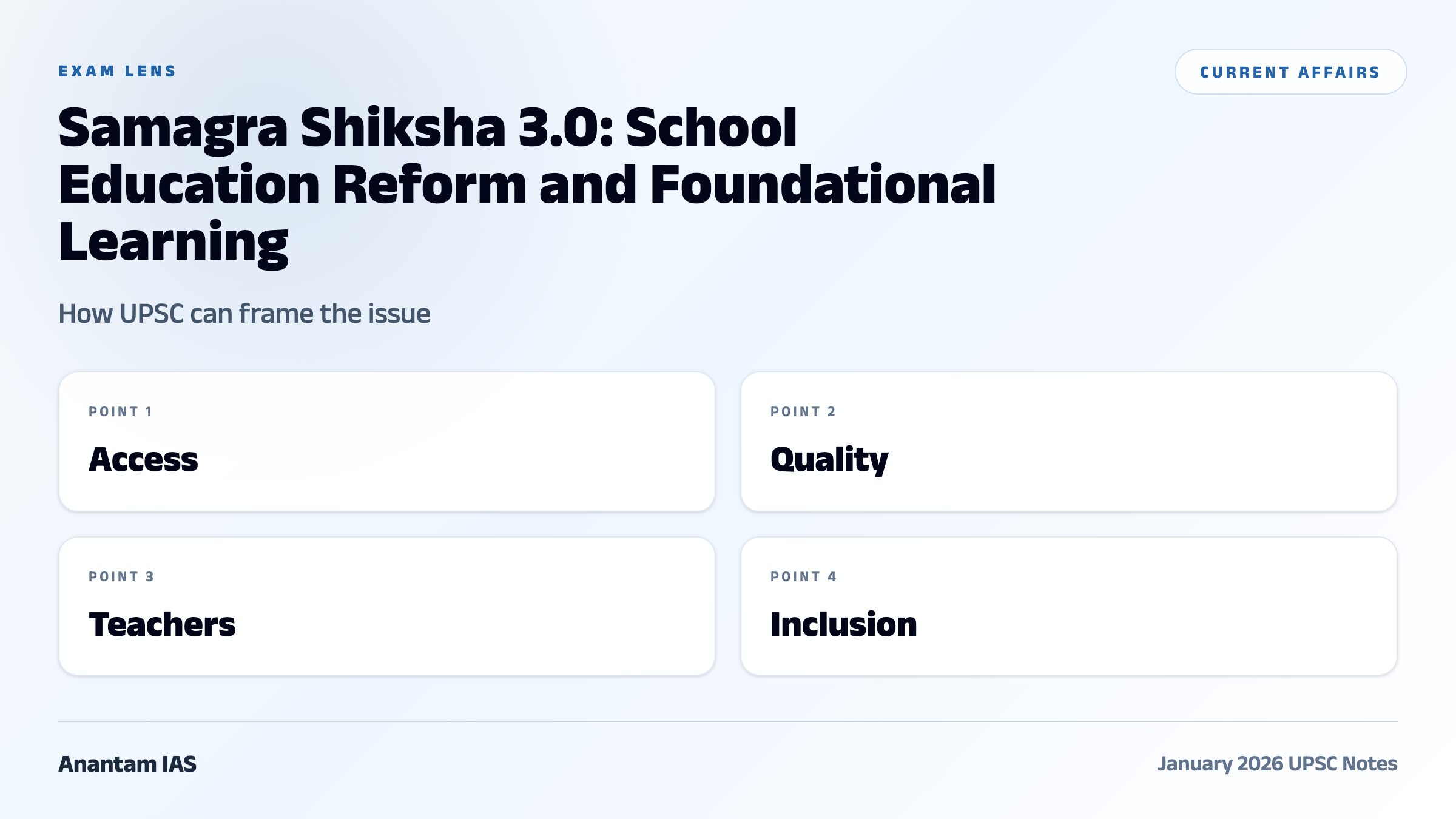
The core policy architecture can be read through these features.
- Integrated coverage: pre-school to Class XII under one program architecture.
- Learning focus: foundational literacy and numeracy receive priority.
- Inclusion: girls, CWSN, disadvantaged groups and remote areas need targeted support.
- Teacher development: training and professional support are crucial.
- Digital layer: technology can support learning but cannot replace teachers.
- Federal funding: Centre and states share responsibilities and implementation.
Why It Matters
This is a high-yield UPSC topic because it joins current news with durable syllabus themes.
- It connects a January 2026 event with durable UPSC syllabus themes.
- It gives usable facts for Prelims and analytical hooks for Mains.
- It helps students move from news recall to policy reasoning.
- It can be linked with static concepts in polity, economy, governance, science, environment or society.
Detailed Analysis: Education Policy Lens
The shift from schooling to learning is the real reform. Enrolment is necessary, but UPSC answers should focus on whether children can read, count, reason and stay in school.
Teachers are the policy hinge. Infrastructure and digital content cannot compensate for unsupported teachers in overcrowded classrooms.
Equity must be measured inside classrooms. Girls, tribal children, disabled students and first-generation learners may be enrolled yet still excluded from real learning.
Comparative Perspective
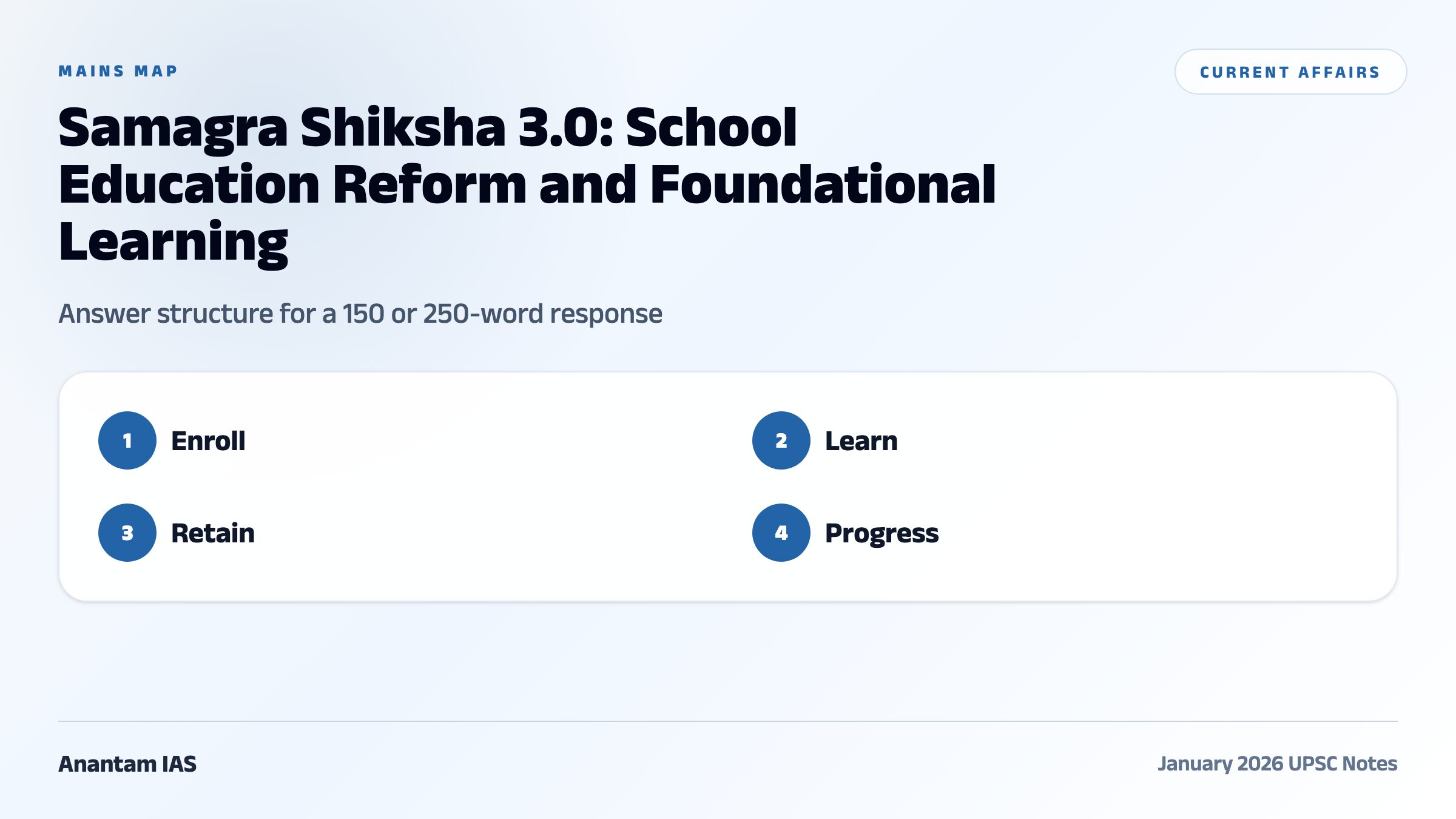
A comparison helps prevent the answer from becoming a one-dimensional news summary.
- SSA: focused on universal elementary education.
- RMSA: targeted secondary education expansion.
- Samagra Shiksha: integrates school education stages and quality goals.
- NEP 2020: provides the broader reform philosophy.
Challenges
The policy or institutional promise runs into recurring constraints.
- Learning outcomes remain uneven across states.
- Teacher vacancies and multi-grade teaching affect quality.
- Digital learning can widen inequality if device access is unequal.
- CWSN inclusion requires trained teachers and assistive infrastructure.
- Funding delays and state capacity can weaken implementation.
Prelims Pointers
- Samagra Shiksha subsumed SSA, RMSA and teacher education components.
- NIPUN Bharat focuses on foundational literacy and numeracy.
- School education is influenced by both Union and state governments.
- NEP 2020 emphasises 5+3+3+4 curricular structure.
- UDISE+ is a key school education data system.
- CWSN means Children With Special Needs.
Mains Questions
- India’s school challenge has shifted from enrolment to learning outcomes. Discuss with reference to Samagra Shiksha. (GS Paper II, 250 words)
- Why is teacher capacity central to school education reform? (GS Paper II, 150 words)
- Evaluate the role of centrally sponsored schemes in improving school education in a federal system. (GS Paper II, 250 words)
- Digital learning can support but not substitute classroom reform. Analyse. (GS Paper II, 250 words)
Way Forward
Samagra Shiksha 3.0 should prioritise foundational learning, teacher mentoring, school complexes, inclusive infrastructure and regular learning assessments.
States need flexibility, but national dashboards should track learning, retention and inclusion, not only expenditure.
A strong answer should treat education as human-capital policy and social-justice policy at the same time.
The examiner is unlikely to reward a bare fact dump here. The better answer connects the January 2026 event to institutional design, implementation capacity and India’s long-term development priorities.
Frequently Asked Questions
What is Samagra Shiksha?
It is India’s integrated school-education scheme covering pre-school to Class XII.
Which earlier schemes were subsumed?
Sarva Shiksha Abhiyan, Rashtriya Madhyamik Shiksha Abhiyan and teacher education components.
What is NIPUN Bharat?
It is a mission for foundational literacy and numeracy.
Why is Samagra Shiksha important for UPSC?
It links education, welfare delivery, federalism, human capital and social justice.
What is the main challenge?
Improving learning outcomes and inclusion, not merely enrolment.
How does NEP 2020 connect?
Samagra Shiksha supports implementation of many school-level NEP priorities.
Source: https://anantamias.com/current-affairs/samagra-shiksha-3-0-2026/