A New Phase in India-Nepal Relations
Why in News?
India-Nepal relations appear to be entering a new phase after the Nepalese Prime Minister Balendra Shah suggested in Parliament that the boundary dispute over Kalapani, Lipulekh and Limpiyadhura should not be viewed as a one-sided question. His remarks indicated that both countries need to examine facts objectively and resolve the issue through diplomatic channels.
| UPSC Relevance: GS-2 International Relations: Bilateral Relations, India and Neighbourhood Mains: India-Nepal Bilateral Relations |
Background: India-Nepal Relations
- India and Nepal ties are rooted in geography, civilisation, religion, culture, kinship and economic interdependence. The two countries share an open border of about 1,751 km across five Indian States: Sikkim, West Bengal, Bihar, Uttar Pradesh and Uttarakhand.
- The relationship has traditionally been described as “special” because of the 1950 Treaty of Peace and Friendship, open-border mobility, deep defence linkages, common cultural circuits, extensive trade, and India’s role as Nepal’s major transit and development partner.
However, Nepal often worries about asymmetry and overdependence, while India worries about security vulnerabilities, external influence in the Himalayas, and cross-border instability. Thus, the India-Nepal relationship is both exceptionally close and periodically fragile.
The Boundary Dispute: Kalapani, Lipulekh and Limpiyadhura:
- The boundary dispute is centred on the interpretation of the 1816 Treaty of Sugauli, which defined Nepal’s western boundary with British India along the Kali river. The disagreement arises from different interpretations of the river’s origin.
- Nepal argues that the Kali river originates from the Limpiyadhura area and therefore Kalapani, Lipulekh and Limpiyadhura fall within Nepali territory.
- India maintains that the areas are part of Uttarakhand and that its administrative and security presence reflects the boundary it inherited at Independence.
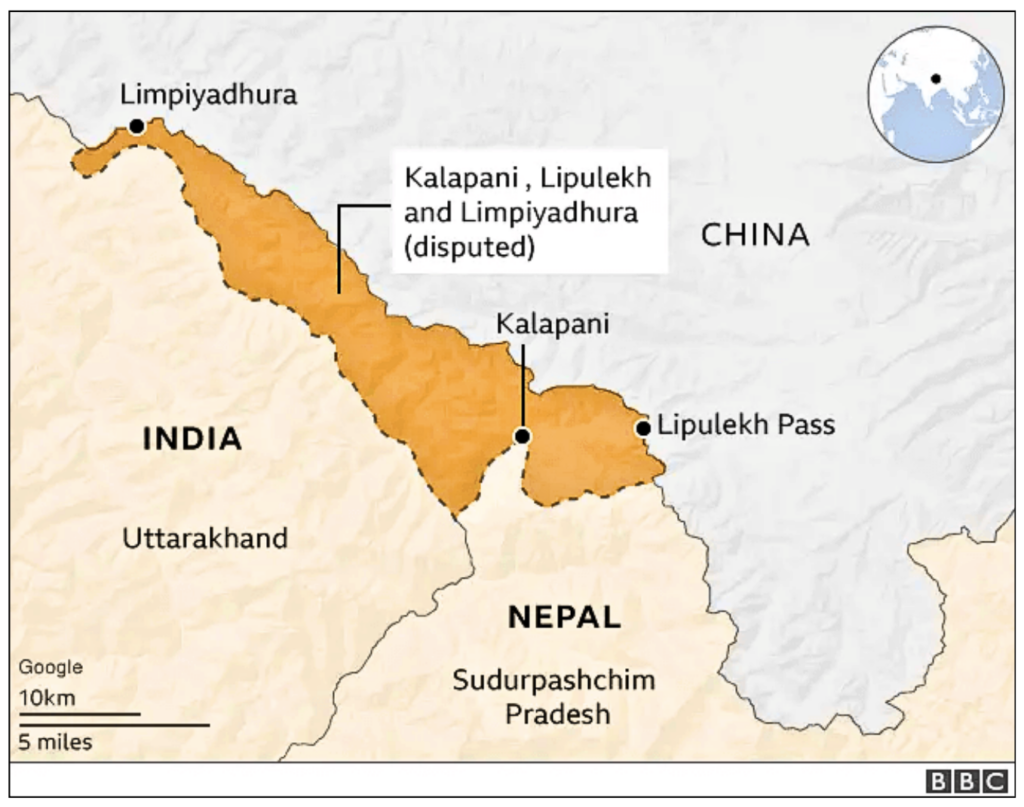
The area is strategically important because Lipulekh lies near the India-Nepal-China tri-junction and provides access to Tibet. It is also connected with the Kailash Mansarovar Yatra route and historical trade routes. After the India-China war of 1962, the security significance of the region increased substantially for India.
The dispute escalated sharply in 2020 when Nepal issued a revised political map showing Kalapani, Lipulekh and Limpiyadhura within its territory. Later, Nepal’s decision to print its revised map on currency notes further hardened positions. India has rejected Nepal’s expanded claims as artificial and unilateral.
Why does the Recent Statement Matter?
Nepalese Prime Minister Balendra Shah’s statement is significant for four reasons.
- It departs from a purely accusatory nationalist framing. By saying that the issue may not be one-sided, he acknowledged the complexity of border management along an open and historically porous frontier.
- It creates space for technical and diplomatic processes. Border disputes cannot be resolved by slogans. They require historical documents, maps, surveys, river morphology, administrative records and ground-level verification.
- It reflects a generational change in Nepal’s politics. The rise of younger political leadership suggests a shift from old ideological alignments and anti-India mobilisation towards governance, employment, anti-corruption and development-oriented politics.
- It allows India to respond with maturity. New Delhi must avoid reading every assertion of Nepali sovereignty as hostility. Nepal’s desire to be treated as an equal partner is natural for a sovereign state.
The new political climate in Nepal is marked by a desire to move away from older patterns of corruption, ideological rivalry and elite bargaining. The public mood that propelled new leadership in Kathmandu is linked to dissatisfaction with unemployment, weak governance and political instability.
This shift is visible in Nepal’s approach towards India. Kathmandu may continue to emphasise the “special relationship,” but it is also likely to insist on formal protocol, equality and institutional engagement.
Major Pillars of India-Nepal Cooperation:
- Civilisational and People-to-People Linkages: India and Nepal share Hindu and Buddhist heritage, linguistic affinities, pilgrimage routes, inter-marriages and kinship networks. Sites such as Pashupatinath, Janakpur, Lumbini, Bodh Gaya, Varanasi and Ayodhya form a shared civilisational geography.
- Open Border and Mobility: The open border allows citizens of both countries to cross without passports or visas. This has supported livelihoods, trade, family ties and cultural continuity. However, it also creates challenges such as trafficking, smuggling, illegal migration, counterfeit currency, narcotics movement and security threats.
- Trade and Transit: India is Nepal’s largest trade and investment partner. Since Nepal is landlocked, India provides crucial transit access for Nepal’s third-country trade. Rail connectivity, integrated check posts, road links and inland cargo movement are central to Nepal’s economic future.
- Energy Cooperation: Hydropower has become one of the most promising areas of cooperation. The long-term power trade agreement aims to enable Nepal to export large quantities of electricity to India over the coming decade. This can transform Nepal’s economy, support India’s renewable energy needs, and deepen regional power trade, including potential electricity movement to Bangladesh through Indian grids.
- Connectivity: Rail links, petroleum pipelines, roads, bridges, integrated check posts and digital payment connectivity are gradually changing the texture of the relationship. Connectivity reduces the psychological distance between the two countries and turns geography into an economic asset.
- Security and Defence: Indian and Nepali armies share a distinctive relationship, including recruitment of Nepali Gorkhas in the Indian Army and the tradition of honorary generalship. Security cooperation is vital because instability in Nepal directly affects India’s Himalayan security, border management and internal security.
Key Irritants in the Relationship:
- Boundary and Cartographic Nationalism: The Kalapani-Lipulekh-Limpiyadhura dispute has become emotionally charged in Nepal. Maps, currency notes and parliamentary resolutions can harden public opinion and reduce diplomatic flexibility.
- Asymmetry and Sovereignty Concerns: Nepal is much smaller than India in size, population and economy. This asymmetry often produces fears of domination. India’s challenge is to reassure Nepal through respectful engagement, not through paternalism.
- China Factor: China’s infrastructure and political presence in Nepal have grown. Nepal seeks diversification of external partnerships, while India sees the Himalayan region through a security lens.
- Implementation Deficit: Many India-Nepal projects face delays due to land acquisition, environmental clearances, bureaucratic procedures and local-level politics. Announcements often outpace delivery. This creates frustration in Nepal and weakens India’s credibility.
- Trade Imbalance: Nepal has long complained of an unfavourable trade balance with India. Greater market access, value-chain integration, power exports, tourism and investment can help reduce this imbalance.
- Domestic Political Use of Anti-India Sentiment: In Nepal, anti-India nationalism has often been used as a political tool. In India, too, public opinion can become rigid on territorial issues. Both sides need to prevent domestic politics from overwhelming diplomacy.
Why India Must Take Nepal Seriously?
- Nepal is not just another neighbour. It is central to India’s Himalayan security, Ganga basin ecology, energy transition, cultural diplomacy and regional connectivity. A stable and prosperous Nepal serves India’s interests in at least five ways.
- It reduces external strategic penetration in the Himalayas.
- It supports secure borders.
- It offers renewable hydropower for India’s energy transition.
- It strengthens sub-regional connectivity under BIMSTEC and BBIN.
- It reinforces India’s credibility under the Neighbourhood First policy.
Therefore, India’s approach should not be reactive or episodic. It must be patient, generous and institutionally consistent.
Way Forward:
- Revive High-Level Political Dialogue: Regular Prime Minister-level, Foreign Minister-level and Foreign Secretary-level exchanges should be institutionalised. Political trust is necessary before technical solutions can succeed.
- Strengthen Boundary Mechanisms: The boundary dispute should be addressed through a time-bound expert process. Both sides should identify areas of agreement, areas of technical disagreement and areas needing political decision.
- De-politicise the Border: The open border should remain a symbol of trust, but it must be better managed through joint surveillance, biometric-friendly facilitation where needed, modern customs infrastructure and community cooperation.
- Build an Energy Partnership: Hydropower trade can become the backbone of a new economic relationship. India should facilitate long-term power purchase, cross-border transmission and trilateral electricity trade with Bangladesh.
- Expand Connectivity: Rail, road, riverine, pipeline, and digital connectivity should be accelerated. Connectivity should be treated as a public good for the entire Himalayan-Gangetic region.
- Address Trade Imbalance: India can help Nepal integrate into the Indian and regional value chains. Agriculture processing, herbal products, tourism, textiles, hydropower and digital services can create new opportunities.
- Promote Youth and Civil Society Engagement: Given Nepal’s changing political demography, India should expand scholarships, start-up linkages, media exchanges, university partnerships and cultural programmes for younger Nepalis.
The new phase in India-Nepal relations should be built on three principles: respect for sovereignty, sensitivity to security, and commitment to shared prosperity. If both countries can combine historical wisdom with future-oriented pragmatism, they can transform a fragile “special relationship” into a modern, sustainable and mutually beneficial partnership.
Practice Mains Question:
Q. “India-Nepal relations are marked by deep civilisational intimacy but recurring political distrust.” Discuss with reference to recent boundary-related developments.