Aadhaar Face SDK: Single-App Authentication and Safer Testing
Why in News?
UIDAI launched the Aadhaar Face Authentication SDK and a testing sandbox at Global Fintech Fest on 9 September 2026, enabling partners to integrate facial authentication into their applications.
- The software development kit supports native Android and iOS integration, reducing dependence on a separate FaceRD application.
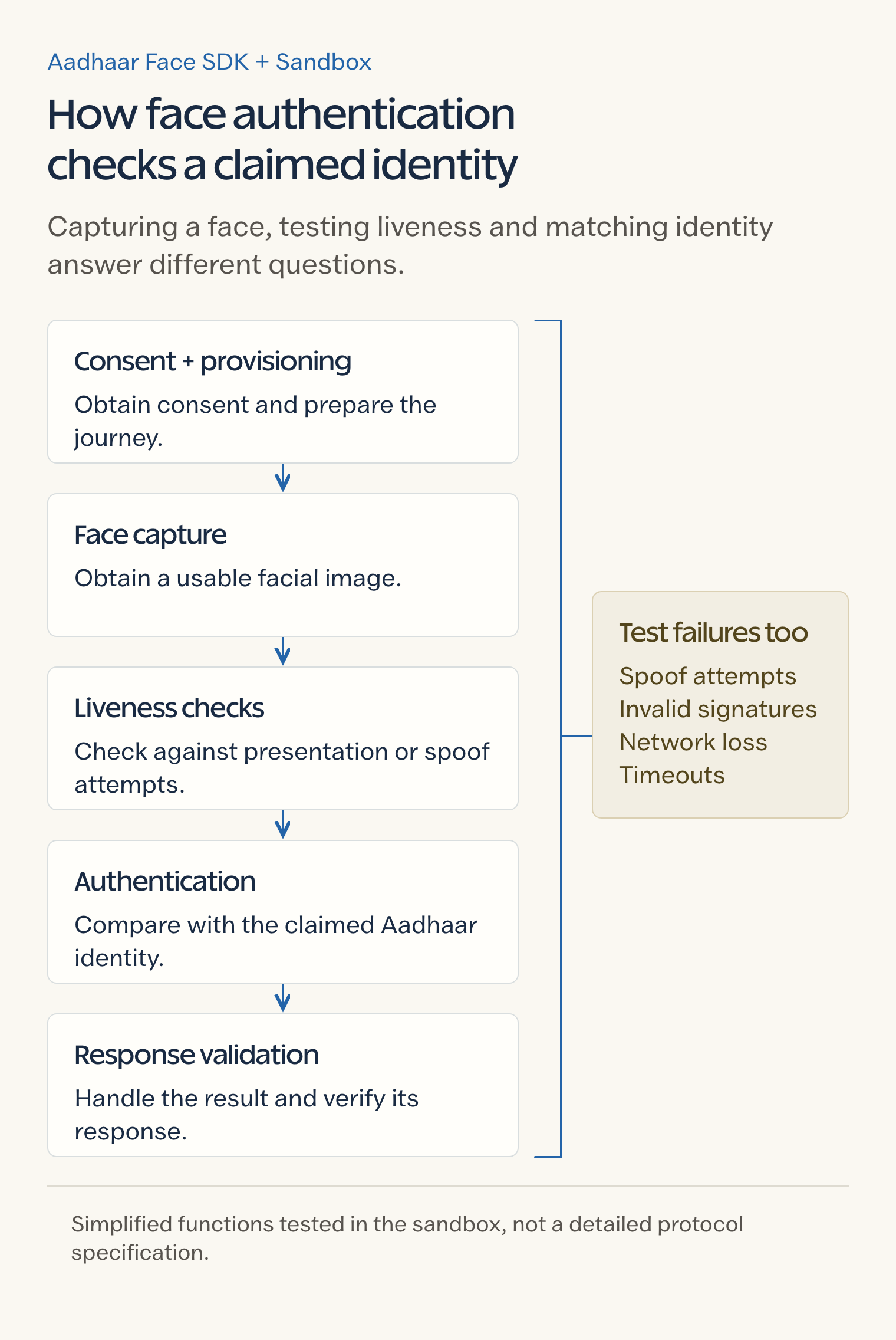
- The sandbox tests consent, capture, liveness, authentication and response handling before production onboarding.
- Failure tests include invalid digital signatures, network interruptions, timeouts and spoofing attempts.
- The launch improves an available authentication capability; it does not announce compulsory facial authentication across all services.
- Fewer application switches can reduce onboarding friction, but the service must still handle interrupted or unsuccessful authentication.
- Digital inclusion depends on usable recovery paths as well as successful identity checks.
UPSC Relevance
Prelims Relevance
- SDK: reusable software components integrated into a partner application.
- Sandbox: controlled environment for testing before production onboarding.
- Liveness: checks aimed at detecting presentation or spoofing attempts.
- Face authentication: verification of a claimed identity against its Aadhaar record.
- Consent: a distinct stage, not a consequence of merely opening a camera.
Mains Relevance
GS Paper 2
- E-governance: reducing onboarding friction without increasing exclusion.
- Accountability: meaningful consent, recovery and grievance handling.
GS Paper 3
- Cybersecurity: liveness checks, encryption and testing of failure scenarios.
Essay
- Digital trust is tested when a system fails, not only when it works.
Background and Context
What changes when authentication moves inside an app?
The SDK changes how organisations embed an existing identity service; it does not create a new identity database or make every service biometric.
- An SDK packages reusable software for an application’s developers. Here, UIDAI’s face capability can operate within a bank or other partner’s native application, making the authentication journey easier to integrate and maintain.
- Previously, a comparable journey depended on the separate FaceRD app being present. The new integration reduces this dependency and application switching; it does not establish that every existing service has already migrated.
- The SDK incorporates AI/ML-based liveness and anti-spoofing, alongside secure handling and encryption of authentication data. These are safeguards within a larger service, not proof that the entire partner application is risk-free.
- Designed for consumer smartphones, the capability can support government and financial services without an external biometric reader. Actual usability still needs testing across devices and conditions before an organisation treats integration as complete.
- Keep this distinct from the citizen-facing Aadhaar app: the new SDK is for partner applications. A developer integration tool, a resident’s app and an authentication modality are different layers of the system.

Consent, liveness and authentication answer different questions
A successful face capture is only one step: authorisation, anti-spoofing and identity matching each solve a different problem in the authentication journey.
- Consent concerns the user’s agreement to authentication. Opening a camera or obtaining a usable photograph should not be treated as a substitute for explaining the request and capturing the person’s agreement first.
- Face capture provides an image for the process, while liveness checks assess whether a presentation may be an attempted spoof. Capturing an image alone does not demonstrate either identity confirmation or a completed transaction.
- Face authentication checks a claimed identity through matching with the corresponding Aadhaar record. UIDAI describes this as one-to-one verification; it differs from searching a crowd to discover the identity of an unknown person.
- Response validation is another explicit sandbox stage. An application needs to interpret the returned outcome correctly rather than display success merely because the camera worked or the request was sent without a visible error.
- For digital financial inclusion, distinguish identity verification from service eligibility. A successful identity check cannot by itself establish loan eligibility, determine a welfare entitlement or replace the other checks that the service requires.
Why failure testing matters as much as a successful demo
The sandbox is a controlled rehearsal of the complete journey, including failures that can otherwise leave users stranded or applications misreading an outcome.
- The sandbox permits integration and validation before production onboarding. Developers and quality-assurance teams can test provisioning, consent, capture and later stages together, rather than assume that separately working components guarantee a reliable end-to-end journey.
- Testing an invalid digital signature examines how the application responds to a failed authenticity or integrity check. The useful operational question is whether the failure is handled safely instead of being mistaken for success.
- A network interruption or timeout is different from a confirmed identity mismatch. Service design should distinguish those outcomes, explain the next step and avoid labelling a person ineligible simply because a technical request failed.
- A spoofing attempt tests the defensive pathway rather than ordinary convenience. The announcement does not provide an independent accuracy benchmark, so the presence of anti-spoofing tools cannot support a claim that impersonation is impossible.
- Production readiness also requires accessible recovery, assistance and monitoring after deployment. These are governance recommendations, not benefits automatically delivered by downloading the SDK; faster onboarding must be assessed alongside people who cannot finish the journey.
Way Forward
Measure recovery alongside convenience
- Test interrupted journeys and explain whether users should retry, wait or seek assistance.
- Make consent prompts clear and specific to authentication, with language and accessibility support.
- Monitor unsuccessful attempts and recovery across devices; a successful demonstration is insufficient evidence of inclusive deployment.
- Keep service eligibility decisions separate from technical authentication errors and provide accountable grievance handling.
Conclusion
- The Aadhaar Face SDK simplifies integration, while the sandbox exposes weaknesses before deployment. Their value lies in a complete, understandable journey, including consent and failed attempts, rather than biometric convenience alone.
- In an answer, connect security with inclusion: liveness addresses spoofing, authentication verifies a claimed identity, and recovery prevents technical failures becoming service barriers. The launch itself establishes no universal requirement to use face authentication.
UPSC Practice Questions
Prelims MCQ 1
With reference to the Aadhaar Face Authentication SDK and Sandbox, consider the following statements:
- The SDK enables integration within native Android and iOS partner applications.
- The sandbox can test network interruptions and invalid digital signatures.
- The launch makes face authentication compulsory for every digital service.
How many of the above statements are correct?
(a) Only one (b) Only two (c) All three (d) None
Answer: (b) Only two
Explanation:
The first two statements reflect UIDAI’s announcement. The launch introduces integration and testing tools; it does not impose universal compulsory face authentication.
Prelims MCQ 2
Which distinction best explains liveness checks in a face-authentication journey?
(a) They determine eligibility for a welfare scheme. (b) They replace the user’s consent. (c) They address spoofing or presentation attempts, while identity matching verifies a claimed identity. (d) They certify that network interruptions cannot occur.
Answer: (c) They address spoofing or presentation attempts, while identity matching verifies a claimed identity.
Explanation:
Liveness and identity matching address separate questions. Neither establishes scheme eligibility, replaces consent nor prevents every technical failure.
UPSC Mains Questions
- Explain how embedding biometric authentication within service applications can improve convenience while creating new responsibilities for inclusion and accountability. (150 words)
- Why should digital identity systems test failure scenarios before deployment? Discuss with reference to consent, liveness and response handling. (150 words)
Sources: PIB, Ministry of Electronics & IT and UIDAI, Unlocking Face Authentication playbook.
Frequently Asked Questions
What is the Aadhaar Face Authentication SDK?
It is a software development kit that lets partners integrate UIDAI’s face-authentication capability within native Android and iOS applications, reducing reliance on switching to or installing a separate supporting app.
What does the Aadhaar face sandbox test?
It tests the journey before production onboarding, including consent, capture, liveness, authentication and responses. Failure scenarios include invalid signatures, network interruptions, timeouts and spoofing attempts, helping developers check how their applications react.
Does liveness prove a person’s identity?
Liveness addresses whether a presentation may be a spoof. Identity matching is a separate part of authentication. A captured image, or a completed liveness stage, should not be confused with the entire transaction succeeding.
Is face authentication now compulsory everywhere?
The SDK and sandbox announcement does not make it universally compulsory. It supplies integration and testing tools. Requirements for a particular service must be assessed separately instead of inferred from this technology launch.