Aarogya Setu 2.0: Digital Health Stack Expands
Why in News?
PIB confirmed that Union Health Minister J.P. Nadda launched Aarogya Setu 2.0 and a set of digital health initiatives on 29 June 2026 to strengthen India’s Digital Public Infrastructure for Health.
The launch brings citizen apps, health registries, claims exchange, digital clinics and open-network services closer to the Ayushman Bharat Digital Mission architecture.
- Aarogya Setu 2.0 was described by PIB as a revamped application for mothers, children, youth, elderly persons and patients with chronic illnesses.
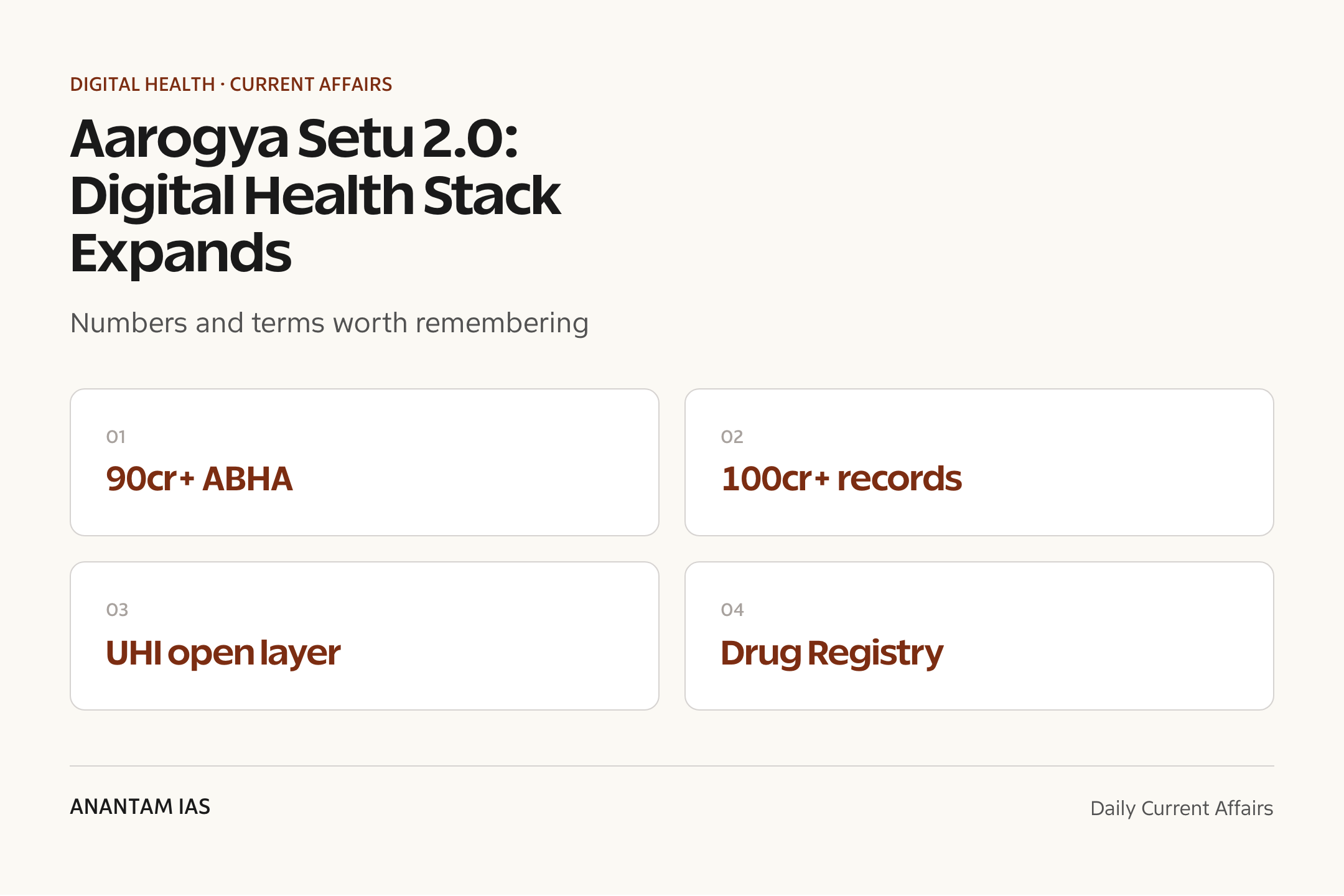
- ABDM has crossed 90 crore ABHA accounts and more than 100 crore linked health records, according to PIB.
- The new initiatives include Unified Health Interface, Drug Registry, Ayushman Sarathi, eSushrut@Clinic and National Health Claims Exchange.
- National Health Authority and NRCeS are key institutional anchors for several components.
- PIB said the stack aims to improve accessibility, efficiency and continuity of care through interoperable health information exchange.
The development matters in the context of:
- Health is a State subject, so adoption by States and Union Territories decides the practical impact of national digital rails.
- Digital public infrastructure in health follows India’s wider DPI model in identity, payments and public-service delivery.
- Interoperability is the core governance issue: citizens should not be locked into one app, hospital platform or insurer system.
- Data protection, consent, cyber security and exclusion risks need equal attention as digital service delivery expands.
UPSC Relevance
Prelims Relevance
- ABHA is the health account layer of ABDM and links a person’s health records across participating systems.
- UHI is the service layer of ABDM for discovery and access to verified digital health services.
- NHA develops and maintains ABDM’s core gateway and operates PM-JAY-linked digital systems.
- HPR and HFR are ABDM registries for verified health professionals and facilities.
- Drug Registry creates a single source of truth for medicines with standardized codes.
- CDSCO and NRCeS collaborated on the Drug Registry, using standards such as SNOMED CT.
- Ayushman Sarathi is a PM-JAY WhatsApp chatbot with secure API-based access to beneficiary services.
- e-RaktKosh is linked to UHI for real-time blood bank discovery.
Mains Relevance
GS Paper 2
- Governance: digital public infrastructure, cooperative federalism and last-mile service delivery in health.
- Social justice: access for PM-JAY beneficiaries, elderly persons, women, frontline workers and patients in underserved areas.
- Accountability: consent, privacy, grievance redress and trust in verified public digital systems.
GS Paper 3
- Science and Technology: open protocols, health data standards, APIs, AI in health and digital registries.
- Economic infrastructure: health claims exchange, insurance integration and efficiency gains in public spending.
Essay
- Digital public infrastructure as a welfare multiplier
- Technology can widen access only when trust and inclusion are built in
- Health systems in the age of data, consent and interoperability
Background and Context
What Was Launched
PIB framed the launch as a package for a more connected, accessible and citizen-centric health ecosystem.
- Aarogya Setu 2.0: a revamped citizen-facing app meant to bring several health services into one access point.
- Ayushman App: the PM-JAY-linked digital route for beneficiary identity and service access.
- Ayushman Sarathi: a WhatsApp chatbot for PM-JAY services, grievance support and beneficiary information.
- Unified Health Interface: an open network through which citizens can discover and access verified health services across platforms.
- Drug Registry: a standardized digital reference for medicines across health systems.
- eSushrut@Clinic, NHCX, Insurance Plan FHIR Object Creator, Common LOINC Codes for India and Bharat Health Terminology Service complete the standards-and-service layer.
Aarogya Setu 2.0 And ABDM
The news marks a shift from a standalone emergency-era app toward a broader health-service gateway.
- Aarogya Setu 2.0 is expected to help citizens access a range of health services through one familiar digital interface.
- ABDM provides the national architecture around health IDs, registries, consent-based data sharing and interoperable services.
- ABHA accounts and linked health records are the scale indicators: PIB cited over 90 crore accounts and more than 100 crore linked records.
- Continuity of care improves when a patient can carry digital records across doctors, hospitals, cities and schemes.
- Women were specifically highlighted by PIB because digital records can help them keep track of health information while moving across care points.
Unified Health Interface
UHI is the open-network layer that lets different health apps and verified providers connect without platform lock-in.
- UHI operates through open protocols on ABDM’s core gateway, developed and maintained by the National Health Authority.
- Interoperability: citizens and providers can use any UHI-enabled platform instead of depending on the same private or public app.
- Fair discoverability: verified doctors, facilities and services can be found on the network without size or geography becoming the main barrier.
- Verification: only providers credentialed through ABDM registries such as HPR and HFR can participate.
- Live services include blood bank discovery, PM-JAY hospital search, Jan Aushadhi Kendra discovery, ambulance discovery and booking, and doctor consultations.
Drug Registry And Health Standards
The Drug Registry addresses a classic health-data problem: the same medicine being recorded in different names and formats.
- Drug Registry is a single source of truth for medicines in India under ABDM.
- CDSCO and NRCeS Pune collaborated on the platform, with alignment to international standards such as SNOMED CT.
- 123,000+ branded drugs, 10,000+ generic drugs and 29,000+ substances are covered, according to PIB.
- Search fields include generic name, brand name, substance and manufacturer.
- Open APIs allow hospital management systems, e-prescription platforms, doctor-facing apps and ABDM-compliant solutions to integrate the registry.
Ayushman Sarathi
Ayushman Sarathi brings PM-JAY beneficiary services into WhatsApp, making access less dependent on offices and call centres.
- Ayushman Sarathi is a PM-JAY WhatsApp chatbot developed by the National Health Authority.
- PM-JAY beneficiaries can check eligibility, apply for or download Ayushman Card, redo eKYC and link Aadhaar.
- Card controls include lock or unlock features and access to the Ayushman Vaya Vandana Card for the 70-plus age group.
- Service support includes wallet balance, treatment history, nearby empanelled hospitals, grievances, call-back requests and discharge feedback.
- 24×7 access is available by sending Hi on WhatsApp to +91 72908 23838, as stated by PIB.
Governance Significance
The package matters because it joins welfare delivery, standards, data exchange and citizen interfaces in one expanding public stack.
- Centre-State coordination is essential because health is a State subject while national platforms supply policy direction and digital infrastructure.
- Frontline workers such as ASHA and Anganwadi workers can gain when paperwork and duplicate data entry reduce.
- Insurance workflows can become faster through NHCX and standard digital claims exchange.
- Primary healthcare can improve when records, referrals, consultations and medicines are digitally traceable.
- AYUSH integration was flagged by PIB as part of a wider whole-of-government approach to health services.
Risks And Safeguards
Digital health can help only when the system protects rights, avoids exclusion and remains clinically useful.
- Privacy: health data is sensitive, so consent, purpose limitation and data minimisation must be strictly followed.
- Cyber security: registries, claims exchanges and health records create high-value targets for breaches.
- Digital divide: poor connectivity, language barriers, disability access and low digital literacy can exclude vulnerable users.
- Data quality: wrong codes, duplicate records or incomplete histories can harm clinical decisions.
- Trust: citizens need clear grievance redress, audit trails and visible controls over who accesses their records.
Way Forward
Build Consent And Trust
- Consent dashboards should let users see, approve and revoke access to health records in simple language.
- Audit trails must show when a record was accessed, by whom and for what purpose.
- Privacy-by-design should cover every app, API, registry and claims workflow linked to ABDM.
Make States Equal Partners
- State health departments need funding, training and change-management support to adopt national digital rails.
- Public hospitals and primary health centres should get hardware, connectivity and help-desk support before compliance targets are pushed.
- Local languages and assisted access through frontline workers are needed for inclusive use.
Improve Clinical Usefulness
- Doctors should see fewer clicks, cleaner records and better referral information, not a heavier reporting burden.
- Drug Registry and terminology standards should be embedded into e-prescriptions, pharmacy systems and hospital software.
- UHI services should expand with strong verification so citizens can trust discovery results.
Conclusion
Aarogya Setu 2.0 is important not because it is another app, but because it sits inside a larger ABDM-linked stack of identity, registries, standards and open networks.
The real test is implementation: whether States, hospitals, doctors, insurers and citizens can use these platforms without friction, exclusion or loss of trust.
For public policy, the launch is a useful case study in how digital public infrastructure can move from payments and identity into health, where the stakes are more personal and the safeguards must be stronger.
UPSC Practice Questions
Prelims MCQ 1
With reference to the Unified Health Interface, consider the following statements:
- It is the service layer of the Ayushman Bharat Digital Mission.
- It allows only one official government app to offer digital health services.
- Verified providers credentialed through ABDM registries can participate in the network.
How many of the above statements are correct?
(a) Only one (b) Only two (c) All three (d) None
Answer: (b) Only two
Explanation:
Statements 1 and 3 are correct. PIB says UHI is ABDM’s service layer and relies on verified providers through ABDM registries. Statement 2 is wrong because UHI is based on open protocols across compatible applications.
Prelims MCQ 2
Which institution developed Ayushman Sarathi, the PM-JAY WhatsApp chatbot?
(a) Indian Council of Medical Research (b) National Health Authority (c) Central Drugs Standard Control Organization (d) National Medical Commission
Answer: (b) National Health Authority
Explanation:
PIB stated that Ayushman Sarathi was developed by the National Health Authority under the Ministry of Health and Family Welfare.
UPSC Mains Questions
- Digital public infrastructure in health can improve access, portability and efficiency, but it also raises concerns around privacy, exclusion and federal implementation. Discuss with reference to the recent ABDM-linked digital health initiatives.
- Open networks such as the Unified Health Interface can reduce platform lock-in in healthcare. Examine the governance conditions needed to make such networks trustworthy, inclusive and clinically useful.
- Health is a State subject, but digital health platforms are increasingly being built at the national level. Analyze the opportunities and tensions this creates for cooperative federalism in India.
Sources: PIB, Ministry of Health and Family Welfare and PIB, Unified Health Interface.
Frequently Asked Questions
What is Aarogya Setu 2.0?
Aarogya Setu 2.0 is the revamped version of the earlier citizen app, now positioned by PIB as a wider digital health access point. It is linked to India’s ABDM ecosystem and is meant to help different groups, including mothers, children, elderly persons and chronic-care patients, access health services more smoothly.
What is UHI in digital health?
The Unified Health Interface is the ABDM service layer. It lets citizens search for and access verified health services through any UHI-compatible app. Its key idea is interoperability: patients and providers should be able to connect without being locked into the same platform.
Why is the Drug Registry important?
The Drug Registry standardizes medicine-related information across health systems. PIB says it includes branded drugs, generic drugs and substances, with search by generic name, brand name, substance and manufacturer. This helps e-prescriptions, hospital systems and digital health apps speak a common data language.
What can Ayushman Sarathi do?
Ayushman Sarathi gives PM-JAY beneficiaries 24×7 WhatsApp access to services such as eligibility check, Ayushman Card application and download, eKYC, Aadhaar linking, card lock or unlock, treatment history, hospital search, grievances, call-back requests and discharge feedback.
How does this help governance?
The package can reduce paperwork, improve portability of records, speed up claims and make public health services easier to discover. For governance, the gain comes from joining citizen interfaces, verified registries, standards, claims systems and service networks in one interoperable public stack.
What are the main concerns?
The main concerns are privacy, cyber security, digital exclusion, data quality and trust. Health data is sensitive, so consent, audit trails, simple grievance redress and strong safeguards are as important as service expansion.