Agni-5 Missile

Context:
India has successfully tested Agni-5 Missile.
UPSC Relevance:
UPSC CSE has focused on Defence Technology in prelims examination.
PYQ2023 Prelims:
Consider the following statements:
1. Ballistic missiles are jet-propelled at subsonic speeds throughout their flights, while cruise missiles are rocket powered only in the initial phase of flight.
2. Agni-V is a medium-range supersonic cruise missile, while BrahMos is a solid-fuelled intercontinental ballistic missile.
Which of the statements given above is/are correct?
(a) 1 only
(b) 2 only
(c) Both 1 and 2
(d) Neither 1 nor 2
About Agni-5 Missile:
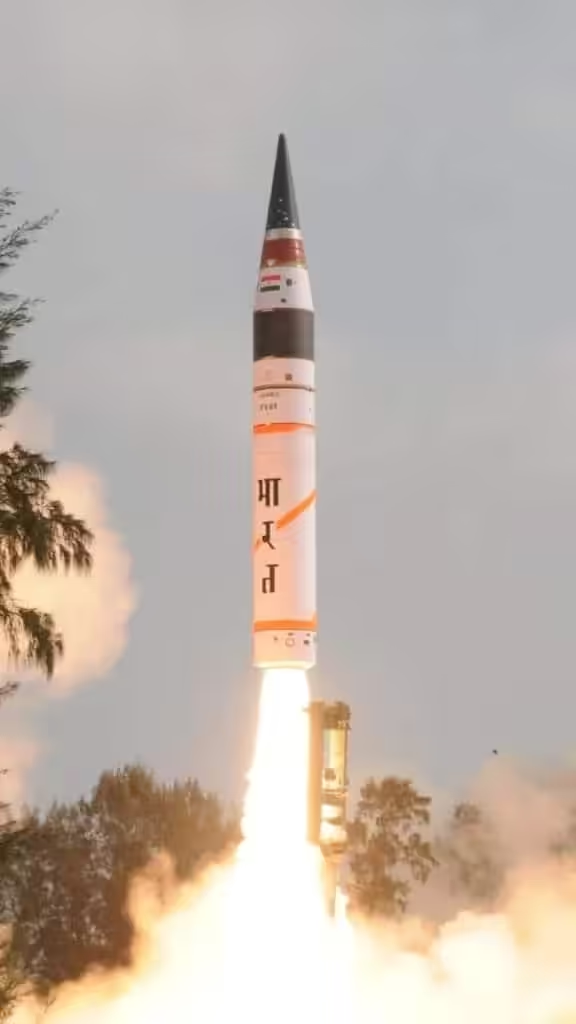
- Agni-5 is an advanced intermediate-range ballistic missile (IRBM)
- It is developed by India under the Integrated Guided Missile Development Programme (IGMDP).
- It is designed to carry nuclear warheads with long-range capability and is a key part of India’s strategic nuclear deterrence arsenal.
- It covers almost the entire Asian continent, including northern China, as well as parts of Europe.
- The missile enhances India’s capability to penetrate missile defense systems and respond decisively in case of nuclear aggression with a credible and flexible second-strike capability.
- Its development has raised concerns in neighboring countries regarding regional stability and nuclear balance.
Features:
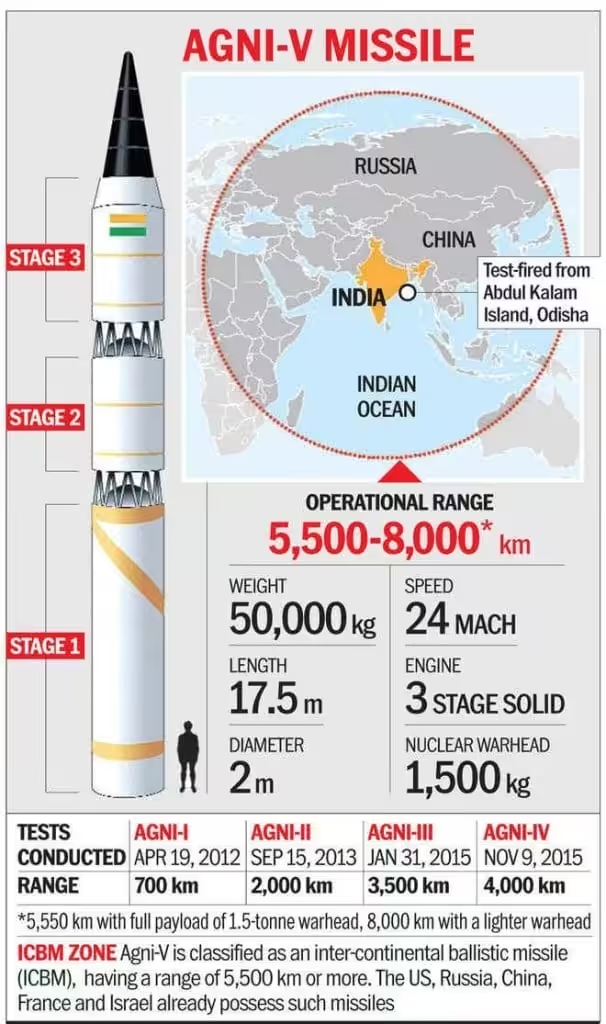
- Range: Over 5,000 km, potentially extendable up to 7,500 km or more in upgraded variants.
- Payload: Capable of carrying nuclear warheads with up to 1.5 tonnes of payload capacity, including Multiple Independently Targetable Re-entry Vehicle (MIRV) technology, which allows it to strike multiple targets with a single missile.
- An MIRV is a ‘missile bus’ whose passengers are nuclear bombs and which facilitates a single booster to deliver them to different targets.
- Mission Divyastra was conducted by DRDO in 2024 led by a woman director . It was the first successful flight test of the indigenously developed Agni-5 missile equipped with (MIRV) Multiple Independently Targetable Re-entry Vehicle technology.
- Today, the United States, the United Kingdom, and France use MIRV technology on SLBMs.
- China has MIRVed ICBMs, while Russia deploys both MIRVed ICBMs and SLBMs.
- The use of MIRVs on submarines is considered less destabilizing than on land-based missiles because the difficulty of finding nuclear submarines makes strikes against them unlikely.
- In January 2017 Pakistan reportedly tested a MIRVed missile, the Ababeel.

- Propulsion: Three-stage solid-fuel rocket motor for enhanced range, reliability, and faster launch capabilities.
- Guidance: Equipped with advanced guidance systems, combining gyroscope-based inertial navigation with satellite navigation systems such as India’s NavIC and American GPS, ensuring high accuracy over long distances.
- Launch system: Canisterized cold-launch system from mobile platforms for quick deployment and protection from harsh environmental conditions.
- Speed: Among the fastest missiles, reaching speeds up to Mach 24.
Comparison with Other Agni Missiles:
| Missile | Range (km) | Role |
| Agni-1 | 700–900 | Short-range, mainly towards Pakistan |
| Agni-2 | ~2,000 | Medium-range for broader region coverage |
| Agni-3 | 2,500–3,000 | Longer-range targeting China |
| Agni-4 | 3,500 | Intermediate-range, strategic deterrence |
| Agni-5 | 5,000+ (upgradable) | Long-range with MIRV, multi-target strike |
Note:
Read more about missiles and know the difference between cruise missiles and ballistic missile : Pralay Missile