Agnibaan RLV: Why Reuse Needs More Than a Recoverable Booster
Why in News?
On September 25, the Technology Development Board announced an agreement supporting Agnikul Cosmos in developing Agnibaan RLV, a launch system intended to advance beyond first-stage recovery towards full-system reusability.
- The development programme combines a lightweight upper stage, precise orbital insertion and propulsion designed for restart and deep throttling.
- The proposed architecture includes upper-stage reuse and descent propulsion for controlled recovery, making the return journey a central engineering requirement.
- Support comes through the Research Development and Innovation Fund; the announcement describes technology development and validation, not a completed reusable launch service.
- Reusability joins ascent, payload delivery, descent and preparation for another mission into one system; success at only one stage cannot establish operational readiness.
- Lower costs and less debris are intended benefits. Their achievement depends on recovery reliability, refurbishment requirements and the number of successful repeat flights.
UPSC Relevance
Prelims Relevance
- First-stage recovery versus full-system reusability
- Engine restart versus deep throttling
- Semi-cryogenic liquid propulsion
- Orbital insertion and upper-stage functions
- Recovery, refurbishment and reflight
Mains Relevance
GS Paper 3
- Engineering trade-offs in reusable space transportation.
- Assessing innovation through demonstrated performance rather than announced benefits.
Essay
- The distance between a successful prototype and a dependable public capability.
Background and Context
What changes when the whole launch system must return?
Full-system reuse makes recovery part of the original vehicle design, rather than treating a recovered booster as the complete technological achievement.
- Staging separates parts of a launcher during ascent so later propulsion does not carry unnecessary empty hardware. Recovering only the first stage leaves the question of upper-stage disposal or reuse unresolved.
- The upper stage performs the later work of delivering a payload into its intended orbit. A reusable architecture must preserve that mission while also preparing the stage for a controlled return.
- Orbital insertion means achieving the required orbit, not merely reaching a high altitude. Guidance and propulsion must deliver the correct trajectory before the same mission can be assessed for successful recovery.
- A lightweight upper stage helps protect payload capacity because the launcher must accelerate its own hardware alongside its cargo. Recovery equipment creates additional design demands that engineers must reconcile with this weight constraint.
- The announced programme targets full-system reusability, including reusable upper-stage architecture. Its components must work together across a mission; the release does not establish that this integrated sequence has already succeeded in flight.
Why restart and deep throttling matter during descent
An engine that accelerates a launcher during ascent must meet different control requirements when propulsion is used to slow and recover a returning stage.
- Restart capability means an engine can ignite again after shutting down. This supports separated powered phases, unlike a single continuous burn, but each restart must function reliably under the conditions of that phase.
- Deep throttling means reducing thrust substantially below its higher operating level while maintaining controlled combustion. It gives descent propulsion a wider operating range instead of offering only maximum thrust or complete shutdown.
- Restart and throttling solve different problems: one restores thrust after an interruption; the other varies thrust during operation. Neither capability alone establishes accurate landing, because trajectory and vehicle attitude must also remain controlled.
- The release identifies semi-cryogenic liquid propulsion as part of the proposed architecture. It does not specify the complete engine configuration, so the announcement cannot support claims about a particular nozzle, fuel combination or landing arrangement.
- Guidance, propulsion and vehicle design must operate as an integrated control system. A command to reduce speed is useful only if the engine responds predictably and the vehicle remains on its intended descent path.
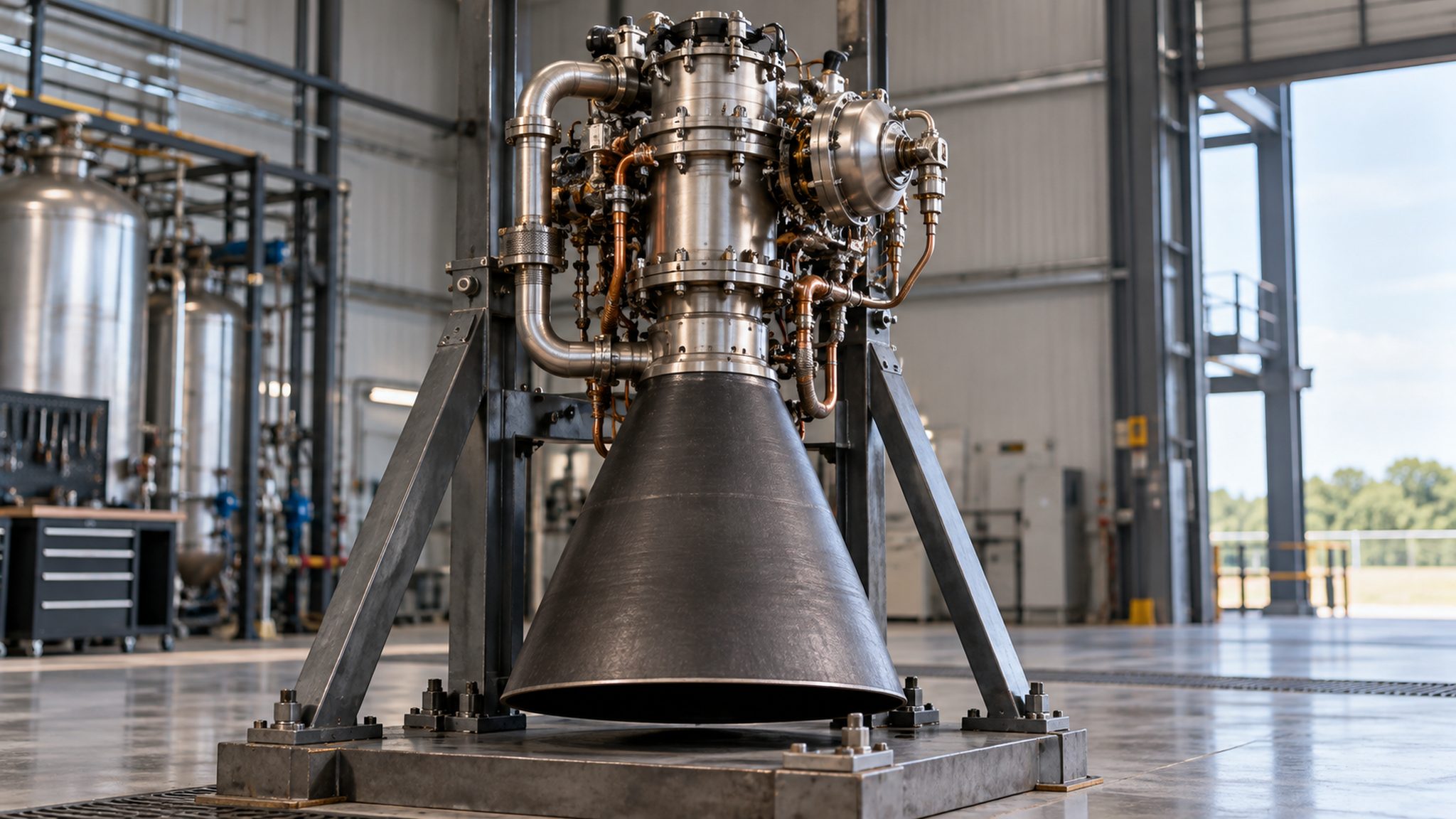
Recovery is a milestone; reliable reflight is the test
A recovered vehicle becomes economically reusable only when engineers can inspect it, prepare it and send it on further missions with dependable performance.
- Recovery preserves hardware that might otherwise be discarded, but preservation alone does not establish readiness for another launch. Engineers must determine what suffered damage, what needs replacement and what can safely remain in service.
- Thermal and structural loads accumulate across flight phases. A reusable system needs evidence that repeated exposure does not compromise critical components; an isolated engine test cannot answer every vehicle-level question about repeated operation.
- Payload delivery and recovery compete for vehicle resources. Fuel retained for descent cannot simultaneously power payload delivery, so mission planning must balance return requirements against the useful cargo and orbit the launcher can serve.
- Launch-cost reductions depend on more than avoiding manufacture of a new vehicle. Inspection, repair, recovery operations and flight frequency affect the result; the release presents savings as an objective without demonstrated operational cost evidence.
- Reduced debris generation likewise remains an intended outcome of this programme. Assessments should check how stages are returned or disposed of, rather than assuming the word reusable guarantees that every mission leaves no hardware behind.
Way Forward
Validate the complete mission sequence
- Link development milestones to demonstrated restart, throttling, orbital delivery and controlled recovery, with clear separation between component tests and integrated missions.
- Track refurbishment effort and repeat-flight reliability alongside recovery success; these measures test whether reusable hardware produces a repeatable launch service.
- Report payload and recovery trade-offs transparently so cost and debris claims can be evaluated against the actual mission profile.
Conclusion
- Agnibaan RLV is a development commitment to integrate launch and recovery functions, not an announcement that fully reusable orbital flight has already been demonstrated.
- For an answer on space innovation, distinguish capability, integration and operations: an engine can work, a vehicle can return, and yet reliable low-cost reflight can remain an unfinished engineering task.
UPSC Practice Questions
Prelims MCQ 1
With reference to reusable launch propulsion, consider the following statements:
- Restart capability allows an engine to ignite again after shutdown.
- Deep throttling refers to controlled operation at substantially reduced thrust.
- Successful recovery alone proves that a vehicle is ready for repeated flights without inspection.
How many of the above statements are correct?
(a) Only one (b) Only two (c) All three (d) None
Answer: (b) Only two
Explanation:
Restart and throttling are distinct propulsion capabilities. Recovery must be followed by inspection and readiness assessment; it does not establish maintenance-free reflight.
Prelims MCQ 2
Which requirement most directly distinguishes the announced Agnibaan RLV ambition from first-stage-only recovery?
(a) Eliminating all guidance requirements (b) Replacing orbital insertion with altitude alone (c) Integrating reusable upper-stage architecture with descent and recovery (d) Treating engine development as proof of commercial service
Answer: (c) Integrating reusable upper-stage architecture with descent and recovery
Explanation:
The programme seeks full-system reusability, including upper-stage architecture. It remains a development effort rather than demonstrated commercial operation.
UPSC Mains Questions
- Explain why restart and deep-throttling capabilities are necessary but insufficient for a dependable reusable launch system.
- Discuss the engineering and operational trade-offs that determine whether launch-vehicle recovery translates into economical, repeated access to space.
Source: PIB, Ministry of Science and Technology.
Frequently Asked Questions
Has Agnibaan RLV demonstrated full reusability?
The announcement concerns an agreement supporting development and validation. It describes a proposed reusable architecture and intended benefits; it does not establish successful full-system recovery and repeated operational flight.
How are engine restart and throttling different?
Restart means igniting an engine after shutdown. Throttling means adjusting thrust while it operates. Controlled descent may require both, together with guidance and vehicle control, rather than either capability in isolation.
Why is upper-stage recovery important?
First-stage recovery leaves the later propulsion stage outside the reuse cycle. Including the upper stage extends the engineering problem to orbital delivery, return, recovery and preparation for subsequent missions.
Does reusability automatically make launches cheaper?
No. Avoided manufacturing costs must be weighed against recovery, inspection, repair and operating costs. Flight frequency and reliability also matter, so intended savings need evidence from repeated missions and actual operations.