AI-Assisted Mathematics: Breakthroughs Still Need Human Verification
Why in News?
The Indian Express recently examined the growing role of language models in advanced mathematics after frontier AI systems began contributing to research-level conjectures, counterexamples and proofs.
- The unit-distance problem, posed by Paul Erdős in 1946, asks for the maximum number of pairs exactly one unit apart among n points in a plane.
- Erdős had conjectured that this maximum grows no faster than n^(1+o(1)), meaning only slightly faster than linear as n becomes very large.
- The AI-generated argument constructs an infinite family of point sets with at least n^(1+epsilon) unit-distance pairs for some fixed epsilon greater than zero, which contradicts that proposed upper bound.
- The construction connects discrete geometry with algebraic number theory, including CM fields, infinite class-field towers and Golod-Shafarevich theory.
- External mathematicians checked the argument, simplified and generalised parts of it, and published a companion exposition describing it as a human-verified version of the AI-generated proof.
- AI is moving beyond retrieving known theorems toward searching large spaces of possible constructions and finding connections across mathematical fields.
- Mathematics offers unusually crisp verification because a proposed result can be tested against definitions and logical rules, yet subtle assumptions can still hide in informal arguments.
- The development strengthens the case for human-machine research teams, not for removing mathematicians from authorship, interpretation or peer review.
UPSC Relevance
Prelims Relevance
- A conjecture is a mathematical statement believed to be true but not yet proved.
- A single valid counterexample disproves a universal statement, while many supporting examples do not prove it.
- The planar unit-distance problem was posed by Paul Erdős in 1946.
- Discrete geometry studies combinatorial properties of points, lines and other geometric objects.
- Algebraic number theory studies number fields, algebraic integers and related structures; it supplied the unexpected tools used in the new construction.
- A formal proof assistant checks a proof written in a precise formal language against a trusted logical kernel and declared axioms.
Mains Relevance
GS Paper 3
- Applications of artificial intelligence in scientific discovery and the shift from pattern recognition toward research-level reasoning.
- Importance of foundational mathematics, formal methods, shared compute, high-quality research corpora and interdisciplinary institutions for national scientific capability.
GS Paper 4
- Research integrity, honest attribution of human and machine contributions, disclosure of uncertainty and responsibility for errors.
- The professional duty to verify AI-generated arguments before publication, funding decisions or educational use.
Essay
- Tools expand the frontier of knowledge only when institutions preserve doubt, verification and responsibility.
Background and Context
What the Unit-Distance Conjecture Claimed
The breakthrough concerns an asymptotic claim about how densely one fixed distance can occur among many points.
- Let u(n) denote the largest possible number of point pairs at distance exactly one among n points in the Euclidean plane. A line gives n-1 such pairs, while suitable grids produce more.
- Earlier grid-based constructions achieved roughly n^(1+C/log log n) unit distances for a constant C. Since C/log log n approaches zero as n grows, this is written as n^(1+o(1)).
- Erdős conjectured that n^(1+o(1)) was also an upper bound. The best general upper bound remained O(n^(4/3)), leaving a wide gap between known constructions and what could be ruled out.
- The AI result supplies point sets with at least n^(1+epsilon) unit distances for a fixed positive epsilon along an infinite sequence. This cannot fit within n^(1+o(1)), so the conjectured upper bound is false, although the true.
How the AI Found an Unexpected Route
The important contribution was a cross-domain construction rather than a faster calculation of familiar examples.
- Erdős’s lattice construction can be interpreted using Gaussian integers, numbers of the form a+bi. The model explored whether richer algebraic number fields could create more unit-length differences.
- The successful route uses CM fields and an infinite class-field tower with controlled root discriminant. A rational prime that splits repeatedly through the tower helps generate many algebraic elements of absolute value one.
- After embedding a bounded set of algebraic integers in the complex plane, those elements become differences between points. Counting these differences yields unusually many unit-distance pairs.
- The companion paper notes that many experts had concentrated on proving the widely believed upper bound. The model instead pursued a counterexample, a direction that humans had considered less promising.
Discovery, Proof and Verification Are Different Stages
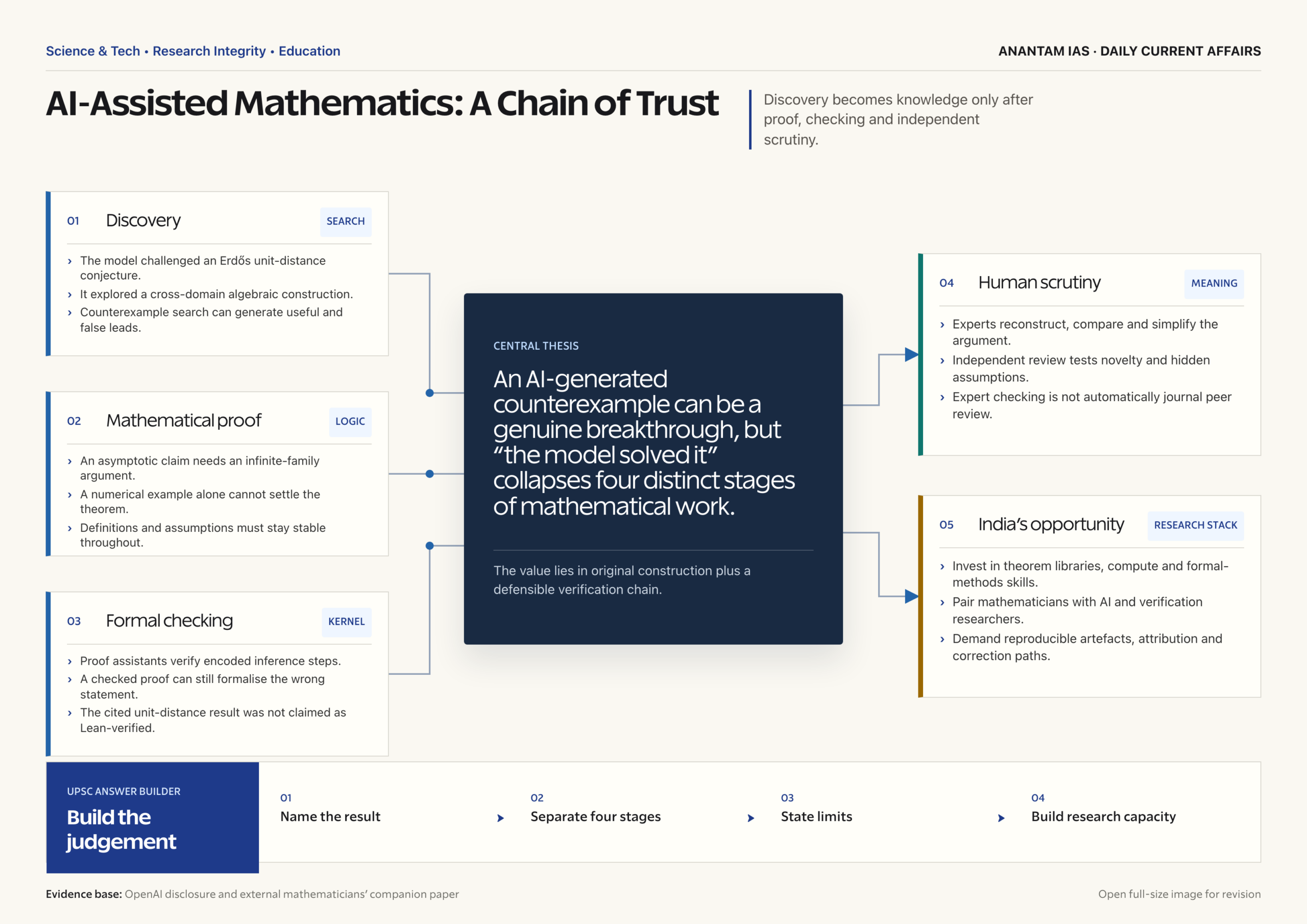
A careful answer should separate four activities that are often collapsed into the phrase AI solved mathematics.
- Conjecture or counterexample search proposes patterns, statements, examples or constructions worth examining. It is exploratory and may generate many false leads.
- A mathematical proof gives a logically valid argument from stated assumptions. In this case, the construction needs a proof that an infinite family exists and has the required number of unit distances; merely displaying a numerical.
- Formal verification encodes a theorem and its proof in a system such as Lean, whose kernel checks every permitted inference. It reduces the risk of hidden logical gaps, but formalising the wrong statement or importing unsuitable.
- Independent human verification asks experts to reconstruct the argument, test definitions and assumptions, compare it with existing literature, simplify it and judge its mathematical meaning. The OpenAI case received such external checking and a human-digested exposition.
- The available OpenAI account and companion paper do not describe this unit-distance proof as Lean-verified. Calling it formally verified would overstate the evidence. Expert checking before release also should not be called completed journal review unless.
What AI Can and Cannot Yet Reliably Do
AI-assisted mathematics is already plural: different systems perform different parts of the research workflow.
- Machine learning has helped detect patterns and propose conjectures; earlier Nature research used it to guide human intuition in knot theory and representation theory.
- Language models can retrieve relevant theorems, translate between informal and formal statements, search proof strategies, write code for experiments and suggest counterexamples. Each role needs its own evaluation.
- Formal proof-search agents can use compiler feedback from Lean to reject invalid steps. This creates a tighter error signal than ordinary natural-language generation, but success depends on available libraries, a correct formal statement and manageable search.
- Natural-language proofs remain vulnerable to hallucinated lemmas, skipped cases, circular reasoning and altered assumptions. A fluent explanation is not evidence of validity.
- Even a correct proof may deliver limited understanding if it is opaque. Mathematicians value explanation, generalisation and connections, not only a binary verdict. This mirrors the wider principle in agentic AI: greater autonomy needs.
Way Forward
Build Verification into the Research Pipeline
- Separate exploratory model output from verified claims in repositories and lab records.
- Use computer algebra, independent tests, proof assistants and expert reconstruction according to the result, with assumptions and known gaps stated before calling it solved.
- Train mathematicians in AI and formalisation while training model developers in mathematical research practice and epistemology.
- Reward failed replications and simplified proofs, and keep humans responsible for problem selection, interpretation, attribution and downstream claims.
Conclusion
- The unit-distance result matters because an AI system found a genuine cross-field construction that experts judged correct, not because it produced fluent mathematical language.
- India should treat AI-assisted mathematics as research infrastructure: pair ambitious exploration with formal methods, open artefacts, independent experts and accountable institutions.
UPSC Practice Questions
Prelims MCQ 1
With reference to AI-assisted mathematical discovery, consider the following statements:
- A single valid counterexample can disprove a universal mathematical conjecture.
- A proof accepted by a formal proof assistant necessarily establishes that the formal statement matches the intended real-world or mathematical question.
- Independent human verification and formal verification are distinct processes.
How many of the above statements are correct?
(a) Only one (b) Only two (c) All three (d) None
Answer: (b) Only two
Explanation:
Statements 1 and 3 are correct. A counterexample refutes a universally quantified claim, and expert reconstruction is different from kernel-based formal checking. Statement 2 is incorrect because users must still ensure that the encoded theorem and assumptions correspond to the intended problem.
Prelims MCQ 2
Which one of the following best describes the 2026 AI-assisted result on Erdős’s planar unit-distance conjecture?
(a) It proved the exact maximum number of unit distances for every value of n (b) It checked the conjecture numerically for a large but finite set of examples (c) It constructed and proved the existence of an infinite family contradicting the conjectured asymptotic upper bound (d) It showed that every discrete-geometry conjecture can be translated automatically into Lean
Answer: (c) It constructed and proved the existence of an infinite family contradicting the conjectured asymptotic upper bound
Explanation:
The result gives point sets with at least n^(1+epsilon) unit-distance pairs along an infinite sequence, contradicting the proposed n^(1+o(1)) upper bound. It does not settle the exact growth rate or claim universal automatic formalisation.
UPSC Mains Questions
- AI-assisted mathematical discovery can widen the search for new knowledge, but it does not collapse the distinction between conjecture, proof and verification. Discuss with reference to recent research-level results and suggest a trustworthy validation framework.
- For India, sovereign scientific capability requires the ability to verify and reproduce AI-generated knowledge, not merely access frontier models. Examine the institutional, skill and infrastructure priorities needed to build such capacity.
Sources: OpenAI and the external mathematicians' companion paper and The Indian Express Explained.
Frequently Asked Questions
Did AI fully solve the planar unit-distance problem?
It disproved Erdős’s proposed n^(1+o(1)) upper bound by constructing an infinite family with n^(1+epsilon) unit distances for a fixed positive epsilon. That settles the conjecture as false, but it does not determine the exact maximum growth rate of unit-distance pairs.
What is the difference between finding a counterexample and proving one?
A candidate counterexample is an object that appears to violate a universal claim. It becomes a mathematical disproof only after its required properties are established rigorously. In this case, the argument had to prove that an infinite family of point.
Was the OpenAI unit-distance proof formally verified in Lean?
The published OpenAI account and companion paper describe external mathematicians checking, digesting, simplifying and generalising the proof. They do not describe this particular result as Lean-verified. It is accurate to call it independently human-verified; calling it formally verified would add.
Why is human verification needed if mathematics has definite answers?
Natural-language arguments can hide altered assumptions, omitted cases, circular steps or fabricated lemmas. Experts also check whether the theorem answers the original question, fits prior literature and has wider meaning. Formal tools can check encoded logic, but humans still choose.
What role can proof assistants play in AI-assisted mathematics?
Proof assistants such as Lean check each formal inference against a small trusted kernel and declared axioms. They can provide precise feedback during proof search and make a completed proof machine-checkable. Their limits include formalisation effort, library coverage and the.