AI-Fabricated Precedents: The Supreme Court’s Warning on Manufactured Justice
Why in News?
The Supreme Court of India has set aside orders of the National Company Law Tribunal and its appellate body after finding that the tribunal had relied on fictitious, AI-generated legal citations in an insolvency matter. The Court, per an editorial in The Hindu, treated the lapse as far graver than an ordinary error and quashed the decisions rather than merely correcting them.
A Bench of Justices P.S. Narasimha and Alok Aradhe likened AI hallucinations creeping into judicial reasoning to methyl isocyanate, the gas behind the 1984 Bhopal tragedy, calling such contamination ‘invisible, insidious, and catastrophic by the time anyone notices’. The editorial framed the episode as the latest in a series of 2026 interventions cautioning against fabricated precedents in court proceedings.
- The Court held that any judgment influenced by even ‘an iota’ of fake or hallucinated AI material is ‘no decision in the eyes of law’.
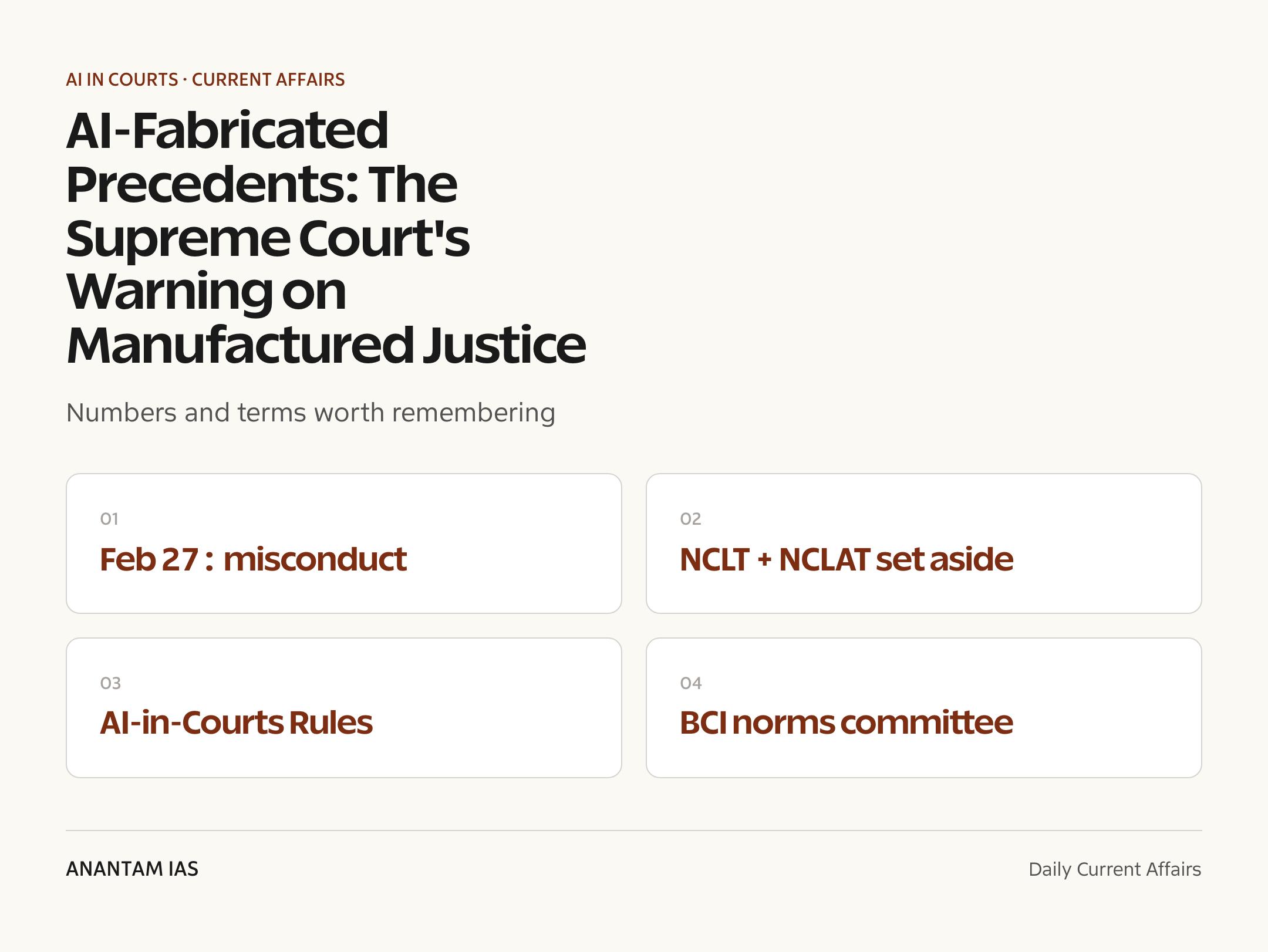
- On February 27, the same Bench flagged a trial court’s reliance on AI-generated fictitious case laws as judicial ‘misconduct’, not merely ‘an error in decision-making’.
- Presenting fabricated, machine-generated ‘judgments’ was ruled professional misconduct for advocates and a serious lapse of duty for judges.
- The draft ‘Regulations for Use of Artificial Intelligence (AI) in Courts, 2026’ are open for public consultation.
- The Court directed the Bar Council of India to set up a dedicated committee to frame strict norms and disciplinary action for lawyers citing unverified AI material.
- The editorial closed with the line that justice must be done and seen, not hallucinated.
The development matters in the context of:
- This is the latest in a run of 2026 interventions where the top court has cautioned against AI-generated fictitious precedents entering the record.
- It crystallises the line between AI as an assistive tool for efficiency and AI as a substitute for independent human reasoning, which the Court forbids.
- The Court read the risk not as a stray glitch but as a structural feature of generative AI that demands institutional safeguards, not ad-hoc correction.
UPSC Relevance
Prelims Relevance
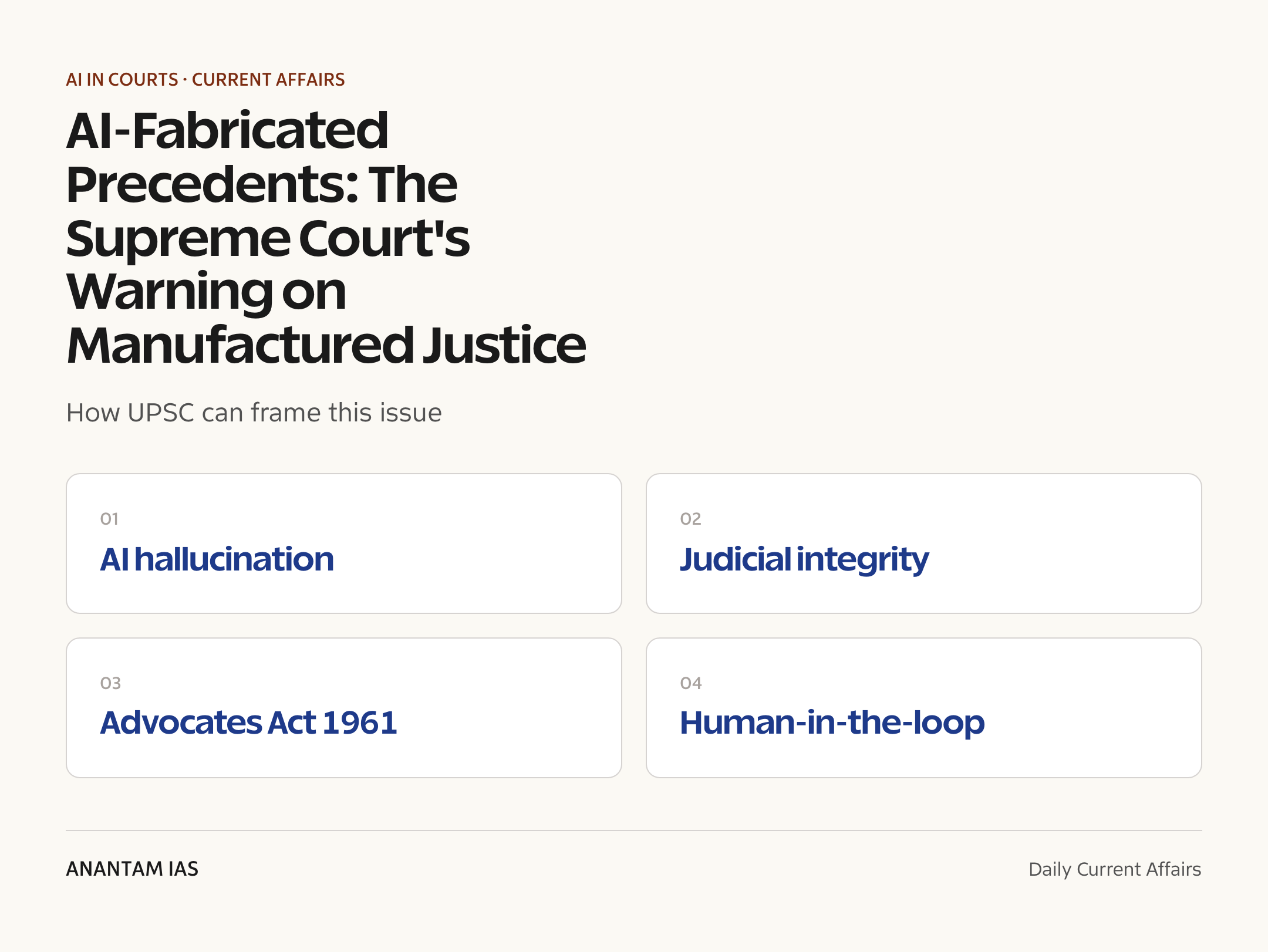
- AI hallucination — an AI system producing confident but fabricated output (here, non-existent case citations).
- NCLT and NCLAT — tribunals adjudicating insolvency and company-law matters under the IBC and Companies Act, 2013.
- Bar Council of India (BCI) — statutory body under the Advocates Act, 1961, regulating legal practice and professional conduct.
- Professional misconduct — ground for disciplinary action against advocates under the Advocates Act, 1961.
- Draft Regulations for Use of AI in Courts, 2026 — bars AI from adjudication, sentencing, bail eligibility and credibility assessment.
- SUPACE (Supreme Court Portal for Assistance in Court Efficiency) and SUVAS (Supreme Court Vidhik Anuvaad Software) — the judiciary’s own AI-assist systems.
- Contempt of court and criminal-misconduct exposure for filing fabricated material.
- 1984 Bhopal gas tragedy — methyl isocyanate leak, used here as an analogy for latent, invisible harm.
- Automation bias — the human tendency to over-trust confident machine output and skip verification.
Mains Relevance
GS Paper 2
- Regulating emerging technologies in the justice-delivery system: opportunities, risks and the assistive-versus-substitutive line.
- Role of the Bar Council of India and the Advocates Act, 1961 in enforcing professional accountability for AI misuse.
GS Paper 4
- Integrity, objectivity and accountability of public servants when technology can fabricate authority.
- Ethical use of AI in governance: human oversight as the essential counter to automation bias.
Essay
- Technology can inform judgement, but it cannot replace the burden of judging.
- In the age of the machine, integrity is the last human safeguard.
Background and Context
What actually happened
The trigger was an insolvency appeal that exposed how easily fabricated authority can slip through layers of review.
- The NCLT relied on fictitious AI-generated citations in an insolvency case; the NCLAT overlooked the lapse on appeal.
- The Supreme Court set aside both orders, treating the reliance on hallucinated precedent as fatal to the decision, not a defect that could be patched.
- The Bench used a stark analogy — methyl isocyanate, the Bhopal gas — to convey that the harm is latent and visible only after damage is done.
- A judgment tainted by fabricated AI material is ‘no decision in the eyes of law’, so it must be quashed rather than merely corrected.
- The lapse surfaced in an insolvency matter, where the wrong precedent could have skewed the outcome for creditors and the corporate debtor alike.
- The failure at two levels — trial-stage reliance plus appellate oversight — showed the risk is systemic, not confined to one careless bench.
- The editorial noted this is one in a series of 2026 interventions where the Court has taken a strict, cautionary line on AI in the justice-delivery system.
How AI hallucination works
The controversy rests on a well-documented failure mode of generative AI that predates this case.
- Hallucination is when a language model generates plausible-sounding but false content — invented cases, quotes, statutes or citations.
- Large language models predict the next likely word from patterns, so they can fabricate a case name, citation number and holding that read as authentic but never existed.
- The output carries no in-built signal of truth or falsity, so a fake citation looks identical to a real one unless it is checked against an official law reporter.
- The globally cited example is Mata v. Avianca (US, 2023), where lawyers filed a brief with non-existent AI-generated citations and were sanctioned by a federal court.
- Indian High Courts and trial courts have flagged similar fabricated filings, making this a recurring risk, not an isolated slip.
The Court’s assistive-not-substitutive line
The rulings draw a firm boundary around where AI may and may not operate in a courtroom.
- AI may act as an assistive tool to improve efficiency — legal search, summarisation, translation, listing and case-file processing.
- AI can never replace independent human reasoning, judicial discretion or professional accountability, the Court held.
- The draft rules reserve adjudication, sentencing, bail eligibility and the assessment of a party’s or witness’s credibility for humans.
- Human oversight is framed as the essential counter to AI’s dangers, not an optional add-on.
- The editorial cast AI disruption as a ‘known unknown’ — everyone sees it happening, but no one can yet gauge its full extent — which is precisely why caution is warranted.
The regulatory response taking shape
Judicial observations are being converted into written norms and institutional duties.
- The draft Regulations for Use of AI in Courts, 2026 prohibit AI in core adjudicatory functions and are open for public consultation.
- The Bar Council of India has been directed to form a committee to frame strict norms and disciplinary action for lawyers citing unverified AI material.
- Under the Advocates Act, 1961, the BCI and State Bar Councils already hold disciplinary jurisdiction over professional misconduct — the AI directive plugs into this existing machinery.
- Existing judicial-AI tools such as SUPACE and SUVAS already model the ‘assist, don’t decide’ principle — SUPACE aids case-file processing, SUVAS translates judgments into regional languages.
- Filing fabricated material can expose an advocate to professional misconduct proceedings and, potentially, contempt and cost consequences.
Why this is a GS4 ethics case, not just law
The episode is a live study in integrity, accountability and the misuse of technology.
- Integrity and objectivity: a citation must be verified before it is relied upon; convenience is no defence for skipping the check.
- Accountability: the duty to check the record cannot be outsourced to a machine, and the human who signs the order owns the outcome.
- Non-maleficence: a fabricated precedent can wrongly decide liberty, property, solvency or livelihood — real harm to real people.
- Automation bias is the ethical trap — deferring to a confident machine erodes the professional’s own judgement and diligence.
- The fiduciary duty of an officer of the court is personal and non-transferable; a tool cannot bear the moral weight of a wrong decision.
- Ethical failure here is a mix of negligence (skipped verification) and, at worst, deliberate deception when fake authority is knowingly passed off as real.
How other jurisdictions have responded
India’s caution echoes a wider global reckoning with AI in courts.
- In the United States, the Mata v. Avianca sanctions prompted several federal judges to issue standing orders requiring disclosure and certification of AI-assisted filings.
- Courts in the United Kingdom have issued judicial guidance warning that legal professionals remain personally responsible for material generated with AI tools.
- The common thread is human accountability — AI use is not banned, but the professional who files or signs cannot hide behind the tool.
- India’s draft AI-in-Courts Regulations, 2026 sit within this global move toward trustworthy, verifiable AI in high-stakes public decisions.
Wider stakes for AI in governance
Courts are one arena; the same tension runs across the administrative state.
- Automated decision-support is spreading into welfare targeting, policing, taxation and revenue systems, where a hallucinated input carries real cost.
- The judgment strengthens the case for human-in-the-loop design and auditable trails in every public-sector AI system.
- It signals that explainability and verifiability, not raw speed, are the true tests for AI in high-stakes governance.
- The reasoning applies equally to algorithmic bias and opaque ‘black-box’ models that citizens cannot challenge or appeal.
- A wrong AI-driven welfare or revenue decision may go unnoticed for months, echoing the Court’s latent-harm warning far beyond the courtroom.
- India’s approach sits alongside global debates on trustworthy AI and the emerging idea of AI-specific professional standards.
Way Forward
Verification duty
- Mandate that every cited authority be independently checked against an official reporter or database before filing.
- Require counsel to certify the provenance of AI-assisted research in the pleading itself, so responsibility is documented.
- Build citation-verification into standard legal-education and continuing-education modules so diligence becomes habit, not afterthought.
Institutional guardrails
- Finalise the AI-in-Courts Regulations, 2026 after consultation, keeping adjudication, sentencing and bail firmly human.
- Operationalise the BCI committee with clear disciplinary consequences, reporting channels and training for advocates.
- Extend the same ‘assist, don’t decide’ rule to tribunals such as the NCLT and NCLAT, where this lapse originated.
Systemic design
- Deploy court-approved, source-linked AI tools that surface citations only with verifiable links to genuine judgments.
- Build human-in-the-loop checkpoints, audit logs and provenance trails into any AI used across governance.
- Prefer explainable systems whose outputs can be traced and challenged over opaque models in any decision affecting rights.
Conclusion
The Supreme Court’s intervention reframes AI hallucination from a technical curiosity into a question of judicial integrity. By treating a tainted order as no decision at all, it puts the burden of verification back where it belongs — on the human who signs the judgment, not the tool that drafted it.
The Bhopal analogy is deliberate. Like a leaked gas, a fabricated citation does its damage quietly and is often noticed only after a wrong outcome has already touched someone’s liberty or livelihood. That is why the Court favours prevention — verification duties, disciplinary norms and firm limits on where AI may operate — over after-the-fact correction.
The larger lesson travels beyond the courtroom. Wherever AI enters public decision-making, speed cannot substitute for accountability, and oversight is the price of using the tool at all. Justice, as the editorial put it, must be done and seen — not hallucinated.
UPSC Practice Questions
Prelims MCQ 1
With reference to the use of Artificial Intelligence in India’s judicial system, consider the following statements:
- The draft Regulations for Use of AI in Courts, 2026 permit AI to decide bail eligibility to reduce pendency.
- The Supreme Court has held that a judgment influenced by hallucinated AI material is ‘no decision in the eyes of law’.
- The Bar Council of India has been directed to frame norms and disciplinary action for lawyers citing unverified AI material.
How many of the above statements are correct?
(a) Only one (b) Only two (c) All three (d) None
Answer: (b) Only two
Explanation:
Statements 2 and 3 are correct. Statement 1 is wrong — the draft regulations prohibit AI in adjudication, sentencing and bail eligibility, reserving these for humans.
Prelims MCQ 2
The bodies whose orders the Supreme Court set aside for relying on fictitious AI-generated citations were the:
(a) CAT and the High Court (b) NCLT and the NCLAT (c) SEBI and the SAT (d) NGT and its appellate bench
Answer: (b) NCLT and the NCLAT
Explanation:
The National Company Law Tribunal relied on fabricated AI citations in an insolvency case, and the National Company Law Appellate Tribunal missed the lapse; the Supreme Court set aside both orders.
UPSC Mains Questions
- “AI in the courtroom may assist efficiency but can never replace independent human reasoning.” In light of recent Supreme Court observations, examine the risks of AI hallucination in judicial decision-making and the safeguards needed.
- Fabricated, machine-generated citations raise questions of professional ethics as much as of law. Discuss the ethical duties of advocates and judges in verifying authority, and the role of the Bar Council of India in enforcing accountability.
- Human oversight is described as the essential counter to the dangers of AI in governance. Analyse how a human-in-the-loop principle can be built into public-sector decision-making systems in India.
Sources: The Hindu, Editorial and Supreme Court of India.
Frequently Asked Questions
What is an AI hallucination in this context?
It is when a generative AI tool produces confident but false content — here, legal citations for cases that do not exist. Because the output looks authentic, it can be relied upon without verification, which is exactly the risk the Supreme Court flagged when fabricated precedents entered tribunal orders.
Why did the Supreme Court compare it to Bhopal gas?
The Bench likened AI hallucinations in judicial reasoning to methyl isocyanate, the gas behind the 1984 Bhopal tragedy — ‘invisible, insidious, and catastrophic by the time anyone notices’. The analogy stresses that the harm is latent and often detected only after a wrong decision has already caused damage.
Is using AI banned for judges and lawyers?
No. The Court holds that AI may serve as an assistive tool for efficiency, such as search and translation. What is barred is letting AI substitute for human reasoning — adjudication, sentencing, bail and credibility assessment remain human functions under the draft AI-in-Courts Regulations, 2026.
What can happen to a lawyer who cites fake AI cases?
Presenting fabricated machine-generated material was ruled professional misconduct for advocates. The Supreme Court directed the Bar Council of India to set up a committee to frame strict norms and disciplinary action, and such conduct can also invite contempt and cost consequences.
What are SUPACE and SUVAS?
They are the judiciary’s own AI-assist tools. SUPACE (Supreme Court Portal for Assistance in Court Efficiency) helps process case files and information, while SUVAS translates judgments into regional languages. Both illustrate the ‘assist, do not decide’ principle the Court endorses.
Why is this an ethics issue for UPSC GS4?
It tests integrity, objectivity and accountability. A citation must be verified before reliance, and that duty cannot be outsourced to a machine. The failure combines negligence with, at worst, deception, making human oversight the ethical safeguard against AI misuse in governance.