AI in Warfare: How autonomous systems are reshaping conflict and India’s response
Why in News?
Writing in The Indian Express, a retired Lieutenant General who commanded the Army Training Command (ARTRAC) has argued that the trinity of artificial intelligence (AI), military autonomy and algorithmic warfare is redefining warfighting and deterrence — and that India’s strategic-military establishment faces a ‘Manhattan Project’ moment: the deployment of military software at unprecedented speed and scale.
The piece draws on the Russia-Ukraine war, where AI-enabled data fusion and cheap drones have compressed the time from detection to strike into minutes, and prescribes a sovereign roadmap for India — from a Delta-style battlefield data platform to a five-million-drone inventory by 2028.
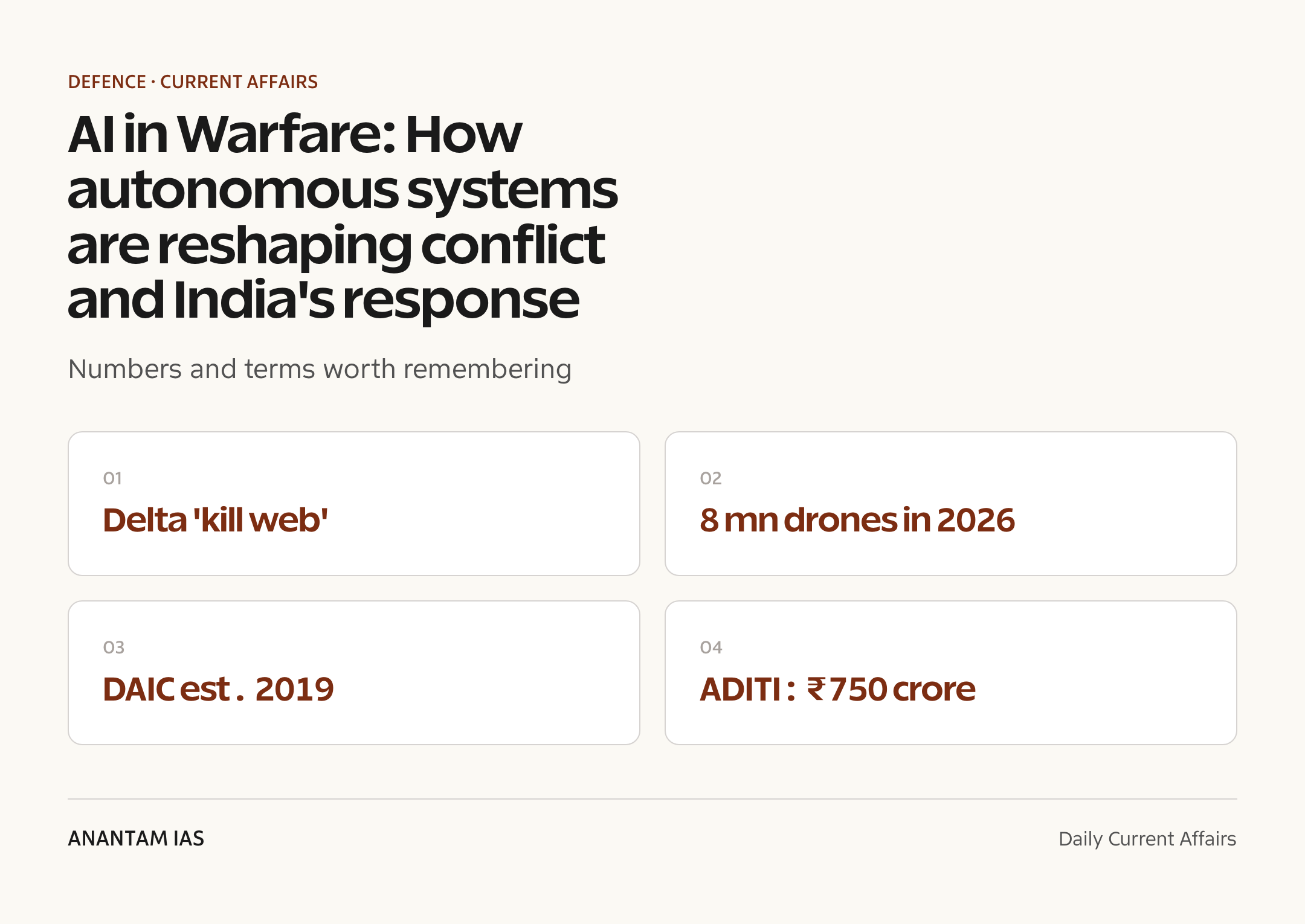
- Ukraine’s AI-enabled data analytics platform Delta fuses inputs from radar imagery to social media into one stream and plugs into drone fleets to form a digital ‘kill web’ that compresses detection-to-neutralisation to a couple of minutes.
- A roughly 35-km corridor along the Russia-Ukraine frontier is nicknamed the ‘death zone’ — artillery is outranged, tanks can’t move, and infantry spotted by surveillance drones is neutralised by FPV (first-person view) drones within minutes.
- Ukraine is buying eight million drones this year — more units than the artillery shells it fired last year — giving commanders options from close air support (~25 km) to strategic strikes (~2,500 km).
- The article notes combat-theatre software innovation cycles of three weeks against hardware cycles of three months, and the rise of autonomous platforms such as the YFQ-44A Fury AI-powered fighter developed by the US defence-tech startup Anduril.
- Key prescriptions for India: a sovereign Delta-like platform, drone-swarm coordination software, 5 million drones by 2028, counter-drone ‘kill webs’ on the LoC and LAC, and at least 40% of the ~₹2 lakh crore modernisation budget for technological solutions from 2027.
The development matters in the context of:
- For India this is not academic: Operation Sindoor (May 2025) saw large-scale drone and loitering-munition exchanges with Pakistan, with the indigenous Akashteer automated air-defence control system credited for intercepts — a live preview of algorithmic warfare on India’s borders.
- India faces a two-front challenge: attaining ‘combat overmatch’ against Pakistan and ‘asymmetric deterrence’ against a China whose digital-military innovation is accelerating.
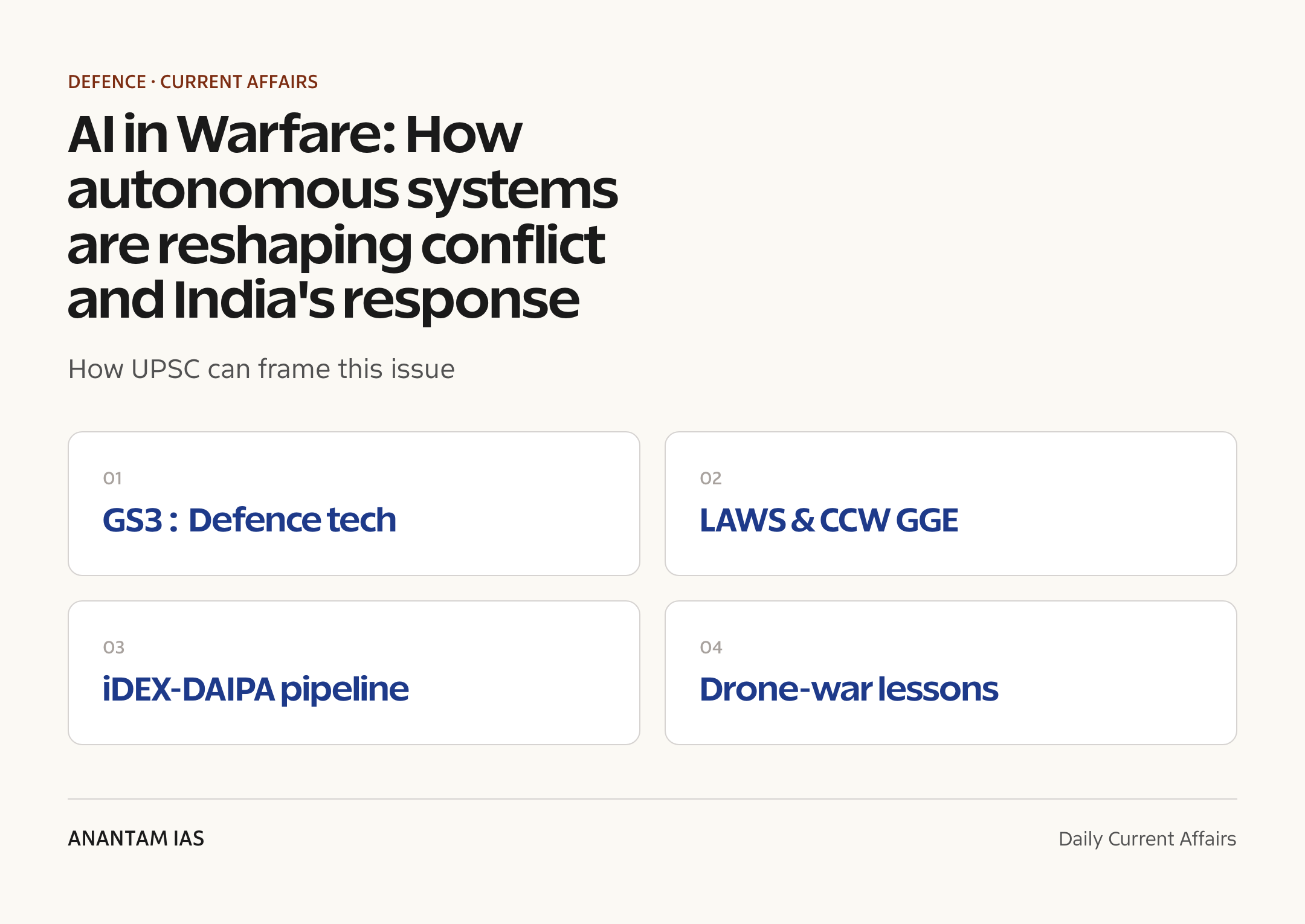
- Military AI sits at the heart of a favourite GS3 mains theme — indigenisation of defence technology, emerging tech and internal security — and links to the global debate on lethal autonomous weapon systems (LAWS).
UPSC Relevance
Prelims Relevance
- Delta — Ukraine’s AI-enabled battlefield data-fusion and situational-awareness platform; feeds a drone-based ‘kill web’.
- Kill web vs kill chain — a kill chain is a linear sensor-to-shooter sequence; a kill web is a resilient, many-to-many network of sensors, deciders and shooters.
- FPV drones — cheap first-person-view attack drones; with loitering munitions, the signature weapons of the Russia-Ukraine war.
- Defence AI Council (DAIC) — apex body created in 2019, chaired by the Raksha Mantri; gives strategic direction for AI adoption in defence.
- Defence AI Project Agency (DAIPA) — execution arm under the chairmanship of Secretary (Defence Production); both bodies flow from the 2018 N. Chandrasekaran task force on strategic implementation of AI for national security.
- iDEX (Innovations for Defence Excellence) — MoD’s startup-innovation platform; its ADITI sub-scheme (₹750 crore, 2023-24 to 2025-26) funds deep-tech projects — AI, autonomous weapons, quantum — with grants up to ₹25 crore.
- Akashteer — indigenous automated air-defence control-and-reporting system that anchored India’s counter-drone grid during Operation Sindoor.
- CCW GGE on LAWS — the Group of Governmental Experts on lethal autonomous weapon systems under the UN Convention on Certain Conventional Weapons; India chaired its first session in 2017-18.
- Collaborative Combat Aircraft (CCA) — AI-piloted ‘loyal wingman’ drones (e.g., Anduril’s YFQ-44A Fury) designed to fly alongside crewed fighters.
- Offensive ISR — using dense low-Earth-orbit (LEO) satellite constellations to move from passive surveillance to targeting-grade intelligence.
Mains Relevance
GS Paper 3
- Effect of AI, autonomy and drones on the character of war; lessons from Russia-Ukraine and Operation Sindoor for Indian force design.
- Indigenisation of defence technology: DAIC-DAIPA architecture, iDEX-ADITI, DRDO AI groups, and the shift from platform-centric to software-centric procurement.
- Internal and border security: counter-drone grids on the LoC/LAC, directed-energy weapons, and protecting critical infrastructure from cheap aerial threats.
GS Paper 2
- Global governance of lethal autonomous weapons — the CCW GGE process, ‘meaningful human control’, and India’s balancing position.
- Institutional reform: converting the Ministry of Defence from a ‘platform and weapons factory’ into a software enterprise; civil-military-startup interface.
Essay
- Algorithms at war: when code, not courage, decides the battlefield.
- Technology changes the character of war, never its nature — examine in the age of AI.
- National security in the 21st century is built in laboratories, not just on borders.
Background and Context
The new trinity: AI, autonomy and algorithmic warfare
Three overlapping technologies are compressing the decision cycle of combat from hours to minutes.
- Artificial intelligence ingests and fuses battlefield data — radar, satellite imagery, intercepts, even social media — far faster than human staff officers can.
- Military autonomy lets platforms act with little or no human piloting: drones that navigate jammed airspace, naval vessels captained by software, and AI wingmen flying beside crewed jets.
- Algorithmic warfare is the connective tissue — software that matches sensors to shooters automatically, generating targeting solutions at machine speed.
- The result is the ‘kill web’: instead of a linear kill chain, any sensor can cue any shooter through a resilient network, shrinking detection-to-strike timelines to minutes.
- The Indian Express piece calls drones the greatest techno-military revolution since gunpowder and nuclear weapons — and warns that lethality will rise exponentially over the next few years.
Lessons from the Russia-Ukraine war
Ukraine has become the live laboratory of algorithmic warfare, and its lessons travel directly to India’s borders.
- Ukraine’s Delta platform fuses multi-source data into one intelligent stream and plugs into a versatile drone inventory, compressing engagement times to a couple of minutes.
- In the ~35-km ‘death zone’ along the front, artillery has been pushed back and outranged, tanks don’t move, and infantry is spotted by surveillance drones and destroyed by FPV drones.
- Unmanned platforms now perform tasks once done by humans — acquiring targets, resupplying ammunition and rations, and even evacuating casualties.
- Scale matters: Ukraine’s purchase of eight million drones in a single year signals that attritable, cheap systems — not exquisite platforms — dominate this style of war.
- Innovation tempo is the real weapon: new combat software ships every three weeks; new hardware every three months. Armies that iterate faster win.
- India saw a compressed version of this during Operation Sindoor, when waves of drones and loitering munitions were met by the Akashteer-anchored counter-UAS grid — proof that drone-on-drone warfare has already arrived in South Asia. (See our explainer on drone swarms and counter-drone technology.)
India's military AI architecture so far
India built its defence-AI institutions early; the gap is between architecture on paper and capability at scale.
- The 2018 task force on AI for national security, chaired by N. Chandrasekaran (Chairman, Tata Sons), set the blueprint; it reported to the Department of Defence Production in June 2018.
- On its recommendation, the Defence AI Council (DAIC) — chaired by the Raksha Mantri, with the three service chiefs, Defence Secretary and the National Cyber Security Coordinator — was created in 2019 for strategic direction.
- The Defence AI Project Agency (DAIPA), under Secretary (Defence Production), executes AI projects; PIB has confirmed budgetary support of about ₹100 crore per year to DAIPA, with each service earmarking a similar amount for AI applications.
- All DRDO system laboratories run AI technology groups, and roughly 70 defence-specific AI projects have been identified across defence PSUs under AI roadmaps.
- iDEX channels startups into defence innovation; its ADITI sub-scheme (₹750 crore outlay) funds ~30 deep-tech strategic technologies — AI, autonomous weapons, quantum, satcom — with grants up to ₹25 crore per project. (Background: iDEX explained.)
- iDEX-ADITI challenges already target this battlespace directly — a loitering aerial interceptor swarm to counter drone swarms, and an expendable active-decoy swarm with electronic-warfare payloads for the IAF.
The global race: startups, autonomy and China
The centre of gravity of defence innovation is shifting from legacy primes to agile software-first startups — and China is sprinting.
- Anduril’s YFQ-44A Fury, an AI-powered autonomous fighter developed under the US Collaborative Combat Aircraft effort, signals that future airpower will be human-machine teaming, not solo pilots.
- The business model is migrating from traditional defence primes to defence-tech startups that ship software like consumer companies do.
- Chinese digital innovation is turbo-charging the competition: the piece cites DeepSeek-style AI models and Huawei’s push towards 1.4-nanometre transistor density by 2031 to challenge Nvidia’s Blackwell-class chips.
- Autonomy is spreading across domains — uncrewed surface and underwater vessels, robotic ground logistics, and dense LEO satellite constellations that shift ISR from persistent watching to offensive targeting.
- For a fuller map of this landscape, see our note on new and emerging defence technologies.
Lethal autonomous weapons: the law and ethics debate
As machines edge towards kill decisions, international law is scrambling to keep ‘meaningful human control’ in the loop.
- Lethal autonomous weapon systems (LAWS) can select and engage targets without further human intervention once activated — the heart of the global regulatory debate.
- Discussions run through the Group of Governmental Experts (GGE) under the UN Convention on Certain Conventional Weapons (CCW) at Geneva, meeting since 2017; India chaired the first GGE session.
- Core concerns: accountability gaps when an algorithm errs, compliance with international humanitarian law (distinction, proportionality), and the risk of lowering the threshold of war.
- States are split — many push for a binding ban or regulation of LAWS, while major military powers prefer non-binding principles; the UN General Assembly has begun adopting resolutions urging urgent action.
- India’s position balances both worlds: it supports human accountability over weapons while resisting premature bans that could freeze technological asymmetries against it.
Why India finds this hard: the structural gaps
The obstacle is less money than metabolism — procurement, data and culture move slower than the three-week software cycle.
- The Ministry of Defence has historically been a platform-and-weapons buyer; algorithmic warfare demands it behave like a software enterprise with continuous updates, not decadal acquisitions.
- Military data remains locked in service-wise silos; a Delta-style fusion platform needs shared data standards, secure cloud infrastructure and jointness across the three services.
- Import dependence in high-end chips, sensors and flight controllers exposes drone supply chains to disruption; scale manufacturing of five million drones needs a deep domestic component base.
- Talent competition is brutal: AI engineers command private-sector salaries the services can’t match, so models of lateral entry and startup partnership become essential.
- Testing, certification and rules of engagement for autonomous systems barely exist — doctrine has to catch up with the code.
Way Forward
Build the sovereign software stack
- Urgently develop an indigenous Delta-style data-analytics platform that fuses radar, satellite, electronic and open-source feeds into a single operational picture.
- Create software that autonomously coordinates drone swarms, identifies objects of interest, distinguishes birds and civilian aircraft from combat platforms, and cues shooters.
Scale the drone and counter-drone ecosystem
- Build a diverse drone inventory with a target of five million drones by 2028, prioritising cheap, attritable systems over exquisite platforms.
- Field layered counter-drone systems — including laser and high-power microwave weapons — with dedicated drone-hunting teams to create AI-enabled kill webs along the LoC and LAC.
- Crowd low-Earth orbit with Indian satellites to move from persistent surveillance to offensive ISR.
Reform money and institutions
- The article urges that at least 40% of the ~₹2 lakh crore modernisation budget from 2027 flow to technological solutions rather than legacy platforms.
- Deepen the DAIC-DAIPA-iDEX pipeline: faster contracts, milestone funding, and assured procurement so startups survive the ‘valley of death’.
- Push jointness and theaterisation so data, drones and decisions flow across services — algorithmic warfare punishes silos hardest.
Conclusion
The Russia-Ukraine war has settled one argument: wars are now won by whoever senses, decides and strikes faster, and that speed comes from software. The ‘Manhattan Project’ framing is apt — the change is not one more weapon but a new grammar of war built on AI, autonomy and algorithms.
India has the institutional skeleton — DAIC, DAIPA, iDEX-ADITI, DRDO’s AI groups — and a live demonstration from Operation Sindoor of what drone-age conflict looks like. What it needs now is metabolism: budgets that favour code over chrome, procurement that moves at startup speed, and doctrine that keeps a human accountable even as machines take over the loop.
Done right, this transition expands India’s options in crisis and buys ‘combat overmatch’ on one front and ‘asymmetric deterrence’ on the other. Done slowly, it cedes the death zone’s lessons to adversaries who are already studying them.
UPSC Practice Questions
Prelims MCQ 1
With reference to India’s institutional architecture for artificial intelligence in defence, consider the following statements:
- The Defence AI Council (DAIC) is chaired by the Union Defence Minister.
- The Defence AI Project Agency (DAIPA) functions under the chairmanship of the Vice-Chairman of NITI Aayog.
- ADITI is a sub-scheme of iDEX meant to fund deep-tech critical and strategic defence technologies.
How many of the above statements are correct?
(a) Only one (b) Only two (c) All three (d) None
Answer: (b) Only two
Explanation:
Statements 1 and 3 are correct. The DAIC, created in 2019 on the recommendation of the 2018 N. Chandrasekaran task force, is chaired by the Raksha Mantri, and ADITI (₹750 crore) is iDEX’s deep-tech sub-scheme. Statement 2 is wrong — DAIPA works under the chairmanship of Secretary (Defence Production), not NITI Aayog.
Prelims MCQ 2
The ‘Delta’ platform, recently seen in news in the context of modern warfare, is best described as:
(a) India’s automated air-defence control and reporting system (b) Ukraine’s AI-enabled data-fusion and situational-awareness platform that links sensors to drone strikes (c) A NATO framework for collective cyber defence (d) A Chinese low-Earth-orbit military satellite constellation
Answer: (b) Ukraine's AI-enabled data-fusion and situational-awareness platform that links sensors to drone strikes
Explanation:
Delta fuses inputs from radar imagery to social media into one intelligent stream and plugs into Ukraine’s drone inventory, forming a digital ‘kill web’ that compresses detection-to-neutralisation to minutes. India’s automated air-defence system is Akashteer.
UPSC Mains Questions
- “The trinity of artificial intelligence, autonomy and algorithmic warfare is changing the character of war.” Examine this statement in the light of the Russia-Ukraine conflict, and evaluate the adequacy of India’s institutional response. (250 words)
- Cheap attritable drones and AI-driven ‘kill webs’ have shifted military advantage from platforms to software. Discuss the implications for India’s defence modernisation priorities and border security along the LoC and LAC. (250 words)
- Autonomous weapons promise military efficiency but strain international humanitarian law. Critically examine the global debate on lethal autonomous weapon systems and India’s position in it. (150 words)
Sources: The Indian Express (Explained) and PIB, Ministry of Defence.
Frequently Asked Questions
What is algorithmic warfare?
Algorithmic warfare uses software to fuse battlefield data, match sensors to shooters and generate targeting decisions at machine speed. Combined with AI analytics and autonomous platforms like drones, it compresses the time from detecting a target to striking it into minutes, as seen in the Russia-Ukraine war.
What is Ukraine’s Delta platform?
Delta is Ukraine’s AI-enabled data-analytics platform. It fuses inputs ranging from radar imagery to social media into one intelligent stream and connects to a versatile drone inventory, creating a digital ‘kill web’ that shrinks detection-to-neutralisation timelines to a couple of minutes.
What are DAIC and DAIPA?
The Defence AI Council (DAIC), chaired by the Defence Minister, gives strategic direction for AI adoption in Indian defence. The Defence AI Project Agency (DAIPA), under Secretary (Defence Production), executes AI projects. Both were created in 2019 on the recommendation of the 2018 N. Chandrasekaran task force.
What is the ADITI scheme?
ADITI (Acing Development of Innovative Technologies with iDEX) is a ₹750 crore iDEX sub-scheme running 2023-24 to 2025-26. It funds about 30 deep-tech critical and strategic technologies — AI, autonomous weapons, quantum, satellite communication — with grants of up to ₹25 crore per project to startups and MSMEs.
What are lethal autonomous weapon systems (LAWS)?
LAWS are weapons that can select and engage targets without further human intervention once activated. Their regulation is debated in the Group of Governmental Experts under the UN Convention on Certain Conventional Weapons, where questions of accountability and ‘meaningful human control’ dominate.
What does the article recommend for India?
Key prescriptions: build a sovereign Delta-style data platform, develop drone-swarm coordination software, create a five-million-drone inventory by 2028, deploy laser and microwave counter-drone kill webs along the LoC and LAC, expand LEO satellites for offensive ISR, and spend at least 40% of the modernisation budget on technology.