Akash-NG Trials and India’s Layered Air Defence
Why in News?
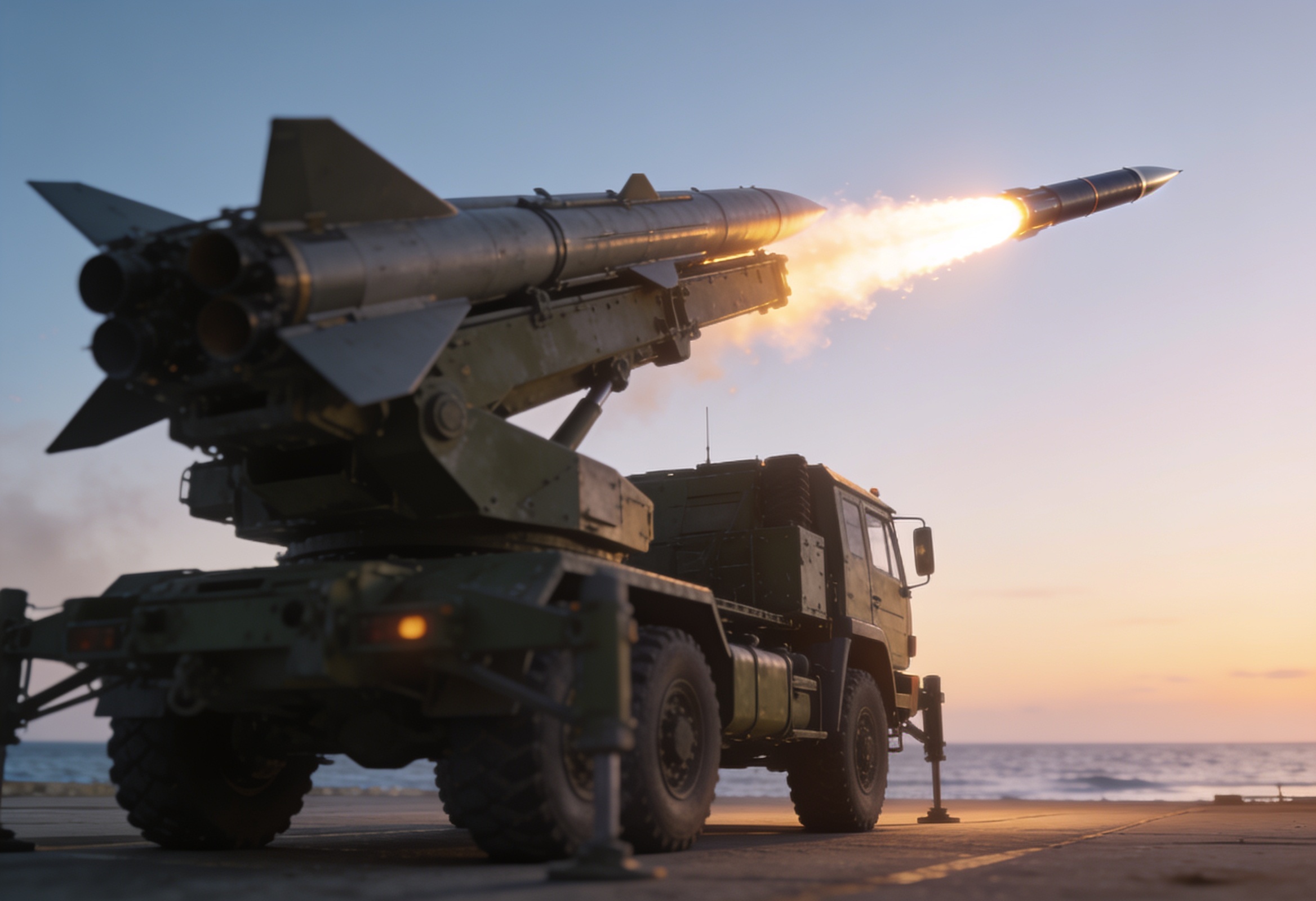
On 23 December 2025 the Defence Research and Development Organisation (DRDO) successfully completed user-evaluation trials of the indigenous Akash-NG (New Generation) surface-to-air missile off the Odisha coast, with launches from the Integrated Test Range (ITR), Chandipur. The missiles intercepted high-manoeuvring aerial targets across near-boundary low-altitude and long-range high-altitude scenarios.
The trials matter because Akash-NG is a faster, longer-reaching and more compact evolution of the home-grown Akash system. It tightens the Indian Air Force’s (IAF) medium-range air-defence layer and is a flagship example of Atmanirbhar Bharat (self-reliance) in critical defence technology.
- System tested: the Akash-NG, a new-generation surface-to-air missile designed to engage high-manoeuvring, low radar cross-section (RCS) aerial threats.
- Outcome: the missiles intercepted targets in near-boundary low-altitude and long-range high-altitude conditions, validating the full engagement envelope.
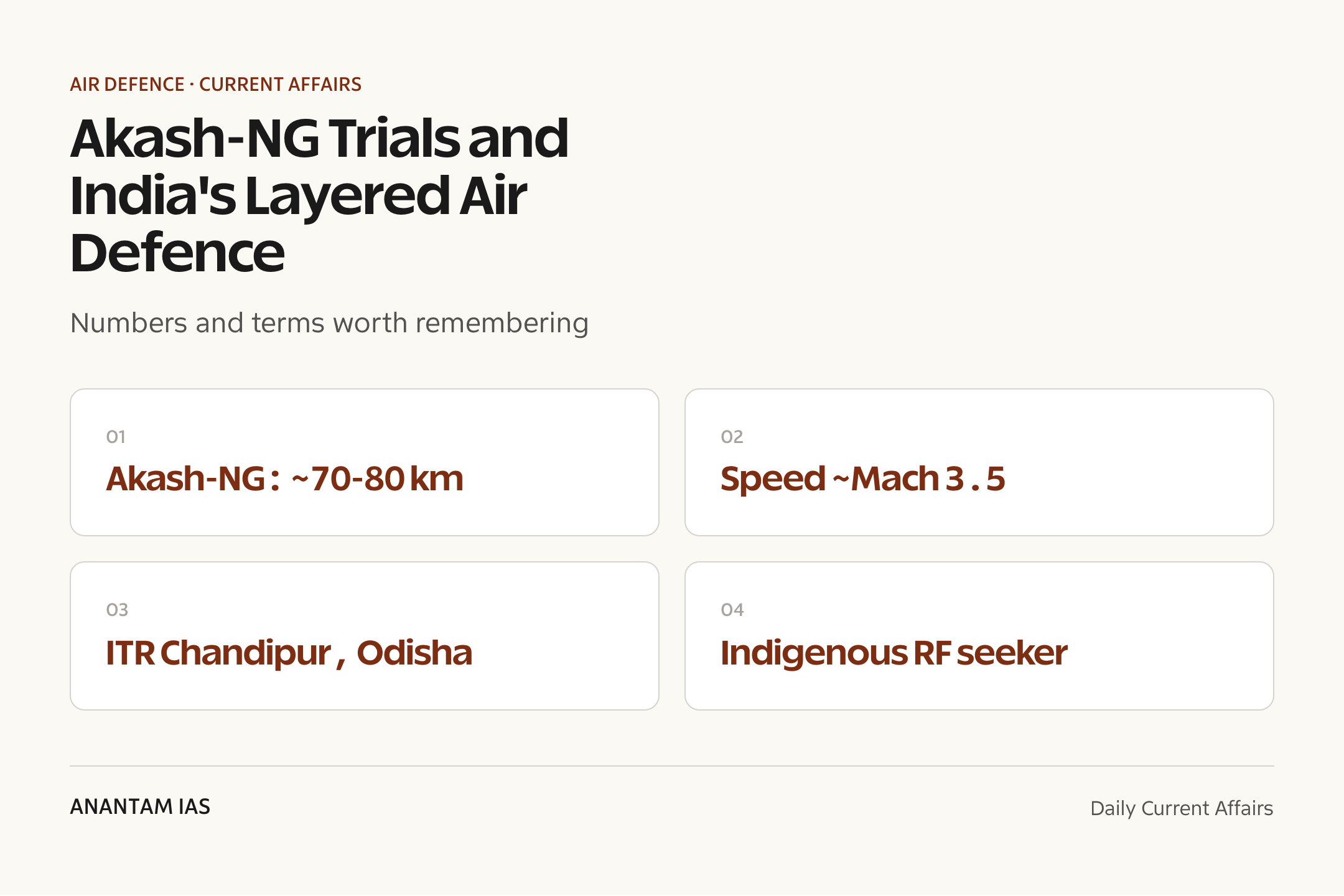
- Range extended to roughly 70–80 km — close to three times that of the original Akash — at speeds up to about Mach 3.5.
- Equipped with an indigenous Radio Frequency (RF) seeker for fire-and-forget homing and powered by a solid rocket motor.
- Defence Minister Rajnath Singh complimented the DRDO, the IAF and industry, saying the system would “further strengthen the air defence capabilities of the IAF”.
- The trial was one of a cluster of late-December tests, alongside the K-4 SLBM, signalling momentum in indigenous missile development.
The development matters in the context of:
- Modern air threats are layered — drones, cruise missiles, aircraft and stand-off munitions — so a credible shield needs interceptors that cover different ranges and altitudes, not a single weapon.
- Akash-NG fills the medium-range tier between short-range point-defence systems and long-range systems, giving India a denser, more indigenous air-defence net.
UPSC Relevance
Prelims Relevance
- Akash-NG: new-generation SAM, range ~70–80 km, speed ~Mach 3.5, indigenous RF seeker, DRDO-developed.
- Akash (base) and Akash Prime: earlier indigenous SAMs in the family, shorter range, with the Prime variant tuned for high-altitude/low-temperature performance.
- Radio Frequency (RF) seeker: terminal active-homing sensor enabling fire-and-forget engagement, reducing reliance on ground guidance.
- Canisterised launcher: sealed launch container that cuts ground-system footprint and improves mobility and readiness.
- DRDO: lead developer; production partners include Bharat Dynamics Limited (BDL) and Bharat Electronics Limited (BEL).
- Integrated Test Range (ITR), Chandipur, Odisha: principal missile-test facility for such trials.
- Radar Cross Section (RCS): a measure of how detectable a target is to radar; low-RCS threats are harder to track and intercept.
- Layered air defence: short-, medium- and long-range interceptors stacked to cover different threats and engagement zones.
- S-400 Triumf: imported long-range air-defence system in Indian service, occupying the outer layer above Akash-NG.
- QRSAM and VSHORADS: other indigenous DRDO air-defence programmes for quick-reaction and very-short-range roles.
Mains Relevance
GS Paper 3
- Significance of a layered, indigenous air-defence architecture for national security against evolving aerial threats.
- Role of DRDO programmes and the Atmanirbhar Bharat push in reducing import dependence in defence.
GS Paper 2
- How indigenous defence capability supports strategic autonomy and shapes India’s posture in its neighbourhood.
Essay
- Self-reliance as security: can a nation be strategically autonomous without an indigenous defence industrial base?
Background and Context
What is layered air defence?
A layered shield stacks several air-defence systems so that threats can be engaged at different ranges and altitudes.
- Outer layer: long-range systems such as the imported S-400 Triumf engage aircraft and missiles hundreds of kilometres out.
- Medium layer: systems like Akash-NG intercept targets in the tens-of-kilometres band, covering the gap below the long-range tier.
- Inner layer: short- and very-short-range systems (point defence) handle drones, low-flying threats and leakers that get through.
- The logic is redundancy — if one layer misses, the next gets a shot, so no single threat axis is left uncovered.
The Akash-NG missile
Akash-NG is a redesigned, more capable successor in India’s home-grown Akash family.
- Range: extended to about 70–80 km, nearly three times the original Akash, at speeds up to roughly Mach 3.5.
- Seeker: an indigenous RF seeker gives terminal active homing and fire-and-forget capability, cutting dependence on continuous ground illumination.
- Propulsion: a solid rocket motor design, lighter and more compact than the ramjet-based earlier Akash.
- Footprint: a canisterised launcher and reduced ground-system count make the battery more mobile and quicker to deploy.
- Target set: optimised for high-manoeuvring, low-RCS threats — the kind of agile, hard-to-track targets modern air war throws up.
From Akash to Akash-NG
The Akash line shows how a single indigenous programme has been iterated over two decades.
- Akash: the baseline medium-range SAM, inducted by the Army and IAF, with a range in the 25–30 km class.
- Akash Prime: an upgraded variant with an indigenous seeker and improved performance in high-altitude, low-temperature conditions.
- Akash-NG: the most advanced variant — longer range, compact solid-motor design, RF seeker and a smaller ground footprint.
- Each generation has raised the indigenous content, building domestic expertise in seekers, propulsion and radars.
Indigenous ecosystem and Atmanirbhar Bharat
Akash-NG is built and produced almost entirely within India’s defence industrial base.
- Developed by the DRDO, with the RF seeker and key subsystems sourced domestically.
- Production partners include Bharat Dynamics Limited (BDL) for the missile and Bharat Electronics Limited (BEL) for radars and electronics.
- Indigenous air-defence systems support Atmanirbhar Bharat and the push to cut imports through measures like the Ministry of Defence’s positive indigenisation lists.
- A home-grown supply chain also eases life-cycle support, upgrades and export potential without import-licence constraints.
Strategic significance
The trials strengthen a capability India has repeatedly needed against drones, missiles and aircraft.
- A denser medium-range layer reduces reliance on a small number of expensive imported long-range systems.
- Mobility and a smaller footprint let batteries reposition quickly to protect different vulnerable areas and points.
- Successful user-evaluation trials are the gateway to induction, after which series production and deployment can scale.
- Coupled with the same-week K-4 SLBM test, the trials signalled a broader stretch of indigenous missile activity in late 2025.
Way Forward
Complete induction and scale production
- Move swiftly from user-evaluation trials to induction and series production with BDL and BEL.
- Build adequate war reserves of missiles so the layer is credible in a sustained, high-intensity engagement.
Integrate the layers
- Network Akash-NG with long-range systems and short-range point defence under a common air-defence command-and-control grid.
- Add counter-drone and counter-cruise-missile capability so the medium layer copes with cheap, swarming threats.
Sustain DRDO research on seekers, propulsion and radars, deepen private-sector participation through indigenisation lists and offsets, and pursue export opportunities so the Akash family earns scale, feedback and revenue while reducing import dependence.
Conclusion
The Akash-NG user-evaluation trials are less about one missile and more about the maturing of an indigenous, layered air-defence architecture. A longer-range, more mobile medium-tier interceptor closes a gap that previously had to be filled with imports.
For an exam, the durable takeaways are the logic of layered air defence, the evolution of the Akash family, and why an indigenous defence industrial base is central to both security and strategic autonomy.
UPSC Practice Questions
Prelims MCQ 1
With reference to the Akash-NG missile system, consider the following statements:
- It is a surface-to-air missile developed indigenously by the DRDO.
- It uses an indigenous Radio Frequency seeker that enables fire-and-forget engagement.
- It is a long-range ballistic missile meant to replace the Agni series.
How many of the above statements are correct?
(a) Only one (b) Only two (c) All three (d) None
Answer: (b) Only two
Explanation:
Statements 1 and 2 are correct. Statement 3 is wrong: Akash-NG is a medium-range surface-to-air (air-defence) missile, not a ballistic missile, and is unrelated to the Agni series.
Prelims MCQ 2
In the context of India’s air defence, the term ‘layered air defence’ best refers to:
(a) Stacking interceptors of short, medium and long range to cover different threats and altitudes (b) Layers of armour plating on a missile launcher (c) Multiple warhead layers inside a single interceptor (d) A three-nation air-defence treaty
Answer: (a) Stacking interceptors of short, medium and long range to cover different threats and altitudes
Explanation:
Layered air defence combines systems across the short-, medium- and long-range tiers so a threat that beats one layer can be engaged by another, providing redundancy.
UPSC Mains Questions
- An indigenous, layered air-defence architecture is now central to India’s security. Examine the role of programmes like Akash-NG in reducing import dependence and covering the medium-range tier. (250 words)
- Self-reliance in defence is as much about industrial capacity as about firepower. Discuss with reference to India’s surface-to-air missile development under Atmanirbhar Bharat. (250 words)
Sources: News On AIR (Prasar Bharati), Ministry of Defence and The Week.
Frequently Asked Questions
What is the Akash-NG missile?
Akash-NG (New Generation) is an indigenous surface-to-air missile developed by the DRDO to intercept high-manoeuvring, low radar-signature aerial threats. It has a range of roughly 70–80 km, reaches about Mach 3.5, uses an indigenous radio-frequency seeker for fire-and-forget homing, and is more compact and mobile than the earlier Akash, primarily for the Indian Air Force.
What happened in the December 2025 trials?
On 23 December 2025 the DRDO completed user-evaluation trials of Akash-NG off the Odisha coast, with launches from the Integrated Test Range at Chandipur. The missiles successfully intercepted targets across near-boundary low-altitude and long-range high-altitude scenarios, clearing the way towards induction into the Indian Air Force.
How is Akash-NG different from the original Akash?
Akash-NG offers a longer range — about 70–80 km against roughly 25–30 km for the base Akash — and higher speed. It swaps the older ramjet design for a compact solid rocket motor, adds an indigenous RF seeker for fire-and-forget engagement, and uses a canisterised launcher with a smaller ground footprint, making batteries more mobile.
What is layered air defence?
Layered air defence stacks several interceptor systems so threats can be engaged at different ranges and altitudes. Long-range systems form the outer layer, medium-range systems like Akash-NG cover the middle band, and short-range systems handle close-in threats such as drones. The layers provide redundancy, so a threat that beats one tier can be tackled by another.
Why does Akash-NG matter for self-reliance?
Akash-NG is designed and largely produced within India, with the DRDO leading development and Bharat Dynamics Limited and Bharat Electronics Limited as production partners. A home-grown medium-range interceptor reduces dependence on imported air-defence systems, supports Atmanirbhar Bharat, eases upgrades and life-cycle support, and opens the door to potential exports.
Where was the Akash-NG tested?
The user-evaluation trials were conducted off the Odisha coast, with launches from the Integrated Test Range at Chandipur, a principal facility for missile testing in India. The trials validated the missile across low-altitude and high-altitude engagement scenarios under realistic conditions.