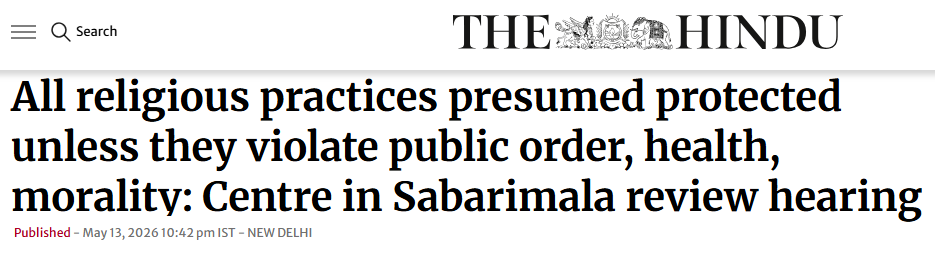
All religious practices presumed protected unless they violate public order, health, morality: Centre in Sabarimala review hearing
Why in News?
During the ongoing Sabarimala review hearing before a nine-judge Constitution Bench of the Supreme Court, the Union government argued that all religious practices are constitutionally protected unless they violate public order, morality or health under Articles 25 and 26 of the Constitution.
The Centre questioned the long-standing “Essential Religious Practices” (ERP) doctrine evolved by the judiciary, arguing that the Constitution itself does not use the phrase “essential religious practices”. The hearing has revived broader constitutional debates concerning:
- Religious freedom
- Judicial review of faith-based practices
- Rights of religious denominations
- Equality and constitutional morality
UPSC Relevance
GS Paper 2
- Fundamental Rights, Judiciary and constitutional interpretation, Secularism in India, Freedom of religion and minority rights
GS Paper 1
- Indian society and religion, Social reform movements, gender justice
Essay
- Constitutional morality versus social morality
- Religion and constitutional governance
- Freedom and reform in a plural society
Background and Context
The Sabarimala issue concerns the entry of women of menstruating age (traditionally between 10 and 50 years) into the Sabarimala temple dedicated to Lord Ayyappa in Kerala.
The restriction was historically justified on the basis that:
- Lord Ayyappa is worshipped as a “Naishtika Brahmachari” (eternal celibate).
- The temple constituted a separate religious denomination with the right to preserve its practices.
In 2018, a five-judge Constitution Bench of the Supreme Court, in the Indian Young Lawyers Association v. State of Kerala case, struck down the exclusionary practice by a 4:1 majority.
The Court held that:
- The practice violated equality and dignity of women.
- Biological characteristics such as menstruation cannot be grounds for exclusion.
- Constitutional morality prevails over discriminatory customs.
Subsequently, review petitions were filed, leading to a larger constitutional reference examining broader questions regarding:
- Scope of religious freedom
- Essential Religious Practices doctrine
- Relationship between Articles 25 and 26
- Judicial role in examining faith-based practices
Constitutional Framework on Religious Freedom
Article 25
Article 25 guarantees:
- Freedom of conscience
- Freedom to profess, practice and propagate religion
However, this right is subject to:
- Public order
- Morality
- Health
- Other Fundamental Rights
The Article protects both:
- Individual religious freedom
- Religious practices
Social Reform Clause
Article 25(2) allows the State to enact laws for:
- Social welfare
- Religious reform
- Opening Hindu religious institutions to all classes and sections
This provision reflects the Constitution’s reformist vision.
Article 26
Article 26 grants religious denominations the right to:
- Establish religious institutions
- Manage religious affairs
- Own and administer property
Again, these rights are subject to:
- Public order
- Morality
- Health
The central constitutional question is whether denominational autonomy can override equality-based claims.
The Essential Religious Practices (ERP) Doctrine
The ERP doctrine was developed judicially to determine which practices deserve constitutional protection under Articles 25 and 26.
Under this doctrine:
- Only practices considered “essential” to a religion receive constitutional protection.
- Non-essential or secular practices can be regulated by the State.
The Court therefore examines:
- Religious texts
- Historical traditions
- Nature of the practice
- Centrality to the religion
This doctrine has become one of the most influential yet controversial aspects of Indian constitutional law.
Origin of the ERP Doctrine
Shirur Mutt Case (1954)
In Commissioner, Hindu Religious Endowments v. Sri Lakshmindra Thirtha Swamiar of Shirur Mutt, the Supreme Court held:
- Essential parts of religion are protected under Article 25.
- Courts can determine what constitutes an essential practice.
This judgment became the foundation of ERP jurisprudence.
Evolution of the Doctrine
Over time, courts used the ERP doctrine in various disputes involving:
- Temple entry
- Animal sacrifice
- Religious processions
- Dress codes
- Women’s entry into religious spaces
However, critics argue that courts increasingly became arbiters of theology rather than constitutional adjudicators.
The Centre’s Argument in the Present Hearing
The Union government argued that:
- The Constitution does not contain the phrase “essential religious practices”.
- Articles 25 and 26 should receive broad interpretation like other Fundamental Rights.
- Religious freedom should be presumed unless the practice violates public order, morality or health.
Key Constitutional Position
According to the Centre:
- The burden should lie on the challenger to prove constitutional violation.
- Courts should not narrowly protect only “essential” practices.
- Denominational and individual rights are interconnected.
The Centre argued that Article 26 is merely the collective manifestation of individual freedom of conscience under Article 25.
This interpretation seeks to reduce judicial scrutiny into theological questions.
Judicial Observations During Hearing
During the hearing, the Bench made broader philosophical observations regarding religion and spirituality.
Chief Justice Surya Kant observed that:
- Temple visits are not the sole expression of religiosity.
- Faith can exist independently of ritualistic practices.
Justice B.V. Nagarathna observed that:
- Hinduism is a way of life.
- Spirituality is not dependent solely on rituals or temple access.
These observations touched upon the distinction between:
- Inner freedom of conscience
- Organised religious practices
Legal scholar Mohan Gopal referred to this as “auto-theism”, emphasising individual spiritual autonomy.
Constitutional Morality versus Religious Autonomy
The Sabarimala issue lies at the intersection of two constitutional values:
Religious Freedom
Supporters of denominational autonomy argue that:
- Religious groups should preserve distinct traditions.
- Courts should avoid interfering in matters of faith.
- Secular courts lack competence in theological interpretation.
Equality and Non-Discrimination
Others argue that:
- Constitutional guarantees of equality override exclusionary customs.
- Gender-based exclusion violates dignity and individual liberty.
- Public religious institutions cannot discriminate.
This tension reflects a deeper constitutional debate:
Can practices rooted in faith survive constitutional scrutiny if they conflict with equality?
Constitutional Morality
The concept of constitutional morality was strongly invoked in the 2018 Sabarimala judgment.
The idea originates from Dr. B.R. Ambedkar, who argued that constitutional governance must be guided by:
- Liberty
- Equality
- Fraternity
- Dignity
rather than social prejudice or majoritarian morality.
The Court used constitutional morality to justify judicial intervention in discriminatory religious practices.
Gender Justice and Religious Reform
The Sabarimala case is also part of a broader trajectory of judicial reform concerning gender and religion.
Triple Talaq Case (2017)
The Supreme Court invalidated instant triple talaq as unconstitutional.
Haji Ali Dargah Case
Restrictions on women’s entry into the inner sanctum were challenged successfully.
Shani Shingnapur Temple Issue
Women’s entry restrictions were opposed using constitutional equality arguments.
These cases reflect growing judicial engagement with gender justice within religious institutions.
Criticisms of the ERP Doctrine
Judicial Overreach into Theology
Critics argue that courts:
- Lack expertise in religious interpretation
- Risk becoming theological authorities
- May selectively interpret traditions
This can undermine secular constitutionalism.
Inconsistency in Application
Different Benches have adopted varying standards for determining:
- What is “essential”
- Which practices deserve protection
This has created doctrinal inconsistency.
Narrowing Religious Freedom
Restricting protection only to “essential” practices may excessively limit religious liberty.
Many practices evolve culturally rather than doctrinally.
Risk of Majoritarian Interpretation
There are concerns that courts may unintentionally privilege dominant interpretations within religions while marginalising minority sects and traditions.
Arguments Supporting Judicial Scrutiny
Supporters of the ERP doctrine argue that:
- Fundamental Rights cannot be defeated by discriminatory customs.
- Constitutional courts must prevent practices violating dignity and equality.
- Social reform is part of the constitutional vision.
Without judicial scrutiny, practices such as:
- Untouchability
- Exclusionary customs
- Gender discrimination
could continue under the guise of religion.
Comparative Perspective
Different democracies adopt different approaches toward religion-state relations.
United States
American courts generally avoid determining theological “essentiality” and focus instead on:
- Sincerity of belief
- State interest tests
France
France follows strict secularism (laïcité), often restricting religious symbolism in public spaces.
India
India adopts:
- Principled distance
- Reform-oriented secularism
- State engagement with religion for social reform
Thus, Indian secularism differs significantly from Western models.
Broader Implications of the Sabarimala Review
The present constitutional reference may shape future judicial approaches toward:
- Temple entry disputes
- Personal laws
- Religious dress codes
- Denominational rights
- State regulation of religion
The outcome could redefine the balance between:
- Religious autonomy
- Equality
- Constitutional morality
- Judicial review
Way Forward
Evolving a Balanced Constitutional Approach
Courts must balance:
- Religious freedom
- Equality rights
- Dignity
- Social reform
without excessively entering theological domains.
A contextual and rights-based approach may be preferable to rigid doctrinal tests.
Clarifying the ERP Doctrine
The Supreme Court may consider:
- Refining the scope of ERP
- Limiting judicial theological inquiry
- Developing clearer constitutional standards
This would improve doctrinal consistency.
Strengthening Constitutional Dialogue
Sensitive religious disputes require:
- Judicial restraint
- Social dialogue
- Institutional sensitivity
Adversarial constitutionalism alone may not resolve deeply embedded social tensions.
Protecting Individual Dignity
Religious freedom should coexist with:
- Gender justice
- Equality
- Human dignity
Constitutional interpretation must ensure that vulnerable groups are not excluded from public religious life solely on discriminatory grounds.
Promoting Reform from Within Communities
Social reform movements emerging internally within religious communities can produce more sustainable and less polarising outcomes.
The Constitution itself encourages reform-oriented engagement with tradition.
Conclusion
The Sabarimala review hearing represents one of the most significant constitutional debates in contemporary India concerning religion, equality and judicial power. At its core lies the challenge of balancing collective religious autonomy with individual constitutional freedoms.
The Centre’s challenge to the Essential Religious Practices doctrine raises important questions regarding the judiciary’s role in interpreting faith and determining constitutional protection for religious practices. At the same time, the constitutional commitment to equality and dignity requires that religious freedom cannot become a shield for exclusion and discrimination.
The final outcome of the case may significantly shape the future of secularism, religious liberty and constitutional morality in India’s democratic framework.
UPSC Practice Questions
Prelims MCQ 1
With reference to the Essential Religious Practices (ERP) doctrine in India, consider the following statements:
- The phrase “essential religious practices” is explicitly mentioned in the Constitution of India.
- The ERP doctrine originated from the Shirur Mutt case.
- Articles 25 and 26 are subject to public order, morality and health.
How many of the above statements are correct?
(a) Only one
(b) Only two
(c) All three
(d) None
Answer: (b) Only two
Explanation:
- Statement 1 is incorrect because the Constitution does not explicitly mention the phrase “essential religious practices”.
- Statement 2 is correct as the doctrine emerged from the Shirur Mutt judgment (1954).
- Statement 3 is correct because Articles 25 and 26 are subject to public order, morality and health.
Prelims MCQ 2
Which of the following cases is most closely associated with the origin of the Essential Religious Practices doctrine?
(a) Kesavananda Bharati case
(b) S.R. Bommai case
(c) Shirur Mutt case
(d) Minerva Mills case
Answer: (c) Shirur Mutt case
Explanation:
The Shirur Mutt case (1954) laid the foundation of the Essential Religious Practices doctrine under Articles 25 and 26.
UPSC Mains Questions
Examine the tension between religious freedom and constitutional morality in the context of the Sabarimala case. How should constitutional courts balance these competing claims?
Discuss the constitutional debate surrounding the Essential Religious Practices doctrine in India. Should courts determine what constitutes an essential religious practice?