Allahabad High Court Quashes NSA Detention
Why in News?
On September 2, 2026, the Allahabad High Court allowed a habeas corpus plea, quashed a law student’s NSA detention and ordered immediate release unless she was required in another case.
- The Hindu reported that the Bench found major inconsistencies in the State’s account of the arrest and detention.
- The court examined the arrest notice and general diary chronology, and asked the State for evidence supporting the alleged incitement.
- According to the report, the State did not submit the claimed video footage before the court.
- The detailed written judgment was awaited, so the confirmed development is the operative quashing and release order, not a complete statement of legal findings.
- Preventive detention restrains a person to avert anticipated harmful conduct; it is not punishment after a criminal conviction.
- Because ordinary trial safeguards operate differently, constitutional and statutory procedures become the principal checks against arbitrary executive detention.
- Quashing a detention order does not by itself terminate every separate criminal case arising from the same events.
UPSC Relevance
Prelims Relevance
- Article 22 contains specific constitutional safeguards and exceptions concerning preventive detention.
- Section 8 of the NSA governs communication of detention grounds and the earliest opportunity to make a representation.
- An Advisory Board reviews whether sufficient cause exists for preventive detention under the statutory process.
- A High Court may issue a writ of habeas corpus under Article 226 to test the legality of custody.
- Preventive detention is distinct from punitive imprisonment following investigation, trial and conviction.
Mains Relevance
GS Paper 2
- Personal liberty, procedural due process and judicial review of executive detention
- Constitutional and statutory safeguards governing preventive detention
GS Paper 3
- Balancing internal-security powers with accountable policing and reliable evidence
Essay
- Liberty is protected not only by declaring rights, but by requiring public power to justify every exceptional restraint.
Background and Context
What Preventive Detention Permits
Preventive detention addresses anticipated conduct, making its legal purpose different from prosecution for a completed offence.
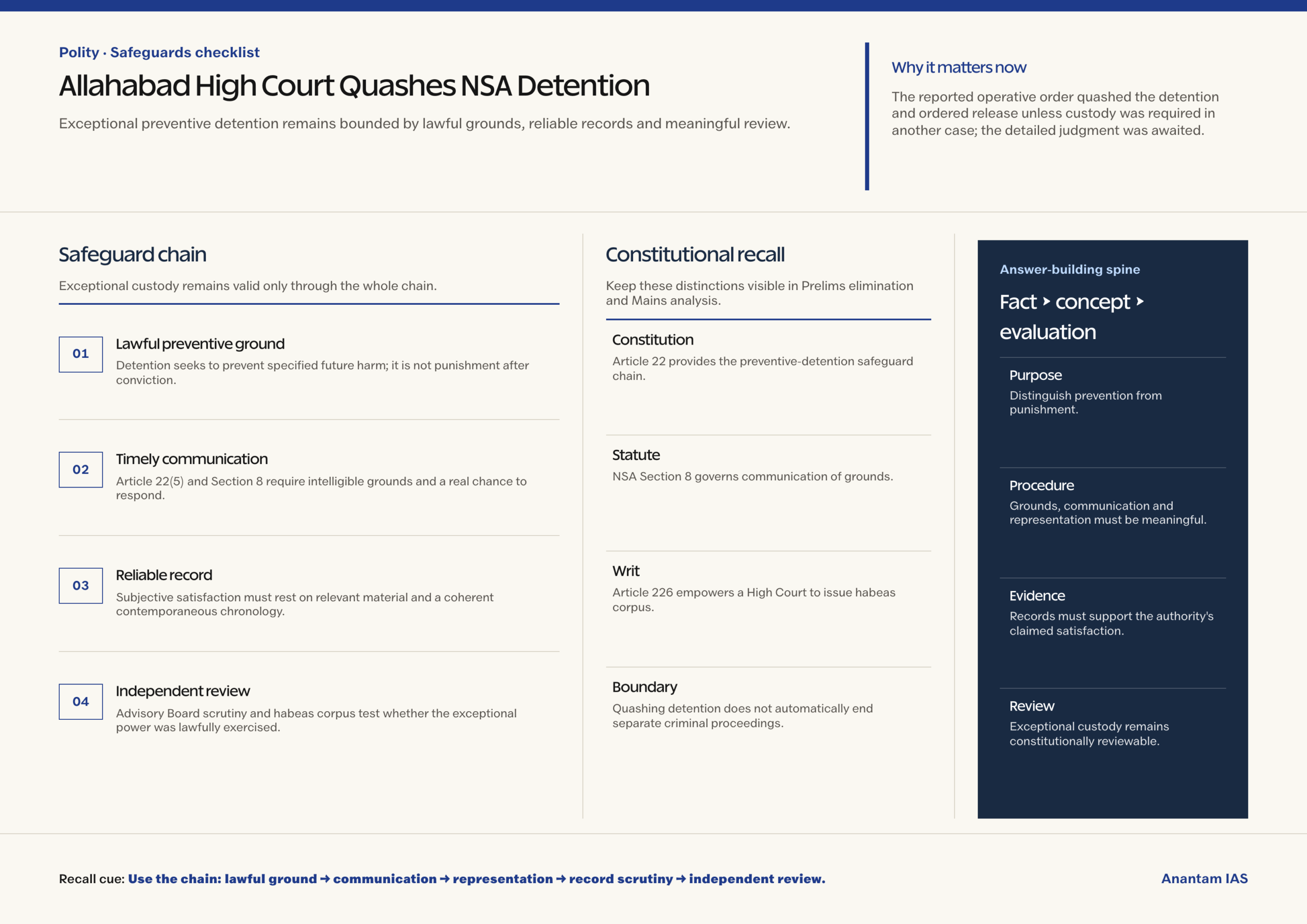
- The National Security Act, 1980 authorises detention to prevent specified acts prejudicial to national security, State security, public order or essential supplies and services.
- The legal basis is prevention, not a judicial finding that the detainee committed the conduct alleged by the executive authority.
- The Central or State Government may make an order on statutory grounds; an empowered District Magistrate or Commissioner of Police may also exercise the power within authorised limits.
- A preventive order and a criminal prosecution can coexist because they serve different purposes and follow different legal tracks.
- For this reason, release from preventive custody does not automatically decide guilt, innocence, bail or continuation in a separate criminal case.
Communication and Representation Safeguards
The detention authority must give the detainee enough timely information to make the constitutional right of representation meaningful.
- Article 22(5) requires communication of the grounds of detention as soon as possible and the earliest opportunity to make a representation against the order.
- Section 8 ordinarily requires communication within five days; exceptional delay may extend to ten days only when reasons are recorded in writing.
- The grounds must be intelligible enough for an effective representation; a bare conclusion or an inaccessible factual basis can defeat the safeguard’s practical purpose.
- The statute permits withholding facts whose disclosure the authority considers contrary to public interest, but that exception cannot erase the basic duty to communicate grounds.
- These duties are not administrative courtesies. They form part of the legal conditions that make exceptional detention power valid.
Habeas Corpus and Evidentiary Scrutiny
Habeas corpus enables a constitutional court to require legal justification for custody and examine whether mandatory safeguards were observed.
- Under Article 226, a High Court can test the legality of detention, including jurisdiction, statutory purpose, procedural compliance and the existence of relevant material.
- Judicial review does not convert the writ court into a criminal trial; its task is to examine whether the detention power was lawfully exercised.
- Contemporaneous records matter because subjective satisfaction must rest on a real evidentiary basis, not a chronology contradicted by the authority’s own documents.
- In the reported case, the court called for the general diary and asked for evidence of incitement, while the claimed footage was not produced before it.
- Because the detailed judgment was awaited, broader propositions about the Bench’s reasoning should not be attributed to this order beyond the reported procedural and evidentiary concerns.
Way Forward
Make Exceptional Power Reviewable
Preventive detention should remain traceable from initial material to communication, representation and independent review.
- Record a coherent timeline and preserve the source material relied upon before issuing the detention order.
- Communicate specific and intelligible grounds promptly so the detainee can exercise the right to representation in substance.
- Place relevant records, representations and government decisions before the Advisory Board and reviewing court without selective omission.
- Keep preventive detention separate from ordinary policing shortcuts; investigate and prosecute alleged offences through the regular criminal process.
Conclusion
- The operative order reinforces a durable principle: exceptional preventive detention powers remain bounded by communicated grounds, reliable records, representation and habeas corpus review.
- In a Mains answer, distinguish prevention from punishment, then organise the safeguards as a chain: lawful grounds, timely communication, effective representation, Advisory Board scrutiny and judicial review.
- Treat the reported quashing narrowly: it ended the challenged NSA detention, subject to custody required in another case, without establishing that every separate proceeding had ended.
UPSC Practice Questions
Prelims MCQ 1
With reference to preventive detention under the National Security Act, 1980, consider the following statements:
- Grounds of detention must ordinarily be communicated within five days.
- The statutory Advisory Board examines whether sufficient cause exists for detention.
- A habeas corpus court is barred from examining compliance with mandatory detention procedure.
How many of the above statements are correct?
(a) Only one (b) Only two (c) All three (d) None
Answer: (b) Only two
Explanation:
Statements 1 and 2 are correct. Constitutional courts may examine the legality of custody and compliance with mandatory safeguards through habeas corpus jurisdiction.
Prelims MCQ 2
Which one of the following best describes the constitutional purpose of communicating preventive-detention grounds to the detainee?
(a) To substitute an executive order for a criminal conviction (b) To enable the earliest effective representation against detention (c) To prevent the Advisory Board from examining the detention (d) To terminate every criminal case concerning the same events
Answer: (b) To enable the earliest effective representation against detention
Explanation:
Article 22(5) connects communication of grounds with the detainee’s earliest opportunity to make a representation against the detention order.
UPSC Mains Questions
- Preventive detention is constitutionally exceptional because it restrains liberty without a criminal conviction. Explain the safeguards that make this power reviewable and accountable.
- How does habeas corpus review test the legality of preventive detention without turning the writ court into a criminal trial? Discuss with reference to evidentiary basis and procedural compliance.
Sources: The Hindu and Legislative Department, Constitution of India.
Frequently Asked Questions
What did the Allahabad High Court reportedly order?
It allowed the habeas corpus plea, quashed the challenged NSA detention and ordered immediate release unless the detainee was required in another case.
What is the difference between preventive and punitive detention?
Preventive detention seeks to avert anticipated conduct. Punitive imprisonment follows adjudication of an offence through the ordinary criminal process.
Why must detention grounds be communicated?
Communication enables the detainee to understand the basis of custody and make an effective representation, as required by Article 22(5) and Section 8 of the NSA.
Does quashing an NSA order end related criminal cases?
Not automatically. Preventive detention and criminal prosecution are separate legal tracks; each criminal case must proceed or end under its own orders and procedure.
Why is the detailed judgment important?
It supplies the court’s authoritative reasoning, findings and legal basis. Until available, reports of the operative order should not be expanded into unconfirmed holdings.