Green Ammonia at Kakinada: India’s Bet on Clean Fuel Exports
Why in News?
Andhra Pradesh is moving to anchor one of India’s largest green-ammonia and green-hydrogen production complexes on its Kakinada coast in the East Godavari region, positioning the state as a hub for clean-fuel manufacturing and exports under the National Green Hydrogen Mission.
The plan stitches together gigawatt-scale renewable power, large electrolyser capacity and a deep-water port so that green ammonia made from green hydrogen can be shipped to fertiliser plants and to buyers in Europe, Japan and South Korea.
- Project sited at Kakinada, Andhra Pradesh, leveraging an existing deep-water port and SEZ for direct export.
- Built around renewable-powered electrolysis — solar and wind feeding electrolysers that split water into hydrogen.
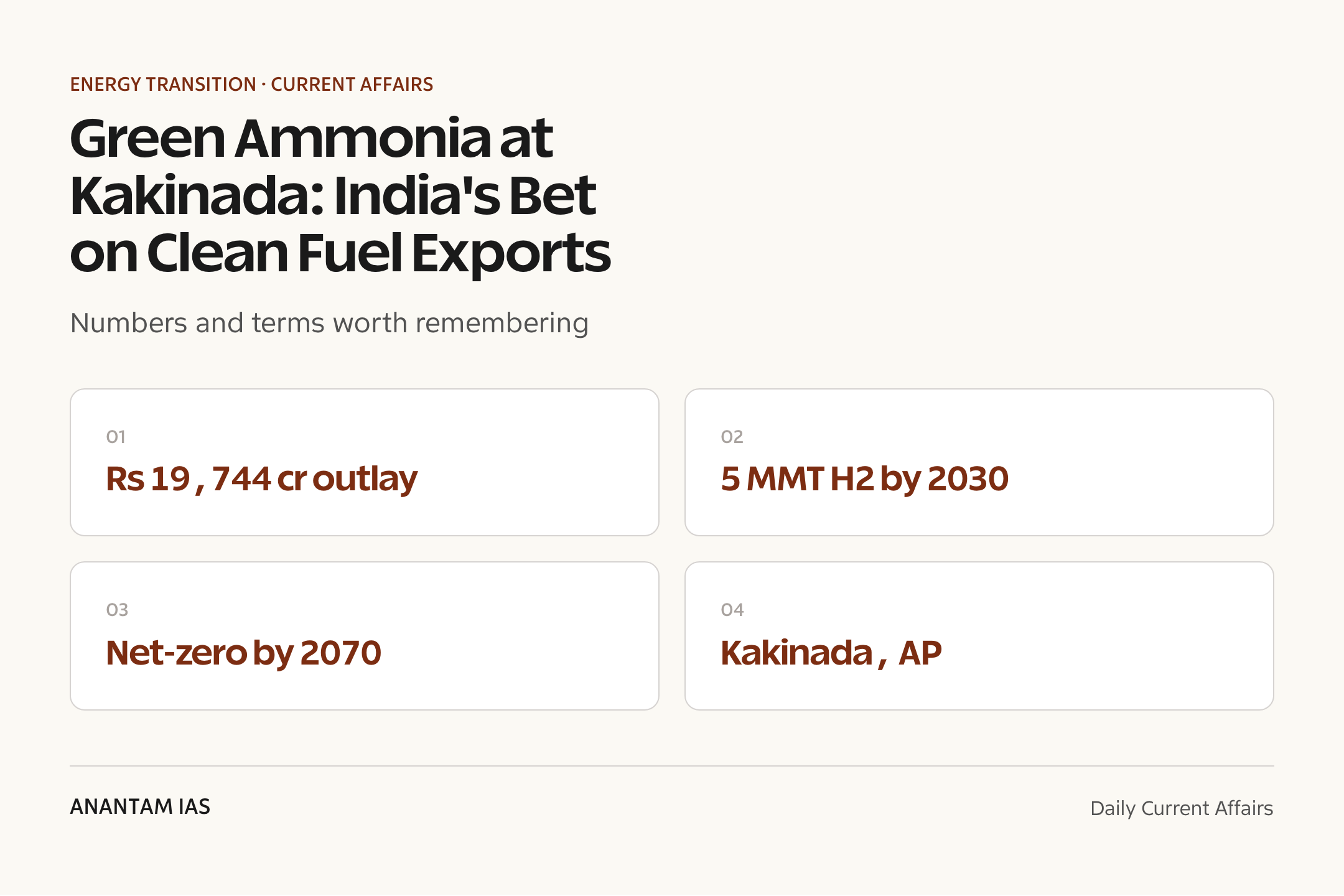
- Falls under the National Green Hydrogen Mission (launched 2023), with a Mission outlay of about Rs 19,744 crore.
- Targets green ammonia (NH3) as the marketable output — a fertiliser feedstock, a shipping fuel and a hydrogen carrier.
- Aligns with India’s net-zero by 2070 commitment and its target of 5 MMT green-hydrogen output by 2030.
The development matters in the context of:
- Hard-to-abate sectors — fertilisers, refining, steel and shipping — need a non-fossil molecule, not just clean electricity.
- Coastal complexes like Kakinada link domestic decarbonisation with an export revenue stream in green fuels.
- Sits at the intersection of energy security, the trade balance and climate diplomacy.
UPSC Relevance
Prelims Relevance
- National Green Hydrogen Mission — launched 2023, nodal ministry MNRE, outlay about Rs 19,744 crore.
- SIGHT — Strategic Interventions for Green Hydrogen Transition, the Mission’s incentive scheme.
- Green hydrogen — made by electrolysis of water using renewable electricity (zero carbon).
- Grey hydrogen — from natural gas / coal with no carbon capture; blue hydrogen — fossil-based with carbon capture.
- Green ammonia — NH3 synthesised from green hydrogen plus nitrogen via the Haber-Bosch process.
- Ammonia is a hydrogen carrier — liquefies at about -33 degrees C, far easier to ship than pure hydrogen.
- India’s targets — 5 MMT green hydrogen by 2030; net-zero by 2070.
- Kakinada is in East Godavari district, Andhra Pradesh, on the Bay of Bengal.
Mains Relevance
GS Paper 3
- Role of green hydrogen and green ammonia in decarbonising hard-to-abate sectors and securing energy.
- Renewable energy infrastructure, electrolyser manufacturing and the economics of clean-fuel exports.
GS Paper 2
- Centre-state coordination and federal incentives in delivering a flagship energy mission.
GS Paper 1
- Industrial location: why coastal Andhra Pradesh suits an export-oriented green-fuel complex.
Essay
- Can a developing economy lead the clean-energy transition while still meeting its development needs?
- Energy independence is the new measure of national strength.
Background and Context
What is green ammonia and why it matters
Green ammonia is the bridge molecule that turns clean electrons into a tradeable, storable clean fuel.
- Green hydrogen is produced by passing renewable electricity through water in an electrolyser, splitting it into hydrogen and oxygen with no carbon emissions.
- Green ammonia (NH3) combines that green hydrogen with nitrogen drawn from the air through the Haber-Bosch process.
- Three uses in one molecule — a fertiliser feedstock (urea, ammonium-based nutrients), a low-carbon marine fuel, and a hydrogen carrier for export.
- Ammonia liquefies at about -33 degrees C, so it ships in conventional tankers far more easily than pure hydrogen, which needs cryogenic -253 degrees C handling.
- It lets countries with abundant renewables ‘export sunshine and wind’ as a dense chemical fuel.
Green vs grey vs blue hydrogen
The colour code is really a carbon-intensity code; only green hydrogen carries no fossil baggage.
- Grey hydrogen — made from natural gas (steam methane reforming) or coal gasification; emits large volumes of CO2 and dominates today’s output.
- Blue hydrogen — the same fossil route but paired with carbon capture and storage, so emissions are partly trapped.
- Green hydrogen — electrolysis powered by solar, wind or hydro; near-zero carbon, the goal of India’s mission.
- India’s edge is cheap, plentiful renewable power, which can drive electrolysis costs down over the decade.
- Cost parity with grey hydrogen — closing the gap is the single biggest hurdle to scale.
National Green Hydrogen Mission and SIGHT
The Kakinada complex would draw on the policy and money put in place by the national mission.
- The National Green Hydrogen Mission was approved in 2023 with an outlay of about Rs 19,744 crore, steered by the Ministry of New and Renewable Energy.
- Headline targets — about 5 million tonnes of annual green-hydrogen production by 2030, with associated renewable and electrolyser build-out.
- SIGHT (Strategic Interventions for Green Hydrogen Transition) offers incentives for both electrolyser manufacturing and green-hydrogen production.
- Aims to cut fossil-fuel imports, build a domestic clean-tech industry and create skilled green jobs.
- Read more on India’s clean-energy push in our explainer on the National Green Hydrogen Mission.
Why Kakinada and Andhra Pradesh
Location is the whole bet — coastal Andhra Pradesh ties renewables to a port and to demand.
- Kakinada offers a deep-water port and an SEZ, so finished green ammonia can be loaded directly for export.
- Andhra Pradesh has strong solar and wind potential, supplying the renewable electricity electrolysers need.
- Proximity to fertiliser and refining demand gives an anchor domestic off-take market.
- State industrial policy and land are being aligned to attract developers and electrolyser supply chains.
- Coastal siting also eases imports of equipment and exports to Europe, Japan and South Korea.
Decarbonising hard-to-abate sectors
Some sectors cannot simply switch to electricity — they need a clean molecule, and that is the strategic prize.
- Fertilisers — green ammonia can replace fossil-based ammonia, cutting both emissions and the import bill.
- Shipping — ammonia is a leading candidate fuel for cutting maritime carbon under tightening global rules.
- Refining and steel — green hydrogen can displace grey hydrogen and coke in industrial processes.
- These sectors are ‘hard to abate’ because heat, chemistry or weight make direct electrification impractical.
- Compare the wider transition story in our note on India’s energy transition.
Hurdles and risks
The promise is large but the path is capital-heavy and technically demanding.
- High cost — green hydrogen still costs more than grey; viability hinges on falling renewable and electrolyser prices.
- Water and energy intensity — electrolysis needs large volumes of clean water and firm renewable supply.
- Safety — ammonia is toxic and corrosive, demanding strict handling, storage and transport norms.
- Demand certainty — bankable long-term export and domestic off-take contracts are essential.
- Infrastructure — pipelines, storage, port handling and a skilled workforce must scale together.
Way Forward
Drive down cost
- Scale electrolyser manufacturing under SIGHT and cut renewable tariffs to reach grey-hydrogen parity.
- Use viability-gap and demand-aggregation tools to de-risk first-mover projects.
Secure demand
- Set blending or purchase obligations for green ammonia in fertilisers and refining.
- Negotiate long-term export off-take with Japan, South Korea and the EU.
Build the ecosystem
- Develop port handling, storage and safety codes for ammonia at Kakinada.
- Invest in skilling, R&D and certification of green origin for credibility abroad.
Conclusion
The Kakinada green-ammonia complex captures a larger Indian wager — that the country can turn its renewable abundance into a clean-fuel industry that decarbonises at home and earns abroad.
Whether the bet pays off depends on driving down cost, locking in demand and building safe infrastructure. If it works, green ammonia could become to the energy transition what software once was to India’s services economy: a globally traded export born of a domestic strength.
UPSC Practice Questions
Prelims MCQ 1
With reference to green hydrogen and green ammonia, consider the following statements:
- Green hydrogen is produced by the electrolysis of water using renewable electricity.
- Green ammonia is synthesised by combining green hydrogen with nitrogen.
- Ammonia can serve as a carrier for transporting hydrogen over long distances.
How many of the above statements are correct?
(a) Only one (b) Only two (c) All three (d) None
Answer: (c) All three
Explanation:
Green hydrogen comes from renewable-powered electrolysis; green ammonia is green hydrogen plus nitrogen via Haber-Bosch; ammonia liquefies easily and is widely seen as a practical hydrogen carrier. All three are correct.
Prelims MCQ 2
The National Green Hydrogen Mission is administered by which Union ministry?
(a) Ministry of Power (b) Ministry of New and Renewable Energy (c) Ministry of Petroleum and Natural Gas (d) Ministry of Heavy Industries
Answer: (b) Ministry of New and Renewable Energy
Explanation:
The Mission, approved in 2023 with an outlay of about Rs 19,744 crore, is steered by the Ministry of New and Renewable Energy (MNRE), with SIGHT as its incentive scheme.
UPSC Mains Questions
- Green hydrogen and green ammonia are central to decarbonising India’s hard-to-abate sectors. Discuss their role in India’s energy transition and examine the challenges in scaling up domestic production. (250 words)
- Coastal complexes such as Kakinada aim to make India an exporter of clean fuels. Critically analyse the economic and strategic case for green-ammonia export hubs. (250 words)
- Examine how the National Green Hydrogen Mission seeks to balance India’s net-zero commitment with its energy-security and industrial-growth objectives. (150 words)
Sources: Ministry of New and Renewable Energy (MNRE) and Press Information Bureau (PIB).
Frequently Asked Questions
What is green ammonia?
Green ammonia is ammonia (NH3) made by combining green hydrogen with nitrogen from the air. Because the hydrogen comes from electrolysis powered by renewable energy, the whole process emits little or no carbon. It is used as a fertiliser feedstock, a low-carbon shipping fuel and a carrier for transporting hydrogen.
How is green hydrogen different from grey and blue hydrogen?
Grey hydrogen is made from natural gas or coal and emits a lot of carbon. Blue hydrogen uses the same fossil route but captures part of the emissions. Green hydrogen is produced by splitting water through electrolysis using renewable electricity, so it carries near-zero carbon emissions.
Why is Kakinada chosen for the project?
Kakinada in coastal Andhra Pradesh has a deep-water port and an SEZ, allowing green ammonia to be exported directly. The state also has strong solar and wind potential to power electrolysers, and lies close to fertiliser and refining demand, making it well suited for an export-oriented clean-fuel complex.
What is the National Green Hydrogen Mission?
Launched in 2023 with an outlay of about Rs 19,744 crore, the Mission is run by the Ministry of New and Renewable Energy. It aims for roughly five million tonnes of green hydrogen a year by 2030 and uses the SIGHT scheme to incentivise electrolyser manufacturing and green-hydrogen production.
Why is ammonia useful for transporting hydrogen?
Pure hydrogen is very light and must be cooled to around -253 degrees C to liquefy, making it costly to ship. Ammonia liquefies at about -33 degrees C and moves in conventional tankers. So hydrogen can be converted to ammonia, shipped, and then either used directly or converted back, making long-distance export practical.
What are the main challenges for green ammonia in India?
The biggest challenge is cost, as green hydrogen is still pricier than grey. Other hurdles include the large water and renewable-energy needs of electrolysis, the safe handling of toxic ammonia, securing long-term demand and export contracts, and building ports, storage, pipelines and a skilled workforce together at scale.