Angikaar 2025: Social Mobilisation Drive Under PMAY-U 2.0
Introduction
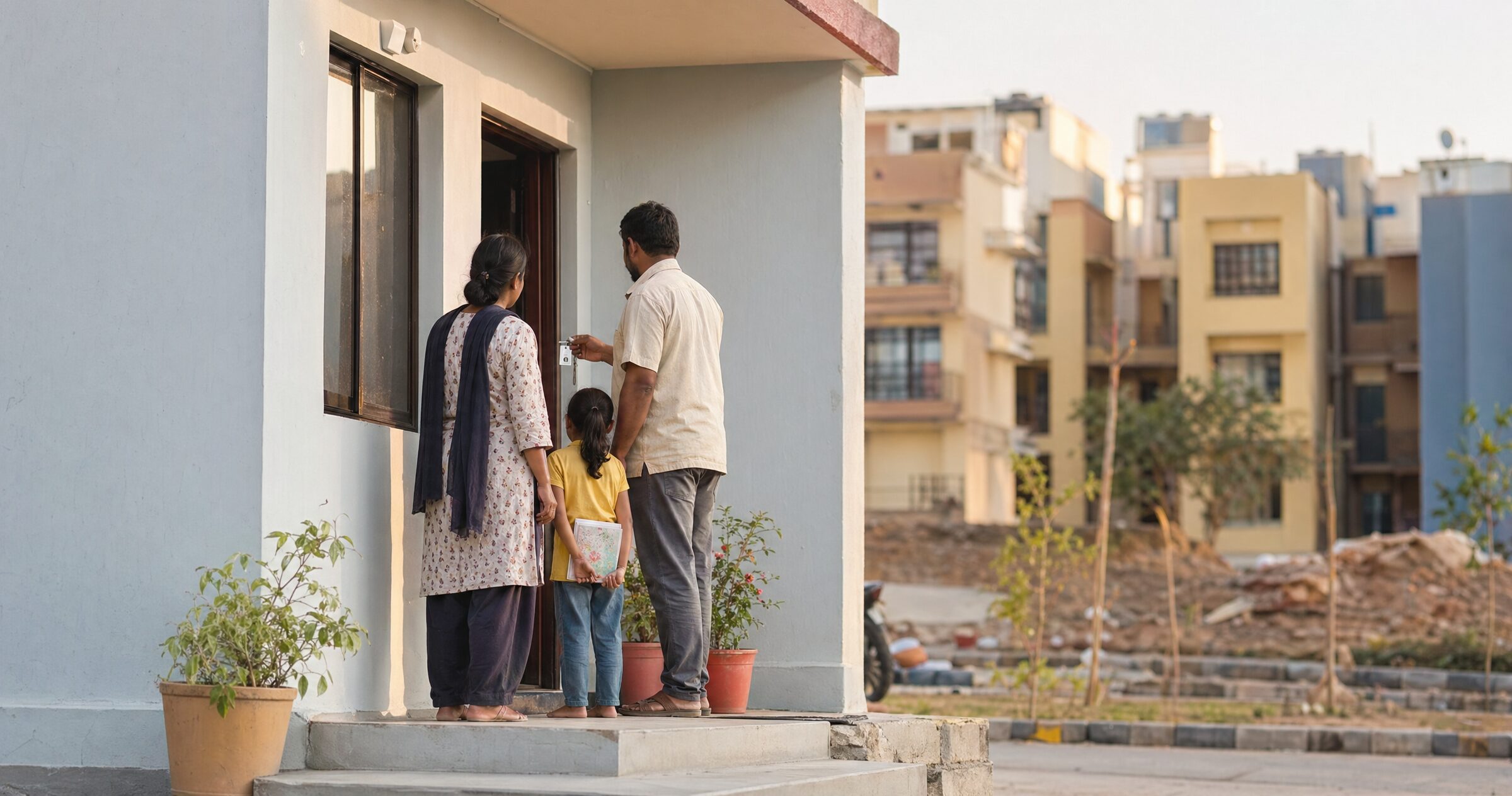
The Ministry of Housing and Urban Affairs (MoHUA) on 7 September 2025 launched Angikaar 2025, a nationwide social-mobilisation drive embedded inside the second iteration of the country’s flagship affordable-housing mission, Pradhan Mantri Awas Yojana – Urban (PMAY-U) 2.0. The campaign is the spiritual successor to the original Angikaar effort run between 2019 and 2020, which had reached over 88 lakh households across 1,743 cities. The 2025 edition is far more ambitious in scope: it ties behaviour-change communication to the doorstep delivery of urban welfare across water conservation, sanitation, energy efficiency, solid-waste management and digital literacy. The launch was anchored at mohua.gov.in with parallel state coordination through Urban Local Bodies (ULBs).
For UPSC aspirants, Angikaar 2025 is a compact case study in the modern Indian state’s preferred tool for last-mile welfare: convergence. Rather than treating housing, sanitation and energy as siloed mandates, the campaign uses the PMAY beneficiary as a single point of contact for multiple ministries. The peg matters for GS-II governance and urban development questions, and for the increasingly common Mains theme of behaviour change as a policy instrument. This article unpacks the design, the antecedents, the data, and the criticisms in the form most useful for the Civil Services examination.
Quick Facts at a Glance
| Indicator | Value | Source |
|---|---|---|
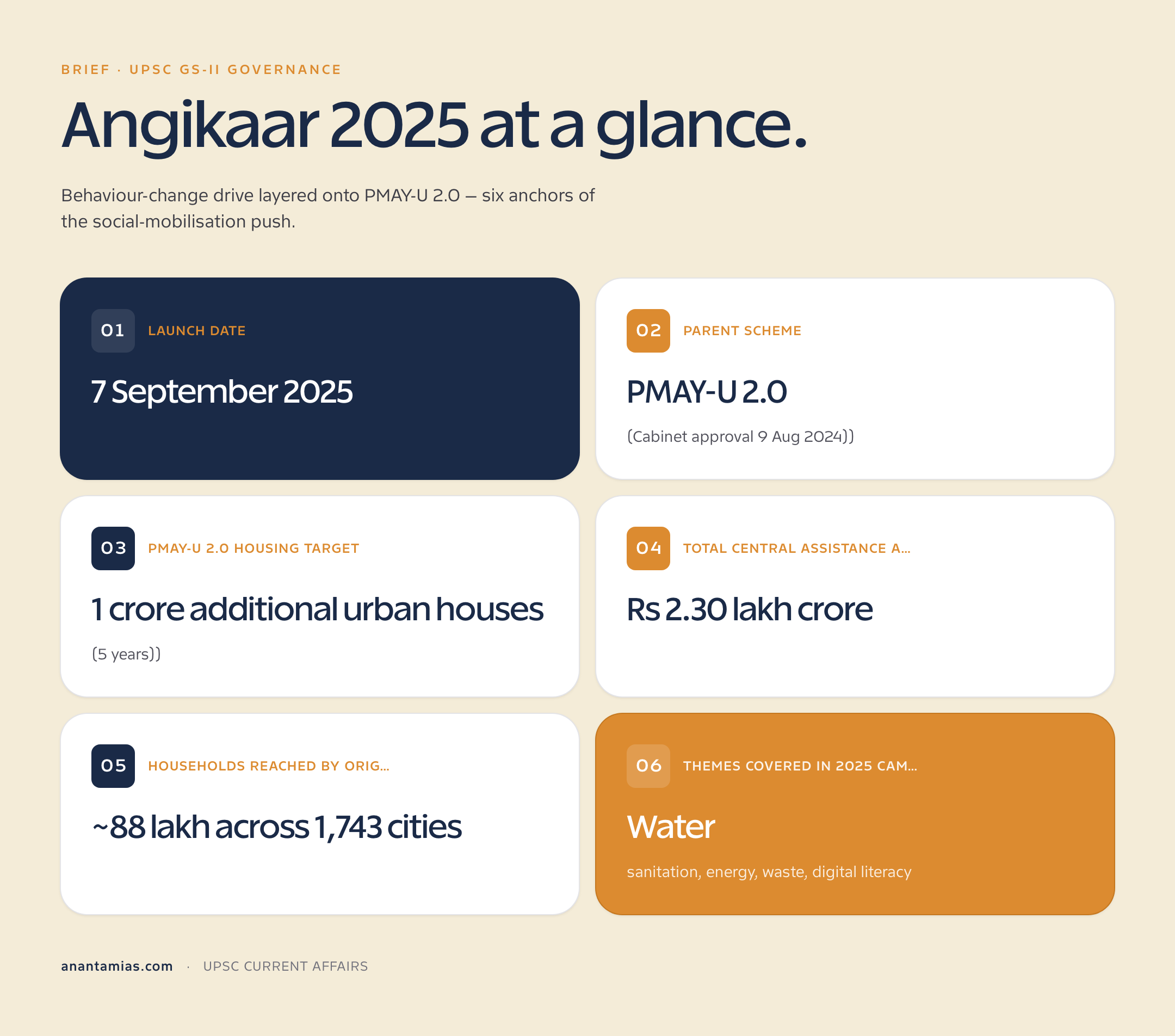
| Launch date | 7 September 2025 | MoHUA press release |
| Parent scheme | PMAY-U 2.0 (Cabinet approval 9 Aug 2024) | pib.gov.in |
| PMAY-U 2.0 housing target | 1 crore additional urban houses (5 years) | MoHUA |
| Total Central assistance approved | Rs 2.30 lakh crore | Cabinet briefing, Aug 2024 |
| Households reached by original Angikaar (2019) | ~88 lakh across 1,743 cities | MoHUA archives |
| Themes covered in 2025 campaign | Water, sanitation, energy, waste, digital literacy | MoHUA |
| Key convergence partners | SBM-U 2.0, BEE, MoP, Jal Shakti, MoSDE | Campaign brief |
| Coverage horizon | All ULBs implementing PMAY-U 2.0 | MoHUA |
Background and Historical Context
India’s urban housing policy has travelled a long arc since Independence, from the Subsidised Industrial Housing Scheme (1952) through the Jawaharlal Nehru National Urban Renewal Mission (JNNURM, 2005) and into the PMAY-U era. PMAY-U was launched on 25 June 2015 with the slogan Housing for All by 2022. Through four verticals – In-Situ Slum Redevelopment, Credit-Linked Subsidy Scheme, Affordable Housing in Partnership and Beneficiary-Led Construction – the mission sanctioned 118.64 lakh houses, of which roughly 89 lakh have been completed and delivered, according to MoHUA’s dashboard. The completion of physical housing, however, exposed a different problem: keeping homes liveable, paying utility bills, segregating waste and using energy-efficient appliances were behaviours not automatic to first-generation urban homeowners.
That gap was the genesis of the original Angikaar campaign in 2019, conceptualised as a 100-day social-mobilisation drive culminating in griha pravesh ceremonies. It piloted door-to-door behaviour-change modules and won internal recognition for surfacing community resource persons inside slums. After PMAY-U’s first phase wound down, the framework went dormant. PMAY-U 2.0, approved by the Union Cabinet on 9 August 2024 and made operational from 1 September 2024, restored the policy and expanded the canvas: an additional one crore houses over five years, with a refreshed Affordable Rental Housing component and an Interest Subsidy Scheme. The MoHUA leadership decided that behaviour-change should not be an after-thought this time; Angikaar 2025 was therefore designed concurrently with PMAY-U 2.0 rather than as a post-construction add-on. It also draws lessons from other welfare schemes where mobilisation deficits hurt outcomes.
Key Features and Highlights
Five Behaviour-Change Pillars
The campaign is organised around five thematic pillars chosen for measurable impact at the household scale: water conservation (rainwater harvesting, leakage reduction, dual-flush adoption), solid-waste segregation at source aligned with Swachh Bharat Mission – Urban (SBM-U) 2.0, energy efficiency through five-star BEE-rated appliances and LED retrofits, sanitation hygiene including handwashing protocols, and digital and financial literacy for using DBT, UPI and grievance portals. Each pillar carries its own training module, IEC collateral and a measurable indicator that ULBs upload to a national dashboard. The pillars are not aspirational alone — they map directly to budget lines under partner ministries.
Cluster Approach and Community Resource Persons
Angikaar 2025 retains the original campaign’s most successful innovation: Community Resource Persons (CRPs) drawn from PMAY beneficiary households themselves, especially women under Deendayal Antyodaya Yojana – National Urban Livelihoods Mission (DAY-NULM) Self-Help Groups. CRPs are trained by ULB officials and conduct fortnightly mohalla meetings, door-to-door visits and grievance documentation. The cluster approach groups every 200–300 housing units under one CRP, ensuring depth over breadth. This makes mobilisation a job-creation instrument as well, because CRPs receive honoraria from converged scheme funds. The model is deliberately bottom-up to avoid the contractor-driven IEC failures of past missions.
Convergence Architecture and Digital Backbone
Convergence is not rhetorical. The campaign formally yokes nine schemes — Jal Jeevan Mission (Urban), SBM-U 2.0, AMRUT 2.0, Ujjwala 2.0, Saubhagya, PM Surya Ghar, Ayushman Bharat, DAY-NULM and the Skill India Mission — to a single household identifier built around the PMAY-U sanctioned-house code. A unified mobile dashboard collects behaviour-indicator data from CRPs in near real time, allowing the central monitoring unit to track adoption rates of, for example, segregation bins or solar rooftops by ward. The digital backbone is engineered for interoperability with the Energy Conservation Building Code (ECBC) Residential, allowing energy-audit nudges to be pushed back to households.
Significance for UPSC
- GS-II Governance: shows convergence as a governance instrument, not just a coordination buzzword, with a single-window beneficiary identifier across nine schemes.
- GS-II Welfare Schemes: connects PMAY-U 2.0, SBM-U 2.0 and DAY-NULM in one analytical frame — useful for any housing or sanitation question.
- GS-II Vulnerable Sections: the campaign’s CRP architecture relies on women-led SHGs, linking gender mainstreaming with urban welfare delivery.
- GS-III Energy & Environment: the energy-efficiency pillar opens a clean line to the Energy Conservation Building Code and India’s NDC commitments.
- GS-IV Ethics: behaviour-change communication as a soft policy tool raises ethical questions about state-induced lifestyle change versus citizen autonomy.
- Essay paper: provides concrete material for prompts on urbanisation, housing-as-right, and the social compact in welfare delivery.
Detailed Analysis: State-Level Targets and Convergence Mapping
The substantive question for examiners is how Angikaar 2025 performs against the heterogeneity of Indian urbanisation. PMAY-U 2.0 sanctions are not evenly distributed. Five states — Uttar Pradesh, Andhra Pradesh, Madhya Pradesh, Gujarat and Tamil Nadu — collectively account for over 60 per cent of cumulative PMAY-U sanctions to date, and they will dominate Angikaar’s caseload through 2030. The challenge is that behaviour-change interventions need vernacular IEC, locally trusted CRPs and a functional ULB — conditions met unevenly across these states. Andhra Pradesh and Tamil Nadu have mature ULB cadres; Uttar Pradesh and Madhya Pradesh have many ULBs that lack engineering staff, let alone communication officers.
The campaign therefore borrows two ideas from international development practice. The first is tournament-style ULB ranking, where wards are scored monthly on indicator adoption and published on a public leaderboard, exploiting status incentives and creating reputational stakes for elected mayors. The second is the nudge-unit approach pioneered by Behavioural Insights Team and adapted by NITI Aayog, embedding default options — for instance, two-bin segregation kits supplied at house-handover — rather than relying on persuasion alone. MoHUA has internally cited these design choices as deliberately drawn from the failure analysis of SBM-U 1.0, where toilet construction outpaced usage behaviour by years.
A second line of analysis concerns convergence costs. Each of the nine partner schemes has its own monitoring system, MIS and audit chain. Stitching them together with one beneficiary code requires either a master data exchange or a heavy reconciliation overhead. MoHUA has chosen the former, building on the existing India Urban Data Exchange (IUDX) protocols and the National Urban Innovation Stack. The risk is data quality: if PMAY-U sanctioned-house codes are incorrectly mapped to electricity connections or LPG IDs, the dashboard will report progress that has not happened. Audit capacity at the central level is the binding constraint. For aspirants, this is a lovely entry to discussions of e-governance and digital public infrastructure.
Finally, the financial architecture deserves scrutiny. Behaviour-change communication is funded from a 2 per cent administrative-and-other-expenses (A&OE) carve-out within PMAY-U 2.0’s central assistance, rather than a dedicated line item. This creates a structural temptation for states to under-spend on mobilisation when construction targets fall short of timelines. The Comptroller & Auditor General’s 2022 performance audit of PMAY-U 1.0 had flagged precisely this pattern. The 2.0 design has not fully insulated against it.
| State | PMAY-U 2.0 indicative target (lakh houses) | Lead convergence focus |
|---|---|---|
| Uttar Pradesh | 17.5 | Sanitation, water |
| Andhra Pradesh | 15.2 | Energy, digital literacy |
| Madhya Pradesh | 12.8 | Sanitation, waste |
| Gujarat | 9.4 | Energy efficiency, solar |
| Tamil Nadu | 8.7 | Water, waste |
| Maharashtra | 7.9 | Affordable rental, energy |
| Karnataka | 5.6 | Digital literacy, water |
| West Bengal | 5.1 | Sanitation, livelihoods |
| Rajasthan | 4.8 | Solar, water harvesting |
| Others | 12.9 | Mixed |
Challenges and Criticisms
The first criticism is structural: behaviour-change campaigns in India have a poor track record of independent evaluation. Angikaar 2019 was never subjected to a randomised control trial or a quasi-experimental impact study; its outputs (households reached) were measured but not its outcomes (sustained behaviour change). The 2025 design has not yet committed to a third-party evaluation framework, despite NITI Aayog recommending one in its 2023 review of urban missions. Without rigorous evaluation, ascription of outcomes to the campaign — rather than to broader urbanisation or to other schemes — remains weak.
The second concern is capacity asymmetry. Tier-2 and tier-3 cities, which house the bulk of PMAY-U beneficiaries, often lack ULB staff trained in social mobilisation, IEC design or data analytics. NGOs and CSR partners are unevenly available outside metros. Civil-society critics have flagged that the CRP honorarium structure, while progressive, is too low to attract sustained engagement in expensive cities like Mumbai or Bengaluru. There are also early concerns about data-protection compliance — the unified beneficiary code links Aadhaar, household consumption and welfare-receipt data without an explicit Digital Personal Data Protection Act consent flow visible at the household level. MoHUA has indicated guidelines are forthcoming, but the campaign has launched without them.
Prelims Pointers
- Angikaar 2025 was launched on 7 September 2025 by MoHUA under PMAY-U 2.0.
- The original Angikaar campaign ran in 2019 and reached ~88 lakh households across 1,743 cities.
- PMAY-U 2.0 was approved by the Union Cabinet on 9 August 2024 and operational from 1 September 2024.
- PMAY-U 2.0 targets 1 crore additional urban houses over five years with Rs 2.30 lakh crore central assistance.
- The five behaviour-change pillars are: water, sanitation, energy, waste segregation and digital literacy.
- Community Resource Persons are largely drawn from DAY-NULM Self-Help Groups.
- The campaign converges nine schemes including SBM-U 2.0, AMRUT 2.0, Jal Jeevan Mission (Urban), Ujjwala 2.0 and PM Surya Ghar.
- The Energy Conservation Building Code (ECBC) was first notified in 2007 and updated in 2017; a residential version is referenced.
- The unified household identifier is anchored on the PMAY-U sanctioned-house code.
- BEE, under the Ministry of Power, runs the star-rating programme for appliances.
- PMAY-U has four verticals: ISSR, CLSS (closed for new sanctions in 2022), AHP and BLC.
- India Urban Data Exchange (IUDX) provides the data-sharing protocol used by the campaign dashboard.
Mains Practice Questions
- “Behaviour change is the missing fifth pillar of India’s urban welfare architecture.” Critically examine in the context of Angikaar 2025 and PMAY-U 2.0. (15 marks, 250 words)
- Discuss the role of convergence as a governance tool in delivering urban welfare. Use Angikaar 2025 to illustrate both its potential and its limitations. (15 marks, 250 words)
- “Affordable housing without behavioural support is incomplete delivery.” Examine in the light of PMAY-U 2.0. (10 marks, 150 words)
- Evaluate the role of Community Resource Persons in last-mile welfare delivery, with reference to the DAY-NULM and Angikaar models. (10 marks, 150 words)
- Examine the data-protection and federalism concerns arising from unified beneficiary identifiers in centrally sponsored urban schemes. (15 marks, 250 words)
Conclusion
Angikaar 2025 marks an evolution in how India thinks about urban welfare delivery. Rather than treating the keys-handover as the terminal moment of state engagement, the campaign extends the welfare relationship across the lifecycle of the home, recognising that liveability and not merely occupancy is the policy goal. By embedding behaviour-change communication inside PMAY-U 2.0 from day one, MoHUA acknowledges what the SBM-U 1.0 experience taught the country: physical infrastructure without behavioural complementarity yields disappointing returns on public investment. The convergence with eight other ministries makes the campaign administratively ambitious; if the data-quality and audit constraints can be solved, it could become a template for other domains, from rural housing to public health.
For the UPSC aspirant, the lesson is more general than the scheme itself. Indian governance is now self-consciously integrating insights from behavioural economics, digital public infrastructure and decentralised mobilisation into one operating model. The questions that this raises — about evaluation rigour, citizen autonomy, data protection and federal capacity — will recur across mission after mission, syllabus paper after syllabus paper. Angikaar 2025 is therefore worth knowing not only as a current-affairs fact, but as a window into the operating logic of welfare in a transitional decade. Aspirants who can anchor an answer in the convergence architecture, the CRP model and the open evaluation question will write fresher, sharper responses than those who recite the scheme features alone.
FAQ
What is Angikaar 2025?
Angikaar 2025 is a social-mobilisation and behaviour-change campaign launched by the Ministry of Housing and Urban Affairs on 7 September 2025 under PMAY-U 2.0. It targets PMAY beneficiaries with door-to-door interventions on water, sanitation, energy, waste segregation and digital literacy.
How is Angikaar 2025 different from Angikaar 2019?
The 2019 campaign was a 100-day post-construction outreach. The 2025 edition is concurrent with PMAY-U 2.0, runs continuously, has a digital dashboard for indicator tracking and converges nine partner schemes through a unified beneficiary identifier.
What is PMAY-U 2.0?
PMAY-U 2.0 is the second phase of the Pradhan Mantri Awas Yojana – Urban, approved by the Union Cabinet on 9 August 2024, with a target of 1 crore additional urban houses over five years and total central assistance of Rs 2.30 lakh crore.
Who are Community Resource Persons in this campaign?
Community Resource Persons are local volunteers, predominantly women drawn from DAY-NULM Self-Help Groups, trained by ULBs to conduct door-to-door behaviour-change interactions and grievance documentation across clusters of 200–300 PMAY households.
Which schemes does Angikaar 2025 converge with?
It converges PMAY-U 2.0 with SBM-U 2.0, Jal Jeevan Mission (Urban), AMRUT 2.0, Ujjwala 2.0, Saubhagya, PM Surya Ghar, Ayushman Bharat, DAY-NULM and the Skill India Mission via a unified household identifier.
How does Angikaar relate to the Energy Conservation Building Code?
The energy-efficiency pillar uses ECBC-Residential nudges — LED retrofits, BEE star-rated appliances, rooftop solar adoption under PM Surya Ghar — to push household energy use toward the code’s recommended thresholds.
Is Angikaar 2025 funded separately?
No. The campaign is funded from the 2 per cent administrative-and-other-expenses carve-out within PMAY-U 2.0 central assistance, supplemented by the budgets of partner schemes. There is no dedicated Angikaar budget head.
Why is Angikaar 2025 important for UPSC aspirants?
It is a compact case study for GS-II governance, GS-II welfare schemes, GS-III energy and GS-IV ethics, illustrating convergence, behaviour-change as policy, and digital-public-infrastructure-led delivery in one programme.