Animal-Free Research Methods and India’s Biomedical Testing Transition
Why in News?
In a written Rajya Sabha reply on August 6, 2026, the Union government detailed India’s efforts to promote human-relevant, non-animal methods for drug discovery, toxicity assessment and biomedical research.
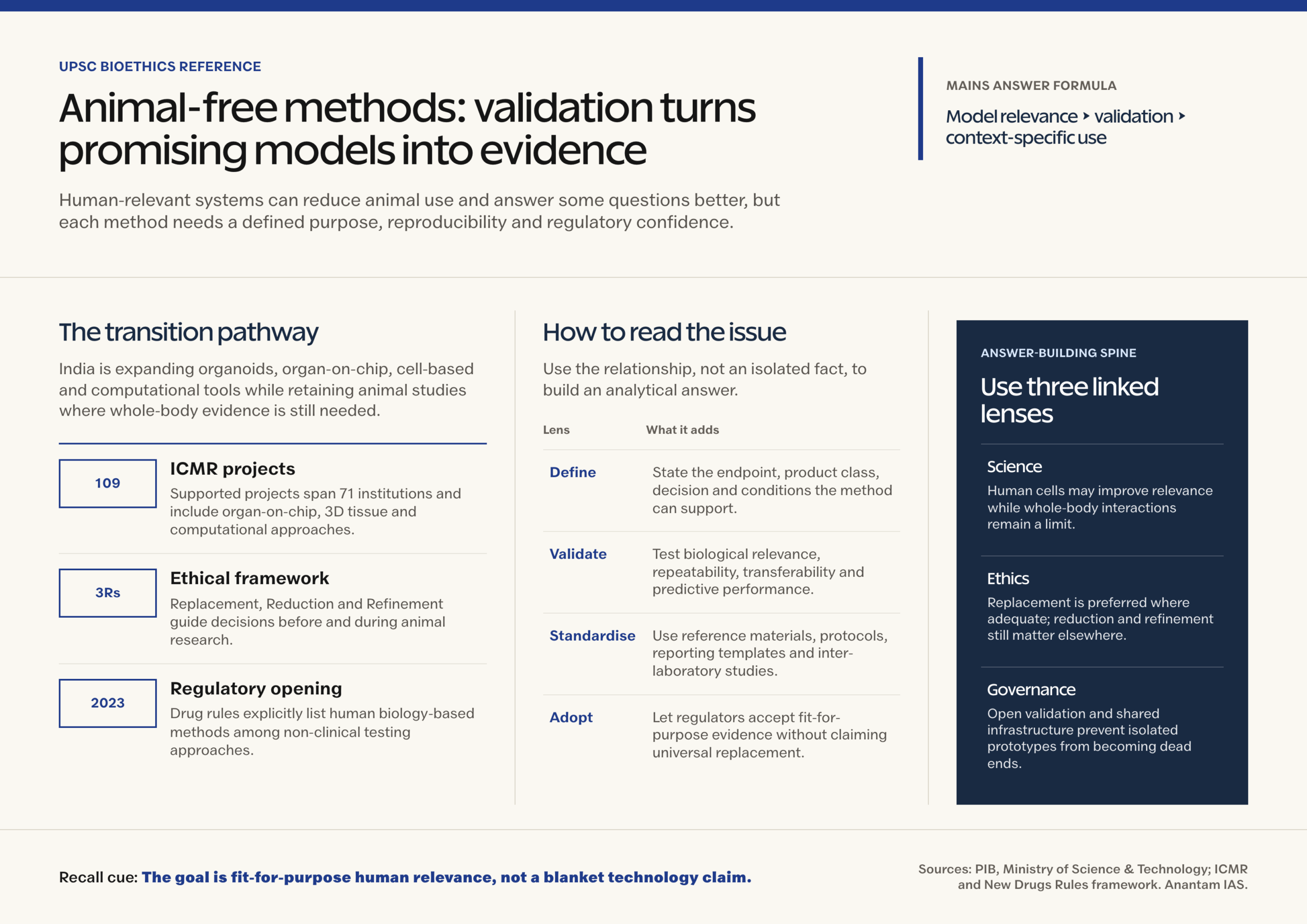
- The Indian Council of Medical Research has supported 109 projects on non-animal testing methods across 71 institutes and laboratories, including organ-on-chip, 3D tissue and computer-based approaches.
- Eight Council of Scientific and Industrial Research laboratories reported capability or activity in one or more alternatives, though facilities vary across the laboratories.
- BRIC-inStem in Bengaluru has dedicated platforms for cell culture, organoids, 2D and 3D cultures, microphysiological systems, bioreactors, high-throughput screening, automation and integrated data analysis.
- BRIC-THSTI in Faridabad has developed an organoid platform that may support drug screening, disease modelling and therapeutic development for liver diseases.
- BIRAC supports the Centre for Predictive Human Model Systems at CSIR-CCMB, Hyderabad, which develops human-relevant platforms and maintains a public database connecting Indian researchers in this field.
- Animal models have contributed to biomedical research, but species differences can limit how reliably a result predicts human biology. Ethical concerns also require researchers to avoid unnecessary pain and animal use.
- Non-animal methods are not one technology. They include in vitro, in chemico, organoid, organ-on-chip and in silico tools, each suited to particular questions and limits.
- The central policy challenge is not simply invention. A method must be reproducible, relevant to a defined biological question, quality-controlled and accepted for a stated regulatory context of use.
UPSC Relevance
Prelims Relevance
- In vitro methods study biological processes outside a living organism, commonly using cells, tissues or biochemical systems under controlled conditions.
- In silico methods use computational models, simulations and data-based predictions to study biological activity, exposure or toxicity.
- An organoid is a three-dimensional cell-derived structure that reproduces selected features of an organ; it is not a complete miniature human organ.
- An organ-on-chip is a microengineered system designed to model selected tissue functions and physical conditions, such as fluid flow or interactions between cell types.
- The ethical 3Rs are Replacement of animals where possible, Reduction in the number used and Refinement of procedures to minimise pain and distress.
- India’s Committee for Control and Supervision of Experiments on Animals regulates animal experimentation and promotes the 3Rs through institutional oversight and guidance.
Mains Relevance
GS Paper 3
- Explain how organoids, organ-on-chip platforms, cell-based assays and computational models can improve the human relevance and efficiency of preclinical research.
- Assess India’s innovation ecosystem across ICMR, CSIR, DBT, BIRAC, BRIC-inStem, THSTI and CCMB, with attention to shared infrastructure and translation.
GS Paper 2
- Examine coordination between research funders, CDSCO, CCSEA, standards bodies, ethics committees and industry in building a predictable approval pathway.
- Relate human-relevant testing to public health governance: patient safety, faster evaluation, scientific transparency, affordability and domestic biomedical capability.
Essay
- Scientific progress becomes humane when compassion is converted into rigorous methods, not when rigour is abandoned.
Background and Context
What New Approach Methodologies Include
New Approach Methodologies, or NAMs, is an umbrella term for tools and strategies that can generate safety or efficacy evidence without default reliance on conventional animal tests.
- Cell-based assays can examine a defined biological response, such as receptor activity, cell damage or a molecular pathway, under controlled conditions.
- 3D tissue models and organoids reproduce more spatial organisation and cell interaction than a simple two-dimensional culture, but their maturity and complexity differ by model.
- Microphysiological systems, including organ-on-chip platforms, use engineered microenvironments to reproduce selected mechanical, chemical and cellular conditions of human tissues.
- Computational approaches can predict molecular interactions or toxicity, integrate existing evidence and prioritise compounds for testing. Their reliability depends on the model, data and domain of applicability.
- An integrated approach may combine multiple methods and prior knowledge because one NAM need not replace one animal test on a one-for-one basis.
Why Human Relevance Matters
The scientific case for NAMs is closely connected to the ethical case: a human-relevant method may reduce animal use while answering some questions more directly.
- Animal species differ from humans in metabolism, immune response, genetics and disease pathways. A result in one species may not reproduce the same clinical effect.
- Human cells and tissues can reveal mechanisms that are absent or altered in an animal model, while patient-derived systems may help study variation between individuals.
- High-throughput systems can screen more candidates or concentrations than many conventional studies, helping researchers reject weak candidates earlier and focus resources on promising mechanisms.
- These advantages are conditional. A model of one organ cannot capture every whole-body process, and cell sources, culture conditions and chip design can introduce new forms of uncertainty.
India's Research Capacity
The August 2026 update describes a distributed public ecosystem rather than a single national laboratory for animal-free testing.
- ICMR’s 109 supported projects across 71 institutions indicate a substantial research base, but project counts do not by themselves show regulatory readiness or replacement achieved.
- CSIR recognises organoids, advanced in vitro systems, organ-on-chip and in silico approaches; eight laboratories reported activity, with uneven facility availability across the network.
- BRIC-inStem provides cell and organoid platforms, microphysiological systems, bioreactors, analytical tools, high-throughput screening and computational resources, along with training programmes in stem-cell and organoid research.
- InStem is developing early embryonic models for developmental-toxicity testing, while THSTI’s liver organoid platform illustrates disease modelling and drug-screening applications.
- BIRAC’s support to the CCMB-based Centre for Predictive Human Model Systems connects public science with translational development and a national researcher database.
The 2023 Regulatory Opening
India’s drug rules now explicitly recognise several human biology-based methods within the menu of non-clinical testing approaches.
- G.S.R. 175(E), notified on March 9, 2023, amended the First Schedule to the New Drugs and Clinical Trials Rules, 2019.
- The amendment lists cell-based assays, organ chips and microphysiological systems, sophisticated computer modelling and other human biology-based methods, along with animal studies, for assessing the safety and efficacy of a new or investigational new drug.
- The wording creates regulatory space for evidence from alternatives, but it does not declare every non-animal method automatically valid for every product, endpoint or decision.
- A sponsor still needs evidence appropriate to the product, risk, endpoint and regulatory question. The scientific standard cannot be reduced to whether a method uses animals.
Way Forward
Create a National Validation Pathway
- Establish shared criteria for context of use, performance standards, reference materials, reproducibility and reporting, aligned where appropriate with OECD and other recognised frameworks.
- Support multicentre studies through public laboratories so promising platforms are tested beyond the developer’s site and against human-relevant benchmarks.
- Publish qualification decisions, limitations and accepted uses in a searchable registry that researchers, regulators, ethics committees and companies can consult.
Conclusion
- India has moved beyond treating animal-free methods as a purely ethical aspiration.
- The next step is harder: converting promising models into reproducible, independently assessed and regulator-ready evidence.
UPSC Practice Questions
Prelims MCQ 1
With reference to New Approach Methodologies in biomedical research, consider the following statements:
- Organoids are three-dimensional cell-derived systems that can reproduce selected features of an organ.
- In silico methods use computational models and simulations.
- India’s 2023 amendment to the New Drugs and Clinical Trials Rules excluded animal studies from all non-clinical testing.
How many of the above statements are correct?
(a) Only one (b) Only two (c) All three (d) None
Answer: (b) Only two
Explanation:
Statements 1 and 2 are correct. The 2023 amendment recognises several human biology-based methods but also retains animal studies in the list of non-clinical testing methods. It does not abolish all animal testing.
Prelims MCQ 2
Which one of the following correctly states the 3Rs of ethical animal experimentation?
(a) Registration, Review and Reporting (b) Relevance, Reproducibility and Regulation (c) Replacement, Reduction and Refinement (d) Research, Risk and Rehabilitation
Answer: (c) Replacement, Reduction and Refinement
Explanation:
Replacement seeks alternatives to animal use, Reduction minimises the number of animals consistent with valid evidence, and Refinement reduces pain and distress when animal use remains necessary.
UPSC Mains Questions
- Animal-free research is as much a problem of validation and regulatory design as one of technological invention. Discuss with reference to India’s emerging biomedical research ecosystem. (250 words)
- How can the 3Rs reconcile scientific uncertainty, animal welfare and the duty to protect human participants in drug development? Examine. (250 words)
Sources: PIB, Ministry of Science & Technology and CDSCO, New Drugs and Clinical Trials (Amendment) Rules, 2023.
Frequently Asked Questions
What are animal-free methods in biomedical research?
They are methods that generate biological, safety or efficacy evidence without conventional live-animal experiments. Examples include cell-based assays, 3D tissue models, organoids, organ-on-chip systems and computational models. Each method answers a defined set of questions and has limits.
What did the government announce in August 2026?
The government reported support for 109 ICMR projects across 71 institutions, activity in eight CSIR laboratories, specialised infrastructure at BRIC-inStem and platforms at THSTI and CCMB. It also said current methods complement rather than fully replace animal models in complex.
What is the difference between an organoid and an organ-on-chip?
An organoid is a self-organising 3D cell-derived structure that reproduces selected tissue features. An organ-on-chip is a microengineered platform that places cells in a controlled environment and may reproduce flow, mechanical forces or interactions between tissue compartments.
Did India abolish animal testing for new drugs in 2023?
No. The 2023 amendment expanded the recognised non-clinical methods to include cell assays, organ chips, computer modelling and other human biology-based tests, but it also retained animal studies. The suitable evidence depends on the product and regulatory question.
Why must a non-animal method be validated?
Validation shows whether a method is reliable and relevant for a defined purpose. It examines factors such as repeatability, transferability, biological relevance, controls and predictive performance. Without a clear context of use, a promising laboratory platform cannot safely support a.