Anti-Defection Law:

Why in news:
The Supreme Court of India has strongly criticized the Telangana Legislative Assembly Speaker for delaying decisions on anti-defection petitions filed against 10 BRS (Bharat Rashtra Samithi) MLAs who defected to the Congress in 2024. The Court has now given a 3-month deadline to decide on the matter and warned that such delays compromise democratic values and the dignity of the Speaker’s office.
UPSC CSE Relevance:
UPSC CSE in prelims and mains examination has focused on Parliament and State legislatures—structure, functioning, conduct of business, powers & privileges and issues arising out of these. As you can see previous year question related to anti defection law.
UPSC Mains PYQ 2013:
Q: The role of individual MPs (Members of Parliament) has diminished over the years and as a result healthy constructive debates on policy issues are not usually witnessed. How far can this be attributed to the anti-defection law, which was legislated but with a different intention?
UPSC Prelims PYQ 2022:
Q: With reference to anti-defection law in India, consider the following statements:
1.The law specifies that a nominated legislator cannot join any political party within six months of being appointed to the House.
1.The law does, not provide any time-frame within which the presiding officer has to decide a defection case.
Which of the statements given above is/are correct?
A) 1 only
B) 2 only
C) Both 1 and 2
D) Neither 1 nor 2
Need of Anti-defection law:
- Helps maintain governmental stability by discouraging frequent changes in party affiliation.
- Ensures elected representatives uphold loyalty to both their political party and the electorate that voted for them.
- Reinforces internal discipline within political parties.
- Allows for the legitimate merger of political parties without triggering disqualification under the anti-defection provisions.
- Aims to curb political corruption by deterring opportunistic defections.
- Empowers the legislature to take disciplinary action against members who defect from one party to another.
About Anti-defection law:
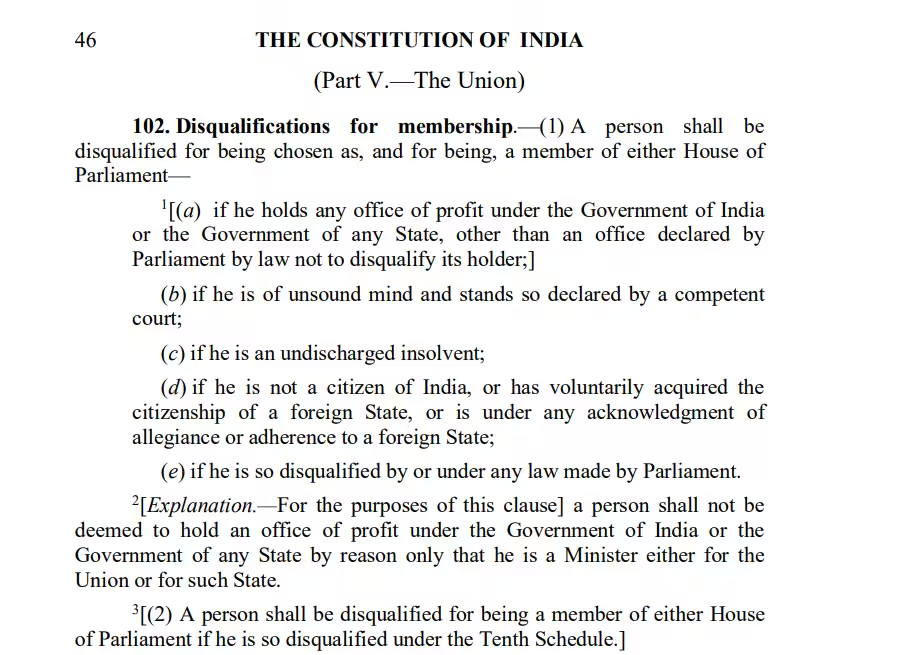
For both Parliament and state assemblies.

Aaya Ram Gaya Ram was a phrase that became popular in Indian politics after a Haryana MLA Gaya Lal changed his party thrice within the same day in 1967. The anti-defection law sought to prevent such political defections which may be due to reward of office or other similar considerations.
Then,
- The 10th schedule was inserted in the Constitution in 1985 by 52nd constitution amendment act(At the time of Rajiv Gandhi).
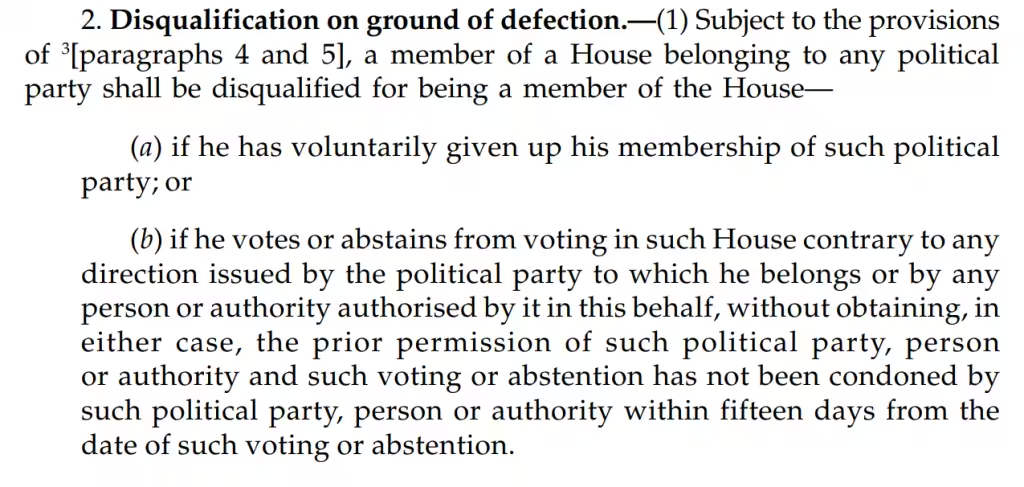
- Legislators may be disqualified on grounds of defection by the Presiding Officer (Speaker of Lok Sabha and Chairman of Rajya Sabha) of a legislature based on a petition by any other member of the House.
- A legislator is deemed to have defected if he either voluntarily gives up the membership of his party or disobeys the directives of the party leadership on a vote.
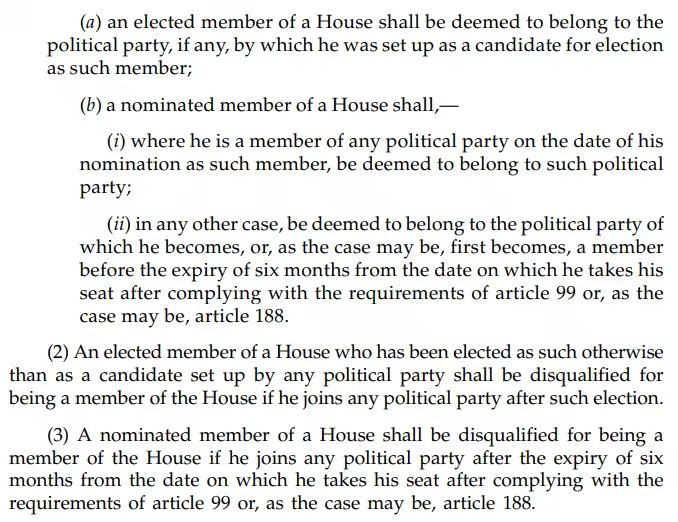
- Independent Member: If he joins any political party after such election, he is disqualified from the House.
- Nominated Member: If he joins any political party after the expiration of six months from the date on which he takes his seat in the House.
- Amrit Pal Singh Case: Article 101(4) provides that if for a period of sixty days, a member of either House of Parliament is, without permission of the House, absent from all meetings of the House, the House may declare his seat vacant. However, in computing the said period of sixty days, no account shall be taken of any period during which the House is prorogued or is adjourned for more than four consecutive days.
Exceptions:
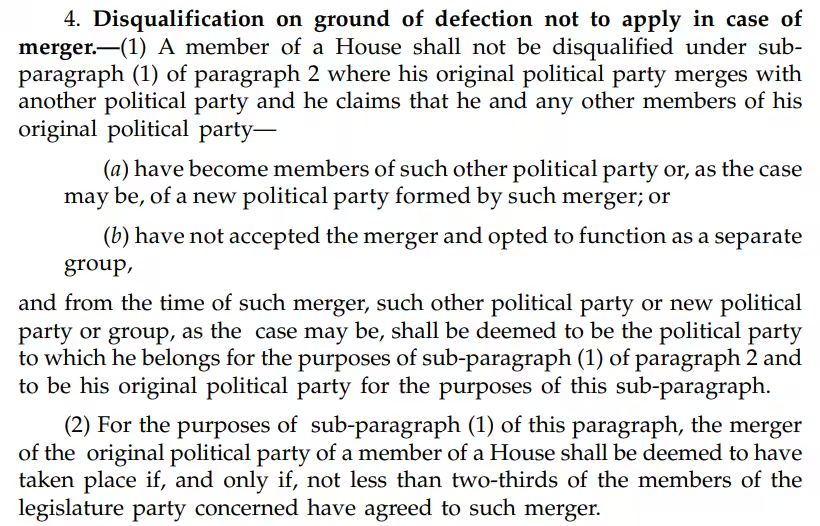
- 91st Constitution Amendment Act: Allows a party to merge with or into another party provided that at least two-thirds of its legislators are in favour of the merger.
- If an elected member becomes the Presiding Officer of the House and voluntarily relinquishes their party membership during their tenure, or re-associates with the party after demitting that office.
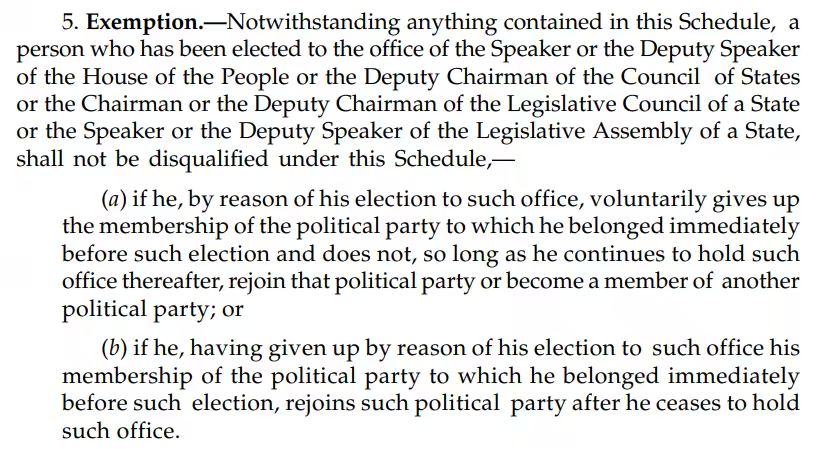
The law does not specify a time-period for the Presiding Officer to decide on a disqualification plea.
Issues:
- Speaker’s Discretion and Delay in Adjudication: The law provides no definite timeline for delivering rulings. As a result, cases sometimes drag on for months or even years, and in some instances, are resolved only after the legislative term has ended.
- Weakening of Parliamentary Debate and Dissent: A critical consequence of the law is the reduction in meaningful debate within the legislature. By penalizing dissent under the same framework as defection, the law discourages alternative viewpoints and mutes internal criticism within parties.
- Selective Tolerance for Defections: The law effectively permits mass defections—where two-thirds of members defect en masse—but penalizes individual or small-group dissent.
- Abolition of ‘Split’ and Confusion in Recognizing Group Movements: This change has created confusion and allowed collective defections under the guise of a merger, even if no such merger occurs at the organizational level.
- Erosion of Democratic Norms and Legislative Independence: making MPs and MLAs more accountable to party leadership than to the electorate. The result is a diminished role for individual judgment in legislative processes.
- It introduces terms such as “original party,” “legislature party,” and “deemed merger,” yet does not offer precise definitions. The term “original party” lacks clarity—whether it refers to a national entity or a regional outfit is not specified, despite the Election Commission of India recognizing both as separate categories.
SC Important Judgements Related to Anti-defection law:
- Kihoto Hollohan case(1992):
- The Supreme Court has held that while adjudicating matters under the anti-defection law, the Speaker or Chairman functions as a tribunal, and their decisions are open to judicial review. However, such review can only be undertaken after the Speaker or Chairman has delivered a decision, not during the proceedings.
- Speakers and Chairpersons occupy a crucial role within the framework of Parliamentary democracy, serving as custodians of the rights and privileges of the legislature.
- The provisions of the Tenth Schedule are corrective in nature, designed to uphold the integrity of India’s Parliamentary system by discouraging opportunistic and unethical defections.
Cases:
Case 1: In the Madhya Pradesh Legislative Assembly, wherein, 16 MLAs absconded, and their resignations were not accepted at first instance by the Speaker of the House. Later on, under the direction of the Supreme Court, the floor test was conducted at midnight and Shri Kamal Nath Government was defeated on the floor of the House. Immediately, thereafter, the Speaker accepted the resignation of these MLA, which he was not willing to accept. These elected members were disqualified and joined the opposition political party and assured tickets to contest the forthcoming by-election.
Case 2: In a controversial move, the Speaker of the Karnataka Legislative Assembly disqualified 17 MLAs for the remainder of the assembly’s term, aiming to prevent them from contesting by-elections and re-entering the House. However, in the case of Srimanth Balasaheb Patil vs. Speaker, Karnataka Legislative Assembly, the Supreme Court ruled this action unconstitutional. The Court held that while the Speaker has the authority to disqualify members, extending the disqualification to cover the entire term — thereby barring them from contesting by-elections — exceeds constitutional limits. Consequently, the Court declared the disqualified MLAs eligible to contest the by-elections.
Defection in Other Jurisdictions:
USA:
A more liberal model pertaining to party discipline is followed in the United States. A member of the House can vote on any matter of policy as per their choice and no matter what, such person shall not be disqualified for exercising their vote in a specific manner.
Recommendations:
- Hashim Abdul Haleem Committee recommended clearly defining “voluntary renunciation”.
- Dinesh Goswami Committee (1990): ADL should be decided by the President/Governor or by the Election Commission.
- Law Commission recommended removal of exemption for merger.
- National Commission to Review the Working of the Constitution: Defectors should be barred from holding public office