When is a party merger valid? The defection law and its gaps
Why in News?
A fresh split inside a major regional party has put the spotlight back on the anti-defection law and one of its most contested questions: when does a group of legislators count as a valid merger rather than a defection? Indian Express, in its Explained section, set out what the law actually says about mergers and what it leaves unaddressed, while The Hindu tracked the political fallout of the breakaway faction.
The trigger is a split in the Trinamool Congress (TMC), where a section of legislators has moved away from the parent party. Because the Tenth Schedule no longer recognises a ‘split’ as a defence, the breakaway group’s survival now turns on whether it can satisfy the strict merger conditions, and on how quickly the presiding officer decides any disqualification petitions.
- A faction of TMC legislators has broken away, reopening debate on the merger exception under the Tenth Schedule.
- The Constitution dropped the ‘split’ defence in 2003, so one-third breakaways are no longer protected.
- Validity of any merger now hinges on the two-thirds rule and the role of the original political party.
- The case again exposes the problem of delay by the Speaker in deciding disqualification petitions.
The development matters in the context of:
- The anti-defection law was added to curb the ‘Aaya Ram, Gaya Ram’ culture of mass floor-crossing for office.
- Repeated splits and defections in state assemblies have made the merger clause a recurring legal flashpoint.
UPSC Relevance
Prelims Relevance
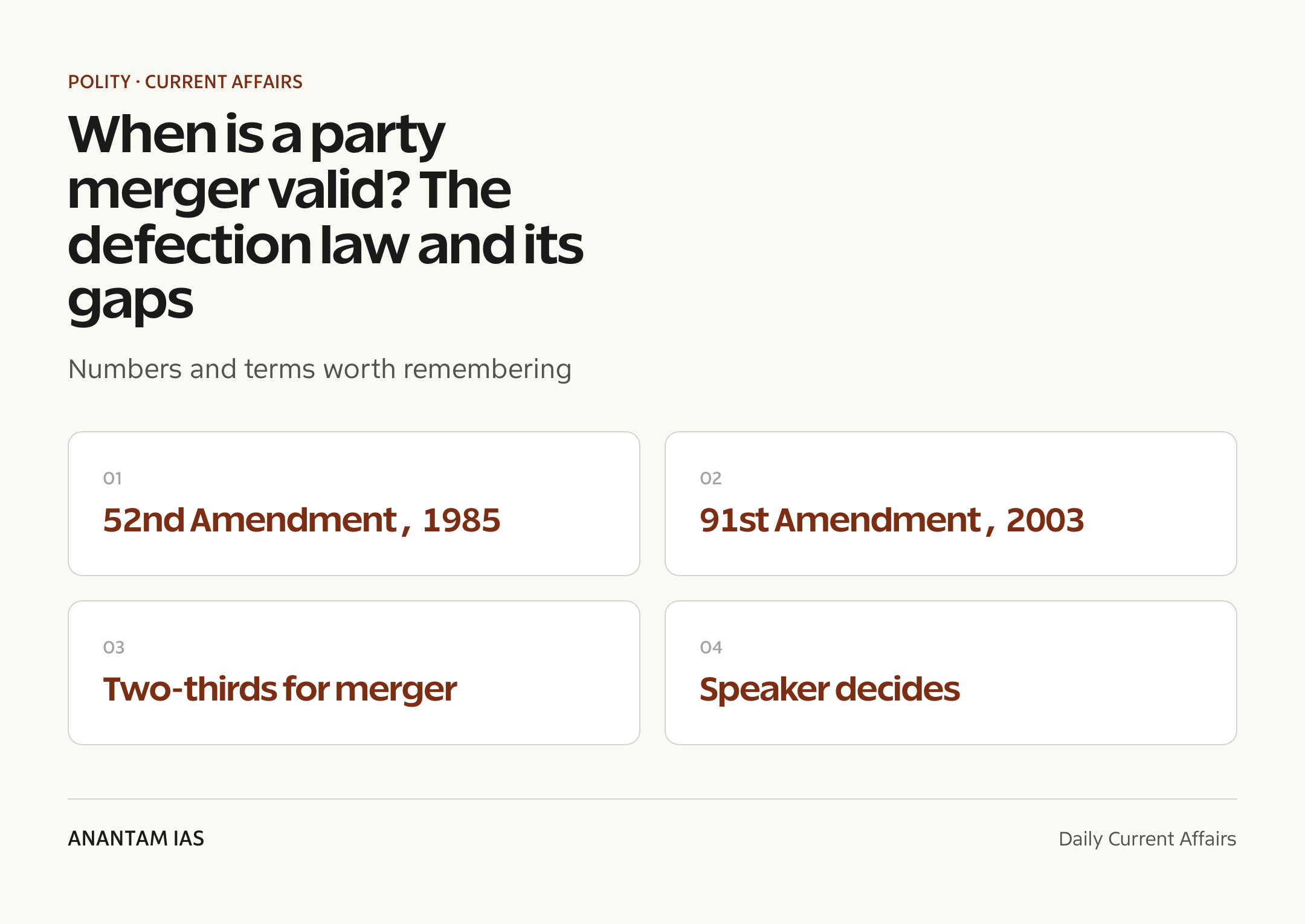
- Tenth Schedule inserted by the 52nd Amendment Act, 1985.
- 91st Amendment Act, 2003 deleted the ‘split’ provision (old Paragraph 3).
- Two grounds for disqualification: voluntarily giving up membership; defying the party whip.
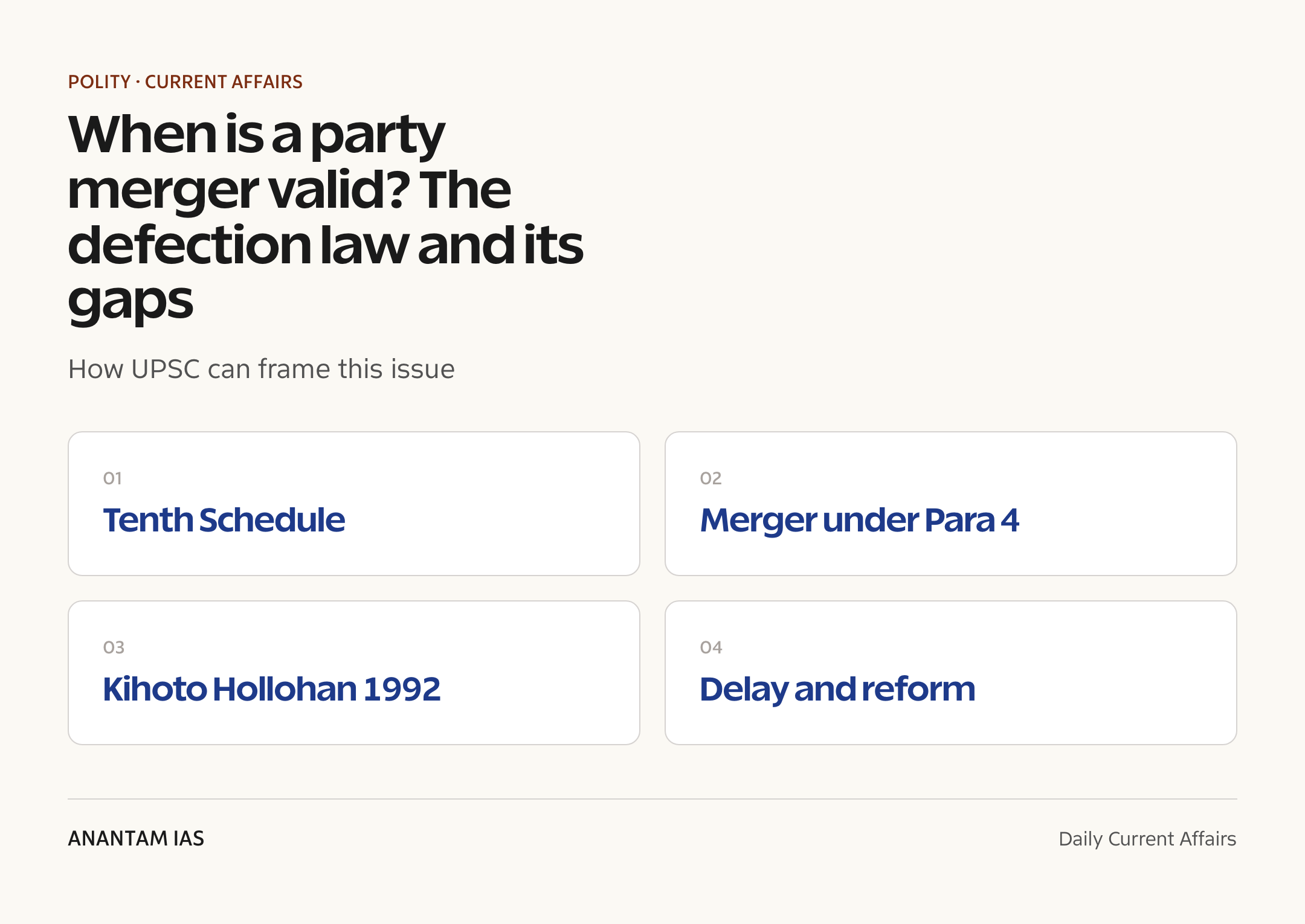
- Merger exception under Paragraph 4 of the Tenth Schedule.
- Merger requires two-thirds of the legislature party to agree.
- The Speaker/Chairman is the adjudicating authority on defection.
- Kihoto Hollohan v. Zachillhu (1992) upheld the Schedule, allowed judicial review.
- Keisham Meghachandra Singh (2020) on delay and an independent tribunal.
- Recommendations: Dinesh Goswami Committee; Law Commission 170th Report.
Mains Relevance
GS Paper 2
- Tenth Schedule and the tension between party discipline and a legislator’s freedom of conscience.
- Role and neutrality of the Speaker as the adjudicating authority on defection petitions.
- Judicial review of presiding officers’ decisions and the problem of indefinite delay.
- Reform options: independent tribunal, fixed timelines, or shifting adjudication to the ECI/judiciary.
Essay
- Defection, opportunism and the erosion of trust in representative democracy.
Background and Context
What the anti-defection law is
The law sits in the Tenth Schedule of the Constitution and targets legislators who switch sides after election.
- The Tenth Schedule was inserted by the 52nd Amendment Act, 1985 to check the culture of frequent floor-crossing summed up in the phrase ‘Aaya Ram, Gaya Ram’.
- It applies to members of Parliament and of state legislatures, covering both elected and nominated members under defined conditions.
- A member can be disqualified on two main grounds: if they voluntarily give up the membership of their party, or if they vote (or abstain) against the party whip without prior permission and without the action being condoned within a set period.
- ‘Voluntarily giving up membership’ is read widely by courts and need not mean a formal resignation; conduct alone can amount to it.
Why the 'split' defence disappeared
The original law let one-third of a party break away as a ‘split’ without disqualification, but that loophole was closed.
- As originally enacted, Paragraph 3 protected a ‘split’ where at least one-third of a legislature party broke away.
- This was misused: groups engineered one-third breakaways to topple or prop up governments while escaping disqualification.
- The 91st Amendment Act, 2003 deleted the split provision entirely, so a one-third breakaway is no longer a defence.
- After 2003, the only safe exit for a group of legislators is a valid merger under Paragraph 4.
The merger exception explained
A merger is the one route by which legislators can change affiliation as a bloc and still keep their seats.
- Paragraph 4 of the Tenth Schedule exempts a merger from disqualification, but only when strict conditions are met.
- There must be a merger of the original political party with another party, and not less than two-thirds of the members of the legislature party must agree to that merger.
- Members who go with the merger, and those who stay with the old party, are both protected from disqualification.
- A practical dispute is whether the original political party must actually merge at the organisational level, or whether agreement by two-thirds of the legislature wing alone is enough. Several court rulings stress that a genuine merger of the parent party is required.
- This makes the merger clause hard to satisfy: a faction needs both the numbers and a real party-level merger to escape disqualification.
Who decides, and judicial review
Disqualification is decided not by a court in the first instance but by the presiding officer of the House.
- The Speaker of the Lok Sabha or Assembly, or the Chairman of the Council, is the adjudicating authority on defection petitions.
- In Kihoto Hollohan v. Zachillhu (1992), the Supreme Court upheld the Tenth Schedule but read down the clause that barred courts from intervening.
- The Court held that while acting under the Schedule, the Speaker functions as a tribunal, and the decision is open to judicial review on grounds such as mala fides, perversity or violation of natural justice.
- Courts generally do not intervene before the Speaker decides, which lets presiding officers control the timing of outcomes.
The problem of delay
Because the Speaker controls timing, petitions can be left undecided for years, defeating the law’s purpose.
- Speakers belong to the ruling side, raising doubts about neutrality when defectors support the government.
- Pending petitions can outlast a full Assembly term, so disqualification becomes meaningless even if it eventually comes.
- In Keisham Meghachandra Singh v. Speaker, Manipur (2020), the Supreme Court flagged this gap and suggested that Parliament consider an independent tribunal outside the Speaker’s office.
- The Court also indicated that defection petitions should ordinarily be decided within about three months, barring exceptional circumstances.
Reform proposals over the years
Several committees and commissions have suggested ways to make adjudication faster and more impartial.
- The Dinesh Goswami Committee on electoral reforms recommended that the decision on disqualification be taken by the President or Governor on the advice of the Election Commission rather than the Speaker.
- The Law Commission’s 170th Report and later work pushed for tighter rules and a more neutral deciding authority.
- Suggestions include shifting adjudication to the judiciary or a dedicated tribunal, and fixing a strict timeline for decisions.
- There is also debate about limiting whips to confidence motions and money bills, so that the law does not crush every dissenting vote.
Way Forward
Fix the deciding authority
- Move adjudication from the Speaker to an independent body such as a tribunal headed by a retired judge, or to the Election Commission, to reduce the partisanship problem.
- Make the deciding authority’s process transparent, with reasoned and published orders.
Enforce strict timelines
- Legislate a firm time limit for deciding petitions, in line with the Supreme Court’s suggested three-month benchmark.
- Treat unexplained delay as a ground for courts to step in earlier.
Clarify and calibrate the law
- Spell out clearly that a valid merger needs a genuine merger of the original political party, not just the legislature wing.
- Limit the binding force of the whip to crucial votes so genuine dissent is not penalised as defection.
Conclusion
The current split is a reminder that the anti-defection law has shifted, not removed, the politics of floor-crossing. By scrapping the split defence and leaving the narrow merger window, the 91st Amendment made bloc exits harder, yet the law’s real weakness now lies in who decides and how fast.
Genuine reform has to address the Speaker’s dual role and the chronic delay in adjudication. An independent authority bound by firm timelines, paired with a clearer merger test, would let the Tenth Schedule serve its original aim of stable, principled politics rather than becoming a tool that rewards whoever controls the clock.
UPSC Practice Questions
Prelims MCQ 1
With reference to the Tenth Schedule of the Constitution, consider the following statements:
- It was inserted by the 52nd Constitutional Amendment Act, 1985.
- The 91st Amendment Act, 2003 added a ‘split’ exception to protect one-third breakaways.
- A merger is exempt from disqualification only if not less than two-thirds of the legislature party agree.
How many of the above statements are correct?
(a) Only one (b) Only two (c) All three (d) None
Answer: (b) Only two
Explanation:
Statements 1 and 3 are correct. The Tenth Schedule was added by the 52nd Amendment Act, 1985, and Paragraph 4 exempts a merger backed by at least two-thirds of the legislature party. Statement 2 is wrong: the 91st Amendment Act, 2003 deleted the ‘split’ provision, it did not add one.
Prelims MCQ 2
In which case did the Supreme Court hold that the Speaker, while deciding defection cases under the Tenth Schedule, acts as a tribunal whose decisions are subject to judicial review?
(a) S.R. Bommai v. Union of India (b) Kihoto Hollohan v. Zachillhu (c) Keisham Meghachandra Singh v. Speaker, Manipur (d) Indira Sawhney v. Union of India
Answer: (b) Kihoto Hollohan v. Zachillhu
Explanation:
In Kihoto Hollohan v. Zachillhu (1992), the Court upheld the Tenth Schedule, held that the Speaker functions as a tribunal while deciding defection petitions, and made that decision open to judicial review. The Keisham Meghachandra Singh case (2020) dealt mainly with delay and the case for an independent tribunal.
UPSC Mains Questions
- The merger exception is the only surviving defence under the anti-defection law after 2003. Examine the conditions for a valid merger under the Tenth Schedule and the problems that arise in applying it. (250 words)
- Delay by the Speaker in deciding defection petitions has weakened the anti-defection law. Critically evaluate the role of the presiding officer and suggest reforms to make adjudication fair and timely. (250 words)
Sources: Indian Express and The Hindu.
Frequently Asked Questions
What is the anti-defection law?
It is the set of rules in the Tenth Schedule of the Constitution, added by the 52nd Amendment Act, 1985, that disqualifies legislators who switch parties or defy the party whip. The aim is to curb opportunistic floor-crossing and keep elected members loyal to the party they were elected on.
When is a party merger valid under the law?
Under Paragraph 4 of the Tenth Schedule, a merger escapes disqualification only if not less than two-thirds of the members of the legislature party agree to it and there is a genuine merger of the original political party with another. Members who join the merger, and those who stay back, are both protected.
Why was the ‘split’ provision removed?
The original law protected a breakaway of one-third of a party as a ‘split’. Groups misused this to topple or support governments while avoiding disqualification. The 91st Amendment Act, 2003 deleted the split provision, leaving merger as the only valid defence for a group switching sides.
Who decides defection cases?
The Speaker of the House, or the Chairman in the case of an upper House, is the adjudicating authority. The Supreme Court in Kihoto Hollohan (1992) held that the Speaker acts as a tribunal in these matters, and the decision can be challenged through judicial review on limited grounds.
What is the main criticism of the law today?
The biggest concern is delay. Speakers, who usually belong to the ruling side, can leave petitions undecided for years, so disqualification loses meaning. The Supreme Court has suggested an independent tribunal and a roughly three-month limit for deciding such cases.
What reforms have been proposed?
The Dinesh Goswami Committee suggested deciding defection on the Election Commission’s advice rather than by the Speaker. The Law Commission’s 170th Report and later proposals favour a neutral authority, fixed timelines, and limiting the whip to crucial votes so honest dissent is not punished as defection.