Andhra Pradesh Transplant Bill: Swap Donation and Anti-Trafficking Safeguards
Why in News?
The Andhra Pradesh Legislative Assembly passed the A.P. Transplantation of Human Organs (Amendment) Bill, 2026 on 19 August, seeking to align the State framework with central changes made in 2011.
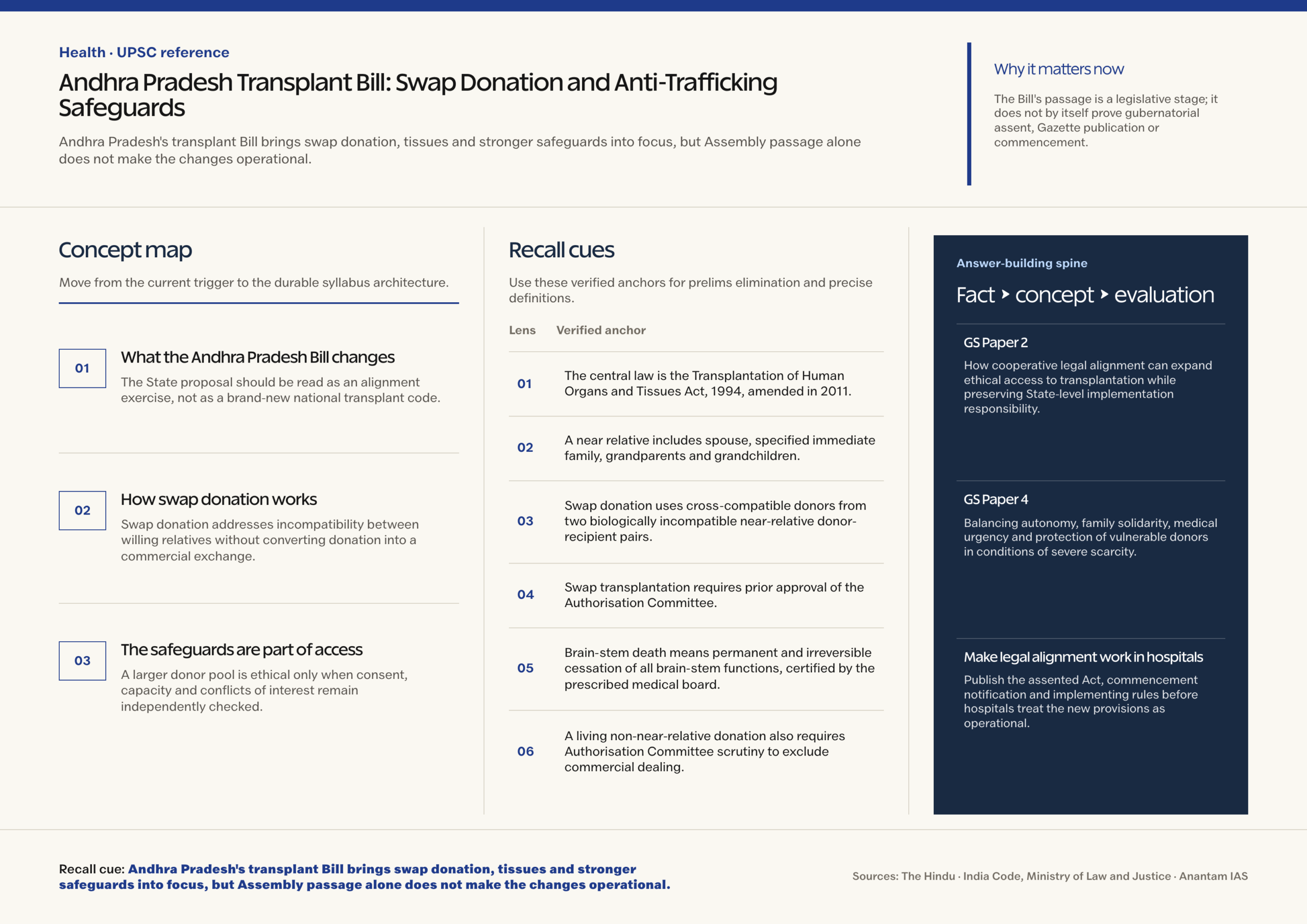
- The Bill’s passage is a legislative stage; it does not by itself prove gubernatorial assent, Gazette publication or commencement.
- The proposed alignment covers human tissues, an expanded near-relative category, swap donation and revised brain-stem-death certification.
- It also carries safeguards for minors, foreign-national cases, persons covered by the Act’s mental-capacity restriction and suspected commercial dealing.
- The central 2011 amendment took effect in 2014; Andhra Pradesh has continued under its separate 1995 State Act.
- Transplant law must widen legitimate donation without turning medical scarcity into a market for vulnerable bodies.
- Swap donation solves biological incompatibility, but compatibility cannot replace consent, relationship verification or regulatory approval.
- For exam answers, separate what the Bill proposes from what the central law already provides and what is legally in force in Andhra Pradesh.
UPSC Relevance
Prelims Relevance
- The central law is the Transplantation of Human Organs and Tissues Act, 1994, amended in 2011.
- A near relative includes spouse, specified immediate family, grandparents and grandchildren.
- Swap donation uses cross-compatible donors from two biologically incompatible near-relative donor-recipient pairs.
- Swap transplantation requires prior approval of the Authorisation Committee.
- Brain-stem death means permanent and irreversible cessation of all brain-stem functions, certified by the prescribed medical board.
- A living non-near-relative donation also requires Authorisation Committee scrutiny to exclude commercial dealing.
Mains Relevance
GS Paper 2
- How cooperative legal alignment can expand ethical access to transplantation while preserving State-level implementation responsibility.
- Why Authorisation Committees, registered hospitals and independent death certification are essential safeguards against trafficking and conflicts of interest.
GS Paper 4
- Balancing autonomy, family solidarity, medical urgency and protection of vulnerable donors in conditions of severe scarcity.
Essay
- Scarcity tests whether institutions can expand access without weakening consent.
Background and Context
What the Andhra Pradesh Bill changes
The State proposal should be read as an alignment exercise, not as a brand-new national transplant code.
- Andhra Pradesh regulates transplantation through its 1995 State Act, while the central statute was substantially amended in 2011 and its new provisions commenced in 2014 nationally.
- The central amendment broadened the framework from organs alone to organs and tissues, bringing corneas, skin, heart valves and regulated tissue banks within the legal architecture.
- It added grandparents and grandchildren to the near-relative definition, enlarging the lawful family donor pool without removing scrutiny for unrelated living donations.
- The Assembly Bill seeks to carry these mechanisms into the State framework after a long legal gap between the separate State and central regimes governing hospitals.
- Until assent and the applicable commencement step are officially confirmed, describe the measure as a passed Bill, not an operational amendment binding hospitals and committees in Andhra Pradesh.
How swap donation works
Swap donation addresses incompatibility between willing relatives without converting donation into a commercial exchange.
- Pair A has a willing near-relative donor who is biologically incompatible with Recipient A; Pair B faces the same problem despite a valid family donation offer.
- If Donor A matches Recipient B and Donor B matches Recipient A, the donors may make a cross-donation based on reciprocal biological compatibility rather than payment.
- Both donors and recipients enter one agreement covering the linked donations; payment is neither the basis nor a lawful consideration for the exchange.
- Section 9(3A) of the central THOTA framework requires prior Authorisation Committee approval even after doctors establish both cross-matches and all four participants agree.
- The 2014 Rules keep swap donation within near-relative pairs, making documentary relationship verification and review of the complete linked arrangement part of the safeguard.
The safeguards are part of access
A larger donor pool is ethical only when consent, capacity and conflicts of interest remain independently checked.
- Living donation by a non-near relative requires the Committee to examine affection, relationship documents, financial disparity, donor motivation and possible involvement of middlemen or touts.
- Foreign-national cases need prior approval; an Indian donor cannot donate to a foreign recipient unless they are near relatives, closing a route for disguised cross-border commercial transplantation.
- The central Act bars living removal from a person within its defined ‘mentally challenged person’ category; minor donation is exceptional, medically justified and approval-bound under the Rules.
- Brain-stem death means permanent, irreversible cessation of all brain-stem functions and requires prescribed medical-board certification; it is neither ordinary coma nor a transplant team’s informal declaration.
- When a neurologist or neurosurgeon is unavailable, approved independent specialists may substitute, but they must not belong to the recipient’s transplant team, limiting conflict of interest.
Way Forward
Make legal alignment work in hospitals
- Publish the assented Act, commencement notification and implementing rules before hospitals treat the new provisions as operational.
- Standardise Authorisation Committee review, conflict checks and written reasons across transplant centres.
- Train independent certifying doctors and transplant coordinators without weakening the separation from recipient care teams.
- Audit relationship documents, financial red flags and outcomes while protecting donor and recipient medical privacy.
Conclusion
- The Bill’s strongest idea is not simply a larger donor pool. It is a regulated path for converting biological incompatibility into two ethical, compatible donations without treating scarcity as permission for commerce.
- In a Mains answer, pair access reforms with safeguards: verified relationships, informed consent, independent death certification, registered institutions, reasoned committee approval and a categorical ban on organ commerce.
UPSC Practice Questions
Prelims MCQ 1
With reference to swap donation under India’s organ-transplant framework, consider the following statements:
- Each donor is a near relative of the recipient for whom the donor originally volunteered.
- The two donors are biologically compatible with the other pair’s recipient.
- Once biological compatibility is established, prior Authorisation Committee approval is unnecessary.
How many of the above statements are correct?
(a) Only one (b) Only two (c) All three (d) None
Answer: (b) Only two
Explanation:
Statements 1 and 2 describe the statutory swap mechanism. Statement 3 is incorrect because Section 9(3A) requires prior Authorisation Committee approval.
Prelims MCQ 2
Which one of the following best describes brain-stem-death certification under the central transplant law?
(a) A declaration made solely by the surgeon who will perform the transplant (b) A presumed death after a fixed period in intensive care (c) Certification by a prescribed medical board, with approved independent substitutes when specified neurological specialists are unavailable (d) A decision made by the Authorisation Committee after matching recipients
Answer: (c) Certification by a prescribed medical board, with approved independent substitutes when specified neurological specialists are unavailable
Explanation:
The Act requires prescribed board certification. Substitutes are permitted under conditions when a neurologist or neurosurgeon is unavailable, and conflict safeguards apply.
UPSC Mains Questions
- Swap donation can widen access to transplantation without legalising a market in organs. Explain the mechanism and the safeguards required. (150 words)
- A transplant law must treat independent certification and donor scrutiny as access safeguards, not procedural delays. Discuss. (250 words)
Sources: The Hindu and India Code, Ministry of Law and Justice.
Frequently Asked Questions
Has the Andhra Pradesh transplant amendment become operational?
The Assembly passed the Bill on 19 August 2026. Passage alone does not establish gubernatorial assent, Gazette publication or commencement; those steps require separate official confirmation.
What is swap donation?
Two incompatible near-relative donor-recipient pairs exchange donors when each donor matches the other recipient. The arrangement requires a single agreement and prior Authorisation Committee approval.
Who is a near relative under the central transplant law?
The statutory definition covers spouse, son, daughter, father, mother, brother, sister, grandfather, grandmother, grandson and granddaughter. The 2011 amendment added grandparents and grandchildren to the original family list.
Why is brain-stem-death certification important?
It establishes death through a prescribed medical board before deceased-donor retrieval. Independent membership and substitute-specialist rules reduce delay while separating certification from the recipient’s transplant team.
How does the law deter organ trafficking?
It prohibits commercial dealing, scrutinises non-relative and foreign-national cases, regulates hospitals and tissue banks, restricts vulnerable living donors, and penalises false documents used to disguise paid donation.