Pillale Sampada: Andhra Pradesh turns pro-natalist on World Population Day
Why in News?
Andhra Pradesh Chief Minister N. Chandrababu Naidu launched the Pillale Sampada scheme at a World Population Day (July 11) programme in Vijayawada, The Hindu reported. The scheme offers direct financial assistance to families for the birth of a third and fourth child — making Andhra Pradesh one of the first major Indian states to formally incentivise larger families.
The Chief Minister framed the shift bluntly: “population preservation, not population control” is the need of the hour, as the Total Fertility Rate (TFR) declines steadily across the world and, sharply, across South India. For a state that once pioneered the two-child norm for local-body candidates, this is a complete policy reversal.
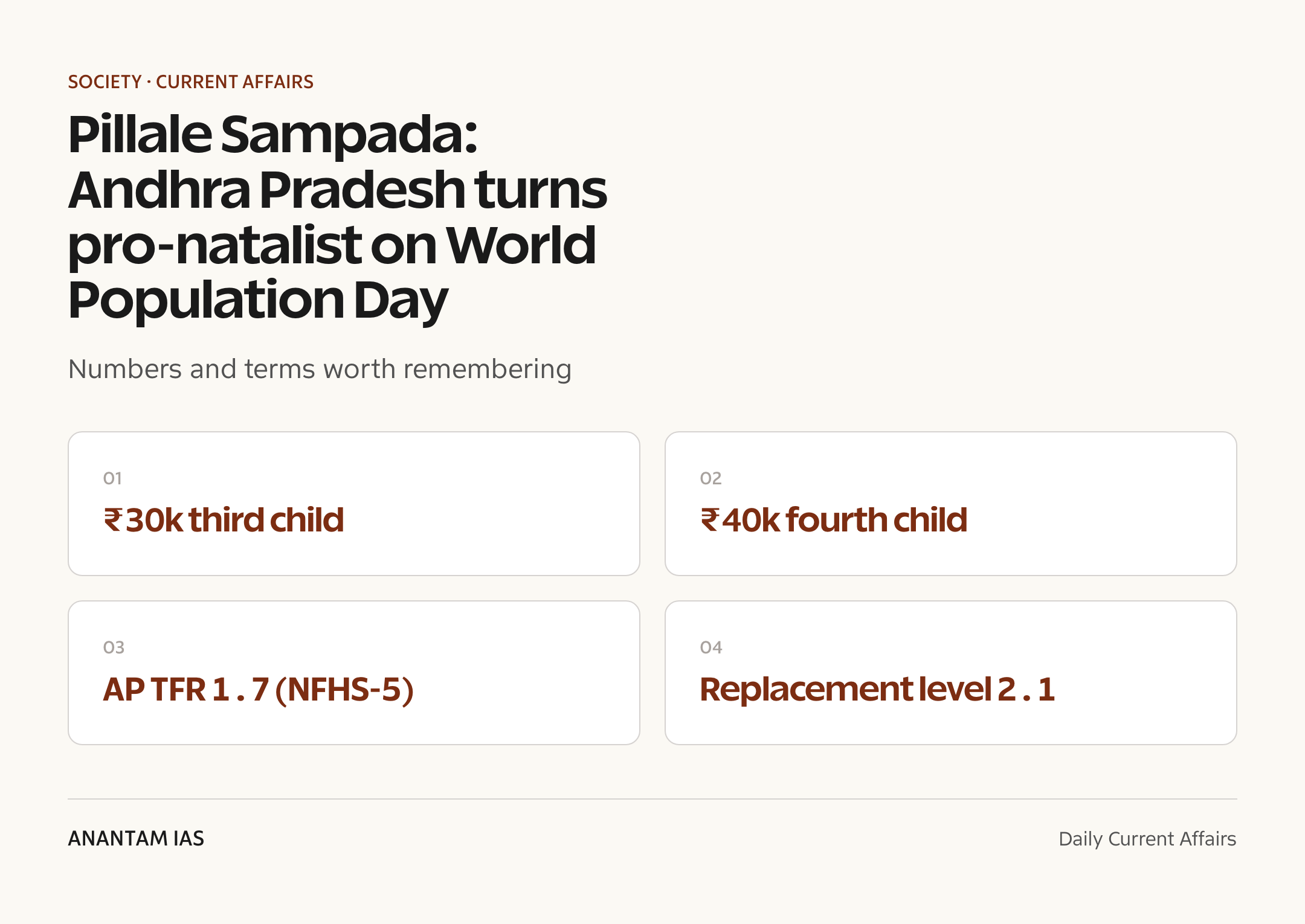
- ₹30,000 will be paid for the birth of a third child and ₹40,000 for a fourth child under Pillale Sampada.
- The stated goal is demographic stability — a healthy working-age population to sustain economic growth, industry and welfare spending.
- Naidu noted that populations are declining in about 40 countries, and a similar trend is visible in South India: falling enrolment in Anganwadi centres and schools alongside a rapidly rising elderly population.
- He recalled that the rule disqualifying people with more than two children from contesting local-body elections has already been revoked in view of changed circumstances.
- Andhra Pradesh ranks seventh in geographical area but has comparatively low population density, the CM said, arguing the state’s TFR should rise.
The development matters in the context of:
- This matters because India’s population policy conversation is inverting: after decades of family planning aimed at limiting births, a large state is now paying families to have more children.
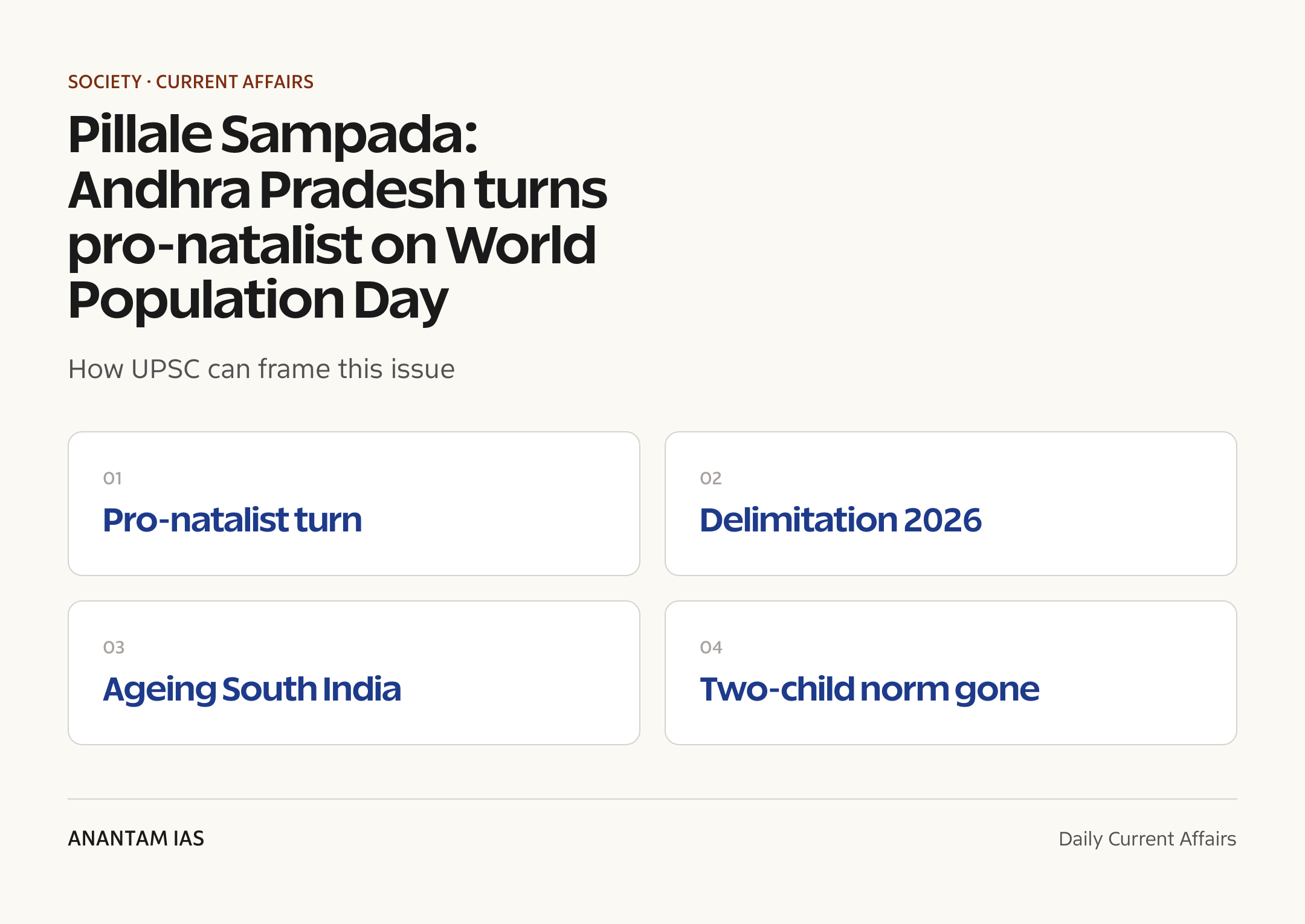
- It crystallises the North–South demographic divergence ahead of the post-2026 delimitation exercise, where states that controlled fertility early fear losing parliamentary weight.
- It puts India inside a global debate — from South Korea to Hungary — on whether cash incentives can actually reverse fertility decline.
UPSC Relevance
Prelims Relevance
- Pillale Sampada — Andhra Pradesh scheme (launched July 11, 2026): ₹30,000 for a third child, ₹40,000 for a fourth; objective: demographic stability.
- Total Fertility Rate (TFR) — average number of children a woman would bear in her lifetime at current age-specific fertility rates.
- Replacement-level fertility — TFR of about 2.1, at which a population exactly replaces itself across generations.
- NFHS-5 (2019–21) — India’s TFR at 2.0, below replacement; Andhra Pradesh at 1.7; Kerala and Tamil Nadu 1.8; Karnataka 1.7.
- World Population Day — observed on July 11, instituted by the UN in 1989 after global population crossed five billion.
- Two-child norm — Andhra Pradesh introduced it for local-body candidates in 1994; repealed via the AP Panchayat Raj (Amendment) Act, 2024 and parallel municipal-law amendments.
- 84th Constitutional Amendment, 2001 — froze the state-wise allocation of Lok Sabha seats on the 1971 Census until the first census after 2026.
- India Ageing Report 2023 (UNFPA) — the 60+ population share is projected to double from about 10.5% (2022) to 20.8% by 2050.
Mains Relevance
GS Paper 1
- Population and associated issues: the demographic transition in South India, below-replacement fertility, and the shift from population control to population preservation.
- Regional demographic divergence — young North vs ageing South — and its social consequences (care economy, migration, shrinking school cohorts).
GS Paper 2
- Government policies and interventions: design and likely efficacy of pro-natalist cash transfers; the 2024 repeal of the two-child norm for local-body polls.
- Federal dimensions — post-2026 delimitation and Finance Commission devolution as reasons low-fertility states fear being penalised for demographic success.
GS Paper 3
- Economy: shrinking working-age share, the closing demographic dividend window in southern states, and fiscal pressure from ageing.
Essay
- Demography is destiny: how falling fertility is rewriting the politics and economics of nations.
- From ‘Hum Do Hamare Do’ to baby bonuses: the arc of India’s population policy.
- A country ages before it grows rich: the middle-income demographic trap.
Background and Context
What Pillale Sampada offers
The scheme is a direct cash incentive for higher-order births, announced with an explicit demographic-stability objective.
- Financial assistance of ₹30,000 for the birth of a third child and ₹40,000 for the birth of a fourth child.
- The name roughly translates from Telugu as “children are wealth” — signalling the state now treats births as an asset, not a burden.
- Launched at a state-organised World Population Day event in Vijayawada on July 11, 2026 — a deliberate irony, since the day was created to draw attention to over-population.
- Naidu paired the scheme with softer levers: women’s empowerment and entrepreneurship, the message that raising children is not the sole responsibility of women, and a push to reduce caesarean deliveries to protect maternal health.
- The rationale: a healthy working-age population underpins economic development, industrial growth, welfare programmes and future productivity.
From two-child norm to baby bonus: a full reversal
Andhra Pradesh has travelled the entire arc of Indian population policy in one generation.
- In 1994, undivided AP barred anyone with more than two children from contesting elections to gram panchayats, mandal and zilla parishads — among the country’s strictest population-control rules.
- In November 2024, the state assembly passed the AP Panchayat Raj (Amendment) Act and municipal-law amendments scrapping that disqualification, with Naidu arguing family planning had “outlived its purpose”.
- Naidu has since floated the opposite idea — that having more children could one day be encouraged, even for public life — and Tamil Nadu CM M.K. Stalin has made similar (half-joking) appeals to young couples.
- Pillale Sampada converts that rhetoric into a funded scheme, joining smaller precedents such as Sikkim’s incentives for indigenous families and allowances announced in Mizoram.
- The reversal echoes national policy direction too: the National Population Policy, 2000 aimed at replacement-level TFR, a goal India achieved around 2020 — earlier than many projections.
The fertility data behind the panic
Every southern state is now well below replacement-level fertility, and has been for two decades.
- Replacement level is a TFR of about 2.1 children per woman — the rate at which each generation exactly replaces itself.
- Per NFHS-5 (2019–21), India’s TFR is 2.0; Andhra Pradesh stands at 1.7, Karnataka 1.7, Kerala 1.8, Tamil Nadu 1.8 and Telangana about 1.8. Sample Registration System estimates place AP lower still, around 1.5.
- The South got here early: Kerala reached replacement fertility in 1988 and Tamil Nadu in 1993; AP crossed it in the early 2000s.
- Only a few large states — Bihar, Uttar Pradesh and Jharkhand — still record TFRs above 2.1, which is what creates the North–South demographic divergence.
- AP’s TFR has collapsed from about 3.7 in 1992–93 (NFHS-1 era) to 1.7 or below now — one of the fastest fertility transitions among big Indian states.
- Once fertility falls this low, population momentum fades and the age pyramid inverts: fewer school entrants and Anganwadi children today, more dependent elderly tomorrow.
Delimitation and fiscal federalism: the political economy
Southern anxiety isn’t only economic — representation and revenue shares are on the line.
- The 42nd Amendment (1976) froze the state-wise allocation of Lok Sabha seats on the 1971 Census; the 84th Amendment (2001) extended that freeze until the first census taken after 2026.
- When the freeze lifts, a population-based delimitation could shift parliamentary weight toward high-fertility northern states — southern states fear being punished for controlling population successfully.
- Fiscal stakes run parallel: the 15th Finance Commission used 2011 Census population (15% weight) in its devolution formula, softened by a 12.5% demographic-performance weight that rewards low-fertility states — but the southern states argue the protection is partial.
- Naidu’s demographic-stability push is best read against this backdrop: population size increasingly determines seats, funds and bargaining power in the federal system.
- Track the broader debate in our monthly current-affairs digests, where delimitation and Finance Commission issues recur.
Ageing before affluence: the workforce problem
Low fertility today is tomorrow’s dependency crisis — and the South is a decade ahead of the national curve.
- The India Ageing Report 2023 (UNFPA–IIPS) projects the 60+ share of India’s population to roughly double from 10.5% in 2022 to 20.8% by 2050; southern states will age fastest.
- Naidu flagged the ground-level symptoms: declining enrolment in Anganwadi centres and schools even as the elderly population rises rapidly.
- A shrinking working-age base threatens the state’s pitch for industrial investment, strains pension and health spending, and deepens dependence on in-migration from northern states.
- The classic risk is the “grow old before growing rich” trap: developed East Asian economies hit low fertility at high incomes; Indian states are hitting it at middle incomes.
- The demographic dividend — a bulge of workers relative to dependents — is a one-time window; for South India it’s already closing, while it stays open longer in the Hindi belt.
Do baby bonuses work? The global record
International experience suggests cash incentives rarely lift fertility durably — which is the core criticism of Pillale Sampada.
- South Korea has spent enormous sums on birth incentives since 2006, yet its TFR fell to around 0.7 — the world’s lowest; Japan and Singapore show similarly weak responses to baby bonuses.
- Hungary’s generous loans and tax breaks for mothers produced only a modest, plateauing rise — and at a very high fiscal cost per additional birth.
- Fertility decisions hinge on structural factors — cost of housing and education, women’s career penalties, childcare availability — that one-time transfers of ₹30,000–40,000 barely touch.
- Critics also warn of design risks: incentives skewed to higher-order births can conflict with maternal-health goals, and poorly targeted transfers may reward births that would have happened anyway.
- Demographers argue the smarter response to ageing is raising female labour-force participation, healthy-ageing policy, skilling, and managed internal migration — not chasing a higher TFR alone.
Way Forward
Support families, not just births
- Pair cash grants with creches, childcare leave, flexible work and affordable schooling so the real costs of raising children fall — the levers that actually move fertility intentions.
- Protect maternal health: ensure incentives for third and fourth births never override safe-birth spacing, anaemia control and the state’s own push to cut caesarean rates.
Plan for ageing regardless
- Fertility responds slowly at best, so AP must simultaneously build elder-care infrastructure, pension sustainability and healthy-ageing programmes in line with the India Ageing Report’s warnings.
- Raise effective workforce size now — higher female labour-force participation, later retirement options and skilling can offset a smaller youth cohort faster than new births can.
Settle the federal question
- The post-2026 delimitation and future Finance Commission formulas need an explicit political settlement that doesn’t penalise states for demographic success — otherwise every low-TFR state has an incentive to game population numbers.
Conclusion
Pillale Sampada is a milestone less for its modest purse than for its symbolism: the state that once disqualified parents of three from panchayat polls now pays for the third child. India’s population debate has formally entered its second act — managing scarcity of the young, not excess of the many.
For aspirants, the scheme sits at the junction of GS1 population dynamics and GS2 governance and federalism. The durable takeaways are the numbers and the structure: TFR 1.7 against replacement 2.1, the 84th Amendment’s 2026 delimitation trigger, and the global evidence that demography yields to childcare economics far more readily than to cash.
UPSC Practice Questions
Prelims MCQ 1
With reference to the Pillale Sampada scheme and Andhra Pradesh’s population policy, consider the following statements:
- The scheme provides ₹30,000 for the birth of a third child and ₹40,000 for the birth of a fourth child.
- Andhra Pradesh has repealed the rule disqualifying persons with more than two children from contesting local-body elections.
- As per NFHS-5, Andhra Pradesh’s Total Fertility Rate is above the replacement level of 2.1.
How many of the above statements are correct?
(a) Only one (b) Only two (c) All three (d) None
Answer: (b) Only two
Explanation:
Statements 1 and 2 are correct: Pillale Sampada (launched July 11, 2026) pays ₹30,000 and ₹40,000 for third and fourth births, and the 1994 two-child norm for local-body candidates was repealed in 2024. Statement 3 is wrong — AP’s NFHS-5 TFR is 1.7, well below the 2.1 replacement level.
Prelims MCQ 2
The 84th Constitutional Amendment Act, 2001 is often cited in debates on South India’s demographic concerns because it:
(a) Introduced a two-child norm for members of Parliament (b) Froze the state-wise allocation of Lok Sabha seats on the 1971 Census until the first census after 2026 (c) Made population stabilisation a Directive Principle of State Policy (d) Transferred family planning from the State List to the Concurrent List
Answer: (b) Froze the state-wise allocation of Lok Sabha seats on the 1971 Census until the first census after 2026
Explanation:
The 42nd Amendment (1976) first froze seat allocation on the 1971 Census; the 84th Amendment (2001) extended this freeze until the first census taken after 2026. Low-fertility southern states fear a population-based delimitation after the freeze lifts would reduce their relative parliamentary strength.
UPSC Mains Questions
- Andhra Pradesh’s Pillale Sampada scheme marks a shift from population control to ‘population preservation’. Examine the demographic and federal factors driving pro-natalist policies in southern states, and critically evaluate whether cash incentives can reverse below-replacement fertility. (250 words)
- “India’s southern states risk growing old before they grow rich.” Discuss the economic and social implications of the closing demographic-dividend window in South India, and suggest policy measures beyond birth incentives to manage rapid population ageing. (250 words)
Source: The Hindu.
Frequently Asked Questions
What is the Pillale Sampada scheme?
Pillale Sampada is an Andhra Pradesh government scheme launched by CM N. Chandrababu Naidu on World Population Day (July 11, 2026) in Vijayawada. It gives ₹30,000 for the birth of a third child and ₹40,000 for a fourth child, aiming at demographic stability as fertility falls below replacement level.
Why is Andhra Pradesh encouraging more births?
AP’s Total Fertility Rate is about 1.7 (NFHS-5), well below the 2.1 replacement level. The state fears a shrinking working-age population, rapidly rising elderly numbers, falling school and Anganwadi enrolment, and loss of parliamentary seats and fiscal share after the post-2026 delimitation.
What is replacement-level fertility?
Replacement-level fertility is a Total Fertility Rate of roughly 2.1 children per woman — the rate at which a generation exactly replaces itself, allowing for some childhood mortality. Below this level, a population eventually starts shrinking once the momentum of its young age structure is exhausted.
Did AP earlier have a two-child rule?
Yes. From 1994, undivided Andhra Pradesh disqualified anyone with more than two children from contesting local-body elections. The rule was repealed in 2024 through the AP Panchayat Raj (Amendment) Act and municipal-law amendments, with the government arguing family planning had achieved its purpose.
Why does delimitation worry southern states?
The 84th Amendment froze the allocation of Lok Sabha seats on the 1971 Census until the first census after 2026. When seats are redrawn by current population, high-fertility northern states could gain representation while southern states, which controlled fertility early, could lose relative weight.
Do cash incentives for births actually work?
Global evidence is discouraging. South Korea, Japan, Singapore and Hungary have spent heavily on baby bonuses with little durable rise in fertility. Births respond more to structural supports — affordable childcare, housing, education and women’s career security — than to one-time cash transfers.