The Army’s New Dress Manual: Phasing Out Colonial-Era Practices
Why in News?
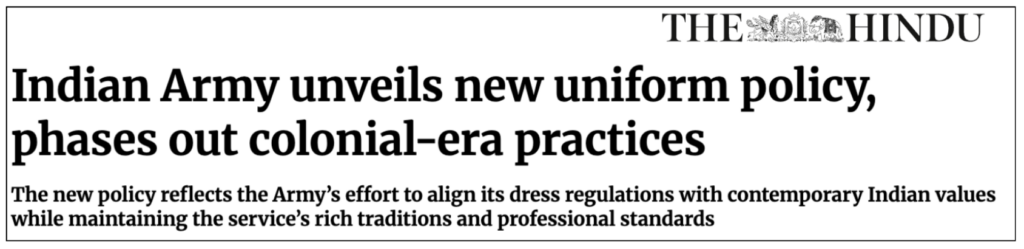
The Indian Army has released a new dress code, the Army Uniforms-2026 pamphlet — a 174-page manual that overhauls uniforms, accoutrements and turnout standards and consciously phases out several colonial-era practices.
It is the first comprehensive revision of the Army’s dress regulations in about eight years and forms part of the wider drive to shed colonial legacies from the armed forces. The Adjutant General, Lt Gen VPS Kaushik, framed it as a step towards aligning dress rules with a contemporary Indian ethos.
- 174-page ‘Army Uniforms-2026’ manual replaces the previous edition issued ~8 years ago.
- The pouch belt is dropped from Mess Dress No. 5 and No. 6.
- Mandatory carriage of the ceremonial sword by Reviewing Officers on parade is made optional.
- Archaic terminology, such as ‘Royal’, is removed across dress descriptions.
- The indigenous Bandi jacket is approved as formal civil attire for officers.
- A new Battle Jacket winter dress will replace the jersey-based Dress 3A by June 2029.
The development matters in the context of:
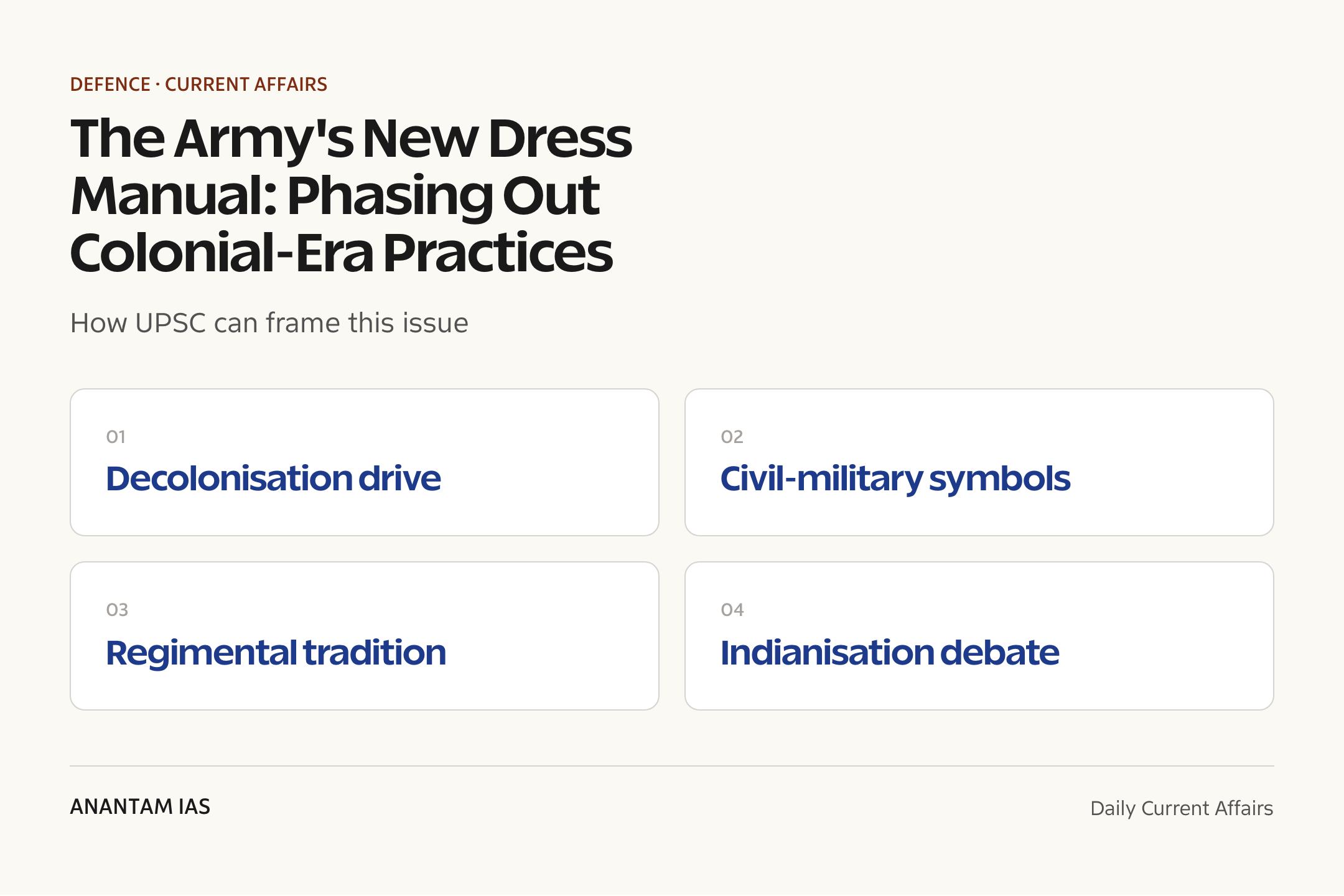
- It matters because uniforms and customs are civil-military symbols — visible markers of how a republic narrates its own identity.
- It extends a decade-long pattern of decolonising state symbols, from the Navy’s ensign to Amrit Udyan and the criminal-law codes.
- It tests the balance between honouring the regimental tradition and discarding the imperial residue embedded in it.
UPSC Relevance
Prelims Relevance
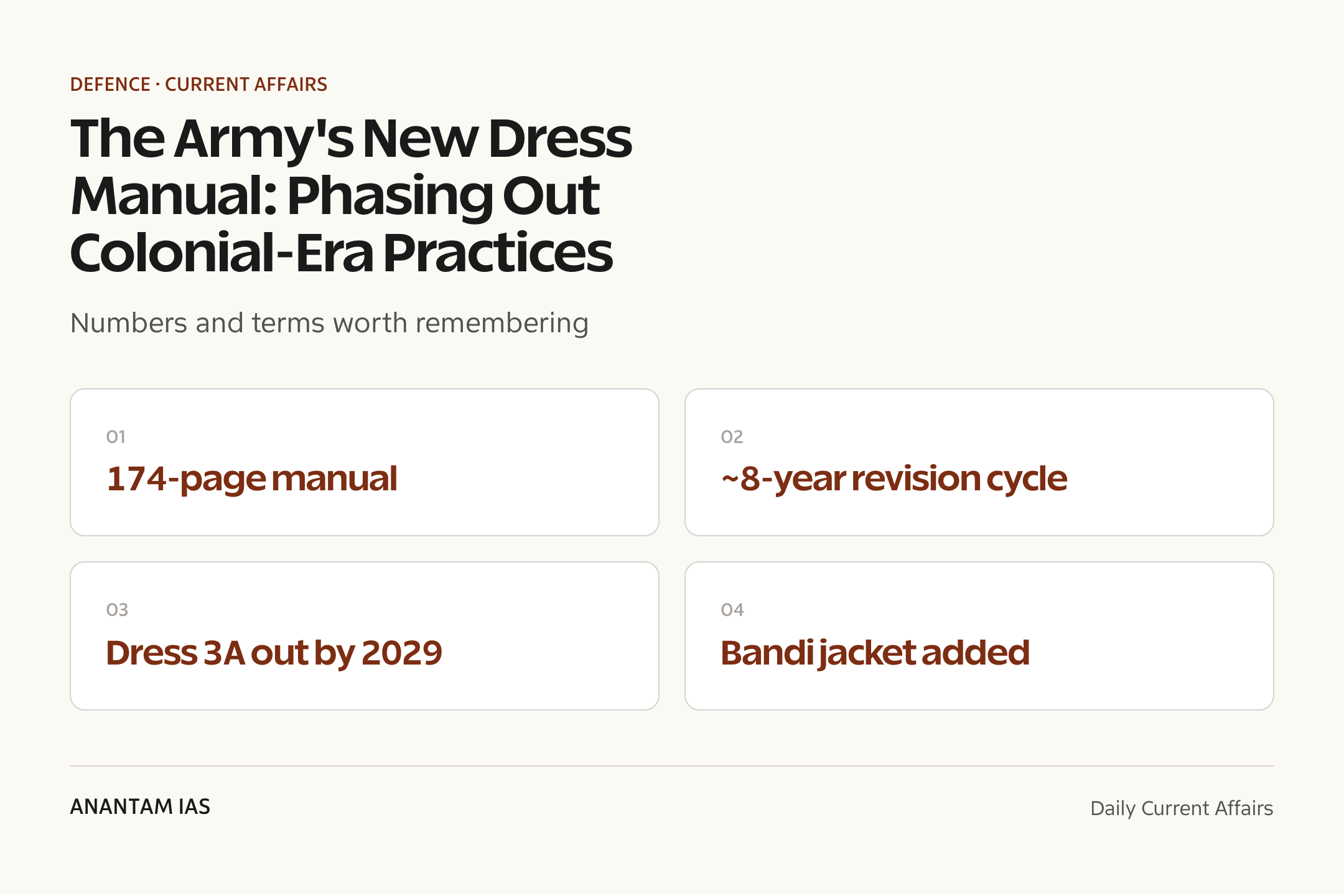
- Army Uniforms-2026 — 174-page Army dress pamphlet, ~8-year revision cycle.
- Adjutant General — the Principal Staff Officer who owns discipline, ceremonial and dress policy.
- Pouch belt — a colonial ceremonial accoutrement, now dropped from Mess Dress No. 5/No. 6.
- Bandi jacket — a closed-neck Indian formal garment approved as officers’ civil attire.
- Battle Jacket / Dress 3A — new winter working dress replacing the jersey by June 2029.
- Decolonisation moves — Navy ensign redesign, IPC/CrPC/Evidence Act to BNS/BNSS/BSA, Mughal Gardens to Amrit Udyan.The The
- Indian Navy earlier permitted the kurta-pyjama in messes as an Indianisation step.
- Regimental system — the class/regional regiment structure inherited from the British Indian Army.
- Term ‘Royal’ — an imperial prefix being stripped from dress nomenclature.
Mains Relevance
GS Paper 3
- Decolonisation of the armed forces — symbolism, force cohesion and the limits of rebranding for actual capability.
- Civil-military relations and the politics of military tradition, regimental identity and ‘Indianisation’.
GS Paper 1
- Uniforms, customs and dress as markers of national identity and the post-colonial reconstruction of culture.
GS Paper 2
- Institutional reform of legacy state symbols and the executive’s role in shaping public memory.
Essay
- Shedding the colonial past: substance versus symbolism in nation-building.
- Tradition and modernity — what a republic chooses to keep and to discard.
Background and Context
What the new manual actually changes
The 2026 pamphlet is a turnout document — it rewrites dress, accoutrements and grooming, not the order of battle.
- Spans roughly 174 pages, covering ceremonial attire, parade customs, working dress, grooming and personal-appearance standards for all ranks.
- Drops the pouch belt — a slung leather/chain belt of imperial cavalry origin — from Mess Dress No. 5 and No. 6; it may still appear at select regimental functions.
- Makes the ceremonial sword optional for Reviewing Officers, ending a mandatory parade custom carried over from British practice.
- Strips the prefix ‘Royal’ and other archaic terms from dress descriptions.
- Frames the exercise as standardisation, simplification and modernisation while keeping military dignity intact.
What gets added — the Indianisation side
Removing imperial items is paired with introducing indigenous and functional alternatives.
- The Bandi jacket — a closed-neck Indian garment — is approved as formal civil attire for officers, worn over a full-sleeved shirt with sober trousers and closed footwear.
- A new Battle Jacket winter working dress is introduced and will progressively replace the jersey-based Dress 3A by June 2029, a roughly three-year transition.
- Grooming and turnout rules are tightened — restrictions on tattoos and piercings, regulated moustache length, and bars on wearing uniform at political, religious or commercial events without sanction.
- Together, these signal a shift from imperial pageantry toward a uniform vocabulary rooted in Indian dress and field utility.
The Adjutant General’s branch — who owns dress policy
Dress and discipline are not random choices; they sit with a specific staff function.
- The Adjutant General (AG) is a Principal Staff Officer at Army Headquarters responsible for discipline, ceremonial, welfare and dress regulations.
- Lt Gen VPS Kaushik, the current AG, authored the foreword, situating the change in a wider decolonisation intent.
- Such pamphlets are policy instruments — once issued, they bind turnout across commands and become examinable as ‘organisation’ facts.
- The roughly 8-year revision cycle shows dress codes evolve slowly and deliberately, not on impulse.
A pattern, not a one-off — the decolonisation arc
This is the latest entry in a sustained effort to recast inherited state symbols.
- The Indian Navy redesigned its ensign in 2022, dropping the St George’s Cross for a seal inspired by Chhatrapati Shivaji.
- The Navy also permitted the kurta-pyjama in officers’ messes as an Indianisation measure.
- Three colonial-era criminal codes — the IPC, CrPC and Indian Evidence Act — were replaced by the BNS, BNSS and BSA.
- Rashtrapati Bhavan’s Mughal Gardens were renamed Amrit Udyan; the Rajpath became Kartavya Path.
- Earlier, the Army began reviewing colonial-origin unit and regiment names and customs — the dress manual fits this trajectory.
The regimental system — why is this sensitive
Customs, accoutrements and names are the connective tissue of the regiment, so change touches morale, not just cloth.
- The regimental system — class and regional regiments — was institutionalised under the British Indian Army and survives as a source of cohesion and pride.
- Many honours, mottos, accoutrements and ceremonies trace to imperial battles, raising the question of what is heritage and what is residue.
- Reformers argue colonial symbols should go; traditionalists caution that abrupt erasure can dilute hard-won esprit de corps.
- The manual’s gradualism — optional swords, phased dress changes — reads as an attempt to decolonise with sensitivity.
Symbolism versus substance — the standing debate
The core analytical tension is whether renaming and re-dressing changes anything that matters for fighting power.
- Critics note that capability rests on doctrine, training, jointness and equipment, not on belts and prefixes.
- Supporters argue that symbols shape identity and morale, and that a sovereign force should not parade in imperial costume.
- The strongest case treats symbolic reform as necessary but not sufficient — meaningful only if paired with hard modernisation.
- Done well, it strengthens institutional legitimacy; done as mere optics, it invites the charge of tokenism.
Way Forward
Pair symbolism with capability
- Anchor the cultural reset to real modernisation — theatre commands, indigenisation and training — so the change is more than cosmetic.
- Sequence symbolic moves so they reinforce, not distract from, hard-power reform.
Reform with regimental sensitivity
- Retain heritage that builds cohesion while discarding genuinely imperial residue, ideally through internal consultation.
- Use phased, optional transitions to protect esprit de corps, as the 2026 manual already attempts.
Communicate the rationale clearly so the public reads decolonisation as confident self-definition rather than a campaign against history, and document changes so they enter institutional memory cleanly.
Conclusion
The Army Uniforms-2026 manual is a small object with a large meaning — by dropping the pouch belt, the optional sword and the ‘Royal’ label while welcoming the Bandi jacket, the Army edits the visible grammar of a colonial inheritance.
Read alongside the Navy’s ensign, the new criminal codes and Amrit Udyan, it confirms a deliberate decolonisation of state symbols. Its lasting worth will depend on whether this confidence in identity is matched by equal seriousness about doctrine, jointness and capability.
UPSC Practice Questions
Prelims MCQ 1
With reference to the Indian Army’s ‘Army Uniforms-2026’ dress manual, consider the following statements:
- It drops the pouch belt from certain categories of mess dress.
- It makes the carriage of the ceremonial sword by Reviewing Officers optional.
- It abolishes the regimental system of the Indian Army.
How many of the above statements are correct?
(a) Only one (b) Only two (c) All three (d) None
Answer: (b) Only two
Explanation:
Statements 1 and 2 are correct — the pouch belt is dropped from Mess Dress No. 5/No. 6, and the sword is made optional for Reviewing Officers. Statement 3 is wrong: the manual changes dress and accoutrements, not the regimental system itself.
Prelims MCQ 2
Which one of the following pairs of decolonisation measures is correctly matched?
(a) Navy’s new ensign — replacement of the St George’s Cross design
(b) Amrit Udyan — renaming of the Rajpath
(c) BNS, BNSS, BSA — new codes replacing the Constitution
(d) Bandi jacket — a colonial-era accoutrement being removed
Answer: (a) Navy’s new ensign — replacement of the St George’s Cross design
Explanation:
The 2022 naval ensign dropped the St George’s Cross for a Shivaji-inspired seal. Amrit Udyan renamed the Mughal Gardens (Rajpath became Kartavya Path); BNS/BNSS/BSA replaced the IPC/CrPC/Evidence Act, not the Constitution; the Bandi jacket is a newly added Indian garment, not a colonial item removed.
UPSC Mains Questions
- The Indian Army’s ‘Army Uniforms-2026’ manual phases out several colonial-era practices. Critically examine the significance of decolonising military symbols and customs, and assess whether such reform meaningfully strengthens the armed forces. (250 words)
- Uniforms, names and customs are markers of national identity. Discuss how recent efforts to shed colonial legacies in India’s institutions reflect a wider project of cultural self-definition, and the cautions such reform must observe. (250 words)
Sources: Business Standard and The Hindu / Indian Express.
Frequently Asked Questions
What is the Army Uniforms-2026 manual?
It is a roughly 174-page pamphlet issued by the Indian Army that revises uniforms, accoutrements, ceremonial customs and grooming standards. Reported around 15 June 2026, it is the first comprehensive update to Army dress regulations in about eight years and consciously phases out several colonial-era practices.
Which colonial-era practices does it phase out?
It drops the pouch belt from Mess Dress No. 5 and No. 6, makes the ceremonial sword optional for Reviewing Officers, and removes archaic terminology such as the prefix ‘Royal’. These are presented as residual colonial accoutrements and customs being replaced under a standardisation and modernisation drive.
What new dress items are introduced?
The indigenous closed-neck Bandi jacket is approved as formal civil attire for officers. A new Battle Jacket winter working dress is introduced and will progressively replace the older jersey-based Dress 3A by June 2029. The reforms also tighten grooming and turnout standards across ranks.
Who is responsible for Army dress policy?
Dress regulations sit with the Adjutant General, a Principal Staff Officer at Army Headquarters who handles discipline, ceremonial and dress. The current Adjutant General, Lt Gen VPS Kaushik, wrote the foreword, framing the changes as aligning the Army’s dress with a contemporary Indian ethos.
How does this fit India’s wider decolonisation of symbols?
It continues a pattern that includes the Navy’s redesigned ensign, permission for kurta-pyjama in messes, the replacement of the IPC, CrPC and Evidence Act by the BNS, BNSS and BSA, and the renaming of the Mughal Gardens as Amrit Udyan. The dress manual recasts inherited imperial symbols in the armed forces.
Does dropping colonial customs make the Army stronger?
Symbolic reform shapes identity, morale and institutional legitimacy, but capability ultimately rests on doctrine, training, jointness and equipment. Most analysts treat such changes as necessary but not sufficient — valuable only when paired with genuine modernisation rather than pursued as optics alone.