Artemis II: Lunar Flyby Mission
Why in News?
- The final countdown for Artemis II (Lunar Flyby Mission) has begun, with launch scheduled for 1 April 2026. It is NASA’s first crewed mission beyond low Earth orbit in over five decades since the Apollo era.

| UPSC Relevance: (GS-3 Science and Technology: Space Technology) Prelims: Artemis Mission |
What is Artemis Mission?
- Artemis is a series of missions for Lunar exploration.
- Joint Mission: Led by the National Aeronautics and Space Administration (NASA), along with the European Space Agency (ESA), Japan Aerospace Exploration Agency (JAXA), and the Canadian Space Agency (CSA).
- Aim: To send astronauts to the lunar south pole and eventually establish a permanent presence (base) on the Moon. To use Moon as a launch pad for deep space explorations and human missions to Mars.
Key Missions under Artemis:
- Artemis 1: Uncrewed test flight of the Orion spacecraft around the Moon (launched in 2022).
- Artemis 2: Lunar flyby mission (fly astronauts around the Moon and back without landing); planned in 2026. First crewed mission of the Artemis programme.
- Artemis 3: Mission to test docking and landing systems in lunar orbit; planned launch in 2027.
- Artemis 4: Landing crewed mission near the lunar South Pole; planned launch in 2028. It was originally intended to deliver astronauts to the Lunar Gateway (a proposed space station in lunar orbit). However, recent updates (2026) indicate possible changes in mission architecture or reduced emphasis on Lunar Gateway.
Artemis II Mission:
- Launch target: April 2026
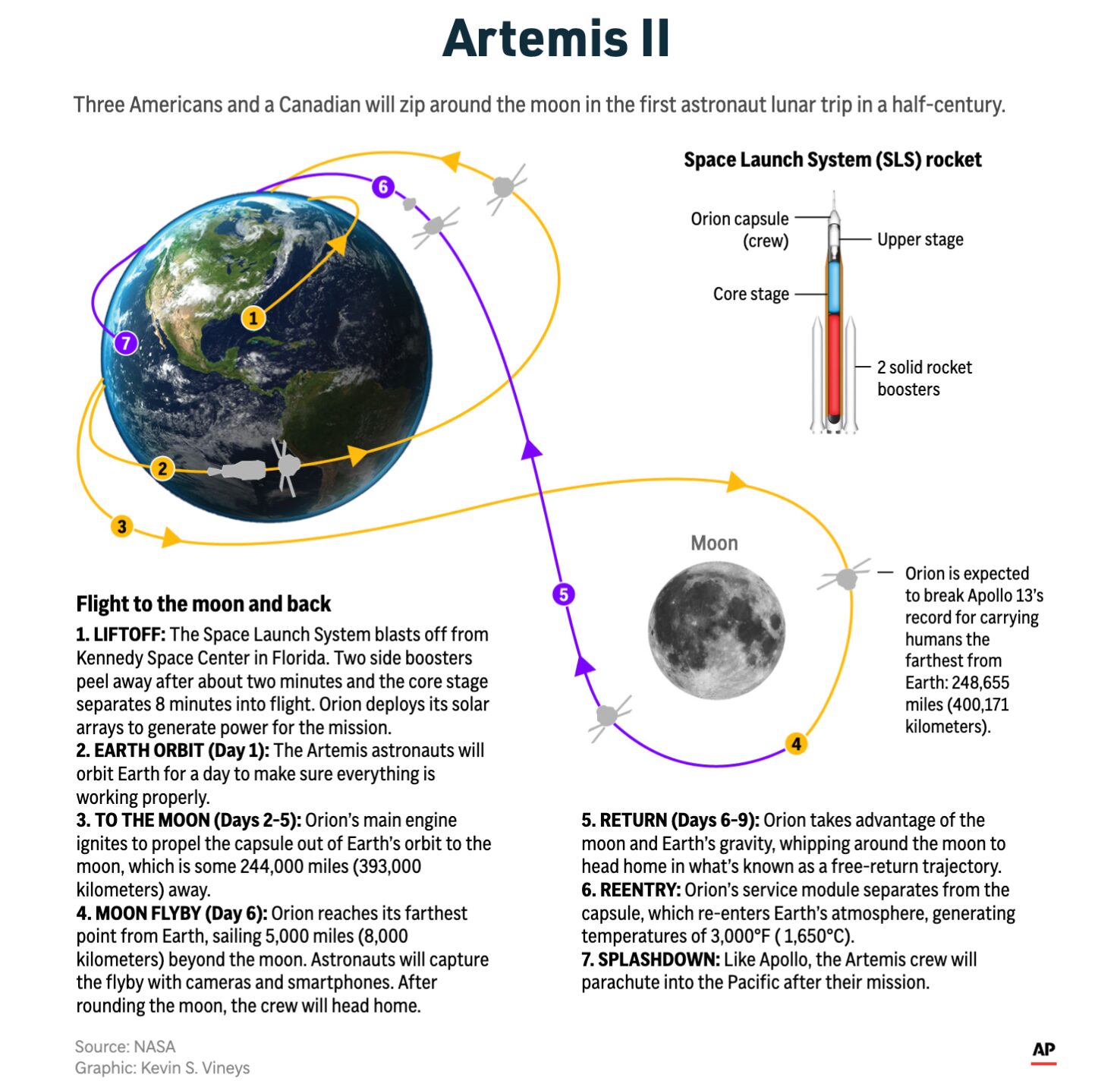
- A 10-day-long lunar crewed mission where four astronauts will fly around the Moon and return to Earth without landing.
- Aim: To test and stress Orion’s life-support systems to make sure that it is capable of supporting astronauts to live and work in deep space, and collect valuable flight test data.
- Lunar free return trajectory: Earth’s gravity will naturally pull the spacecraft back home after flying by the Moon. The spacecraft does not need any propulsion on its return journey. It takes advantage of the Earth-Moon gravity field.
- It will be the second flight of the Space Launch System (SLS), the first crewed mission of the Orion spacecraft, and the first crewed mission beyond low Earth orbit since Apollo-17 in 1972.
Practice MCQ:
Q. With reference to the Artemis II mission, consider the following statements:
1. It is the first crewed mission of the Orion spacecraft and the second flight of the Space Launch System (SLS).
2. The mission involves landing astronauts near the lunar South Pole.
3. The spacecraft will follow a free-return trajectory without requiring propulsion for the return journey.
4. It will be the first crewed mission beyond low Earth orbit since Apollo 17 in 1972.
Which of the statements given above are correct?
(a) 1, 3 and 4 only
(b) 1 and 2 only
(c) 2 and 3 only
(d) 1, 2, 3 and 4
Answer: (a)
UPSC PYQ 2020
Q. “The experiment will employ a trio of spacecraft flying in formation in the shape of an equilateral triangle that has sides one million kilometres long, with lasers shining between the craft.” The experiment in question refers to:
(a) Voyager-2
(b) New Horizons
(c) LISA Pathfinder
(d) Evolved LISA
Answer: (d)