Ashok Dham Stampede and Crowd Safety
Why in News?
The Ashok Dham stampede in Bihar’s Lakhisarai district on 17 August 2026 killed at least seven devotees and injured several others during a heavy morning arrival of visitors.
- The Indian Express reported the district police’s confirmation of seven deaths and injuries, while The Hindu also reported at least seven deaths and more than ten injured. Early injury totals varied, so a single final injury.
- The incident occurred at about 6:40 a.m., according to the District Magistrate quoted by The Hindu, when a large number of devotees were approaching or waiting near the temple.
- The District Magistrate said two trains arrived in the 6:30-6:45 a.m. window and added to the crowd. A transport arrival can act as a pulse load if the pedestrian route and holding areas cannot meter people.
- A police officer told The Indian Express that an electric pole had fallen in a field and that warnings from people behind triggered panic farther ahead. The Hindu reported an eyewitness account involving a broken bamboo.
- The incident should be studied as a crowd-management failure chain, not reduced to blaming visitors. Density, route geometry, information, barriers, electrical hazards, staffing and medical access interact before a crowd collapse becomes fatal.
- The National Disaster Management Authority’s 2014 guide treats crowd disasters as broadly preventable through capacity planning, risk assessment, preparedness, incident response and trained personnel.
- Religious gatherings combine predictable calendar peaks with uncertain arrival surges. Planning must cover the full journey: transport nodes, approach roads, staging areas, queues, the venue, exits and dispersal routes.
- Public safety depends on service design as much as police deployment. Water, toilets, shade, accessible lanes, medical posts and trustworthy waiting-time information reduce distress and unsafe attempts to bypass queues.
UPSC Relevance
Prelims Relevance
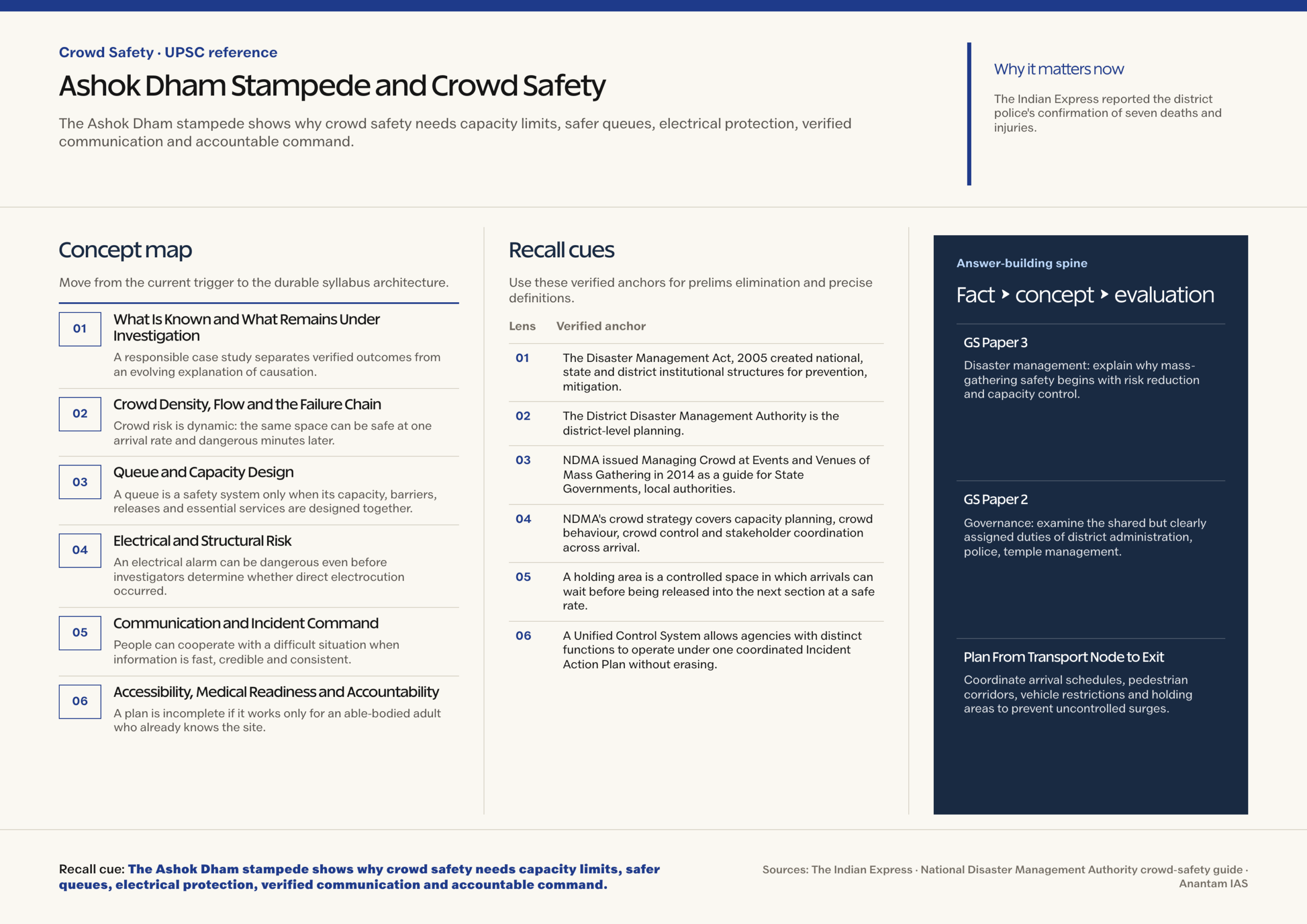
- The Disaster Management Act, 2005 created national, state and district institutional structures for prevention, mitigation, preparedness and response.
- The District Disaster Management Authority is the district-level planning, coordinating and implementing body under the Disaster Management Act.
- NDMA issued Managing Crowd at Events and Venues of Mass Gathering in 2014 as a guide for State Governments, local authorities, administrators and organisers.
- NDMA’s crowd strategy covers capacity planning, crowd behaviour, crowd control and stakeholder coordination across arrival, attendance and departure.
- A holding area is a controlled space in which arrivals can wait before being released into the next section at a safe rate; it is not the same as an exit route.
- A Unified Control System allows agencies with distinct functions to operate under one coordinated Incident Action Plan without erasing their individual accountability.
Mains Relevance
GS Paper 3
- Disaster management: explain why mass-gathering safety begins with risk reduction and capacity control, not only post-incident rescue.
- Infrastructure safety: connect barrier design, electrical isolation, lighting, transport pulses, medical access and emergency communication as one system.
GS Paper 2
- Governance: examine the shared but clearly assigned duties of district administration, police, temple management, transport agencies, health services, fire services and utilities.
- Accountability and inclusion: discuss independent technical inquiry, public disclosure, corrective action and safe access for women, children, older persons and persons with disabilities.
Essay
- A gathering becomes safe not when people are ordered to be disciplined, but when institutions design movement so that one failure cannot become a human crush.
Background and Context
What Is Known and What Remains Under Investigation
A responsible case study separates verified outcomes from an evolving explanation of causation.
- At least seven people died at Ashok Dham on the morning of 17 August 2026. Multiple reports said most victims were women, but identification and formal reporting were continuing in the first hours.
- Officials and witnesses described a heavy arrival of devotees, people falling and a subsequent pile-up. The Indian Express reported that most injured persons were out of danger at the time of its update, with one referred.
- One official account linked the crowd pulse to two trains arriving close together. That observation supports examining transport-to-venue flow, but it does not by itself establish negligence or the complete cause.
- Reports mention a failed bamboo barricade and an electrical pole or warning about it. Investigators must establish whether the pole was energised, when each failure occurred, what messages spread, and whether the barricade failed before or.
- The inquiry should preserve CCTV, control-room logs, duty rosters, public-address records, electrical inspection records, train arrival data, medical timelines and the physical condition of barriers. A credible sequence must rest on evidence rather than hindsight.
Crowd Density, Flow and the Failure Chain
Crowd risk is dynamic: the same space can be safe at one arrival rate and dangerous minutes later.
- The key variables are people per unit area, arrival rate, service rate and route width. When more people enter a section than can leave it, density rises even if the venue’s total attendance appears manageable.
- A sudden pulse from trains, buses or a released holding area can meet a slow point such as security screening, a turn, a gate or a narrow worship area. The resulting queue may propagate backward beyond.
- Inward and outward streams should not cross. NDMA warns that colliding flows, reverse movement and reliance on one exit can destabilise a crowd, especially when a rumour or visible hazard causes people to change direction.
- At very high density, individual choice becomes limited. People can be displaced by pressure waves, lose footing and struggle to breathe. Calling this simply panic can conceal the physical conditions created by the site and operating.
- Monitoring must focus on critical points and trends, not only total headcount. Sector observers, CCTV and staff reports should trigger an early stop to inflow before distress becomes visible.
Queue and Capacity Design
A queue is a safety system only when its capacity, barriers, releases and essential services are designed together.
- Capacity should be calculated for the weakest segment: the approach path, holding pen, checkpoint, narrow turn, worship point or exit. A large open ground does not compensate for a bottleneck downstream.
- Staging and holding areas should meter visitors in controlled batches. Each release requires a defined number, timing and confirmation that the next sector has room, rather than pressure from the rear determining movement.
- Barriers should guide flow without becoming brittle hazards or blocking emergency escape. They need structural suitability for expected loads, secure anchoring, inspection and layouts that avoid trapping people in dead ends.
- Separate entry and exit routes, multiple escape options and an always-clear emergency lane reduce conflicting movement. Temporary shops, parked vehicles and service points must not narrow these routes.
- Long waits need shade, water, toilets, rest points and clear expected waiting times. Priority or assisted lanes should support children, pregnant women, older persons and persons with disabilities without creating unsafe cross-flows.
Electrical and Structural Risk
An electrical alarm can be dangerous even before investigators determine whether direct electrocution occurred.
- Generators, distribution boxes and circuit breakers should be isolated from crowds, fenced where necessary and protected from weather. Cables crossing pedestrian routes should be removed, routed overhead safely or covered against tripping and damage.
- Temporary poles, lighting, public-address equipment and extension wiring need competent installation, load assessment, earthing, residual-current protection where appropriate and documented checks before opening.
- A fallen pole or suspected live wire requires a pre-agreed response: isolate power, stop inflow, create distance, issue one verified instruction and open a safe diversion. Conflicting shouts can produce harmful reverse movement.
- Barrier and electrical inspections should be independent of the teams facing pressure to open the venue quickly. Defects must have a named owner and closure deadline.
- The Ashok Dham inquiry should not assume that an electrical fault caused the deaths merely because a pole figures in early reports. It should test the electrical, structural and crowd-flow evidence as connected but distinct questions.
Way Forward
Plan From Transport Node to Exit
- Coordinate train and bus schedules, pedestrian corridors, vehicle restrictions and holding areas so arrivals do not create uncontrolled pulse loads.
- Model peak inflow, service and dispersal rates; cap or pause entry whenever the next sector approaches its safe operating limit.
- Use fit-for-purpose barriers, separate flows, protected emergency lanes and documented structural checks before every major gathering.
- Audit electrical installations, isolate equipment from the public and rehearse power isolation plus safe diversion for any suspected fault.
Conclusion
- The Ashok Dham stampede is not instructive because every detail is already known.
- India already has an NDMA framework for mass gatherings.
UPSC Practice Questions
Prelims MCQ 1
With reference to the National Disaster Management Authority’s guidance on crowd management, consider the following statements:
- Capacity planning should cover holding areas and the rate at which the venue can serve visitors.
- Inward and outward crowd flows should preferably be mixed so that all routes remain active.
- Unified control can coordinate agencies under one Incident Action Plan without removing their individual accountability.
How many of the above statements are correct?
(a) Only one (b) Only two (c) All three (d) None
Answer: (b) Only two
Explanation:
Statements 1 and 3 are correct. NDMA links capacity to venue and holding-area throughput, and its unified-control model preserves agency accountability. Statement 2 is incorrect because colliding inward and outward flows increase risk and should be separated.
Prelims MCQ 2
Which one of the following best describes a holding area in mass-gathering management?
(a) A locked enclosure used after an incident (b) A controlled space that meters people into the next section at a safe rate (c) The lane reserved exclusively for ambulances (d) Any open ground outside the notified venue
Answer: (b) A controlled space that meters people into the next section at a safe rate
Explanation:
A holding area absorbs arrival variation and allows controlled batch release according to downstream capacity. It must have suitable services and safe escape options; it is not a substitute for an emergency lane or a generic open space.
UPSC Mains Questions
- Crowd disasters are often the outcome of interacting design and governance failures rather than one moment of panic. Discuss with reference to mass gatherings in India. (GS Paper 3)
- Suggest an accountable district-level framework for capacity control, electrical safety, risk communication, accessibility and incident command at major religious gatherings. (GS Paper 2)
Sources: The Indian Express and National Disaster Management Authority, Managing Crowd at Events and Venues of Mass Gathering.
Frequently Asked Questions
What happened at Ashok Dham on 17 August 2026?
At least seven devotees died and several were injured during a heavy morning gathering at Ashok Dham in Lakhisarai, Bihar. Early reports described people falling after crowd pressure increased. Accounts involving a broken barricade, an electrical pole and warning messages.
Why should the incident not be explained simply as panic?
The word panic can shift attention to individual behaviour. Crowd outcomes also depend on density, arrival rate, bottlenecks, barriers, conflicting flows and the information available. At high density, people may have little control over their movement. Investigation should examine these.
What does NDMA recommend for crowd capacity?
NDMA asks planners to estimate demand, venue throughput and holding-area capacity across arrival, attendance and departure. Staging points should count or monitor visitors and regulate release. Capacity should reflect the weakest route or service point, while emergency exits and responder.
How can electrical risk trigger a crowd disaster?
A real or suspected electrical fault can create injury risk and sudden reverse movement. Equipment should be isolated, weather-protected and inspected, while cables should not create trip hazards. If a fault is reported, authorities need rapid power isolation, a stopped.
What is unified control in a mass gathering?
Unified control brings agencies with different mandates into one coordinated operating structure and Incident Action Plan. Police, administration, health, fire, utilities, transport and organisers share situational information and objectives, but each remains accountable for its assigned professional and legal duties.