Astrosat

Why in news:
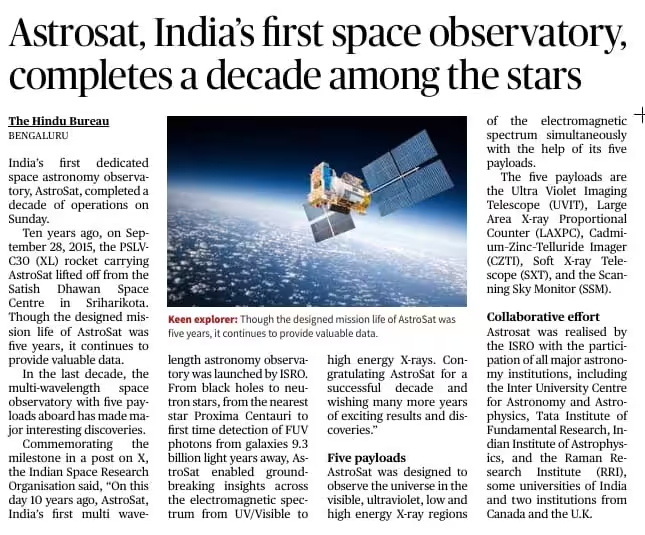
India’s first space observatory, Astrosat, has successfully completed a decade of operations since its launch on September 28, 2015, by PSLV-C30 from Sriharikota. Although its designed mission life was only 5 years, Astrosat has continued to function and provide valuable scientific data for 10 years.
Observatory: A space-based instrument designed to study celestial objects.
UPSC Relevance:
Achievements of Indians in science & technology.
UPSC PYQ:
Q. Recently, scientists observed the merger of giant ‘blackholes’ billions of light-years away from the Earth. What is the significance of this observation? (2019)
(a) ‘Higgs boson particles’ were detected.
(b) ‘Gravitational waves’ were detected.
(c) Possibility of intergalactic space travel through ‘wormhole’ was confirmed.
(d) It enabled the scientists to understand ‘singularity’
About Astrosat:
AstroSat with a lift-off mass of 1515 kg was launched on September 28, 2015 into a 650 km orbit inclined at an angle of 6 deg to the equator by PSLV-C30 from Satish Dhawan Space Centre, Sriharikota.
- AstroSat is the first dedicated Indian astronomy mission aimed at studying celestial sources in X-ray, optical and UV spectral bands simultaneously.
- The payloads cover the energy bands of Ultraviolet (Near and Far), limited optical and X-ray regime (0.3 keV to 100keV).
- One of the unique features of AstroSat mission is that it enables the simultaneous multi-wavelength observations of various astronomical objects with a single satellite.
Objectives:
- To understand high energy processes in binary star systems containing neutron stars and black holes.
- Study star birth regions and high energy processes in star systems lying beyond our galaxy.
- Detect new briefly bright X-ray sources in the sky, etc.
Five Payloads:
- Ultra Violet Imaging Telescope (UVIT)
- Large Area X-ray Proportional Counter (LAXPC)
- Cadmium-Zinc-Telluride Imager (CZTI)
- Soft X-ray Telescope (SXT)
- Scanning Sky Monitor (SSM)
Scientific Achievements:
- Studied phenomena from black holes to neutron stars.
- Provided first detection of UV photons from Proxima Centauri.
- Helped measure X-rays from distant galaxies (as far as 9.3 billion light years away).
- Enabled groundbreaking insights across the electromagnetic spectrum.