ASUSE: What the Survey of Unincorporated Enterprises Tells Us About the Informal Economy
Why in News?
The Ministry of Statistics and Programme Implementation (MoSPI), through the National Statistics Office (NSO), runs the Annual Survey of Unincorporated Sector Enterprises (ASUSE) to measure India’s vast non-agricultural informal economy. As the survey moves to an annual cycle, its findings have become a recurring fixture in debates over jobs, productivity and the true size of the unorganised sector.
ASUSE counts the country’s small, owner-run units — roadside workshops, tailors, kirana shops, household manufacturers — and reports their number, employment, Gross Value Added (GVA) and increasingly their use of the internet and formal registration. It is the primary input MoSPI uses to estimate output for the unorganised segment in national accounts.
- ASUSE succeeds the older NSS unincorporated-enterprise surveys (the 73rd round of 2015-16 was the last in the earlier series).
- It covers non-agricultural establishments across manufacturing, trade and other services that are not registered as companies.
- Estimates feed directly into GDP/GVA figures for the unorganised sector compiled by the NSO.
- Recent rounds added indicators on internet use and maintenance of accounts, tracking digital adoption and formalisation.
The development matters in the context of:
- Why it matters for jobs: the informal sector employs the overwhelming majority of India’s non-farm workforce, so its health is a proxy for livelihood security.
- Why it matters for data: without reliable enterprise surveys, GDP estimates for the unorganised economy rest on weak benchmarks.
- Why it matters for policy: schemes like Udyam registration and e-Shram are judged by how far the informal sector is formalising.

UPSC Relevance
Prelims Relevance
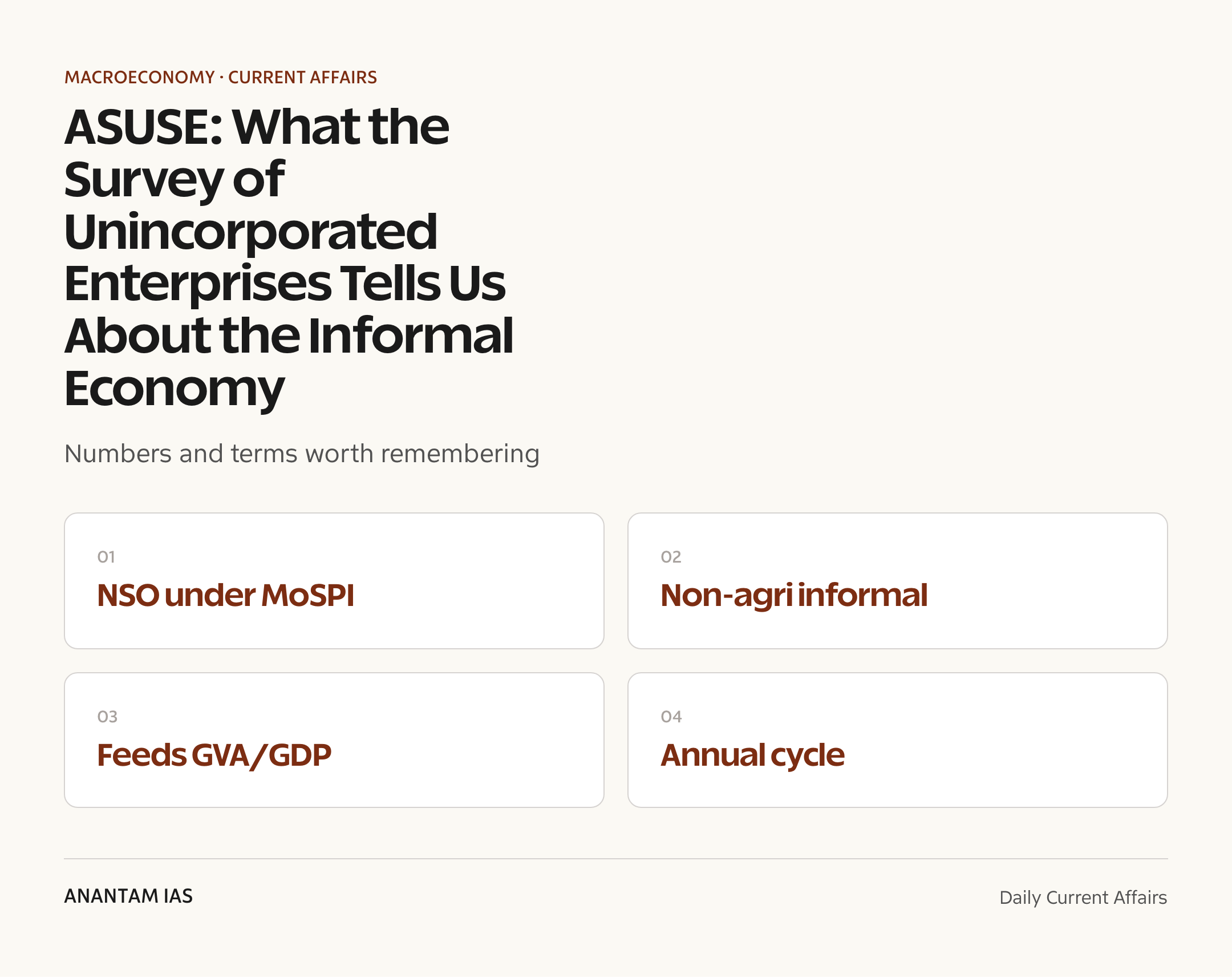
- ASUSE — Annual Survey of Unincorporated Sector Enterprises; conducting body NSO under MoSPI.
- Predecessor: NSS surveys of unincorporated non-agricultural enterprises (last full round 73rd, 2015-16).
- Coverage: non-agricultural manufacturing, trade, other services; excludes companies and agriculture.
- Key concept: Gross Value Added (GVA) = output minus intermediate consumption.
- Unincorporated vs incorporated: unincorporated units are proprietorships/partnerships, not registered as companies under the Companies Act.
- Formalisation tools: Udyam Registration (MSMEs) and e-Shram (unorganised workers’ database).
- MoSPI also conducts the Periodic Labour Force Survey (PLFS) and Annual Survey of Industries (ASI) — distinguish the three.
- OAE vs establishment: an Own-Account Enterprise (OAE) runs without any hired worker; an establishment hires at least one.
Mains Relevance
GS Paper 3
- Significance of robust enterprise surveys for credible national income estimation and the unorganised sector.
- Informal sector’s role in employment, productivity gaps, and the challenge of formalisation.
GS Paper 2
- Strengthening India’s official statistical system and the governance of data quality.
Essay
- The unseen economy: counting the work that holds India together.
- Data is the new oil only if we choose to measure honestly.
Background and Context
What ASUSE actually measures
ASUSE is a sample survey of unincorporated non-agricultural enterprises, designed to capture the economic activity that company registers and factory rolls miss.
- Universe: proprietary and partnership units in manufacturing, trade and other services that are not incorporated as companies or cooperatives.
- Variables captured: number of enterprises, employment, fixed assets, GVA, value of output and operating expenses.
- Distinguishes Own-Account Enterprises (OAEs) — run by household labour alone — from establishments that employ at least one hired worker.
- Newer rounds record internet use, computer use and whether the unit maintains accounts — signals of digitisation and formal practice.
- Excluded: agriculture, and any unit registered under the Factories Act or as a company (those are picked up by the Annual Survey of Industries).
From NSS rounds to an annual survey
ASUSE is the successor to a long line of National Sample Survey (NSS) enterprise surveys, but with a crucial upgrade — frequency.
- Earlier, unincorporated enterprises were surveyed only periodically; the 73rd NSS round (2015-16) was the last in that older series.
- ASUSE shifts measurement to an annual cycle, narrowing the gap between successive benchmarks.
- Annual data lets the NSO update GDP estimates for the unorganised sector with fresher inputs rather than projecting from a dated base year.
- It complements the annual Periodic Labour Force Survey (PLFS), giving both an enterprise-side and a household-side view of informal work.
Why it feeds GDP and national accounts
The informal sector is statistically hard to see, so ASUSE acts as the empirical anchor for estimating its contribution to the economy.
- National income for the unorganised segment is largely estimated, not directly recorded — ASUSE supplies the per-worker GVA benchmarks used in that estimation.
- These benchmarks are combined with workforce numbers to scale up sector output in the national accounts.
- A stale benchmark risks mis-stating the size of the informal economy and, with it, headline GDP.
- So ASUSE matters far beyond the units it surveys — it shapes how the whole unorganised economy is valued.
What the data reveals about the informal economy
Read together, ASUSE indicators sketch a sector that is huge in headcount but thin in productivity.
- A very large share of non-farm units are tiny Own-Account Enterprises with no hired worker — survival livelihoods rather than growing firms.
- Average GVA per worker in the informal sector trails the formal sector sharply, exposing a deep productivity gap.
- Rising internet and account-keeping adoption hints at gradual formalisation, but from a low base.
- Sectoral mix is dominated by trade and services, with manufacturing units smaller and more vulnerable to shocks.
Formalisation: Udyam, e-Shram and the bridge to data
Policy increasingly tries to pull informal units into formal registers, and ASUSE is one way to check whether that bridge is being crossed.
- Udyam Registration brings MSMEs onto a formal portal, unlocking credit, schemes and procurement preferences.
- e-Shram builds a national database of unorganised workers to deliver social security and benefits.
- ASUSE’s questions on registration and account-keeping help gauge whether such drives are widening formal coverage on the ground.
- Formalisation is not automatic: many units stay informal to avoid compliance cost, so survey evidence keeps the policy debate honest.
Where ASUSE sits in MoSPI's statistical system
ASUSE is one pillar of a broader official statistics architecture, and confusing it with its siblings is a common exam trap.
- ASUSE — unincorporated, non-agricultural enterprises (the informal/unorganised side).
- Annual Survey of Industries (ASI) — registered factories under the Factories Act (the organised manufacturing side).
- Periodic Labour Force Survey (PLFS) — household-based employment and unemployment data.
- All three are run by the National Statistics Office (NSO) within MoSPI, the apex body for India’s official statistics.
Way Forward
Tighten the statistical backbone
- Sustain the annual frequency so GDP benchmarks stay current rather than drifting on old base years.
- Improve the sampling frame by linking it to live registers like Udyam and GST data to reduce coverage gaps.
Use the data to lift productivity
- Target credit, skilling and digital tools at the low-GVA Own-Account Enterprises that ASUSE flags.
- Treat formalisation as a means to better terms — credit, markets, social security — not as an end in itself.
Pair ASUSE with PLFS and administrative data so that enterprise-side and worker-side evidence are read together, giving policymakers a single, coherent picture of the informal economy rather than fragments.
Conclusion
ASUSE is unglamorous but foundational. By systematically counting the workshops, shops and home-based units that make up the bulk of India’s non-farm economy, it turns an otherwise invisible sector into measurable evidence — and that evidence flows straight into the nation’s GDP estimates.
For UPSC, the survey is best understood as the meeting point of three durable themes: the informal economy, the integrity of India’s statistical system, and the long project of formalisation. Get those linkages right, and ASUSE stops being a name to memorise and becomes a lens on how India sees its own economy.
UPSC Practice Questions
Prelims MCQ 1
With reference to the Annual Survey of Unincorporated Sector Enterprises (ASUSE), consider the following statements:
- It is conducted by the National Statistics Office under MoSPI.
- It covers registered factories operating under the Factories Act.
- It excludes agricultural enterprises from its coverage.
How many of the above statements are correct?
(a) Only one (b) Only two (c) All three (d) None
Answer: (b) Only two
Explanation:
ASUSE is conducted by the NSO under MoSPI (1 correct) and excludes agriculture (3 correct). It covers unincorporated non-agricultural units, NOT registered factories — those fall under the Annual Survey of Industries (2 wrong).
Prelims MCQ 2
Which of the following is correctly matched with the population it primarily surveys?
(a) ASI — household employment and unemployment (b) PLFS — registered factories under the Factories Act (c) ASUSE — unincorporated non-agricultural enterprises (d) ASUSE — incorporated companies under the Companies Act
Answer: (c) ASUSE — unincorporated non-agricultural enterprises
Explanation:
ASUSE surveys unincorporated non-agricultural enterprises. ASI covers registered factories, PLFS measures household employment, and incorporated companies are outside ASUSE’s scope.
UPSC Mains Questions
- Reliable measurement of the informal sector is essential for credible national income estimation. In this light, examine the significance of the Annual Survey of Unincorporated Sector Enterprises (ASUSE) for India’s statistical system. (250 words)
- The informal economy employs the bulk of India’s non-farm workforce yet contributes far less per worker than the formal sector. Discuss the productivity challenge this poses and suggest measures to address it. (250 words)
- Formalisation of enterprises is often presented as a policy goal in itself. Critically evaluate this view with reference to instruments such as Udyam registration and e-Shram. (150 words)
Sources: MoSPI, National Statistics Office and PIB, Ministry of Statistics and Programme Implementation.
Frequently Asked Questions
What is ASUSE?
ASUSE is the Annual Survey of Unincorporated Sector Enterprises, conducted by the National Statistics Office under MoSPI. It measures India’s non-agricultural informal enterprises — their number, employment, Gross Value Added, assets and increasingly their internet use and registration status — to map the unorganised economy.
Who conducts ASUSE?
It is conducted by the National Statistics Office (NSO), which functions under the Ministry of Statistics and Programme Implementation (MoSPI). MoSPI is the apex body for India’s official statistics, and the NSO also runs surveys such as the Periodic Labour Force Survey and the Annual Survey of Industries.
How is ASUSE different from the Annual Survey of Industries?
ASUSE covers unincorporated, non-agricultural units that are not registered as companies or factories — the informal sector. The Annual Survey of Industries (ASI) covers registered factories operating under the Factories Act, which form the organised manufacturing side. The two surveys deliberately measure different universes.
Why does ASUSE matter for GDP?
Output of the unorganised sector is largely estimated rather than directly recorded. ASUSE supplies per-worker Gross Value Added benchmarks that the NSO combines with workforce numbers to scale up the sector’s contribution in the national accounts. A stale benchmark can distort the estimated size of the informal economy and headline GDP.
What did ASUSE replace?
ASUSE succeeds the older National Sample Survey rounds on unincorporated non-agricultural enterprises, the last full round of which was the 73rd round in 2015-16. The key change is frequency: ASUSE measures the sector annually, keeping national-accounts benchmarks fresher than the earlier periodic approach.
How does ASUSE connect to formalisation?
ASUSE records whether units maintain accounts, use the internet and are registered. Read alongside drives like Udyam registration for MSMEs and the e-Shram database for unorganised workers, these indicators help gauge whether the informal sector is gradually entering formal registers and practices.