DFS launches revamped BAANKNET one-stop e-auction portal for properties
Why in News?
The DFS launched a revamped BAANKNET e-auction portal that centralises property listings of all public sector banks to streamline recovery, increase transparency and make asset disposal more efficient.
- Launch by DFS Secretary signals central government push for digital consolidation of bank asset disposals.
- Portal aggregates listings from all PSBs, offering a one-stop marketplace for buyers and investors.
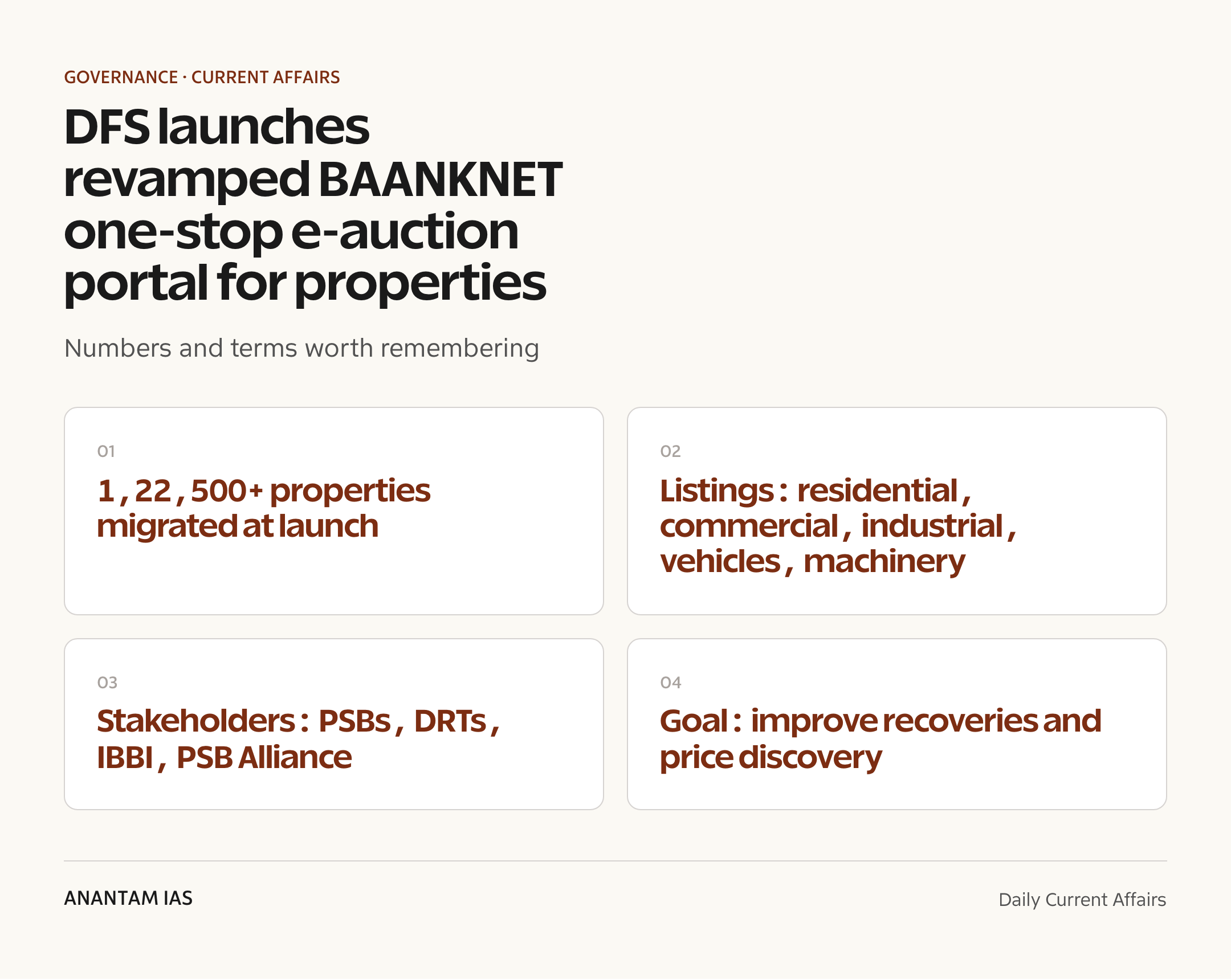
- Migration of over 1,22,500 properties to the new system at launch indicates scale and immediate utility.
- Expected to improve recoveries for PSBs, which can strengthen bank balance sheets and support credit flow.
The development matters in the context of:
- Asset recovery by banks has been a long-standing challenge, with dispersed auction platforms across banks creating opacity and inefficiency.
- National initiatives earlier aimed at resolving stressed assets include Insolvency and Bankruptcy Code, SARFAESI enforcement and Debt Recovery Tribunals; BAANKNET complements these by focusing on secondary-market disposal.
- Public sector banks hold significant amounts of non-performing assets and attached collateral that require transparent, wide-reach marketplaces to realise fair value.
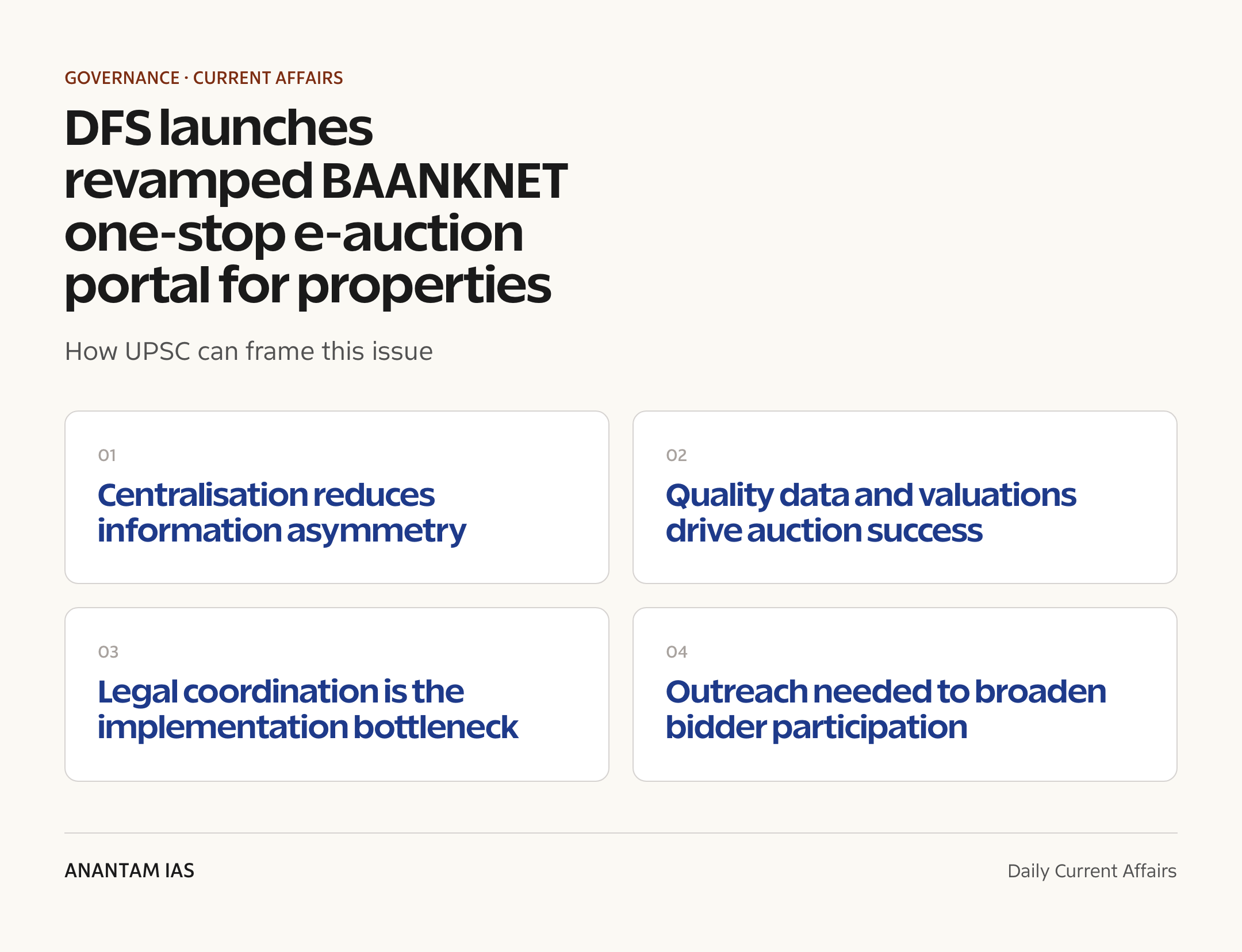
- Digital platforms can lower transaction costs, widen bidder participation and reduce collusion risk associated with fragmented auctions.
- Coordination with DRTs, IBBI and PSB operational teams is critical for legal clearance, asset handover and dispute resolution post-auction.
- Large-scale property data standardisation and migration are prerequisites for any centralised e-auction marketplace to function effectively.

UPSC Relevance
Prelims Relevance
- BAANKNET is a centralised e-auction portal launched by the Department of Financial Services for property auctions of PSBs.
- The portal consolidates residential, commercial, industrial properties, vehicles and machinery from multiple banks in a single platform.
- Over 1,22,500 properties were migrated to the new portal at launch, indicating scale.
Mains Relevance
GS3 Economy
- Analyse how a centralised e-auction portal can strengthen bank balance sheets by improving asset disposals and recoveries.
- Discuss the governance, legal and operational challenges in implementing a unified digital marketplace for distressed assets.
- Evaluate the impact of consolidated e-auctions on market transparency, competition and price discovery in the secondary market for collateral.
Essay
- Digital interventions in public finance and banking can be evaluated in essay questions on economic reforms, governance and technology-led efficiency.
- BAANKNET can be used as a case study in essays on structural reforms to improve the banking sector and access to credit.
Background and Context
Why asset disposal matters for banks
Realising value from collateral is a key route for banks to recover dues and free up capital for fresh lending.
- Non-performing assets lock capital and reduce banks’ ability to extend credit, affecting economic growth.
- Efficient disposal of attached assets shortens recovery timelines and reduces carrying costs.
- Public sector banks hold a large share of stressed assets; recovery rates directly influence fiscal exposure and recapitalisation needs.
- Transparent auctions can improve market confidence and prevent price suppression due to lack of bidders.
Existing legal and institutional framework
Multiple legal mechanisms support creditor recovery, but practical constraints persist.
- SARFAESI Act gives banks powers to attach and sell secured assets without court intervention in many cases.
- Insolvency and Bankruptcy Code provides an alternate route for corporate defaults, with a structured resolution timeline.
- Debt Recovery Tribunals and Debt Recovery Appellate Tribunals handle adjudication of recovery cases and appeals.
- Coordination gaps between banks, tribunals and buyers often slow down physical transfer and possession processes.
Fragmentation of auction platforms: the problem
Prior to BAANKNET, banks used individual portals or third-party marketplaces that varied widely.
- Different platforms had diverse listing formats, searchability and verification standards, making comparison hard for buyers.
- Smaller bidder base per platform reduced price discovery and encouraged bid manipulation in some locales.
- Operational overhead for banks increased as they trained staff and maintained multiple seller accounts.
- Data silos prevented analytics at scale about asset types, recovery rates and regional patterns.
BAANKNET features at launch
The revamped portal introduces centralisation and upgraded functionality to address prior gaps.
- Consolidated listings across all PSBs include residential, commercial, industrial plots, vehicles, plant and machinery.
- Improved search and discovery helps buyers filter by asset type, location, reserve price and auction date.
- Training provided to PSB executives and DRT recovery officers to ensure uniform usage and reduce procedural errors.
- Migration of existing listings to the new portal ensures continuity and provides immediate inventory for bidders.
Stakeholder roles and collaboration
Successful operation requires cooperation between banks, tribunals and regulators.
- PSBs must ensure accurate asset data, legal clearances and timely uploading of documentation.
- DRTs and appellate bodies provide adjudication; their officers are trained to operate within the portal workflow.
- Regulators like IBBI and RBI can issue guidelines to harmonise auction protocols and safeguard bidder rights.
- Third-party service providers may be needed for valuations, title searches and asset rehabilitation where required.
Risks and limitations
Centralisation is not a standalone solution; operational and legal frictions remain.
- Legal disputes over title and possession can stall transfer even after successful auctions.
- Valuation quality and reserve price setting will determine whether auctions realise true market value.
- Digital divide and bidder awareness in smaller towns may limit participation without outreach.
- Concentration risk: if many large assets are mispriced, it could distort local real estate markets.
Way Forward
Strengthen legal-operational linkages
- Create fast-track protocols between PSBs and DRTs for post-auction possession and title transfer.
- Standardise documentation templates and digital affidavits to reduce delays in legal clearance.
- Set up a helpdesk connecting auction winners with recovery officers to guide handover procedures.
Improve data quality and valuation processes
- Mandate independent, certified valuations uploaded with each listing to improve price discovery.
- Introduce mandatory digital title-search reports to reduce post-sale litigation risks.
- Use periodic audits of migrated listings to identify and fix data anomalies or stale entries.
Expand bidder outreach and market access
- Run targeted awareness campaigns and roadshows to educate investors, real estate agents and MSMEs about BAANKNET.
- Enable easy account creation and low-value bid participation to include retail buyers alongside institutional bidders.
- Provide multilingual interfaces and grievance redressal to broaden geographic reach.
Leverage analytics and policy feedback
- Use portal analytics to publish periodic reports on recovery rates, asset realisation and regional trends.
- Feed insights to policymakers to calibrate banking resolution frameworks and recapitalisation needs.
- Deploy AI-assisted search and recommendation tools to match buyers with suitable assets and improve auction outcomes.
Conclusion
BAANKNET’s centralisation of PSB property auctions is an important step to improve transparency, widen bidder participation and accelerate recoveries. Its success will depend on quality of data, legal coordination and active outreach to market participants. With appropriate operational reforms and monitoring, the portal can unlock value from distressed assets and support healthier bank balance sheets.
UPSC Practice Questions
Prelims MCQ 1
What is BAANKNET as launched by the Department of Financial Services in January 2025?
(a) A credit guarantee scheme for MSMEs (b) A centralised e-auction portal for properties and assets of public sector banks (c) A regulatory body for bank mergers (d) A loan restructuring framework for NBFCs
Answer: (b) A centralised e-auction portal for properties and assets of public sector banks
Explanation:
BAANKNET is a one-stop e-auction portal launched by DFS to consolidate property and asset listings of PSBs and facilitate transparent auctions.
Prelims MCQ 2
Which of the following was an immediate outcome at the launch of the revamped BAANKNET portal in January 2025?
(a) All stressed assets were resolved under IBC (b) Over 1,22,500 properties were migrated to the new portal (c) RBI issued a circular merging PSBs onto a single balance sheet (d) DRTs were abolished and replaced by a new tribunal
Answer: (b) Over 1,22,500 properties were migrated to the new portal
Explanation:
The press release from DFS stated that more than 1,22,500 properties had been migrated to BAANKNET at launch.
UPSC Mains Questions
- {‘question’: ‘Examine the role of a centralised e-auction platform like BAANKNET in strengthening the recovery mechanism of public sector banks. What operational and legal challenges must be addressed for the portal to be effective?’, ‘model_answer_points’: [‘Role: Centralisation improves market transparency by aggregating listings, aiding price discovery and widening bidder base.’, ‘Role: Reduces operational duplication across banks and allows analytics to identify recovery bottlenecks and regional asset trends.’, ‘Role: Faster and fairer disposal of collateral can improve bank balance sheets and boost credit availability.’, ‘Challenges: Legal disputes on title and possession require streamlined coordination with DRTs and standardised documentation.’, ‘Challenges: Accurate valuation and reserve price setting demand independent appraisals to prevent undervaluation or sale failures.’, ‘Challenges: Capacity building across PSBs and tribunals is needed to ensure consistent data entry and portal usage.’, ‘Policy measures: Issue regulatory guidelines for digital auctions, audit migrated listings and set timelines for post-auction possession transfer.’, ‘Conclusion: BAANKNET can be transformative if backed by legal reforms, strong data governance and market outreach.’]}
- {‘question’: ‘Critically discuss how digital consolidation of asset disposal interfaces impacts competition and price discovery in the secondary market for distressed assets.’, ‘model_answer_points’: [‘Digital consolidation increases market access by bringing more buyers to a single marketplace, improving competition.’, ‘Wider participation enhances price discovery which can reduce instances of artificially low sale prices.’, ‘Standardised listings and valuations make cross-comparison easier for bidders, reducing information asymmetry.’, ‘However, concentration might create single-point failure risks and dependency on platform governance for fairness.’, ‘Digital divide and low awareness in some regions could limit genuine competition unless outreach is conducted.’, ‘Regulatory oversight, transparency in reserve pricing and third-party valuation norms are needed to ensure healthy competition.’]}
Source: PIB, Ministry of Finance (Department of Financial Services).
Frequently Asked Questions
q
a
q
a
q
a
q
a
q
a
q
a