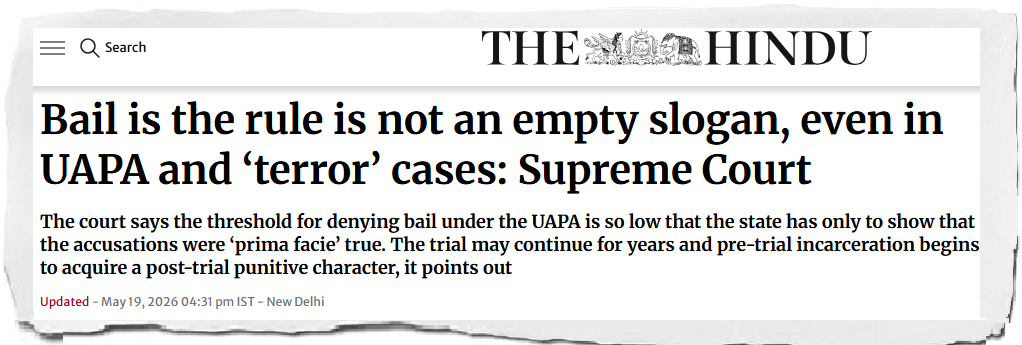
Bail is the rule is not an empty slogan, even in UAPA and ‘terror’ cases: Supreme Court
Why in News?
The Supreme Court recently reiterated that the principle of “bail is the rule and jail is the exception” applies even in cases under the Unlawful Activities (Prevention) Act (UAPA). While granting bail to an accused in a narco-terrorism case after prolonged incarceration, the Court raised concerns regarding earlier judicial approaches that restricted bail and emphasised that constitutional protections under Article 21 cannot be subordinated to statutory restrictions.
UPSC Relevance
Prelims:
UAPA, Article 21, Fundamental Rights, K.A. Najeeb case, Bail provisions under criminal law.
Mains:
GS II: Judiciary, Fundamental Rights, Criminal justice system, Constitutional safeguards, Rule of law.
Background/Context
The Unlawful Activities (Prevention) Act (UAPA), 1967 was enacted to deal with unlawful activities threatening India’s sovereignty and integrity. Over time, amendments expanded its scope to include terrorism-related offences and strengthened state powers in investigation and detention.
Unlike ordinary criminal laws, UAPA contains stricter provisions relating to arrest and bail. Section 43D(5) creates a high threshold for bail by stating that courts should deny bail if accusations appear “prima facie true”.
The present observations arose while hearing a bail matter involving prolonged incarceration of an undertrial prisoner under UAPA provisions.
Understanding UAPA Bail Provisions
Section 43D(5) of UAPA
The provision places restrictions on courts in granting bail to accused persons.
Under this provision:
- Bail can be denied if the court finds accusations against the accused to be prima facie true.
- The burden on the prosecution is comparatively lower.
- The accused may remain incarcerated for long periods because of lengthy trials.
The intention behind such restrictions is to prevent serious threats involving terrorism and national security.
Constitutional Principles Involved
Article 21: Right to Life and Personal Liberty
Article 21 guarantees that no person shall be deprived of life or personal liberty except according to procedure established by law.
Judicial interpretation has expanded Article 21 to include:
- Right to speedy trial
- Protection against arbitrary detention
- Right to fair procedure
- Human dignity
Presumption of Innocence
The criminal justice system is based on the principle that a person remains innocent until proven guilty.
Prolonged pre-trial detention may undermine this principle if imprisonment itself effectively becomes punishment before conviction.
Supreme Court’s Key Observations
Bail is a Constitutional Principle
The Court observed that the principle “bail is the rule and jail is the exception” is not merely a slogan but emerges from constitutional guarantees relating to liberty and fair process.
Article 21 Prevails Over Statutory Restrictions
The Court stated that statutory restrictions under Section 43D(5) cannot override constitutional protections under Article 21.
Long Incarceration Cannot Become Punishment
The Court noted that delayed trials may convert pre-trial detention into a form of punishment, defeating principles of justice.
Constitutional Courts Retain Wider Powers
The judgment clarified that constitutional courts can intervene and grant bail in situations involving prolonged incarceration even when the prima facie threshold under UAPA appears satisfied.
Important Judicial Developments
K.A. Najeeb Case
The Supreme Court had earlier held that prolonged incarceration and delay in trial can justify granting bail despite statutory restrictions under UAPA.
The judgment recognised that constitutional courts have a duty to protect personal liberty.
Earlier Judicial Concerns
The Court also expressed concern that certain later decisions had diluted broader constitutional protections recognised in earlier judgments.
Challenges
Balancing National Security and Individual Liberty
Anti-terror laws are designed to protect national security interests, but excessively restrictive provisions may create tensions with individual rights and due process guarantees.
Prolonged Undertrial Detention
Terror-related cases often involve complex investigations and lengthy trials, leading to extended detention periods without conviction.
Low Threshold for Bail Refusal
The “prima facie true” standard under UAPA provides substantial discretion to investigating agencies and may limit judicial flexibility.
Judicial Delays
Backlogs and slow disposal of cases can convert detention into de facto punishment before guilt is established.
Potential Misuse Concerns
Stringent anti-terror provisions occasionally raise concerns regarding their use against activists, dissenters, or individuals later acquitted after lengthy incarceration.
Way Forward
Ensure Time-bound Trials
Special courts handling UAPA cases should follow stricter timelines so that undertrial incarceration does not become disproportionately long.
Strengthen Judicial Oversight
Courts should periodically review continued detention in prolonged cases and assess whether further incarceration remains justified.
Balance Security with Civil Liberties
While addressing genuine security threats, legal safeguards should ensure that anti-terror laws remain consistent with constitutional values.
Improve Investigation Capacity
Better forensic capability, evidence collection and efficient prosecution mechanisms can reduce delays in trial completion.
Revisit Bail Framework
Parliament may consider reviewing bail provisions to ensure that statutory restrictions do not undermine the presumption of innocence and constitutional protections.
Conclusion
The Supreme Court’s observations reaffirm a foundational constitutional principle: individual liberty remains central even in cases involving serious offences. While anti-terror laws serve critical security objectives, democratic governance requires that national security concerns coexist with constitutional guarantees of fairness, dignity and personal liberty.
Practice Questions
Prelims Question 1
With reference to the Unlawful Activities (Prevention) Act (UAPA), consider the following statements:
- UAPA contains specific provisions restricting the grant of bail.
- Section 43D(5) requires courts to deny bail if accusations appear prima facie true.
- UAPA completely removes the jurisdiction of constitutional courts to grant bail.
Which of the statements given above is/are correct?
(a) 1 and 2 only
(b) 2 and 3 only
(c) 1 only
(d) 1, 2 and 3
Correct Answer: (a)
Explanation: Statements 1 and 2 are correct. Constitutional courts retain powers to grant bail under appropriate circumstances, particularly where Article 21 protections are implicated.
Prelims Question 2
Consider the following rights associated with Article 21 of the Constitution:
- Right to speedy trial
- Protection against arbitrary detention
- Presumption of innocence
Which of the above have been recognised through judicial interpretation under Article 21?
(a) 1 and 2 only
(b) 2 and 3 only
(c) 1 only
(d) 1, 2 and 3
Correct Answer: (d)
Explanation: Judicial interpretation has significantly expanded Article 21 and connected it with fair trial principles, protection from arbitrary detention and safeguards underpinning presumption of innocence.
Mains Question
- Examine the challenges involved in balancing national security considerations with protection of fundamental rights under anti-terror legislation in India.
- “The principle that bail is the rule and jail is the exception is central to constitutional democracy.” Discuss in the context of India’s criminal justice system.