Baksa Honey ODOP: Assam’s One District Product Earns 43% Export Premium in USA
A consignment of Baksa Honey, packaged in Assam and routed through Kolkata, recently cleared US customs at a price 43 percent above the prevailing wholesale rate for Indian honey. The number caught the attention of trade officials because it suggests, for the first time at scale, that India’s One District One Product framework can deliver real export premiums for a remote tribal-belt commodity.
The Baksa Honey ODOP success matters for three reasons. It validates a programme that has often been dismissed as branding gimmickry. It opens an income channel for Bodoland farmers whose region has cycled through insurgency, peace accords, and uneven development for three decades. And it offers a template for the other 760-odd district products the government has identified under the same scheme.
This article reads the Baksa Honey ODOP breakthrough with a UPSC economy and governance lens. We trace the ODOP architecture, examine why honey from a single Assam district commanded a premium that better-known producers could not, and ask what lessons travel to other districts.
Quick Facts
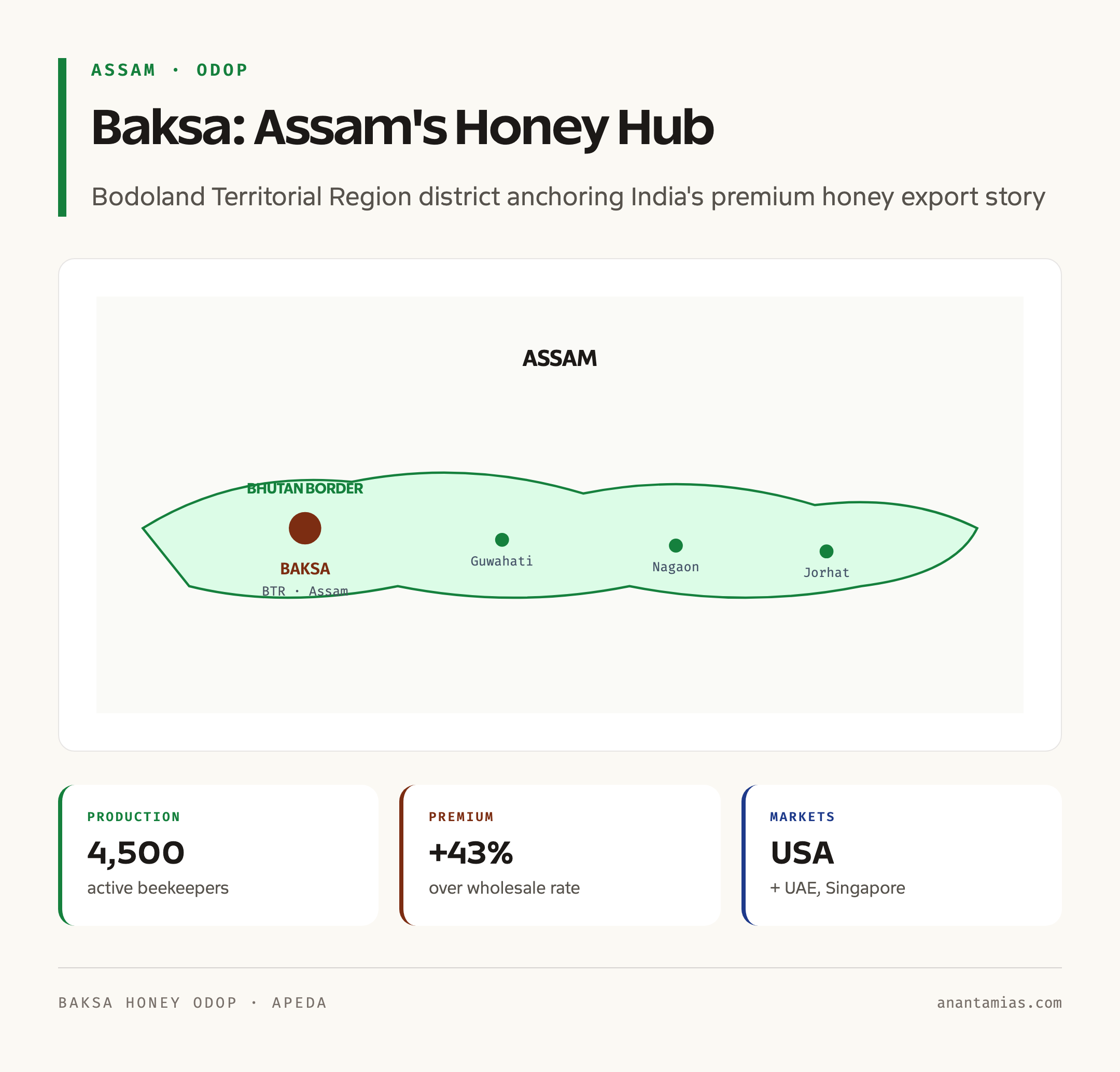
- Product: Baksa Honey, multi-floral and litchi-blossom variants.
- Source: Baksa district, Bodoland Territorial Region, Assam.
- Export premium: 43 percent over standard Indian honey wholesale rates.
- Destination: United States, with consignments also routed to UAE and Singapore.
- Framework: One District One Product (ODOP), launched 2018 under DPIIT.
- Nodal agency for honey exports: Agricultural and Processed Food Products Export Development Authority (APEDA).
- Number of ODOP districts mapped nationally: more than 760.
- Honey production cluster size in Baksa: roughly 4,500 active beekeepers.
What Just Happened
In early May 2026, APEDA and the Bodoland Territorial Council jointly announced that Baksa Honey ODOP shipments to the United States had crossed the threshold of a sustained price premium. The data point, drawn from FOB invoices over the preceding six months, showed an average realisation of 43 percent above the standard Indian honey export benchmark.
The announcement was paired with a memorandum of understanding between APEDA, an Assam-based farmer producer organisation, and a US distributor specialising in single-origin honey. Under the agreement, Baksa Honey will be sold in specialty grocery and online channels in five US states, with traceability built in from individual apiary to retail shelf.
Officials credited four levers for the premium. The first is the unique floral profile of Baksa, where colonies feed on litchi, mustard, and forest blossoms in distinct seasonal windows. The second is laboratory testing that confirmed low residue levels for antibiotics and pesticides, a long-standing concern for Indian honey in US and EU markets. The third is the ODOP-branded packaging with origin storytelling. The fourth is a direct-from-producer supply chain that compressed the value gap usually captured by intermediaries.
Background and Historical Context
The One District One Product idea predates the formal Indian scheme. Japan ran a One Village One Product programme from Oita Prefecture beginning in 1979, and Thailand later adapted it as One Tambon One Product. Both emphasised local distinctiveness, rural pride, and small-batch exports.
India’s version launched in 2018, originally as a focused intervention in Uttar Pradesh’s rural economy, then scaled nationally through the Department for Promotion of Industry and Internal Trade. The Centre’s ODOP cell mapped products across districts, ranging from Madhubani paintings to Channapatna wooden toys, Aligarh locks, and Tirupur knitwear.
The scheme overlapped with the geographical indication regime, which protects place-linked products through a separate legal instrument under the Geographical Indications of Goods (Registration and Protection) Act, 1999. Some ODOP products carry GI tags, others do not. The reading of how GI works for India’s regional commodities is laid out in our explainer on geographical indications and the origin tag.
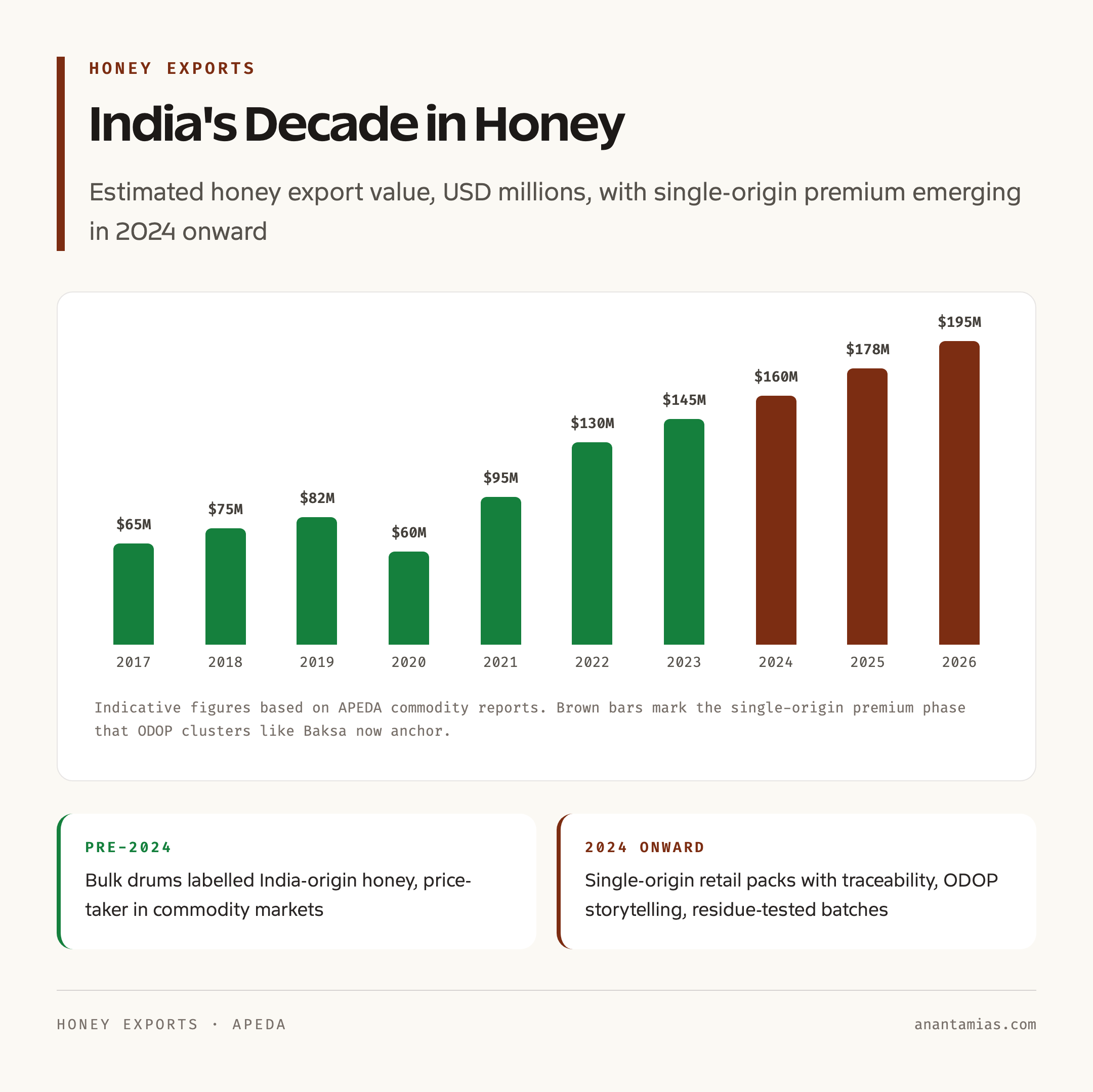
For honey, the policy backdrop was crowded. Indian honey exports had grown steadily through the 2010s, but a 2020 testing controversy in the US flagged adulteration and antibiotic residues in some Indian consignments. The reputation hit took years to repair. APEDA tightened residue monitoring and pushed traceability. Single-origin, well-tested honey from districts like Baksa benefited from the cleaner reputation that followed.
Key Features of the ODOP Framework
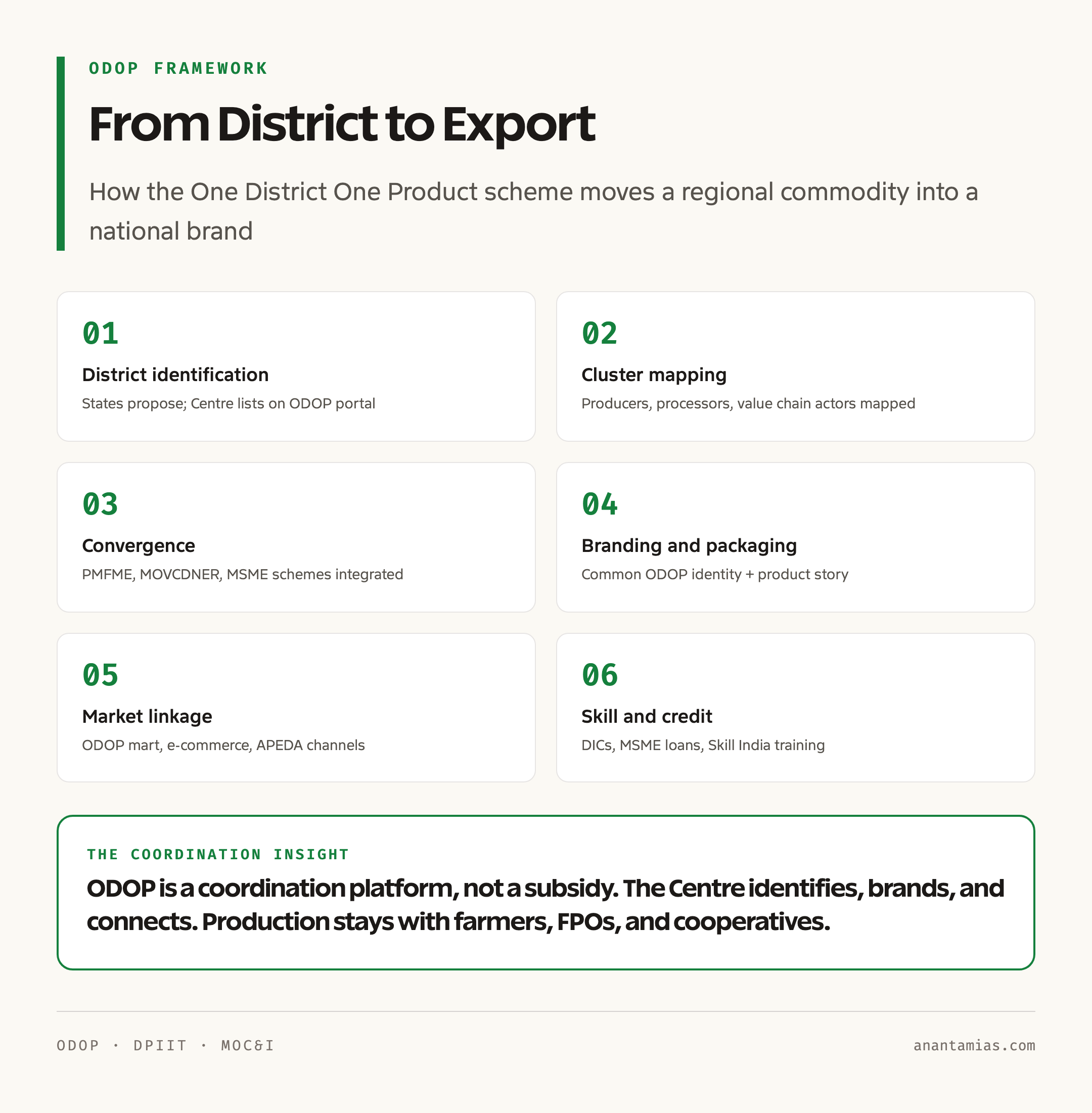
The One District One Product architecture has six moving parts.
- District identification: State governments propose one signature product per district. The Centre validates and lists it on the ODOP portal.
- Cluster mapping: Producers, processors, and value chain actors are mapped to enable targeted intervention.
- Convergence: ODOP integrates with the Pradhan Mantri Formalisation of Micro Food Processing Enterprises scheme, Mission Organic Value Chain Development for North Eastern Region, and state-level schemes.
- Branding and packaging: A common ODOP visual identity is used alongside product-specific branding.
- Market linkage: ODOP mart on the GeM portal, e-commerce tie-ups, and APEDA channels for exportable items.
- Skill and credit: District Industries Centres, MSME loan schemes, and Skill India training feed into ODOP clusters.
The framework is more coordination platform than direct subsidy. The Centre identifies, brands, and connects. Production stays with farmers, cooperatives, and FPOs.
Why Baksa, Why Honey
Baksa sits in the Bodoland Territorial Region, an autonomous area established under the Sixth Schedule of the Constitution. The district borders Bhutan to the north and is dominated by forest, foothill agriculture, and mixed-floral landscape.
Three structural features helped honey work here.
The terrain offers floral diversity that monocrop regions cannot match. Litchi orchards, mustard fields, sal forests, and wild flowers stagger their blooms, giving bee colonies year-round forage and producing distinctly flavoured honey.
The social structure favours collective marketing. Bodo and other tribal communities in the region have a tradition of customary cooperation, which translated well into producer-organisation governance once formal FPOs were registered.
The geography limits competing industrial activity. Baksa has minimal pesticide-intensive farming, which keeps residue baselines low and supports US and EU compliance.
These advantages would have sat dormant without three policy nudges. Mission Organic Value Chain Development for North Eastern Region funded certification and infrastructure. ODOP gave Baksa a marketing identity. APEDA pushed quality testing and buyer linkages.
Why It Matters
The Baksa Honey ODOP story matters beyond a single commodity.
It demonstrates a working rural export channel. Most Indian export earnings flow through a small number of clusters, dominated by gems, textiles, and pharmaceuticals. Diversifying to district-level products spreads gains.
It strengthens the case for the Northeast as an economic frontier, not just a strategic one. The region has long carried infrastructure and connectivity disadvantages. Premium niche exports turn those disadvantages, like isolation from industrial pollution, into market advantages.
It supports tribal livelihoods in a region with delicate political history. The Bodoland Territorial Region’s peace settlement, formalised in 2020, was meant to be accompanied by an economic peace dividend. Beekeeping has emerged as one of the few livelihoods that scales without dispossessing forest land.
It validates the ODOP framework at a moment when many central schemes face mid-cycle scrutiny.
Detailed Analysis: How the Premium Got Built
The 43 percent premium did not appear at the customs invoice. It was constructed step by step.
Step one: traceability infrastructure. Each apiary in the Baksa cluster carries a numeric tag. The FPO’s cloud database records flowering window, harvest date, lab test reports, and the route to the bottling facility. This data is exposed to the US distributor through a QR code on retail packaging.
Step two: residue testing. Every batch is tested for chloramphenicol, oxytetracycline, and a panel of pesticides at NABL-accredited labs. The reports are appended to export documentation. This rebuilds buyer trust after the 2020 reputation episode.
Step three: single-origin packaging. Instead of bulk drums labelled India-origin honey, Baksa ships in retail-ready 250-gram and 500-gram bottles with origin storytelling. Margin per kilogram is dramatically higher than bulk.
Step four: direct buyer engagement. APEDA and the FPO bypassed traditional brokers and engaged the US distributor directly. The captured margin came partly from disintermediation.
Step five: ODOP branding overlay. The ODOP visual identity, alongside Bodoland-specific motifs, signals to a US consumer that the product is regionally distinctive, not an anonymous import.
None of these steps is exotic. Each requires institutional patience. The 43 percent premium is what patience returned.
Comparative Perspective
Read Baksa alongside three reference cases.
- Channapatna wooden toys, Karnataka: GI-tagged, ODOP-listed, but export realisation remains low because traditional artisans have not built the residue-and-traceability equivalent that food products require.
- Madhubani paintings, Bihar: Strong cultural identity, ODOP brand, but limited export volume because aesthetic premium products are slow-moving in foreign retail.
- Mahua flowers, Madhya Pradesh: Tribal-belt forest produce with ODOP intent. Pricing has improved within India, but export breakthroughs are pending due to alcoholic-beverage classification issues abroad.
Baksa Honey crosses both the testing-and-traceability barrier and the consumer-product fit. That combination is rare and replicable.
Challenges
The success story carries real risks.
- Scale ceiling. Baksa’s annual production is finite. As premium demand grows, the temptation to dilute with sourced honey from outside the district will rise. Strict origin enforcement is essential.
- Climate vulnerability. Honey output is exquisitely sensitive to floral timing, rainfall, and temperature. Climate shocks can wipe out a season.
- Concentration risk. Heavy reliance on US distribution exposes producers to a single regulatory environment. The 2020 US testing crisis is a cautionary precedent.
- Quality drift. Cluster-wide quality consistency requires continuous training. A single bad batch can hurt the brand.
- Adulteration policing. Sugar syrup adulteration remains the Indian honey sector’s structural problem. Baksa must stay above it.
- Institutional fragility. FPO governance depends on a handful of leaders. Succession and capacity-building need attention.
Prelims Pointers
- ODOP launched in 2018, now under DPIIT, Ministry of Commerce and Industry.
- APEDA established under the APEDA Act, 1985, regulates agri-export development.
- Geographical Indications of Goods Act, 1999 protects place-linked products.
- Baksa is part of the Bodoland Territorial Region, governed under the Sixth Schedule.
- Bodoland Territorial Council was created under the Bodo Accord, 2003, and reformed in 2020.
- Mission Organic Value Chain Development for North Eastern Region launched 2015 under Agriculture Ministry.
- National Beekeeping and Honey Mission, launched 2020, supports the apiculture value chain.
- India is among the top ten honey exporters by volume globally.
Mains Questions
- The One District One Product framework has often been criticised as branding without substance. Use the Baksa Honey ODOP case to evaluate its real economic potential. (GS Paper III, 250 words)
- Discuss the role of geographical indications and traceability in raising export realisations for tribal-belt commodities in India. (GS Paper III, 250 words)
- The Northeast has long been seen as a connectivity challenge rather than an economic opportunity. Examine how schemes like ODOP and APEDA channels are reshaping that view. (GS Paper II, 250 words)
- Honey is exquisitely sensitive to floral timing and climate. Discuss the implications of climate change for India’s apiculture-based rural livelihoods. (GS Paper III, 150 words)
Way Forward
The Baksa Honey ODOP playbook should be codified and replicated.
Build five to ten more district-product anchors across the Northeast with similar testing-and-traceability investment. The chosen products should have proven export demand, not just cultural distinctiveness.
Diversify destination markets. Add UAE, Singapore, Japan, and Germany as parallel channels to reduce US dependency.
Hardwire farmer-producer organisation governance with mandatory rotation of leadership and external audit. FPOs that thin out at the top lose their negotiating power with buyers.
Invest in cold-chain and bottling capacity within the region. Most value capture currently happens downstream of the district. Bringing more of that infrastructure closer to source raises producer share.
Treat ODOP as a long-cycle programme. Niche export markets reward patient quality, not annual rotation of priority products.
The wider context of how Indian agriculture is repositioning for global markets is covered in our analysis of India farm exports and US tariffs in 2026, and the institutional architecture for rural skilling and credit is examined in our piece on tribal issues in India.
Baksa Honey is one district’s story. The interesting question is how many other districts have a similar story waiting to be made operational.
Frequently Asked Questions
What is Baksa Honey and why is it special?
Baksa Honey is a multi-floral honey produced in Baksa district of the Bodoland Territorial Region in Assam. Its distinctiveness comes from litchi, mustard, and forest blossoms that stagger their bloom cycle, plus low pesticide exposure in the surrounding landscape.
What is the One District One Product scheme?
ODOP is a Government of India initiative launched in 2018 that identifies one signature product for each district, then provides branding, cluster development, market linkage, and credit support through schemes like PMFME and APEDA’s export channels.
How big is the export premium for Baksa Honey?
Recent shipments to the United States cleared at roughly 43 percent above the standard wholesale rate for Indian honey, on a free-on-board basis. The premium reflects single-origin branding, traceability, and clean residue testing.
Which agency promotes Indian honey exports?
APEDA, the Agricultural and Processed Food Products Export Development Authority, is the nodal agency. It coordinates quality standards, buyer-seller meets, and export documentation under the APEDA Act, 1985.
Does Baksa Honey carry a geographical indication tag?
Several Assam honey varieties are in the GI pipeline. ODOP listing and GI registration are separate but complementary. The 2026 export premium has been built primarily on ODOP branding and traceability, with GI work ongoing.
Why was Indian honey controversial in the US around 2020?
A 2020 controversy flagged adulteration and antibiotic residues in some Indian honey consignments. APEDA responded by tightening residue testing, accreditation requirements, and traceability protocols. Clean clusters like Baksa benefited from this reset.
How many beekeepers work in the Baksa cluster?
Roughly 4,500 active beekeepers participate in the cluster, organised through farmer producer organisations that handle aggregation, testing, and export coordination.
What schemes support Northeast agri-exports?
Key schemes include Mission Organic Value Chain Development for North Eastern Region, ODOP, the National Beekeeping and Honey Mission, the Agri-Infrastructure Fund, and APEDA’s market access initiatives.
Can the ODOP model be replicated for other tribal-belt commodities?
Yes, but replication requires food-safety testing capacity, traceability infrastructure, single-origin packaging discipline, and patient buyer engagement. Cultural distinctiveness alone is not enough.
Where can students read more about the ODOP framework?
Official sources include the ODOP portal on the Invest India website, DPIIT releases, APEDA’s commodity reports, and the Ministry of Food Processing Industries annual report.