Bangladesh FM’s First Delhi Visit Under BNP Government (April 2026)
Why in News?
On 7 April 2026, the Foreign Minister of Bangladesh landed in Delhi for the first high-level political visit from Dhaka since the August 2024 ouster of Sheikh Hasina and the subsequent formation of a Bangladesh Nationalist Party (BNP)-led government. The visit, announced after weeks of back-channel diplomacy, was framed by both sides as a “reset” meeting aimed at stabilising a relationship that had frayed across water, border, trade, and minority-rights issues.
The agenda was unusually dense. Teesta water sharing, killings along the 4,096-kilometre border, the continued presence of 1.2 million Rohingya refugees in Cox’s Bazar, transit rights through Tripura, the fate of the Bangladesh-China Mongla port MoU signed in 2025, the security of the Siliguri Corridor or Chicken’s Neck, and the treatment of Hindu minorities in Bangladesh all sat on the table at South Block.
For Indian policymakers, the visit was the first real chance to read the BNP’s foreign-policy instincts in government after a decade and a half in opposition. For Dhaka, it was an opportunity to signal that a change of regime does not automatically mean a shift to Beijing or Islamabad, even as structural dependencies on India remain.
UPSC Relevance at a Glance
| Dimension | Details |
|---|---|
| GS Paper | GS2 (International Relations) |
| Prelims | Ganges Water Treaty 1996, Land Boundary Agreement 2015, 100th Constitutional Amendment, Maitri Setu, BBIN, BIMSTEC, Siliguri Corridor, Cox’s Bazar, CHT |
| Mains | India-Bangladesh relations under a post-Hasina government; water, border and minority issues; connectivity architecture in the eastern neighbourhood |
| Syllabus Tags | India and Neighbourhood, Bilateral Groupings, Regional Connectivity |
Background and Context
India and Bangladesh share the longest land boundary India has with any country at 4,096 kilometres, running across West Bengal, Assam, Meghalaya, Tripura, and Mizoram. That border is also the spine of a relationship that swings between intimacy and irritation. Under the Awami League government of Sheikh Hasina, which ran Bangladesh from 2009 to August 2024, bilateral ties touched a historic peak. The Land Boundary Agreement of 2015, ratified through the 100th Constitutional Amendment, settled adversely held enclaves. Power trade, rail revival, inland-waterways protocols, credit lines worth over eight billion dollars, and intelligence cooperation on insurgent groups in the Northeast anchored the partnership.
That scaffolding cracked in August 2024 when a student-led movement against job-quota decisions toppled the Hasina government. An interim administration under Muhammad Yunus stabilised the transition, and the elections that followed brought the BNP back to power after seventeen years. Between the ouster and the new government’s inauguration, the relationship absorbed multiple shocks: attacks on Hindu minority homes and temples, prickly statements from Dhaka on water and border, visa suspensions, and a perceptible tilt in rhetoric toward China.
By the time the BNP-led foreign minister landed in Delhi in April 2026, the baseline was difficult. The Ganges Water Treaty of 1996, which governs sharing at Farakka, is scheduled to expire in 2026 and must be renegotiated. The Teesta framework, negotiated in 2011, has been stalled for more than a decade because of objections from West Bengal. Border killings, consistently flagged by Bangladeshi media and human-rights bodies, continue to shadow every round of Director General-level talks between the Border Security Force and Border Guard Bangladesh. The India must reboot neighbourhood policy trade is the key debate within Indian strategic circles directly framed the visit.
Key Features
Agenda at South Block
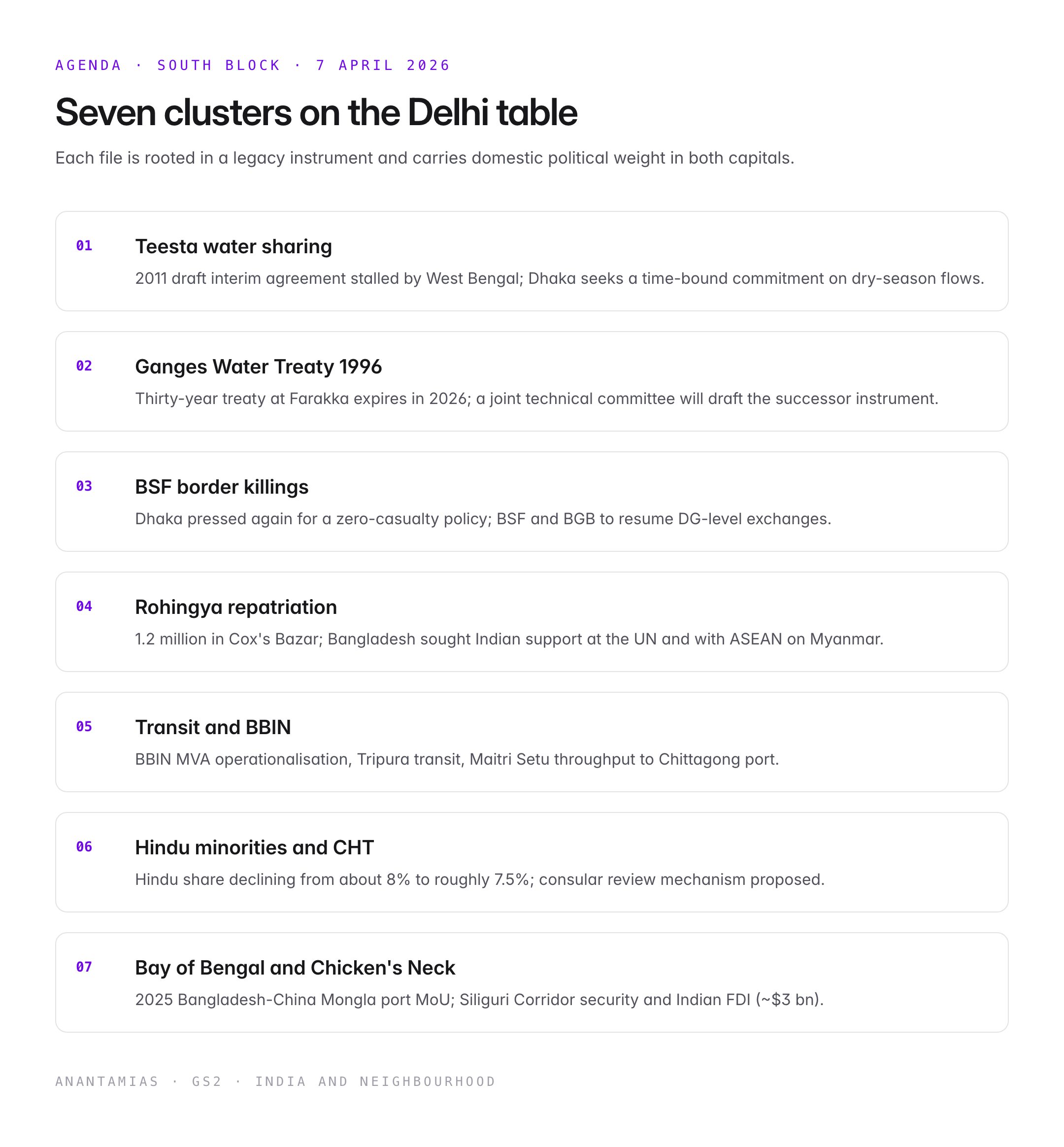
The Foreign Minister’s meetings in Delhi covered seven clusters of issues. Each was rooted in a legacy file and each has implications for domestic politics in both capitals.
- Teesta water sharing: Bangladesh pressed for a time-bound commitment on the draft 2011 interim agreement that would share dry-season flows on the Teesta in an equitable ratio. India restated that the Centre cannot sign without concurrence from West Bengal, which has opposed the arrangement citing reduced upstream flows.
- Ganges Water Treaty 1996 renewal: The thirty-year treaty, which guarantees Bangladesh a minimum share of Ganga waters at Farakka during the lean season, expires in 2026. Both sides agreed to open a joint technical committee to draft a successor instrument.
- BSF border killings: Dhaka raised deaths along the fence and reiterated its long-standing demand for a zero-casualty policy. India pointed to the coordinated border management plan and ongoing operational-level exchanges between the Border Security Force and Border Guard Bangladesh.
- Rohingya repatriation: With 1.2 million Rohingya still in Cox’s Bazar camps, Bangladesh sought India’s support at the United Nations and with ASEAN to push Myanmar’s junta toward a credible repatriation plan.
- Transit and BBIN: India pushed for operationalisation of the Bangladesh Bhutan India Nepal (BBIN) Motor Vehicles Agreement and for faster transit through Tripura, including via the Maitri Setu bridge over the Feni River to Chittagong port.
- Hindu minorities and Chittagong Hill Tracts (CHT): India flagged the security of Hindu, Buddhist and indigenous minorities, noting the decline of the Hindu share of Bangladesh’s population from around 8 per cent in earlier census cycles to roughly 7.5 per cent.
- Strategic anxieties: India raised the 2025 Bangladesh-China memorandum on Mongla port development, the Siliguri Corridor or Chicken’s Neck security, and the broader Bay of Bengal maritime architecture.
Instruments already on the ground
The 2015 Land Boundary Agreement, implemented through the 100th Amendment, remains the most important legal settlement of the border. Maitri Setu, inaugurated in 2021, connects Sabroom in Tripura with Ramgarh in Bangladesh and reduces the distance from the Northeast to Chittagong port to around 80 kilometres. BBIN and BIMSTEC provide the sub-regional and regional architecture, though the former remains blocked by Bhutan’s non-ratification.
New irritants
The Bangladesh-China Mongla port MoU of 2025, which allows Chinese firms to upgrade terminal infrastructure near the Bay of Bengal, was read in Delhi as a strategic signal. Cumulative Indian foreign direct investment in Bangladesh stands at roughly three billion dollars, and New Delhi wants assurances that future port, power and telecom contracts will not exclude Indian bidders.
Significance
- The visit restores a working channel between the two foreign offices after a nearly eighteen-month freeze, allowing technical groups on water, border, trade and connectivity to resume calendared meetings.
- It signals that the BNP government, despite historical scepticism of India, is willing to treat New Delhi as a first-order partner rather than default to Beijing for balance.
- A credible successor to the Ganges Water Treaty 1996 is now possible within the calendar year, protecting dry-season flows at Farakka and reducing a long-standing source of domestic anger in Bangladesh.
- Operationalising BBIN transit, Maitri Setu throughput, and the eastern inland waterways network would pay directly into the Northeast’s logistics costs and reduce dependence on the Siliguri Corridor. The parallel Brahmaputra inland waterways push in Dibrugarh agenda fits this frame.
- The visit creates political cover for Dhaka to manage Chinese port advances transparently, rather than as faits accomplis, and gives India a structured way to raise Bay of Bengal concerns at the Raisina Dialogue 2026 and at G20 platforms.
- It stabilises expectations on minority rights, with both sides committing to a regular consular review covering Hindu, Buddhist and indigenous communities.
Concerns and Challenges
Domestic politics in Bangladesh will constrain any grand bargain. The BNP’s base is sceptical of what it views as concessions to India on transit, water, and border management during the Hasina years. The interim period produced a durable narrative of India having been partisan in Bangladeshi politics, and the new government cannot afford to appear soft in its first year.
West Bengal remains the binding constraint on Teesta. Any federal push from New Delhi on water sharing without the state’s concurrence risks both constitutional friction and an electoral backlash. The Ganges Water Treaty renegotiation is technically more tractable because Bihar and West Bengal are less directly involved than on Teesta, but a 2026 expiry window leaves thin margins.
Border killings are a recurring scar. Despite the 2011 protocol on non-lethal force, deaths continue. Any fresh incident during the negotiation window can collapse the fragile goodwill the visit generated.
The Mongla MoU and growing Chinese footprint in Bangladesh’s defence procurement, including submarines and patrol vessels, raise long-run concerns about Bay of Bengal access and Chicken’s Neck vulnerability. Indian planners worry that a hostile administration in Dhaka, even if not the current BNP government, could complicate Northeast connectivity overnight.
Rohingya repatriation remains hostage to Myanmar’s junta. Neither India nor Bangladesh can move the needle in Naypyidaw without ASEAN and China, which limits what the bilateral can deliver.
Finally, the decline of the Hindu share of Bangladesh’s population, reported drops in temple attendance, and periodic communal incidents have become a persistent irritant in Indian domestic politics. The foreign ministry can manage episodes, but structural demographic change requires patient, long-term engagement.
Comparative / Historical Perspective
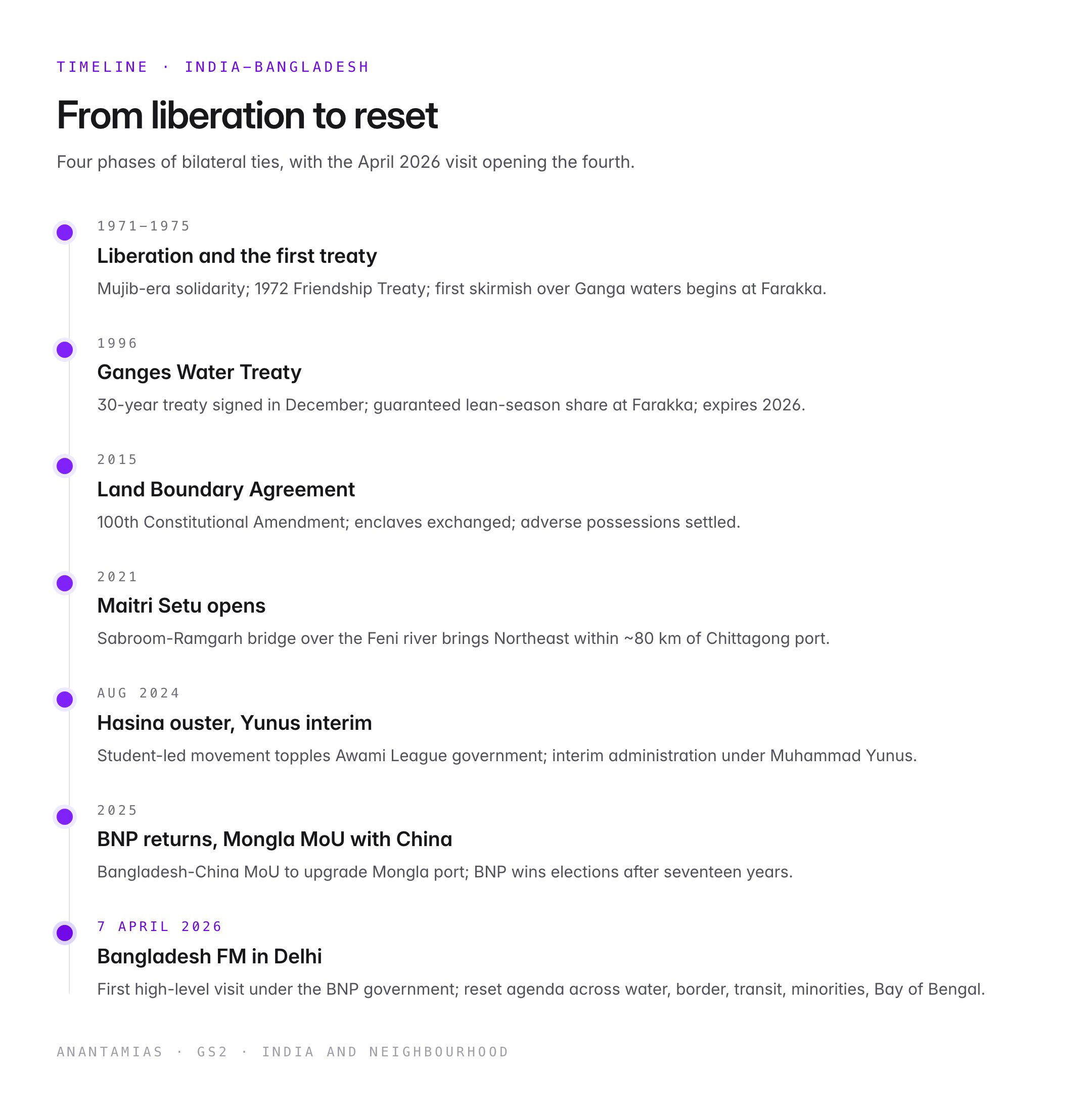
India-Bangladesh ties have moved through three broad cycles since 1971. The liberation-war consensus under Sheikh Mujibur Rahman built a rare moment of strategic trust. The years between 1975 and 2008 saw oscillation, with the BNP governments typically cooler toward Delhi and the Awami League warmer. The 2009 to 2024 Hasina era produced the densest cooperation agenda in South Asia. The post-2024 phase is testing whether institutional architecture can survive a political rupture.
| Phase | Dhaka Government | Defining Feature | India’s Posture |
|---|---|---|---|
| 1971-1975 | Awami League (Mujib) | Liberation solidarity, Ganges waters dispute begins | Security guarantor, treaty-based engagement |
| 1975-2008 | Mixed (military, BNP, AL) | Insurgent sanctuary concerns, trade deficit, migration | Cautious, issue-by-issue |
| 2009-2024 | Awami League (Hasina) | LBA 2015, connectivity, power trade, counter-terror | Strategic partner |
| 2024 onward | BNP (post-Yunus interim) | Reset under stress, China factor, minority anxieties | Guarded re-engagement |
Way Forward
- The Ministry of External Affairs and Ministry of Jal Shakti should front-load negotiations on the Ganges Water Treaty 1996 successor, aiming for initialling before the lean-season cycle of 2026-27.
- The Ministry of Home Affairs, through the Border Security Force, should adopt a time-bound zero-casualty target with published monthly data, mirroring the transparency already extended on drug seizures and cattle movement.
- The Ministry of External Affairs should quietly lead a Teesta-plus package with West Bengal that trades a phased water-sharing arrangement for irrigation modernisation grants and flood-management cooperation on shared tributaries.
- The Ministry of Road Transport and Highways, along with the Ministry of Ports, Shipping and Waterways, should pilot a BBIN-minus-Bhutan trilateral transit protocol and scale throughput via Maitri Setu and Chittagong port.
- The Ministry of Commerce and Industry, supported by the Export-Import Bank of India, should re-open stalled lines of credit with clearer disbursement timelines and a grievance cell for Bangladeshi importers.
- The Ministry of External Affairs and the National Human Rights Commission should formalise a consular review mechanism for minorities, modelled on the India-Sri Lanka fishermen working group.
- NITI Aayog and the Development Monitoring and Evaluation Office should anchor a public audit of project delivery under Indian lines of credit, building confidence against the narrative that Indian projects are slow.
Conclusion
The April 2026 visit does not heal the relationship. It re-opens a room. The substantive questions on water, border, minorities, transit, and Bay of Bengal security will be negotiated across multiple cycles, often under domestic pressures in both countries. What the visit achieves is the replacement of rhetoric with a calendar: joint committees, technical groups, and ministerial reviews that make predictable, documented progress possible.
For UPSC preparation, the visit is a compact case study of how India’s neighbourhood policy manages political transitions in partner states. It shows why structural instruments such as the Land Boundary Agreement and institutional frameworks such as BBIN and BIMSTEC matter more than any single government. It also shows why water, border management, and minority rights will remain the three durable tests of India-Bangladesh ties, regardless of who governs in Dhaka.
Prelims Pointers
- India-Bangladesh land border length: 4,096 km, India’s longest with any country.
- Indian states sharing the Bangladesh border: West Bengal, Assam, Meghalaya, Tripura, Mizoram.
- Ganges Water Treaty signed in December 1996, valid for 30 years, expires in 2026.
- Land Boundary Agreement 1974 ratified through the 100th Constitutional Amendment in 2015.
- Maitri Setu links Sabroom (Tripura) to Ramgarh (Bangladesh) across the Feni river.
- BBIN Motor Vehicles Agreement signed in 2015; pending Bhutan’s ratification.
- BIMSTEC headquarters is in Dhaka; the grouping has seven members around the Bay of Bengal.
- Cox’s Bazar hosts approximately 1.2 million Rohingya refugees from Myanmar.
- Chittagong Hill Tracts (CHT) accord signed in 1997 between Bangladesh and PCJSS.
- Hindu share of Bangladesh’s population recorded at around 8 per cent and more recently around 7.5 per cent in successive census reports.
- Mongla is Bangladesh’s second-largest seaport, on the Pasur river, with a Chinese upgrade MoU signed in 2025.
- Cumulative Indian FDI in Bangladesh stands at approximately 3 billion dollars.
Mains Practice Question
Q. The first visit by Bangladesh’s Foreign Minister to New Delhi under the BNP government marks a reset rather than a reconciliation. Discuss the key issues on the bilateral agenda and suggest a way forward that balances strategic autonomy with neighbourhood stability. (15 marks, 250 words)
- Outline the post-August 2024 disruption and the significance of the April 2026 visit; map the seven agenda clusters from water to Bay of Bengal.
- Analyse constraints: federalism on Teesta, border killings, Mongla MoU, Rohingya, minorities; connect to Chicken’s Neck and Northeast connectivity.
- Conclude with a calibrated roadmap: Ganges treaty renewal, BBIN-minus-Bhutan transit, transparent project delivery, minorities review, consistent with India’s Neighbourhood First policy.
Frequently Asked Questions
What is the significance of Bangladesh Foreign Minister’s Delhi visit in April 2026?
The visit on 7 April 2026 was the first high-level political engagement from Dhaka since Sheikh Hasina’s ouster in August 2024 and the installation of a BNP-led government. It re-opened formal channels on water, border, connectivity, and minority issues after nearly eighteen months of strained relations and marked a deliberate reset in India-Bangladesh ties.
Why is the Bangladesh FM’s Delhi visit in news?
It is the first visit under the BNP government that replaced the Awami League, carries the weight of renegotiating the Ganges Water Treaty 1996 before its 2026 expiry, addresses BSF border killings, Rohingya, Hindu minority rights, Teesta sharing, and responds to the 2025 Bangladesh-China Mongla port MoU that raised strategic concerns in New Delhi.
How does this visit help UPSC aspirants?
It is a ready case study for GS2 on India and its neighbourhood, combining water diplomacy, border management, minority protection, sub-regional connectivity through BBIN and BIMSTEC, and strategic competition with China. Aspirants can use it for mains questions on Neighbourhood First, federalism in foreign policy, and Bay of Bengal security.
What is the Ganges Water Treaty 1996 and why does it matter now?
Signed in December 1996 between India and Bangladesh, the treaty shares Ganga waters at Farakka during the lean season from January to May for thirty years. It expires in 2026, making renewal a central agenda item. A successor instrument will shape dry-season flows, agriculture, and salinity in Bangladesh’s south-west.
How long is the India-Bangladesh border and which Indian states share it?
The border is 4,096 kilometres long, India’s longest land boundary with any neighbour. It runs through West Bengal, Assam, Meghalaya, Tripura, and Mizoram. Border management is handled by the Border Security Force on the Indian side and the Border Guard Bangladesh on the other, with regular DG-level talks.
What is the Land Boundary Agreement and the 100th Amendment?
The Land Boundary Agreement was originally signed in 1974 and finally implemented in 2015 through the 100th Constitutional Amendment. It exchanged 111 Indian enclaves in Bangladesh and 51 Bangladeshi enclaves in India, settling adversely held territories and giving residents the right to choose citizenship.
Why is the Chicken’s Neck or Siliguri Corridor important in India-Bangladesh ties?
The Siliguri Corridor is a narrow strip in north Bengal roughly 20 to 22 kilometres wide that connects mainland India to the Northeast. Its vulnerability makes any hostile alignment in Bangladesh a direct security concern for India, which is why Indian planners track Dhaka’s defence and port deals with China closely.
What is the Bangladesh-China Mongla port MoU of 2025?
In 2025 Bangladesh signed a memorandum with Chinese firms to upgrade terminal infrastructure at Mongla, the country’s second-largest seaport on the Pasur river near the Bay of Bengal. The MoU raised concerns in New Delhi about Chinese presence close to the Indian maritime zone and the future competitiveness of Indian infrastructure bids.