Bangladesh weighs joining the Mecca Defence Pact
Why in News?
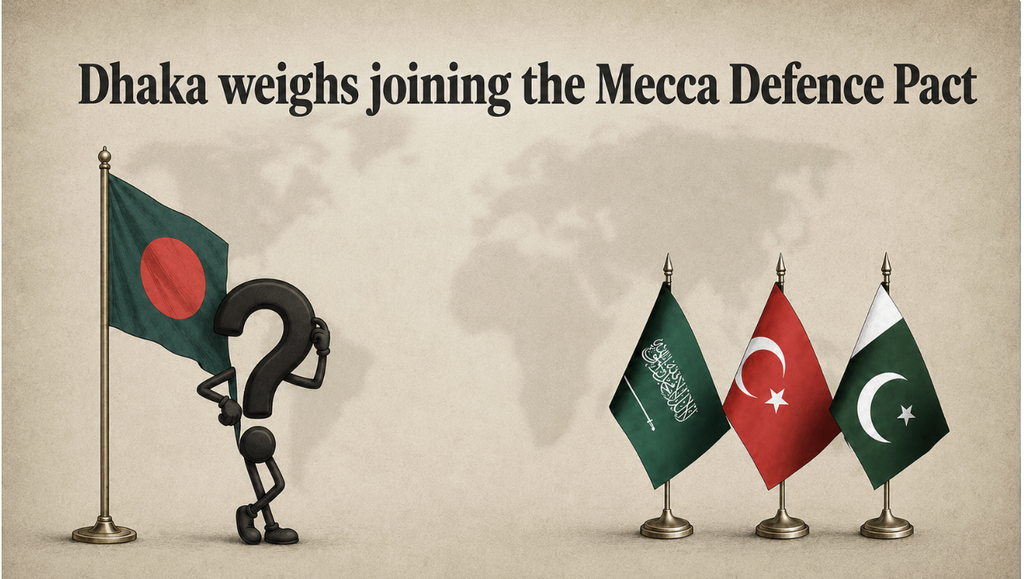
Bangladesh has indicated it would be open to joining the Mecca Joint Defence Agreement if formally invited. The reported pact, signed by Saudi Arabia, Türkiye and Pakistan on August 7, 2026, seeks to strengthen collective deterrence and defence cooperation.
However, Bangladesh has clarified that it has received no formal proposal and that any decision would be based on its national interest.
| UPSC Relevance: GS-2 International Relations: India and its Neighbourhood Mains: Emerging security alignments in West Asia and their implications for India |
What is the Mecca Pact?
- According to the publicly reported joint statement, the agreement:
- treats an armed attack on one signatory as an attack on all three
- seeks to strengthen collective deterrence; and
- promotes wider defence cooperation.
- Its complete text and operational provisions have not been made public. Therefore, it remains unclear whether the mutual-defence clause requires an automatic military response or merely consultations and assistance.
- Unlike NATO, the pact lacks an established integrated command, common military planning system, or clearly disclosed response mechanism.
Strategic Drivers:
- Saudi Arabia: Saudi Arabia seeks to diversify its security partnerships amid regional instability and concerns regarding excessive dependence on the United States. Cooperation with Türkiye and Pakistan could support domestic arms production, technology transfer, missile defence and advanced military capabilities.
- Türkiye: Türkiye possesses a growing defence-industrial base, particularly in drones, missiles, naval systems and the development of the KAAN fifth-generation fighter aircraft. The pact may expand Ankara’s strategic influence in West Asia and strengthen defence exports.
- Pakistan: Pakistan contributes military experience, strategic geography and nuclear-deterrence credentials. The agreement could deepen its defence and economic relationship with Saudi Arabia while institutionalising its long-standing military partnership with Türkiye.
Limits to its credibility:
The pact’s deterrent value will depend on implementation:
- The absence of a publicly available treaty creates uncertainty about obligations.
- The three countries have different threat perceptions and foreign policy priorities.
- Mutual defence clauses do not necessarily guarantee automatic military intervention.
- Saudi Arabia is also a member of the Gulf Cooperation Council’s Joint Defence Agreement, whose operational effectiveness has remained limited.
- Pakistan’s relations with Iran and Türkiye’s NATO commitments could constrain coordinated action.
Thus, the pact presently appears more credible as a framework for defence-industrial cooperation, intelligence sharing, training and technology transfer than as a fully developed military alliance.
Bangladesh’s Possible Entry:
Bangladesh’s participation could strengthen its defence technology access and political ties with major Muslim countries. However, Dhaka must assess:
- impact on its traditional non-aligned foreign policy
- compatibility with relations with India, China and Western countries
- financial and military obligations
- risks of involvement in West Asian conflicts; and
- whether membership serves long-term national interests rather than short-term political calculations.
Implications for India:
The agreement may bring Saudi Arabia closer to the existing Pakistan-Türkiye defence partnership, with China potentially remaining an important technology supplier in the background.
India should monitor:
- possible intelligence and defence-technology transfers to Pakistan
- increased Türkiye-Pakistan military interoperability
- the pact’s position during future India-Pakistan tensions
- Saudi Arabia’s evolving strategic dependence on Pakistan; and
- consequences of Bangladesh or other regional countries joining the framework.
Nevertheless, Saudi Arabia has developed substantial economic, energy and strategic ties with India. The pact should therefore not automatically be viewed as an anti-India alliance.
Way Forward for India:
India should:
- Maintain high-level engagement with Riyadh.
- Expand defence and technology cooperation with Gulf countries,
- Deepen partnerships with the UAE, France and the United States
- Closely monitor military transfers benefiting Pakistan.
- Pursue issue-based strategic engagement without forcing West Asian partners into binary choices.
The Mecca Pact reflects the emergence of a more multipolar West Asian security order and the growing importance of defence-industrial partnerships. Its actual significance will depend on its operational provisions and implementation.
For India, calibrated diplomacy and stronger bilateral relationships will be more effective than viewing the arrangement solely through the Pakistan prism.
Practice Question:
Q. The Mecca Joint Defence Agreement signals a changing security architecture in West Asia. Examine its strategic drivers and implications for India. (10 marks/150 words)