Banned Drugs: Why the Government Barred 16 Fixed-Dose Combinations
Why in News?
The Union Health Ministry has prohibited the manufacture, sale and distribution of 16 irrational fixed-dose combination (FDC) drugs after concluding that they carry no therapeutic justification and that their continued use is not beneficial relative to the risks involved. The Indian Express, in its Explained section, set out how a decade-long regulatory and legal process under the Drugs and Cosmetics Act, 1940 produced this latest round of bans.
The banned list spans common painkillers, antibiotics, antidiabetic and topical skin formulations — for instance, antibiotic combinations pairing amoxicillin or cefuroxime with the enzyme serratiopeptidase, which the expert committee found pharmacodynamically irrelevant. For UPSC, the episode is a clean window into India’s drug-regulation architecture (CDSCO, DTAB), the meaning of irrational FDCs, and their link to antimicrobial resistance (AMR).
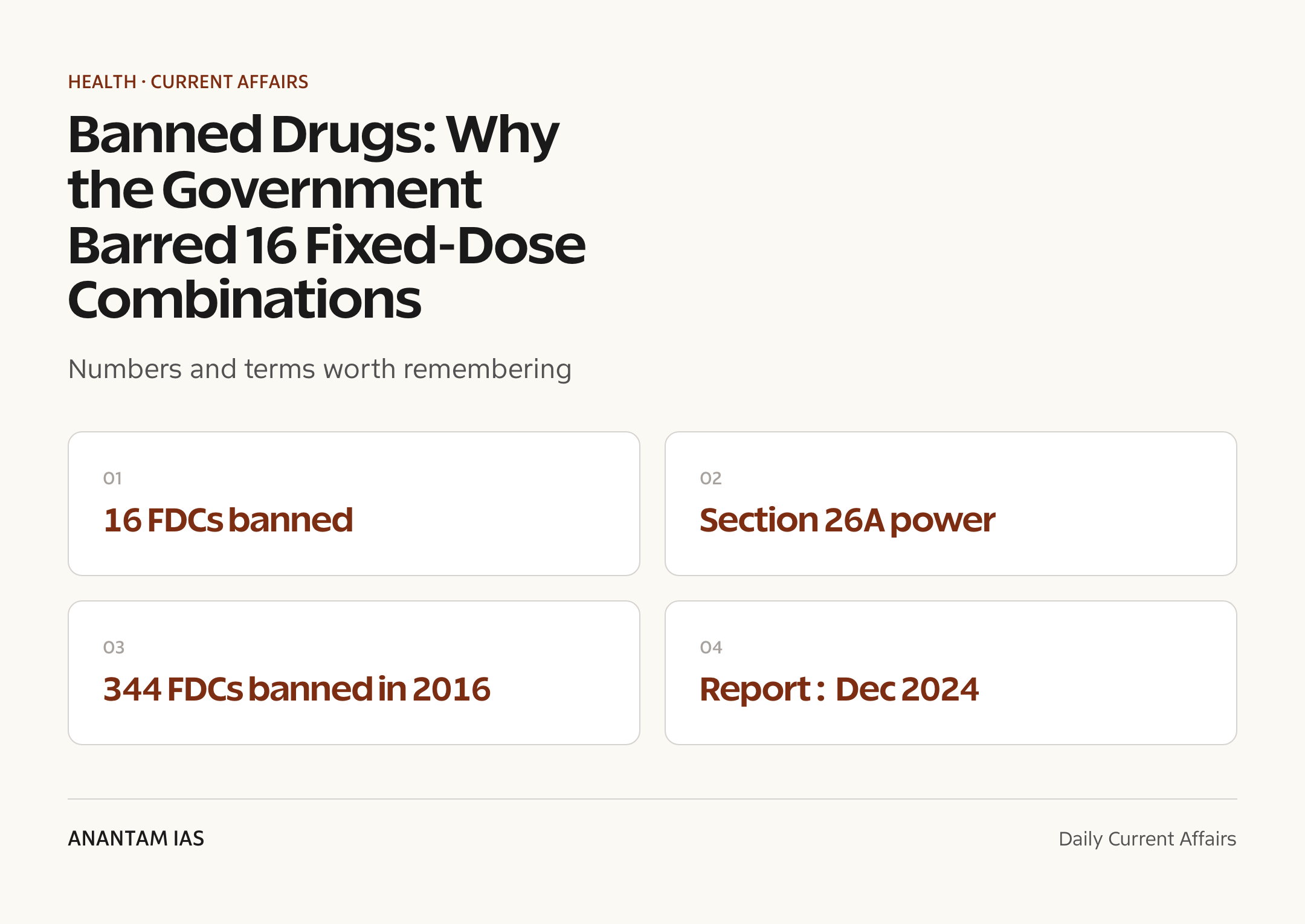
- Notifications under Section 26A of the Drugs and Cosmetics Act, 1940 prohibit 16 FDCs for lacking therapeutic justification.
- Categories hit: paracetamol-based painkillers, antibiotic-enzyme pairings, gliclazide + chromium picolinate (antidiabetic), and topical skin products.
- A DTAB sub-committee finalised its recommendation on 28 December 2024 after giving manufacturers a chance to submit data through public notices.
- The ban flows from a long chain: the 2016 ban on 344 FDCs, court challenges, a 2017 Supreme Court reference, and fresh DTAB scrutiny.
- Antibiotic FDCs were flagged because injudicious use fuels antimicrobial resistance, a recurring concern of the expert committees.
The development matters in the context of:
- An FDC is a single dosage form (tablet, syrup, injection) combining two or more active drugs in a fixed ratio.
- FDCs are rational only when each ingredient adds proven benefit; otherwise they are termed irrational FDCs.
- India has long carried a large market of unscientific combinations, prompting repeated regulatory clean-ups since 2016.
UPSC Relevance
Prelims Relevance
- FDC = fixed-dose combination: two or more active pharmaceutical ingredients in one fixed-ratio dosage form.
- Power to ban drugs in the public interest flows from Section 26A of the Drugs and Cosmetics Act, 1940.
- CDSCO (Central Drugs Standard Control Organisation) is India’s national drug regulator under the Ministry of Health and Family Welfare.
- The DCGI (Drugs Controller General of India) heads CDSCO and approves new drugs and FDCs.
- The Drugs Technical Advisory Board (DTAB) is the top technical advisory body on drug matters under the Act.
- The Kokate Committee (chaired by Prof. C. K. Kokate) examined the rationality of FDCs and underpinned the 2016 ban on 344 FDCs.
- State drug controllers can license drug manufacture, which historically allowed many FDCs to enter the market without central approval.
- Antimicrobial resistance (AMR) is the ability of microbes to survive drugs that once killed them, worsened by misuse of antibiotics including irrational FDCs.
- The current action bans 16 FDCs; notifications take effect on issue and apply nationwide.
Mains Relevance
GS Paper 2
- Health governance: how regulatory bodies (CDSCO, DTAB) and statutory powers (Section 26A) are used to protect public health against market and industry pressures.
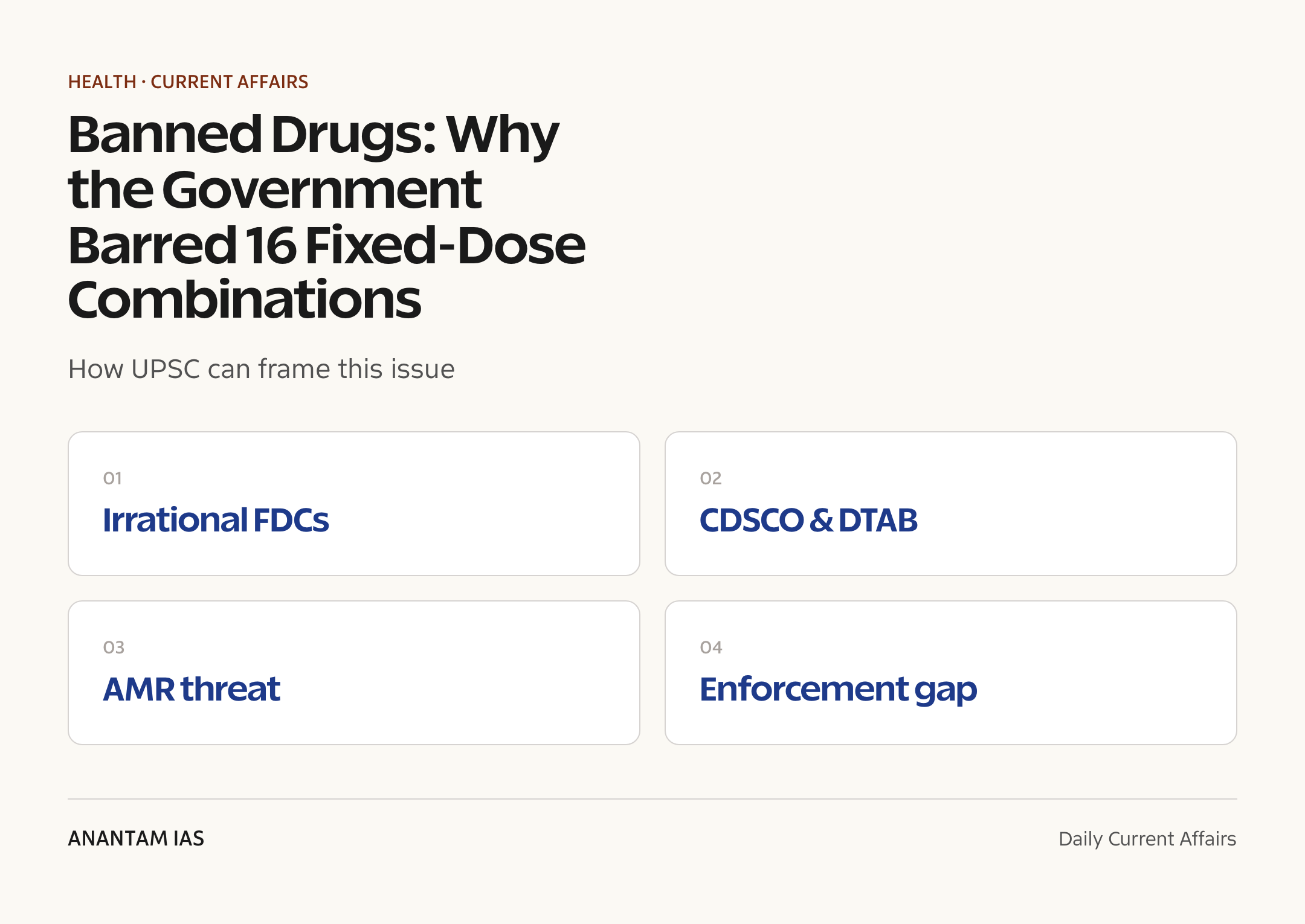
- Regulation versus enforcement gap: persistent circulation of irrational FDCs despite repeated bans points to weaknesses in licensing, surveillance and centre-state coordination.
Essay
- Science, ethics and public interest: when commercial convenience collides with patient safety and the long-term threat of antimicrobial resistance.
Background and Context
What FDCs are, and what makes one irrational
Not every combination pill is a problem; the issue is combinations that add risk without adding proven benefit.
- A fixed-dose combination packs two or more active drugs in a single fixed-ratio tablet, capsule, syrup or injection.
- Rational FDCs (for example, many tuberculosis and HIV regimens) improve adherence and outcomes and appear on the WHO model list.
- An irrational FDC combines drugs with no scientific basis — ingredients that overlap, work against each other, or have no evidence for joint use.
- Reviewers flagged amoxicillin + serratiopeptidase and cefuroxime + serratiopeptidase as pharmacodynamically irrelevant, with no robust evidence or treatment-guideline support.
- Gliclazide + chromium picolinate was barred because diabetes guidelines do not recommend chromium picolinate.
- Combinations stacking redundant antispasmodics (such as adding clidinium to dicyclomine) were judged to offer no extra benefit while raising the risk burden.
Why the 16 were banned now
The 16 notifications rest on a single test: no therapeutic justification, so risk outweighs benefit.
- The Health Ministry held that the 16 FDCs lack therapeutic justification and that continued use is not beneficial against the potential risks.
- A DTAB sub-committee examined safety, efficacy and therapeutic value, then finalised its report on 28 December 2024.
- Manufacturers and stakeholders were invited to submit supporting data through public notices before the recommendation was finalised.
- The list spans everyday categories — painkillers, antibiotics, antidiabetic and topical products — meaning the ban touches widely sold formulations.
- Notifications were issued under Section 26A, which lets the Centre prohibit a drug in the public interest, and the Indian Express noted they take effect on issue.
The regulatory architecture: CDSCO, DCGI, DTAB and Section 26A
Drug regulation in India runs on a shared central-and-state structure with one key ban power at the top.
- CDSCO, headed by the DCGI, is the central regulator that approves new drugs, FDCs and clinical trials under the Drugs and Cosmetics Act, 1940.
- The DTAB is the highest statutory technical body advising the centre and states on technical drug matters.
- State drug controllers license manufacture and sale, a split that historically let some FDCs reach the market without central clearance.
- Section 26A empowers the Centre to prohibit the manufacture, sale or distribution of a drug if it is satisfied this is needed in the public interest.
- The Kokate Committee (from 2014) supplied the scientific review that drove the first big clean-up, the 2016 ban on 344 FDCs.
- Subsequent scrutiny was routed through DTAB and its sub-committees, the route used again for the current 16.
The antimicrobial-resistance link
Several flagged FDCs are antibiotics, tying the ban to India’s wider AMR challenge.
- Antimicrobial resistance develops when bacteria, viruses and other microbes survive the drugs meant to kill them, making infections harder to treat.
- Irrational antibiotic FDCs encourage injudicious use — wrong combinations and unnecessary exposure — which accelerates resistance.
- Expert committees, including the Kokate review, repeatedly named antibiotic resistance from over-use as a serious national concern.
- Curbing pointless antibiotic-enzyme pairings supports antibiotic stewardship and India’s National Action Plan on AMR.
- Internal context for readers is available in our explainer on antimicrobial resistance.
Past FDC bans and the litigation trail
The 16 bans are the latest step in a decade of regulation tangled in courtrooms.
- In March 2016 the Centre issued 344 notifications banning 344 FDCs based on the Kokate Committee’s finding of no therapeutic justification.
- Major manufacturers challenged the bans, and the Delhi High Court stayed them in 2016, holding that the DTAB should have been consulted.
- In December 2017 the Supreme Court set aside the High Court order but referred most post-1988 FDCs back to DTAB for fresh examination.
- A DTAB sub-committee reported in 2018, and the government issued fresh prohibitions covering hundreds of FDCs.
- The 2026 action on 16 FDCs shows the review machinery continues to work case-by-case through DTAB rather than in a single sweep.
Significance and the enforcement gap
Bans on paper matter only if irrational combinations actually disappear from pharmacy shelves.
- Each ban removes a specific risk while signalling that combinations need evidence, not just market demand, to survive.
- A recurring weakness is the gap between notification and ground reality, as banned or unapproved FDCs keep resurfacing.
- The centre-state split in licensing complicates uniform enforcement across India’s large, fragmented pharma market.
- Stronger post-market surveillance, pharmacovigilance and rational-prescribing norms are needed to make the bans stick.
- For aspirants, the case links health policy, federal regulation and the science of drug safety in one example.
Way Forward
Close the enforcement gap
- Strengthen state-level inspection and pharmacovigilance so banned FDCs are pulled from shelves, not just from notifications.
- Build a shared CDSCO-state database to track licensed FDCs and flag unapproved combinations quickly.
Make approvals evidence-first
- Require robust clinical evidence and guideline support before any new FDC is licensed.
- Route all FDC approvals through central CDSCO scrutiny to prevent state-level back doors.
Protect antibiotics
- Tie FDC policy to the National Action Plan on AMR and antibiotic-stewardship programmes.
- Promote rational prescribing and curb over-the-counter sale of antibiotic combinations.
Conclusion
The ban on 16 irrational fixed-dose combinations is a small but telling step in a long campaign to bring evidence back into India’s medicine cabinet. Working through Section 26A, CDSCO and the DTAB, the government is steadily weeding out combinations that add risk without adding proven benefit.
The harder task lies beyond the notification. Unless enforcement, surveillance and prescribing habits catch up, irrational FDCs will keep returning and the threat of antimicrobial resistance will keep growing. For policymakers and aspirants alike, drug regulation is a standing test of whether public health can outweigh commercial convenience.
UPSC Practice Questions
Prelims MCQ 1
With reference to the regulation of Fixed-Dose Combination (FDC) drugs in India, consider the following statements:
- The power to prohibit a drug in the public interest is drawn from Section 26A of the Drugs and Cosmetics Act, 1940.
- The Drugs Technical Advisory Board (DTAB) is the highest statutory technical advisory body on drug matters under the Act.
- All fixed-dose combinations are classified as irrational and stand banned in India.
How many of the above statements are correct?
(a) Only one (b) Only two (c) All three (d) None
Answer: (b) Only two
Explanation:
Statements 1 and 2 are correct. Statement 3 is wrong: many FDCs (such as standard TB and HIV regimens) are rational and remain in use; only irrational FDCs without therapeutic justification are banned.
Prelims MCQ 2
Which body in India’s drug-regulation system heads the Central Drugs Standard Control Organisation (CDSCO) and approves new drugs and FDCs?
(a) Drugs Technical Advisory Board (b) Indian Council of Medical Research (c) Drugs Controller General of India (d) National Pharmaceutical Pricing Authority
Answer: (c) Drugs Controller General of India
Explanation:
The DCGI heads CDSCO and approves new drugs, FDCs and clinical trials. DTAB is advisory, ICMR is a research body, and the NPPA handles drug pricing.
UPSC Mains Questions
- India has repeatedly banned irrational fixed-dose combination drugs, yet they keep returning to the market. Examine the regulatory architecture for drug approval and the structural reasons for this enforcement gap. (GS2)
- Irrational antibiotic combinations contribute to antimicrobial resistance. Discuss how India’s drug-regulation framework can be aligned with antibiotic stewardship to safeguard public health. (GS2)
Source: Indian Express.
Frequently Asked Questions
What is a fixed-dose combination (FDC) drug?
An FDC is a single dosage form, such as a tablet, capsule or syrup, that combines two or more active drugs in a fixed ratio. It is rational only when each ingredient adds a proven benefit.
Why did the government ban these 16 FDCs?
A DTAB sub-committee found the 16 combinations lacked therapeutic justification, meaning their risks were not outweighed by any proven benefit. The Centre then prohibited them in the public interest.
Under which law are FDCs banned in India?
Bans are issued under Section 26A of the Drugs and Cosmetics Act, 1940, which lets the central government prohibit the manufacture, sale or distribution of a drug in the public interest.
Which bodies regulate drugs and FDCs in India?
The Central Drugs Standard Control Organisation (CDSCO), headed by the Drugs Controller General of India (DCGI), is the national regulator. The Drugs Technical Advisory Board (DTAB) is the top technical advisory body, and state drug controllers license manufacture and sale.
How are irrational FDCs linked to antimicrobial resistance?
Several banned FDCs are antibiotics. Pointless or unscientific antibiotic combinations encourage injudicious use, which speeds up antimicrobial resistance and makes infections harder to treat.
Has India banned FDCs before?
Yes. In 2016 the Centre banned 344 FDCs based on the Kokate Committee’s review. After legal challenges and a 2017 Supreme Court reference, fresh DTAB scrutiny led to further bans, of which the current 16 are the latest.