Bar Council and NALSAR: Dissent, Regulatory Power and the Right to a Profession
Why in News?
On August 14, 2026, the Supreme Court restrained the Bar Council of India from taking coercive action against NALSAR University of Law students, faculty members or administrators over a student campaign concerning the invitation to the Chief Justice of India.
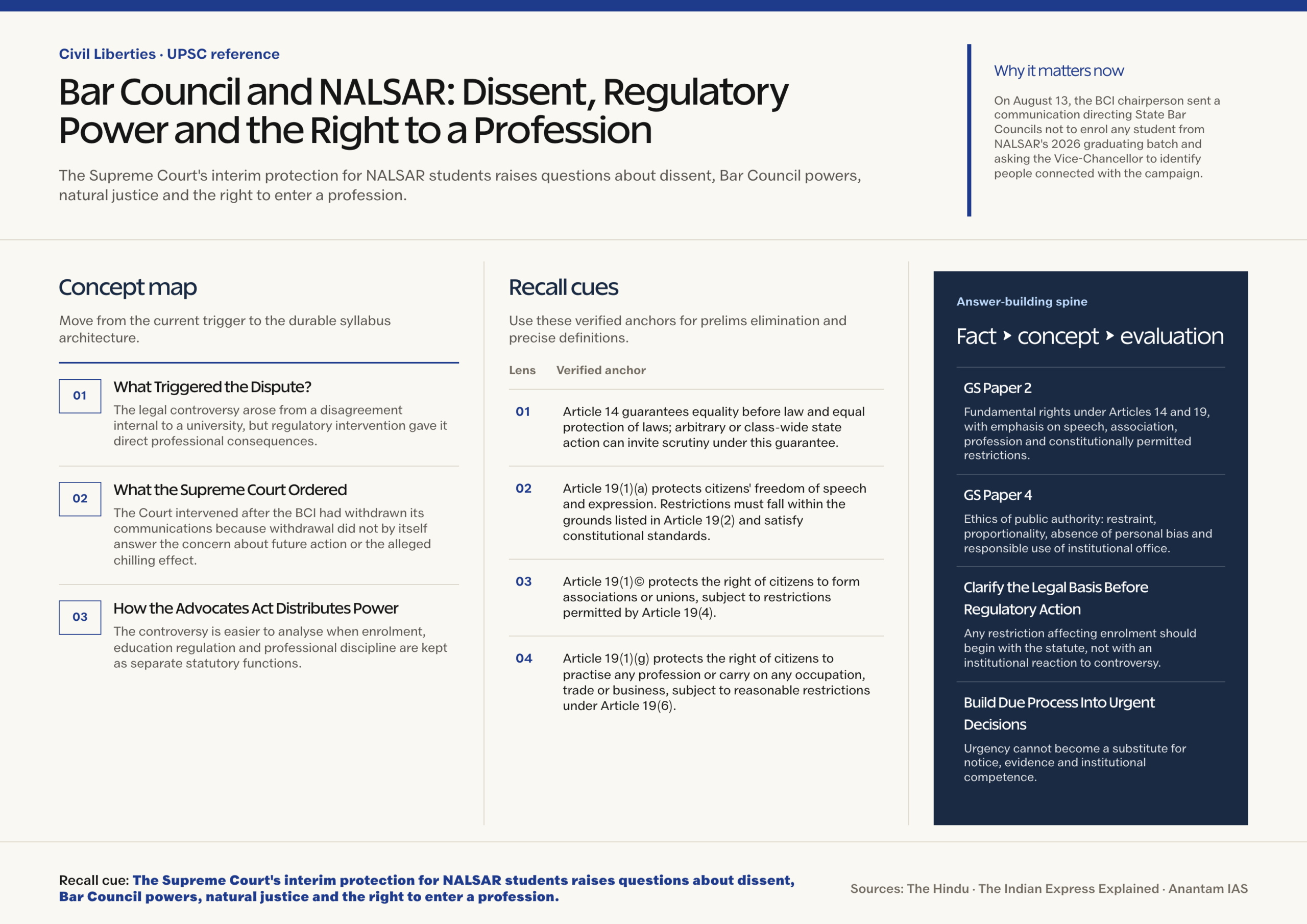
- On August 13, the BCI chairperson sent a communication directing State Bar Councils not to enrol any student from NALSAR’s 2026 graduating batch and asking the Vice-Chancellor to identify people connected with the campaign.
- The Indian Express reported that several BCI office-bearers said the first directive had been issued by the chairperson before collective approval. The BCI modified the direction within hours, removed the batch-wide enrolment bar and initially retained.
- NALSAR’s Vice-Chancellor said the proposed inquiry would first have to be examined for constitutional permissibility and compatibility with the university’s governance framework.
- Early on August 14, the BCI announced that all proceedings against the batch were closed and that the university administration need take no further action.
- Despite that withdrawal, the Supreme Court recorded a protective order against coercive action and gave the BCI two weeks to file an affidavit explaining its directives.
- The controversy connects freedom of speech under Article 19(1)(a) with the freedom to practise a profession under Article 19(1)(g), both subject to the Constitution’s permitted restrictions.
- It also tests Article 14’s protection against arbitrary state action, especially when an entire graduating batch faces consequences without an individual allegation, notice or hearing.
- The Advocates Act, 1961 divides functions between the BCI and State Bar Councils. That statutory design matters because regulatory purpose does not create an unlimited power to impose new enrolment disqualifications.
UPSC Relevance
Prelims Relevance
- Article 14 guarantees equality before law and equal protection of laws; arbitrary or class-wide state action can invite scrutiny under this guarantee.
- Article 19(1)(a) protects citizens’ freedom of speech and expression. Restrictions must fall within the grounds listed in Article 19(2) and satisfy constitutional standards.
- Article 19(1)(c) protects the right of citizens to form associations or unions, subject to restrictions permitted by Article 19(4).
- Article 19(1)(g) protects the right of citizens to practise any profession or carry on any occupation, trade or business, subject to reasonable restrictions under Article 19(6).
- Under Section 6 of the Advocates Act, 1961, admitting persons as advocates on a State roll is a function of the State Bar Council.
- Under Section 7, the BCI sets professional-conduct standards, promotes legal education, recognises qualifying universities and exercises general supervision and control over State Bar Councils.
Mains Relevance
GS Paper 2
- Fundamental rights under Articles 14 and 19, with emphasis on speech, association, profession and constitutionally permitted restrictions.
- The rule of law principle that every public body’s action must have a legal source, remain within statutory purpose and follow fair procedure.
GS Paper 4
- Ethics of public authority: restraint, proportionality, absence of personal bias and responsible use of institutional office.
- Conflict-of-interest safeguards when regulatory action concerns criticism of a person or office closely connected to the triggering dispute.
Essay
- Dissent is not the opposite of institutional loyalty; it can be a method of making institutions answerable to their own principles.
Background and Context
What Triggered the Dispute?
The legal controversy arose from a disagreement internal to a university, but regulatory intervention gave it direct professional consequences.
- A group of NALSAR students opposed inviting Chief Justice of India Surya Kant as chief guest for their convocation and communicated their objections to the university administration.
- On August 13, the BCI chairperson’s first letter sought a report identifying those involved in the campaign and directed all State Bar Councils to halt enrolment of the university’s entire 2026 graduating batch.
- The batch-wide character mattered. The directive did not identify misconduct by each graduate or distinguish organisers, supporters, non-participants and students who may have had no connection with the campaign.
- After objections from within the BCI and outside it, a second letter withdrew the enrolment bar but retained the inquiry. A later communication closed the inquiry as well.
What the Supreme Court Ordered
The Court intervened after the BCI had withdrawn its communications because withdrawal did not by itself answer the concern about future action or the alleged chilling effect.
- The Court restrained the BCI from taking coercive action against NALSAR students, faculty or administrators on the basis of the incidents referred to in the August 13 communications.
- It directed the BCI to file an affidavit within two weeks explaining the circumstances and basis of its actions.
- The Chief Justice orally criticised the BCI’s intervention and said the dispute was a dialogue between the students and him. He also linked the issue to the right to a profession and students’ freedom to protest.
- For answer writing, distinguish an oral observation from an operative judicial direction. Also distinguish a temporary protective order from a final judgment after pleadings and legal issues have been fully considered.
- The pending process may examine statutory jurisdiction, fundamental rights, natural justice and the legal effect of withdrawal. None of those questions should be presented as finally decided merely because interim relief was granted.
How the Advocates Act Distributes Power
The controversy is easier to analyse when enrolment, education regulation and professional discipline are kept as separate statutory functions.
- A State Bar Council admits qualified persons to its roll and maintains that roll. An application is processed by its enrolment committee under the Act.
- The Bar Council of India lays down professional-conduct standards for advocates, promotes legal education, recognises law degrees for enrolment purposes and supervises State Bar Councils.
- Section 26 gives the BCI a defined role when a State enrolment committee proposes to reject a particular application: the State body refers the application and its grounds for the BCI’s opinion.
- The legal issue is not whether the BCI has any influence over enrolment or legal education. It plainly has statutory functions in both domains. The issue is whether those functions authorised a prior, blanket direction tied.
- A regulator cannot infer a new punitive power solely from a broad regulatory purpose. Its action must remain connected to the text, scheme and object of the parent statute.
Free Speech, Profession and the Chilling Effect
The case joins two freedoms that are often studied separately: speaking as a citizen and entering a regulated profession.
- Article 19(1)(a) protects speech, including criticism of public institutions and office-holders. It does not protect every mode of protest in every setting; any restriction still needs a valid Article 19(2) ground and must meet constitutional scrutiny.
- Article 19(1)(g) protects citizens’ freedom to practise a profession. Article 19(6) permits reasonable restrictions in the public interest and allows laws prescribing professional or technical qualifications.
- The constitutional question is sharper when access to a profession is threatened because of expression that is not itself shown to violate a lawful professional-entry condition.
- A chilling effect occurs when the threat of serious consequences causes people to avoid protected expression even without final punishment. A withdrawn order can still matter if it signals that criticism may endanger education or employment.
- Legal education has a special democratic role. Training future advocates requires discipline and professional ethics, but it also requires the capacity to question power, test arguments and disagree without fear.
Way Forward
Clarify the Legal Basis Before Regulatory Action
- Record the exact provision conferring power, the statutory purpose served and the facts connecting each affected person to the proposed action.
- Use individual enrolment procedures under the Advocates Act instead of batch-wide presumptions when eligibility is genuinely in question.
- Publish reasoned decisions so affected persons and reviewing courts can test jurisdiction, relevance and proportionality.
Conclusion
- The NALSAR episode is not only a free-speech controversy.
- The Supreme Court’s present order supplies immediate protection and demands an explanation from the BCI.
UPSC Practice Questions
Prelims MCQ 1
With reference to the Advocates Act, 1961, consider the following statements:
- Admitting persons as advocates on a State roll is a function of the State Bar Council.
- The Bar Council of India promotes legal education and recognises universities whose law degrees qualify for enrolment.
- Expression of dissent against a public authority is expressly listed in Section 24A as a disqualification for enrolment.
How many of the above statements are correct?
(a) Only one (b) Only two (c) All three (d) None
Answer: (b) Only two
Explanation:
Statements 1 and 2 follow Sections 6 and 7 of the Advocates Act. Section 24A contains specified disqualifications linked to moral turpitude and certain employment consequences; it does not list dissent as a disqualification.
Prelims MCQ 2
Which one of the following best describes the Supreme Court’s intervention in the NALSAR-Bar Council matter as reported on August 14, 2026?
(a) A final judgment striking down the entire Advocates Act (b) A final ruling abolishing the BCI’s supervision over State Bar Councils (c) An interim restraint against coercive action accompanied by a direction to the BCI to explain its actions (d) A criminal conviction of the BCI chairperson
Answer: (c) An interim restraint against coercive action accompanied by a direction to the BCI to explain its actions
Explanation:
The Court protected NALSAR students, faculty and administrators from coercive action based on the August 13 communications and sought a BCI affidavit within two weeks. The merits were not finally adjudicated.
UPSC Mains Questions
- The power to regulate entry into a profession cannot become a power to punish disagreement. Discuss with reference to Articles 14 and 19 and the statutory scheme of the Advocates Act, 1961. (15 marks, 250 words)
- How do natural justice and proportionality constrain collective regulatory measures that affect educational or professional opportunities? Explain with suitable constitutional principles. (15 marks, 250 words)
Sources: The Hindu and The Indian Express Explained.
Frequently Asked Questions
What did the Bar Council of India initially direct in the NALSAR matter?
The first August 13 communication directed State Bar Councils not to enrol graduates from NALSAR’s 2026 batch and asked the university to report on people connected with the student campaign. The enrolment restraint was withdrawn within hours, and the retained.
What protection did the Supreme Court grant?
The Supreme Court restrained the BCI from taking coercive action against NALSAR students, faculty members or administrators on the basis of the incidents mentioned in the August 13 communications. It also gave the BCI two weeks to file an affidavit.
Did the Supreme Court finally declare the BCI communications unconstitutional?
No. The reported order was an interim protective measure, not a final adjudication of every statutory and constitutional issue. The Court’s oral criticism and the operative restraint are important, but a final holding requires consideration of pleadings, evidence and legal.
Who enrols a law graduate as an advocate?
Under the Advocates Act, a State Bar Council admits qualified persons to its roll through its enrolment process. The BCI has major supervisory, rule-making and legal-education functions and gives an opinion when a State enrolment committee proposes to refuse a.
What is the chilling effect in free-speech law?
The chilling effect describes how a threat of sanction can deter people from exercising protected speech even when punishment is never finally imposed. In this dispute, the concern is that linking student criticism to professional enrolment could discourage lawful expression.