Basavanna and the Lingayat Movement: Social Reform and Ethical Philosophy
Why in News?
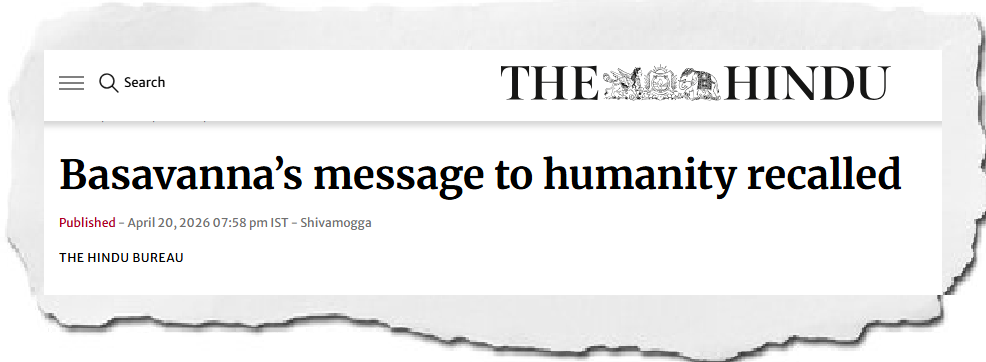
Basava Jayanti, commemorating the birth anniversary of Basavanna, was celebrated across Karnataka, highlighting his contributions to social reform, equality, and ethical governance.
UPSC Relevance
GS-I: Medieval Indian History, Bhakti Movement, Social Reform Movements
GS-IV: Ethics (Equality, Integrity, Work Culture)
Who was Basavanna?
- A 12th-century philosopher, statesman, and social reformer.
- Served as a minister in the court of King Bijjala II (Kalachuri dynasty).
- Founder of the Lingayat (Veerashaiva) movement.
His movement is often described as a “social revolution (Kalyana Kranti)” in medieval India.
Core Philosophy of Basavanna
1. Equality and Anti-Caste Ideology
Basavanna strongly opposed:
- Caste hierarchy
- Untouchability
He advocated a society based on equality and dignity of labour, rejecting birth-based discrimination.
2. Kayaka and Dasoha (Ethical Economic Ideas)
- Kayaka (Work as Worship):
Every individual must engage in productive work; dignity lies in labour, not status. - Dasoha (Sharing of Wealth):
Surplus wealth should be shared with society, promoting social justice and redistribution.
These ideas have strong relevance to inclusive growth and ethical economics.
3. Rejection of Ritualism
- Opposed elaborate rituals, priesthood dominance, and temple-based hierarchy.
- Promoted direct personal devotion to God (Ishtalinga).
This aligns with the broader Bhakti movement’s emphasis on personal spirituality.
4. Anubhava Mantapa: Early Democratic Space
- Established a spiritual-discursive forum called Anubhava Mantapa.
- It functioned like an open assembly, where people from all backgrounds:
- Discussed philosophy
- Questioned social norms
Often described as one of the earliest forms of participatory democracy in India.
5. Vachana Literature
- Basavanna expressed his ideas through Vachanas (short poetic compositions in Kannada).
- These were:
- Simple
- Direct
- Accessible to common people
Played a key role in spreading reformist ideas beyond elites.
Basavanna and the Bhakti Movement
| Feature | Basavanna’s Contribution |
| Social Reform | Strong attack on caste and inequality |
| Religious Reform | Rejection of ritualism and priesthood |
| Language | Use of vernacular (Kannada) |
| Inclusivity | Participation of women and marginalised groups |
His movement represents the radical and reformist strand of the Bhakti tradition.
Relevance in Modern India
1. Social Justice and Equality
Basavanna’s ideas resonate with:
- Constitutional values of equality (Article 14)
- Social justice and inclusion
2. Ethical Governance
His emphasis on:
- Integrity
- Public service
- Welfare orientation
Connects with modern ideas of good governance and ethical leadership.
3. Inclusive Economic Thought
- “Kayaka” aligns with dignity of labour
- “Dasoha” aligns with redistributive justice and welfare state
4. Gender and Social Inclusion
- Women saints like Akka Mahadevi participated in the movement.
Indicates early advocacy of gender inclusion.
5. Democratic Values
- Anubhava Mantapa reflects:
- Dialogue
- Debate
- Participation
Core to modern democratic functioning.
Critical Perspective
- Despite its radical vision, the movement:
- Faced resistance from orthodox structures
- Gradually evolved into a distinct religious identity (Lingayatism)
Shows limits of social reform movements in deeply stratified societies.
Conclusion
Basavanna’s philosophy represents a powerful blend of spirituality, social reform, and ethical living. His emphasis on equality, dignity of labour, and participatory dialogue continues to hold relevance in addressing contemporary challenges of inequality, governance, and social justice. His ideas bridge medieval reform movements with modern constitutional values.
Previous Year Question:
With reference to the cultural history of medieval India, consider the following statements:
- Siddhas (Sittars) of Tamil region were monotheistic and condemned idolatry.
- Lingayats of Kannada region questioned the theory of rebirth and rejected the caste hierarchy.
Which of the statements given above is/are correct?
- 1 only
- 2 only
- Both 1 and 2
- Neither 1 nor 2
Answer: c) Both 1 and 2
Consider the following statements about the Lingayats:
1. They bury their dead.
2. They are great believers in the caste system, especially in the theory of purity and pollution.
3. They are against child marriage and favour widow remarriage.
Which of the statements given above is/are correct?
- 1 and 2
- Only 1
- 2 and 3
- 1 and 3
Answer: a) 1 and 2
Practice Questions
With reference to Basavanna, consider the following statements:
- He was associated with the Bhakti movement in North India.
- He advocated the concept of Kayaka and Dasoha.
- He established Anubhava Mantapa as a platform for discussion.
Which of the statements given above is/are correct?
(a) 1 only
(b) 2 and 3 only
(c) 1 and 3 only
(d) 1, 2 and 3
Answer: (b) 2 and 3 only.
Mains
- Discuss the role of Basavanna in challenging caste hierarchy and promoting social equality in medieval India.
- Examine the relevance of Basavanna’s ideas of Kayaka and Dasoha in contemporary governance.
- “Bhakti movement was both a spiritual and social reform movement.” Analyse with reference to Basavanna.