The High Seas Treaty (BBNJ): Governing Biodiversity Beyond National Borders
Why in News?
The BBNJ Agreement — the treaty on Biodiversity Beyond National Jurisdiction, widely called the High Seas Treaty — remains a landmark in global ocean governance, the first legally binding instrument to protect marine life in the two-thirds of the ocean that lies beyond any country’s control.
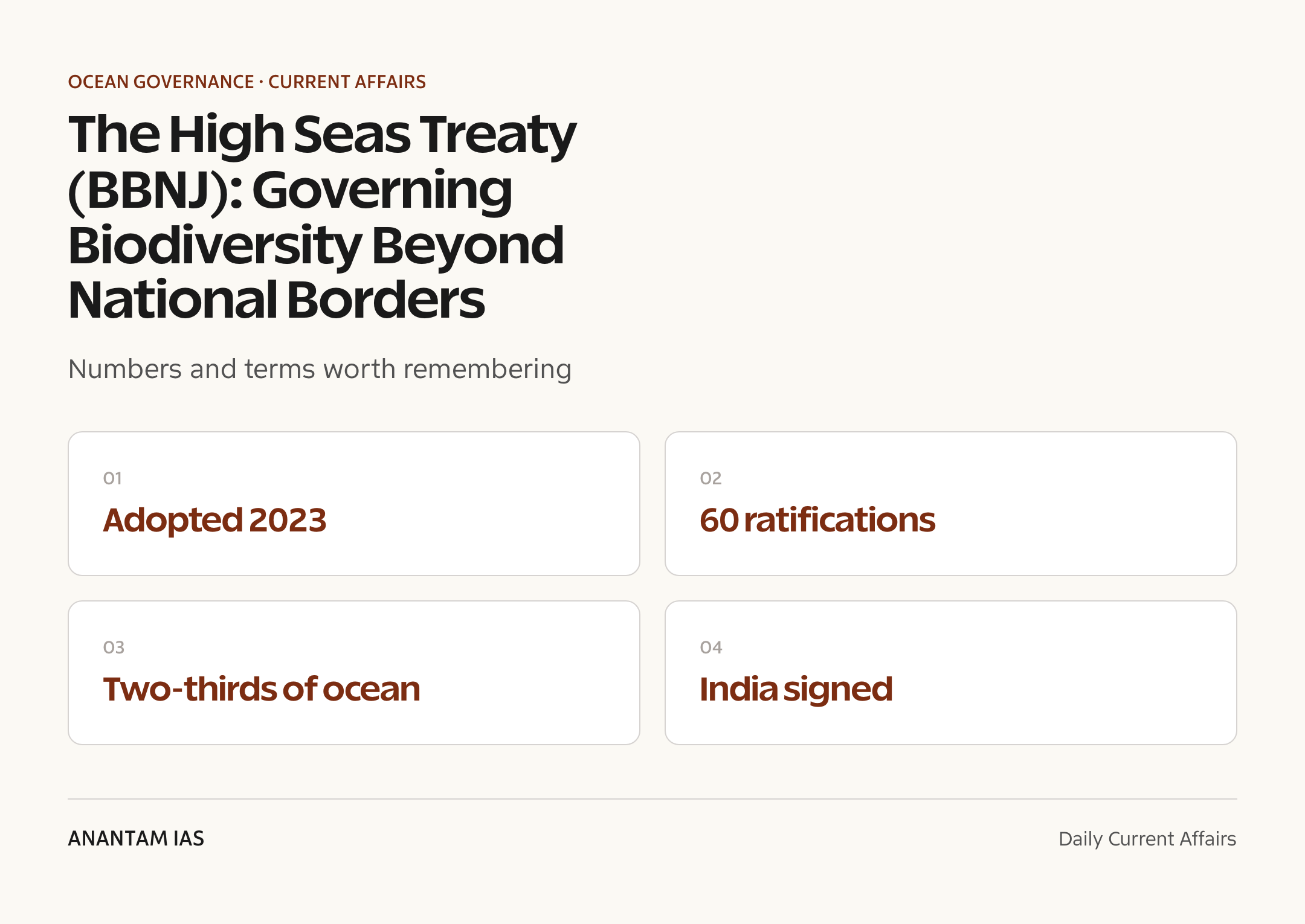
Adopted in 2023 as the third implementing agreement under the UN Convention on the Law of the Sea (UNCLOS), it needs 60 ratifications to enter into force; India has signed it, and the race to ratification keeps it firmly in focus for climate, biodiversity and maritime-strategy watchers.
- What it is: a legally binding treaty for the conservation and sustainable use of marine biodiversity in areas beyond national jurisdiction (ABNJ).
- Parent framework: the third implementing agreement under UNCLOS (after the 1994 Part XI and 1995 Fish Stocks agreements).
- Adoption: agreed at the UN in 2023 after nearly two decades of negotiation.
- Entry into force: requires 60 ratifications before it becomes operative.
- Coverage: applies to the high seas and the international seabed ‘Area’ — together about two-thirds of the ocean.
- India’s stand: India has signed the agreement, aligning it with the Kunming-Montreal 30×30 biodiversity target.
- Four pillars: marine protected areas, environmental impact assessments, marine genetic resources and benefit-sharing, and capacity building and technology transfer.
The development matters in the context of:
- Governance gap: until BBNJ, no single instrument could create protected areas or require impact assessments in the high seas, leaving a vast commons largely unregulated.
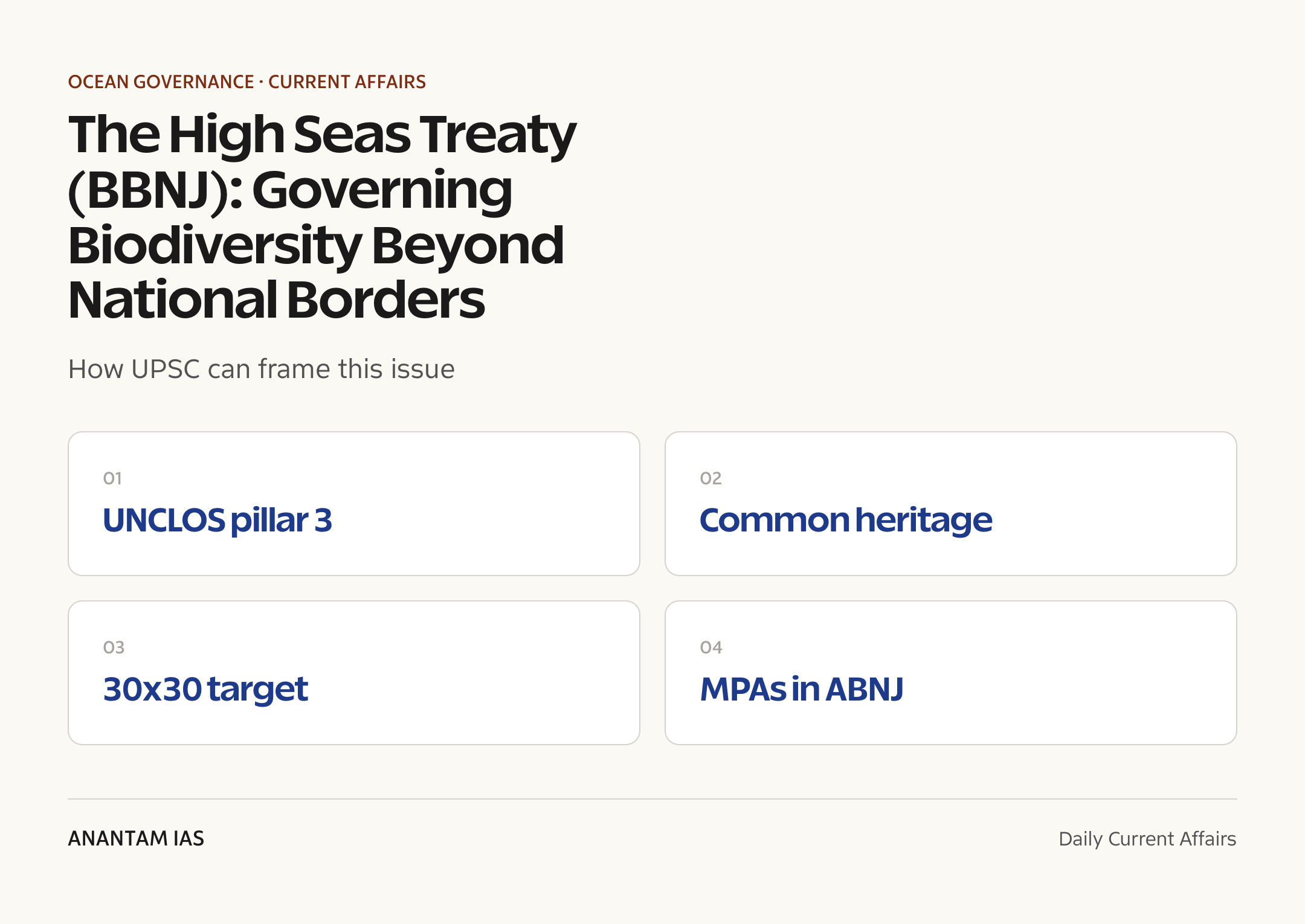
- 30×30 link: the treaty is the practical tool for extending the Kunming-Montreal goal of protecting 30% of land and sea by 2030 into international waters.
- Common heritage: it tests how the principle of the common heritage of mankind applies to living resources, not just seabed minerals.
- Equity stakes: developing states, including India, want fair sharing of benefits from marine genetic resources and real technology transfer, not just paper commitments.
UPSC Relevance
Prelims Relevance
- BBNJ Agreement as the third implementing agreement under UNCLOS.
- UNCLOS maritime zones: territorial sea (12 nm), contiguous zone (24 nm), EEZ (200 nm), continental shelf, high seas.
- Definition of areas beyond national jurisdiction (ABNJ) — the high seas plus the Area.
- The ‘Area’ as the seabed beyond national jurisdiction, and the common heritage of mankind principle.
- The International Seabed Authority (ISA) — mandate, headquarters at Kingston, Jamaica.
- The 60 ratifications threshold for the treaty to enter into force.
- The four pillars: MPAs, EIAs, marine genetic resources / benefit-sharing, capacity building and marine technology transfer.
- Link to the Kunming-Montreal Global Biodiversity Framework and the 30×30 target.
- The Convention on Biological Diversity (CBD) and the freedoms of the high seas (navigation, overflight, fishing, research).
- Difference between the high seas (water column) and the Area (seabed) in international law.
Mains Relevance
GS Paper 3 (Environment)
- Examine how the BBNJ Agreement closes the governance gap in protecting marine biodiversity in the high seas, and its links to the 30×30 target.
- Assess the challenges of designating and enforcing marine protected areas in areas beyond national jurisdiction.
GS Paper 2 (International Relations)
- Discuss the significance of the BBNJ Agreement for global ocean governance and India’s maritime and blue-economy interests.
- Evaluate the North-South tensions over marine genetic resources and benefit-sharing in negotiating the High Seas Treaty.
Essay
- A strong anchor for essays on the global commons, intergenerational equity and stewardship of shared resources.
- Useful for essays on multilateralism, North-South equity and governing what belongs to everyone and no one.
Background and Context
UNCLOS and the legal map of the ocean
To understand BBNJ you first need the zones that UNCLOS draws across the sea.
- UNCLOS: the 1982 UN Convention on the Law of the Sea is the ‘constitution of the oceans’, setting out rights and duties zone by zone.
- National zones: a coastal state controls a 12 nm territorial sea, a 24 nm contiguous zone, and resource rights in a 200 nm Exclusive Economic Zone (EEZ) plus its continental shelf.
- High seas: the water column beyond the EEZ, open to all states with freedoms of navigation, overflight, fishing and scientific research.
- The Area: the seabed and subsoil beyond national jurisdiction, declared the common heritage of mankind and managed by the ISA.
- ABNJ: the high seas and the Area together — the areas beyond national jurisdiction that BBNJ now addresses.
Why a new treaty was needed
UNCLOS framed the zones but left a yawning gap on protecting living biodiversity out there.
- Two-thirds of the ocean lies beyond national jurisdiction, yet no body could create marine protected areas there.
- Fragmented rules: sectoral bodies governed fishing, shipping or seabed mining separately, with no integrated tool for conservation.
- No EIA duty: there was no consistent requirement to assess the environmental impact of activities like deep-sea mining or bioprospecting.
- Genetic-resource vacuum: rules for accessing and sharing benefits from marine genetic resources were absent, raising equity concerns.
- Mandate: the UN General Assembly launched negotiations to fill this gap, concluding with adoption in 2023.
The four pillars of the BBNJ Agreement
The treaty rests on four interlocking elements, often called its package deal.
- Marine protected areas: a mechanism to establish area-based management tools, including MPAs, in the high seas to safeguard ecosystems.
- Environmental impact assessments: a duty to assess and disclose the likely impact of planned activities in ABNJ before they proceed.
- Marine genetic resources: rules for accessing genetic material from the high seas and for fair and equitable benefit-sharing, monetary and non-monetary.
- Capacity building and technology transfer: support so that developing states can participate in research, conservation and the blue economy.
Common heritage versus freedom of the high seas
BBNJ sits on a fault line between two competing legal traditions.
- Common heritage of mankind: a principle, applied to the seabed Area, that resources belong to all humanity and benefits must be shared.
- Freedom of the high seas: the older idea that the open ocean is free for all states to use, including fishing and research.
- The compromise: BBNJ blends both — keeping high-seas freedoms while layering on conservation duties and benefit-sharing for marine genetic resources.
- Institutional link: the seabed minerals of the Area stay with the ISA, while BBNJ focuses on living biodiversity in the water column and beyond.
Links to CBD, 30×30 and the climate agenda
The treaty is the missing ocean piece of the global biodiversity and climate framework.
- 30×30 target: the Kunming-Montreal Global Biodiversity Framework aims to protect 30% of land and sea by 2030 — unreachable at sea without BBNJ.
- CBD bridge: it extends the spirit of the Convention on Biological Diversity into waters the CBD itself does not directly govern.
- Carbon sink: the ocean absorbs heat and carbon, so protecting high-seas ecosystems is also a climate-resilience measure.
- Migratory species: whales, tuna, sharks and turtles cross jurisdictions, so connected high-seas MPAs are vital to their survival.
India's interests and the road to ratification
A landlocked-sounding treaty has direct stakes for a maritime nation like India.
- India has signed the agreement and frames it within its blue economy and ocean-science priorities under the Ministry of Earth Sciences.
- Equity push: India and other developing states want genuine benefit-sharing from marine genetic resources and real technology transfer.
- Deep Ocean Mission: India’s Deep Ocean Mission and ISA-linked exploration give it a direct interest in fair seabed and high-seas rules.
- Threshold race: the treaty needs 60 ratifications to enter into force, and domestic ratification remains the next step for signatory states.
Way Forward
Accelerate ratification and build institutions
- Reach the threshold: push the remaining ratifications past 60 so the treaty enters into force and its bodies can stand up.
- Operational machinery: establish the Conference of Parties, scientific and technical body, and a clearing-house for sharing data and genetic-resource information.
Make benefit-sharing and capacity real
- Fair sharing: design transparent rules for monetary and non-monetary benefits from marine genetic resources so developing states gain.
- Technology transfer: fund and deliver capacity building so countries like India can carry out high-seas research and conservation.
Enforce conservation effectively
- Connected MPAs: build networks of marine protected areas that track migratory species and ecosystems, not isolated patches.
- Monitoring: pair satellite surveillance and shared science with credible ocean-governance mechanisms to deter illegal and unassessed activity.
Conclusion
A commons finally governed: the BBNJ Agreement extends real, binding protection into the two-thirds of the ocean that long sat in a legal grey zone beyond any flag.
The balancing act: it threads the needle between the freedom of the high seas and the common heritage of mankind, layering conservation and equity onto an open ocean.
Why it matters for India: as a maritime power with deep-ocean and blue-economy ambitions, India’s interest lies in swift ratification, fair benefit-sharing and effective high-seas protection that serves both biodiversity and equity.
UPSC Practice Questions
Prelims MCQ 1
With reference to the BBNJ Agreement (High Seas Treaty), consider the following statements:
- It is an implementing agreement under the United Nations Convention on the Law of the Sea.
- It applies to marine areas within the Exclusive Economic Zones of coastal states.
- It requires 60 ratifications to enter into force.
How many of the above statements are correct?
(a) Only one (b) Only two (c) All three (d) None
Answer: (b) Only two
Explanation:
Statements 1 and 3 are correct: BBNJ is the third implementing agreement under UNCLOS and needs 60 ratifications to enter into force. Statement 2 is wrong — it governs areas beyond national jurisdiction (the high seas and the Area), not within EEZs.
Prelims MCQ 2
Which one of the following is the principle, under UNCLOS, that applies to the resources of the international seabed ‘Area’?
(a) Freedom of the high seas (b) Common heritage of mankind (c) Sovereign rights of the coastal state (d) Innocent passage
Answer: (b) Common heritage of mankind
Explanation:
Under UNCLOS, the seabed and subsoil beyond national jurisdiction — the ‘Area’ — are the common heritage of mankind, managed by the International Seabed Authority. Freedom of the high seas applies to the overlying water column, while sovereign rights and innocent passage relate to national zones.
UPSC Mains Questions
- The BBNJ Agreement has been called the missing ocean piece of the global biodiversity framework. Examine how it closes the governance gap in areas beyond national jurisdiction and its links to the 30×30 target.
- Discuss the tension between the freedom of the high seas and the common heritage of mankind in the negotiation of the High Seas Treaty. How does the agreement attempt to reconcile the two?
- Evaluate the significance of the BBNJ Agreement for India’s maritime, blue-economy and ocean-science interests, and the equity concerns it raises for developing states.
Sources: Ministry of Earth Sciences, Government of India and United Nations (Office of Legal Affairs / DOALOS).
Frequently Asked Questions
What is the BBNJ Agreement?
It is the treaty on Biodiversity Beyond National Jurisdiction, popularly called the High Seas Treaty. Adopted in 2023 under UNCLOS, it is the first legally binding instrument to conserve and sustainably use marine biodiversity in the high seas and the international seabed, which together cover about two-thirds of the ocean.
Why is it called the High Seas Treaty?
Because it governs the high seas and the seabed ‘Area’ — the parts of the ocean that lie beyond national jurisdiction, outside any country’s 200 nautical-mile Exclusive Economic Zone. These waters make up roughly two-thirds of the global ocean and had no integrated conservation framework before.
What are the four pillars of the treaty?
First, marine protected areas in the high seas. Second, mandatory environmental impact assessments for activities in international waters. Third, rules on marine genetic resources with fair and equitable benefit-sharing. Fourth, capacity building and marine technology transfer so developing states can take part.
When does the treaty enter into force?
It needs 60 ratifications to enter into force. Signing shows political intent, but a state is only bound once it ratifies domestically. Until 60 states ratify and deposit their instruments, the treaty’s institutions and obligations do not become operative.
How is it linked to the 30×30 target?
The Kunming-Montreal Global Biodiversity Framework sets a 30×30 goal — protecting 30% of land and sea by 2030. That ocean target is impossible without a tool to create protected areas in international waters, which is exactly what the BBNJ Agreement provides.
What is India’s position on the treaty?
India has signed the BBNJ Agreement and sees it as part of its blue-economy and ocean-science agenda. It presses for genuine benefit-sharing from marine genetic resources and real technology transfer for developing states, consistent with its Deep Ocean Mission and broader maritime interests.