BCG and Alzheimer’s Biomarkers: What Two Early Trials Actually Show
Why in News?
A report in Communications Medicine , indexed on PubMed and discussed by The Hindu, combined two very small, single-centre, open-label trials of Bacille Calmette-Guérin vaccination in older adults.
- All 23 treated participants received two intradermal BCG vaccinations, one month apart, and were followed for immune, biomarker, safety, and exploratory cognitive outcomes for up to one year.
- The trials were open-label and uncontrolled: participants and investigators knew the intervention, and there was no placebo or untreated comparison group against which natural change, measurement variation, or test-retest effects could be separated.
- Researchers found persistent stimulus-responsive changes in peripheral blood mononuclear cells and cerebrospinal-fluid monocytes, consistent with, but not definitive proof of, trained innate immunity in the central nervous system compartment.
- In participants classified without Alzheimer-related changes, cerebrospinal-fluid amyloid-beta 42 decreased while plasma amyloid-beta 42 increased. The authors described this as a biomarker association, not proof of improved brain clearance or clinical benefit.
- No significant longitudinal change was found in cerebrospinal-fluid phosphorylated tau-181, neurofilament light, or GFAP, and the study was not powered or designed to establish clinical efficacy.
- The study connects three syllabus themes: vaccine platforms, the changing science of innate immune memory, and the evidentiary path from an exploratory biomarker signal to a clinically useful intervention.
- It also illustrates why public-health communication must separate biological plausibility from demonstrated patient benefit, especially when a familiar vaccine is studied for a new indication.
- For India, the development matters scientifically because BCG is embedded in tuberculosis control, but an experimental neurodegeneration hypothesis must not be confused with the vaccine’s established TB-prevention role.
UPSC Relevance
Prelims Relevance
- The Bacille Calmette-Guérin vaccine is a live attenuated bacterial vaccine derived from Mycobacterium bovis; its established public-health use is protection against tuberculosis, especially severe childhood forms.
- The World Health Organization recommends a single BCG dose for infants in settings with high TB incidence and for specified risk groups in low-incidence settings; it does not recommend BCG as an Alzheimer’s vaccine.
- Trained immunity is a memory-like change in innate immune responsiveness involving metabolic and epigenetic reprogramming; it is distinct from antigen-specific adaptive immune memory mediated by B and T lymphocytes.
- Cerebrospinal fluid surrounds the brain and spinal cord. Sampling it can provide information about the central nervous system, but CSF immune cells are not identical to resident brain microglia.
- Amyloid-beta 42 and phosphorylated tau are Alzheimer’s-related biomarkers; a change in one laboratory marker is not by itself evidence of reduced dementia incidence, slower functional decline, or treatment success.
- PBMCs, or peripheral blood mononuclear cells, include lymphocytes and monocytes and are frequently used to measure immune responses outside the central nervous system.
Mains Relevance
GS Paper 3
- Explain how drug or vaccine repurposing can shorten early discovery pathways while still requiring rigorous phase-wise evidence for a new indication.
- Assess trained immunity as an emerging biotechnology concept linking epigenetic reprogramming, immunometabolism, and disease research.
GS Paper 2
- Discuss the state’s role in communicating uncertain biomedical findings without encouraging self-medication, off-label demand, or diversion from immunisation priorities.
- Examine why trial registration, control groups, adequate sample size, transparent attrition reporting, and diverse recruitment are essential to evidence-based health policy.
Essay
- Scientific progress often begins with a plausible signal, but public trust depends on preserving the boundary between hope and evidence.
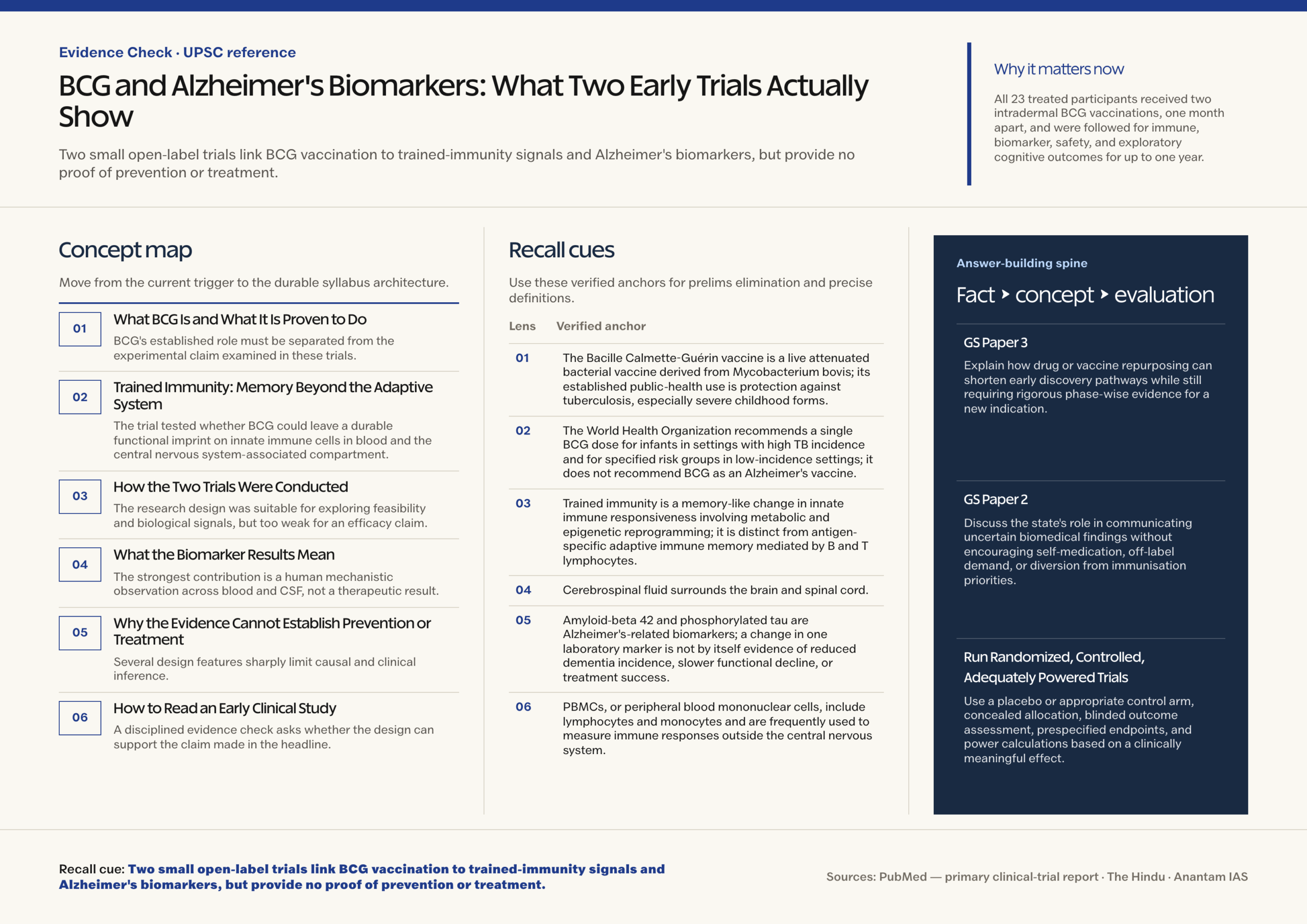
Background and Context
What BCG Is and What It Is Proven to Do
BCG’s established role must be separated from the experimental claim examined in these trials.
- BCG is a live attenuated vaccine developed from Mycobacterium bovis. It is the only licensed vaccine against tuberculosis and has been used for more than a century.
- According to the World Health Organization, BCG is given to babies or young children in many countries and protects children against severe forms of TB and TB-related death.
- Its protection against pulmonary TB varies by age, population, geography, and previous mycobacterial exposure. This variability is separate from the Alzheimer’s hypothesis.
- BCG is also used as an immunotherapy for some forms of bladder cancer. That history makes it a useful platform for studying broad immune effects, but success in one indication cannot be transferred to another without.
Trained Immunity: Memory Beyond the Adaptive System
The trial tested whether BCG could leave a durable functional imprint on innate immune cells in blood and the central nervous system-associated compartment.
- Classic immunological memory is associated with antigen-specific B and T cells. Trained immunity refers to longer-lasting changes in innate cells or their progenitors after an initial stimulus.
- These changes can involve epigenetic marks and cellular metabolism, allowing monocytes or related cells to respond differently when challenged later, even by a different stimulus.
- Researchers stimulated cells outside the body with heat-killed BCG, lipopolysaccharide, and, for some blood-cell assays, heat-killed Candida albicans. Cytokine production and single-cell gene-expression patterns were then compared over time.
- CSF monocytes showed a sustained transcriptional response to lipopolysaccharide, while direct response to heat-killed BCG was negligible in that compartment. This supports an indirect trained-immunity-like interpretation, not proof that vaccine organisms entered or acted directly.
- The distinction matters because stronger recall responsiveness is not the same as constant inflammation. Basal CSF interferon-gamma and interleukin-2 declined by 12 months, while several inflammatory cytokines remained low.
How the Two Trials Were Conducted
The research design was suitable for exploring feasibility and biological signals, but too weak for an efficacy claim.
- The studies recruited adults aged 55 years or older at one centre. Thirty-five people were screened, 23 were enrolled and treated, and 17 completed the full 12-month protocol.
- The two protocol cohorts were reported as 12 participants without Alzheimer-related pathology and 11 with it. In a later pooled analysis using the CSF phosphorylated-tau-181 to amyloid-beta-42 ratio, clustering yielded 11 non-AD and 12 AD.
- Participants received two intradermal BCG doses, at baseline and one month. Blood was sampled at baseline and at 3, 6, and 12 months; CSF was sampled at baseline and at 3 and 12 months.
- The first protocol focused on identifying feasible inflammation, immune-response, and neurodegeneration biomarkers. The second focused on safety and immune and Alzheimer’s-related biomarker changes in people with mild cognitive impairment or mild-to-moderate Alzheimer’s disease.
- The trials were open-label. The mild-cognitive-impairment/Alzheimer’s protocol was originally conceived as randomized but proceeded as a single-arm study because of feasibility and funding constraints.
What the Biomarker Results Mean
The strongest contribution is a human mechanistic observation across blood and CSF, not a therapeutic result.
- Peripheral blood cells showed persistent recall responses, including cytokine responses after laboratory stimulation. CSF monocytes also showed transcriptional reprogramming involving immune signalling, oxidative stress, and metabolic adaptation.
- The peripheral and CSF patterns differed. Plasma responses were more pronounced in participants classified with Alzheimer-related pathology, while CSF cytokine patterns were more restrained across groups, pointing to compartment-specific immune effects.
- In the group classified without Alzheimer-related changes, the CSF-to-plasma amyloid-beta-42 ratio fell by a reported 38.2% over 12 months. This was an exploratory, descriptive association and was not observed meaningfully in the AD group.
- A lower CSF-to-plasma ratio could be consistent with altered amyloid movement or clearance, but the trial did not directly measure clearance. Direction, mechanism, and clinical significance remain uncertain.
- CSF phosphorylated tau-181, neurofilament light, and GFAP did not show significant longitudinal changes. The pattern is mixed and cannot be compressed into a claim that Alzheimer’s pathology improved.
Way Forward
Run Randomized, Controlled, Adequately Powered Trials
- Use a placebo or appropriate control arm, concealed allocation, blinded outcome assessment, prespecified endpoints, and power calculations based on a clinically meaningful effect.
- Stratify participants by disease stage and biomarker status before randomization rather than relying mainly on small post hoc subgroups.
- Extend follow-up beyond one year to measure cognitive trajectory, daily functioning, conversion from mild cognitive impairment, and adverse events.
Conclusion
- The two BCG trials offer a credible early clue that an old vaccine can reshape immune responses detectable in blood and cerebrospinal fluid.
- The same evidence also demands restraint.
UPSC Practice Questions
Prelims MCQ 1
With reference to BCG vaccination and trained immunity, consider the following statements:
- BCG is a live attenuated vaccine derived from Mycobacterium bovis.
- Trained immunity refers exclusively to antigen-specific memory generated by B lymphocytes.
- A change in an Alzheimer’s-related fluid biomarker by itself proves clinical benefit.
How many of the above statements are correct?
(a) Only one (b) Only two (c) All three (d) None
Answer: (a) Only one
Explanation:
Statement 1 is correct. Trained immunity is a memory-like alteration of innate immune responsiveness, not exclusively B-cell memory. A surrogate biomarker change cannot by itself establish prevention, treatment, or clinical benefit.
Prelims MCQ 2
Which one of the following most accurately describes the evidentiary value of the reported BCG-Alzheimer’s trials?
(a) They prove that BCG prevents Alzheimer’s disease in older adults (b) They establish BCG as a treatment for mild-to-moderate Alzheimer’s disease (c) They provide an exploratory mechanistic signal that requires confirmation in larger controlled trials (d) They show that all Alzheimer’s biomarkers improve after BCG vaccination
Answer: (c) They provide an exploratory mechanistic signal that requires confirmation in larger controlled trials
Explanation:
The studies were very small, open-label, single-arm trials focused on safety, immune responses, and biomarkers. They did not establish clinical efficacy, and several neurodegeneration biomarkers did not change significantly.
UPSC Mains Questions
- The journey from a biomedical signal to a public-health intervention depends as much on research design as on biological plausibility. Discuss with reference to vaccine repurposing. (15 marks, 250 words)
- Differentiate trained immunity from adaptive immune memory. Evaluate the opportunities and evidentiary risks of targeting trained immunity in neurodegenerative disease. (15 marks, 250 words)
Sources: PubMed — primary clinical-trial report and The Hindu.
Frequently Asked Questions
Did the study prove that BCG prevents Alzheimer’s disease?
No. The report combined two very small open-label trials with no placebo or untreated control group. It found immune and biomarker changes that can generate hypotheses, but it did not measure or demonstrate reduced Alzheimer’s incidence. Prevention would require a.
Can BCG be used to treat someone who already has Alzheimer’s disease?
Not on the basis of this evidence. The study was not designed or powered to prove clinical efficacy, and it did not show meaningful cognitive or functional improvement attributable to BCG. Any Alzheimer’s use remains experimental and should occur only.
What is trained immunity?
Trained immunity is a memory-like alteration in innate immune cells or their progenitors after an earlier stimulus. Metabolic and epigenetic reprogramming can change later responses, including to unrelated stimuli. It differs from the antigen-specific memory classically produced by adaptive B.
What did researchers observe in cerebrospinal fluid?
They observed persistent trained-immunity-like gene-expression responses in CSF monocytes after laboratory stimulation, along with changes in some cytokines and amyloid-beta measures. The pattern differed from blood, suggesting compartment-specific immune effects. CSF findings do not directly establish what resident brain microglia.
Why is the amyloid-beta result not proof of benefit?
Amyloid-beta concentrations are surrogate biological measures. A change can have several explanations and does not automatically mean better clearance, slower cognitive decline, or improved daily functioning. The shift occurred in a small subgroup, lacked a control comparison, and was not.