Bengal’s Two New Laws: Preventive Detention and Public Property Recovery
Why in News?
The West Bengal Assembly on 29 June 2026 passed two laws marking the first big legislative move by the state’s new government: the West Bengal Public Safety and Control of Anti-social Activities Bill, 2026, a standalone preventive-detention statute, and the West Bengal Maintenance of Public Order (Amendment) Bill, 2026, which builds a money-recovery mechanism for property damaged in riots and protests.
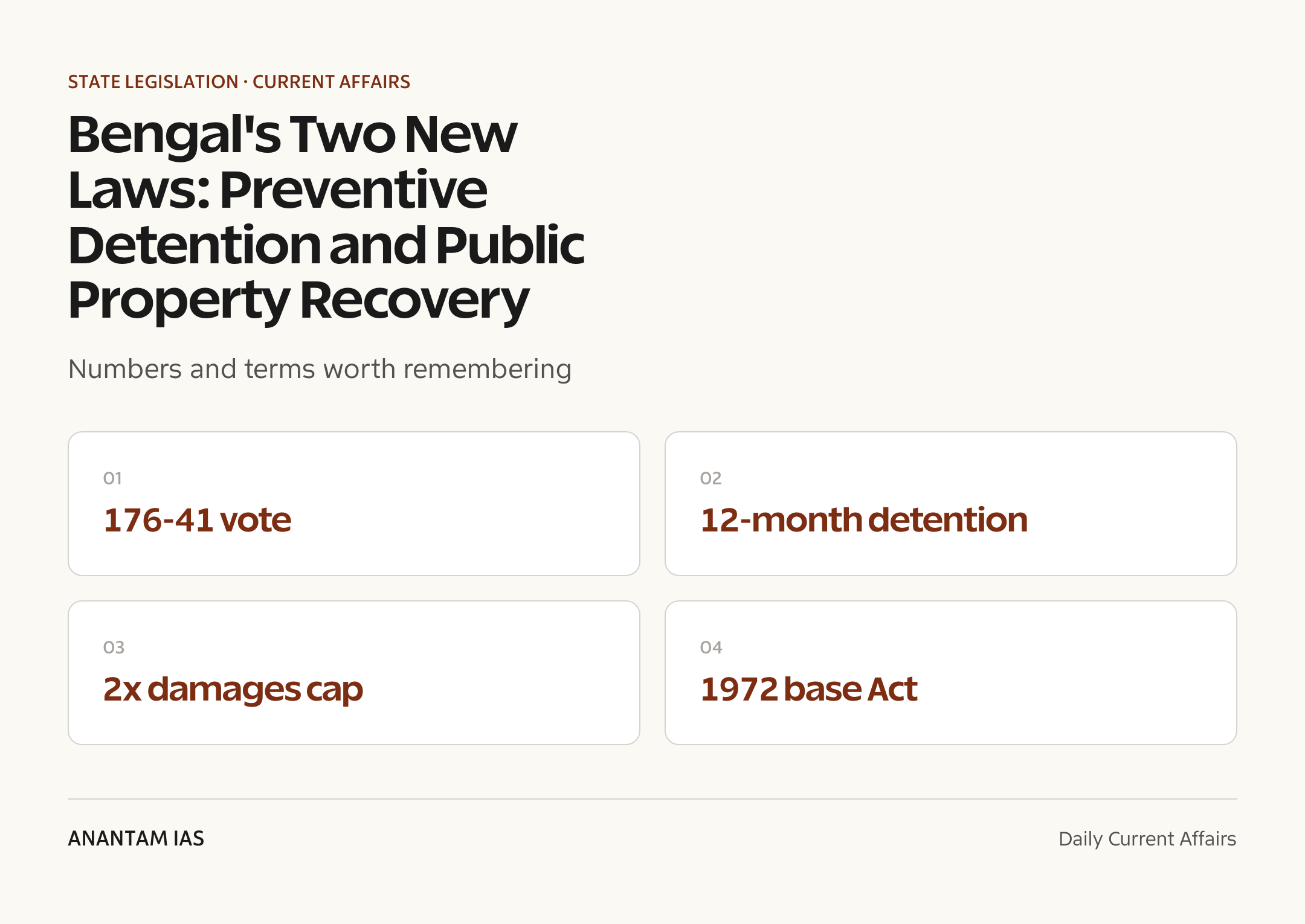
Both cleared the House after a stormy debate, the Public Safety Bill passing by 176 votes to 41, and both follow a template that began in Uttar Pradesh and has since spread across several states.
- The **Public Safety Bill** targets **goondas** and **anti-social activities**, both defined expansively, allowing detention of up to **12 months**.
- The **Public Order (Amendment) Bill** amends the **West Bengal Maintenance of Public Order Act, 1972** to recover the cost of damage during riots, arson and vandalism.
- It sets up a **Claims Commission** headed by an officer of at least **Additional District Magistrate** rank, armed with **civil-court powers**.
- The recovery law applies **strict liability**, can award **exemplary damages up to twice** the compensation, and makes every award **final with no appeal**.
- **Preventive detention** is permitted under **Article 22** and legislated under the **public order** entry, a State List subject.
The development matters in the context of:
- The laws test the constitutional limits on **personal liberty (Article 21)** and the **safeguards in Article 22(4)-(7)** for preventive detention.
- The recovery model echoes the **UP recovery law** that the **Supreme Court** repeatedly reined in for making the state ‘complainant, adjudicator and prosecutor’.
UPSC Relevance
Prelims Relevance
- **Article 22** — protection against arrest and detention; clauses (4)-(7) govern preventive detention.
- **Advisory Board** — required before detention beyond **three months**; members qualified to be **High Court judges**.
- **Preventive detention** appears in both the **Union List** (Entry 9) and **Concurrent List** (Entry 3); **public order** and **police** are **State List** subjects (Entries 1-2).
- **National Security Act, 1980** — central preventive-detention law; states also run their own.
- **Prevention of Damage to Public Property Act, 1984** — the base central statute on public-property damage.
- **Gujarat PASA (Prevention of Anti-Social Activities Act), 1985** — a model ‘goonda’ law.
- **Bharatiya Nyaya Sanhita** — carries provisions on organised crime.
- **Strict liability** and **exemplary damages** — civil-law concepts applied by the Claims Commission.
- **Externment** — removing a person from an area, allowed up to a year under the Bengal law.
- **Governor’s assent** — a State Bill becomes law only after assent (Article 200).
Mains Relevance
GS Paper 2
- Preventive detention and the tension between **state security** and **personal liberty** under Articles 21 and 22.
- Federalism and the use of **State List** powers (public order, police) to enact parallel detention and recovery regimes.
- **Judicial review** of tribunals whose awards are made final and beyond appeal.
GS Paper 3
- Balancing **internal security** and the right to protest while deterring damage to **public property**.
Essay
- Liberty versus order: how far may a democratic state pre-empt harm before an offence is proved?
Background and Context
The Public Safety Bill: a preventive-detention statute
The first law lets the state detain a person to prevent future ‘anti-social’ conduct, not to punish a proved crime.
- The **state government**, a **District Magistrate** or a **Police Commissioner**, once notified, may order a person detained to stop anti-social activity.
- A **goonda** is defined as one who ‘generally’ engages in such conduct; an **anti-social activity** covers acts causing alarm, danger to life or property, disturbance of public order, unlawful dispossession, or illegal mining and quarrying that drains the exchequer.
- Ordinarily the person must have a **conviction in the preceding seven years** or at least **three separate charge-sheets**.
- Detention **cannot exceed 12 months**; the law also allows **externment** (removal from an area) for up to a year.
- It permits **search and seizure**, punishes **harbouring** a detained or externed person, grants officials **good-faith immunity**, and makes offences **cognizable and non-bailable**.
- West Bengal already had a preventive-detention law from the **1970s**; the new statute is **wider in ambit**.
Article 22 and the constitutional safeguards
Preventive detention is expressly allowed, but the Constitution hedges it with time limits and review.
- **Article 22(3)** removes the ordinary arrest safeguards (Articles 22(1)-(2)) for a preventive detainee, then re-inserts special protections.
- **Article 22(4)** bars detention beyond **three months** unless an **Advisory Board** of persons qualified to be **High Court judges** reports sufficient cause.
- The **detaining authority** must communicate the **grounds of detention** as soon as may be and give the detainee an opportunity to **make a representation** (Article 22(5)).
- **Personal liberty (Article 21)** means any such law must follow a ‘procedure established by law’ that is fair and reasonable, per the post-**Maneka Gandhi** reading.
- **Judicial review** survives: courts test whether the grounds are relevant, real and not vague, and whether the procedure was followed.
The recovery law: a no-appeal Claims Commission
The second law creates a machinery to make rioters and their backers pay for the damage they cause.
- The **Maintenance of Public Order (Amendment) Bill** sets up a **Claims Commission** with the **powers of a civil court**, headed by a bureaucrat.
- After damage, the **District Magistrate** or **Police Commissioner** files a claim for public-property losses; **private owners** may file their own.
- The Commission applies **strict liability** once a link between the incident and the damage is shown, and can fix liability on those who **instigated, financed or harboured** the offenders, not only those who acted.
- It may award **exemplary damages up to twice** the compensation; compensation cannot fall below the property’s **market value**.
- Unpaid amounts are recovered as **arrears of land revenue**, so property can be **attached and auctioned**.
- Every award is **final, with no appeal to any court**, and **civil courts are barred** from the subject matter.
The UP template and the Supreme Court's pushback
Both laws copy a model pioneered in Uttar Pradesh, which the courts have twice curbed.
- The UP recovery regime grew out of the **anti-CAA protests of December 2019**, when the state put up **’name-and-shame’ hoardings** of alleged vandals.
- The **Allahabad High Court** ordered the posters removed, and the **Supreme Court** noted there was then **no law** to support the action.
- UP promulgated an ordinance, later the **UP Recovery of Damages to Public and Private Property Act, 2020**, with claims tribunals whose decisions could not be challenged.
- In **February 2022** the **Supreme Court** forced UP to withdraw **274 recovery notices** and refund money, holding the state had acted as ‘complainant, adjudicator and prosecutor’.
- UP withdrew the 2020 law and enacted a **2022 version** placing a **retired district judge** at the head of the tribunal; that law too is **under challenge** before the Supreme Court.
The wider legal landscape
Neither idea is new; comparable statutes and Supreme Court guidelines already exist.
- ‘Goonda’ laws run in several states, most notably **Gujarat’s PASA, 1985**; central preventive detention sits in the **National Security Act, 1980**.
- The **Prevention of Damage to Public Property Act, 1984** already criminalises such damage; the **Bharatiya Nyaya Sanhita** adds organised-crime provisions.
- In **In Re: Destruction of Public & Private Properties v. State of A.P.**, the Supreme Court held that, absent legislation, a High Court could set up machinery to assess damage and fix liability.
- In **Kodungallur Film Society v. Union of India (2018)**, the Court laid down riot-control guidelines and allowed **conditional bail on depositing the quantified loss** caused.
- The recurring judicial theme is that recovery must run through an **independent, appealable process**, not an executive-run tribunal that is judge in its own cause.
The core criticism and the federal debate
Rights advocates and the opposition read both laws as tools that could chill lawful dissent.
- The open-ended definitions of **’goonda’** and **’anti-social activity’** give the executive wide discretion to detain without a proved offence, raising a **vagueness** objection.
- Barring **appeal** and ousting **civil-court jurisdiction** collides with the basic-structure principle that **judicial review** cannot be wholly excluded.
- **Strict liability** on financiers and ‘harbourers’ risks sweeping in organisers of peaceful protest, testing the right to **assemble** under **Article 19(1)(b)**.
- Supporters argue the laws deter **arson and vandalism** and put a price on **mob damage**, protecting the public exchequer and ordinary citizens.
- The larger question is federal design: a state can legislate on **public order** and **police**, but the **Governor’s assent** and, on some heads, **Presidential assent** and later **judicial scrutiny** remain the checks on how far it may go.
Way Forward
Build in independent review
- Place a **sitting or retired judge** at the head of the Claims Commission, as the Supreme Court pressed UP to do.
- Provide a **right of appeal** to a High Court so that no award is truly final, protecting **Article 226** review.
Tighten the definitions
- Narrow the vague terms **’goonda’** and **’anti-social activity’** so detention rests on concrete, provable conduct, not open-ended labels.
- Ensure the **Advisory Board** and **grounds-of-detention** safeguards under Article 22 are written into the operating rules, not left to practice.
Separate the roles of investigator, adjudicator and recovery agent so the state does not sit in judgment over claims it has itself filed, the flaw the Supreme Court flagged in the UP litigation.
Conclusion
The two Bengal laws sit at the fault line of Indian constitutionalism: the state’s undoubted power over **public order** and **police**, weighed against the individual’s **personal liberty** under Articles 21 and 22.
Their fate will turn on the fine print of independent review and appeal. On the recovery side, a no-appeal, executive-run Claims Commission invites the same judicial correction that trimmed the UP model; on detention, the Advisory Board and grounds safeguards remain the decisive test of validity.
UPSC Practice Questions
Prelims MCQ 1
With reference to preventive detention under the Constitution of India, consider the following statements:
- Detention beyond three months requires the opinion of an Advisory Board.
- Preventive detention finds place only in the Union List.
- Article 22 provides safeguards specific to preventive detainees.
How many of the above statements are correct?
(a) Only one (b) Only two (c) All three (d) None
Answer: (b) Only two
Explanation:
Statements 1 and 3 are correct. Article 22(4) requires an Advisory Board for detention beyond three months, and Article 22 carries special safeguards for detainees. Statement 2 is wrong: preventive detention appears in the Union List (Entry 9) and the Concurrent List (Entry 3), so states can legislate too.
Prelims MCQ 2
The West Bengal Maintenance of Public Order (Amendment) Bill, 2026 is most closely modelled on a recovery law first pioneered in which state?
(a) Gujarat (b) Uttar Pradesh (c) Madhya Pradesh (d) Haryana
Answer: (b) Uttar Pradesh
Explanation:
The Claims Commission mechanism follows the Uttar Pradesh format, where district magistrates issued recovery notices for damage to public property; the Supreme Court later forced UP to withdraw 274 such notices.
UPSC Mains Questions
- Preventive detention is a necessary evil, but its safeguards define a constitutional democracy. In the light of Articles 21 and 22, examine the concerns raised by state-level ‘public safety’ detention laws.
- State laws that let an executive-run commission recover the cost of protest-related damage, with no appeal to any court, raise questions of separation of powers and judicial review. Critically discuss.
- Discuss how India’s federal scheme allows states to legislate on public order and police, and the limits the Constitution and the Supreme Court place on such power.
Sources: Indian Express, Explained and Constitution of India, Article 22.
Frequently Asked Questions
What are the two new West Bengal laws?
The West Bengal Assembly passed the Public Safety and Control of Anti-social Activities Bill, 2026, a preventive-detention statute against ‘goondas’, and the Maintenance of Public Order (Amendment) Bill, 2026, which sets up a Claims Commission to recover the cost of property damaged during riots and protests. Both were passed on 29 June 2026.
What is preventive detention?
Preventive detention means holding a person to stop them from committing a future offence, rather than punishing a proved crime. It is expressly permitted under Article 22 of the Constitution, but only with safeguards: an Advisory Board must approve detention beyond three months, and the detainee must be told the grounds and allowed to make a representation.
Why is the Claims Commission controversial?
The Commission is headed by a bureaucrat, applies strict liability, can award exemplary damages up to twice the compensation, and its awards are final with no appeal to any court. Critics say this makes the state complainant, adjudicator and recovery agent at once, the very flaw the Supreme Court corrected in the Uttar Pradesh recovery cases.
Can states make their own detention laws?
Yes. Preventive detention appears in the Union List and the Concurrent List, and public order and police are State List subjects. So states can enact their own preventive-detention and public-order laws, subject to the safeguards of Article 22 and to judicial review by the courts.
What did the Supreme Court say about the UP recovery law?
In February 2022 the Supreme Court forced Uttar Pradesh to withdraw 274 recovery notices and refund the money, holding that the state had acted as ‘complainant, adjudicator and prosecutor’. UP then replaced its 2020 law with a 2022 version headed by a retired district judge, which is itself now under challenge.
Does the Constitution allow externment?
Externment, removing a person from a specified area for a period, is a form of restriction on movement that states impose under public-order powers. The Bengal law allows externment for up to a year. Such restrictions must still meet the reasonableness test under Article 19 and the fair-procedure requirement flowing from Article 21.