Bharat Taxi: A cooperative-based ride-hailing service launches in Gujarat
Why in News?
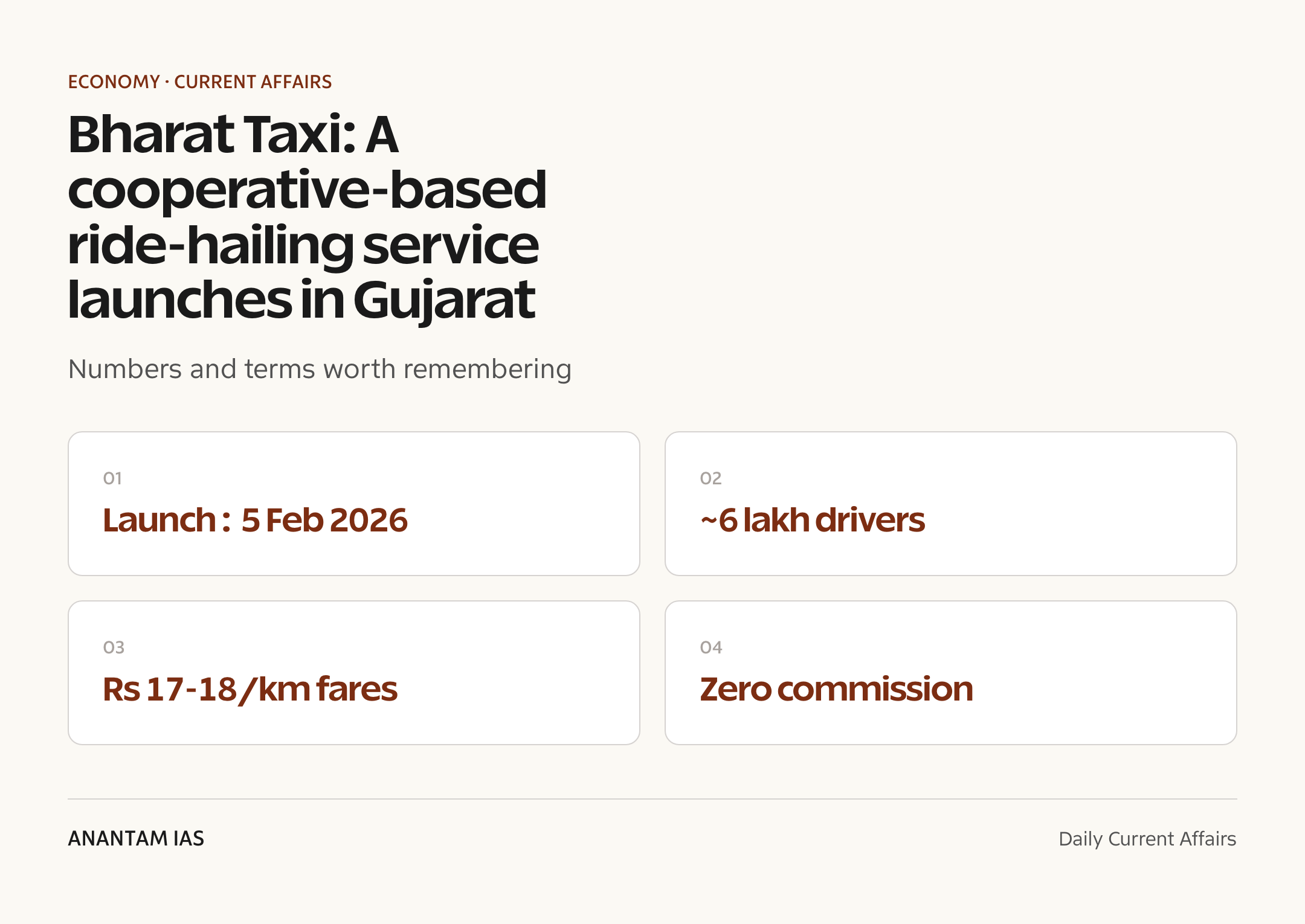
The Ministry of Cooperation has rolled out Bharat Taxi, billed as India’s first driver-owned cooperative ride-hailing service, with operations live in parts of Gujarat (Ahmedabad and Surat) and the National Capital Region. The platform is run by Sahakar Taxi Cooperative Limited, registered on 6 June 2025, and was formally launched by Union Home and Cooperation Minister Amit Shah on 5 February 2026.
Bharat Taxi is the working incarnation of the Sahkar Taxi idea that Amit Shah first announced in the Lok Sabha in March 2025. Its central promise is zero commission on rides, with earnings credited directly to drivers, positioning the cooperative model as an alternative to commission-charging aggregators like Ola, Uber and Rapido. The launch operationalises the ‘Sahkar se Samriddhi’ (prosperity through cooperation) vision in the gig and platform economy.
- Run by Sahakar Taxi Cooperative Limited, supported by the Ministry of Cooperation and eight apex cooperatives including AMUL (GCMMF), IFFCO, KRIBHCO, NAFED, NABARD, NDDB, NCEL and NCDC.
- Live in Gujarat (Ahmedabad, Surat) and the NCR, with reported expansion toward Vadodara and other cities; the customer app first went live as a soft launch on 1 December 2025.
- Marketed as the ‘Amul of cabs’ — drivers are enrolled as members of the cooperative, not independent contractors, and the platform advertises no platform fee and no surge fee.
- Reported reach of around 6 lakh drivers nationwide (about 1 lakh in Gujarat) and over 35 lakh app downloads, with fares quoted near Rs 17-18 per km against roughly Rs 30 per km on rival platforms.
The development matters in the context of:
- The Ministry of Cooperation, carved out as a separate ministry in 2021, has driven a wave of new national cooperatives; Bharat Taxi extends this push into urban mobility and the gig economy.
- App-based aggregators have faced sustained criticism over high commissions (often 20-30%), opaque surge pricing and weak driver welfare — the gaps the cooperative model claims to close.
- The initiative draws on the 97th Constitutional Amendment framework that gave cooperatives constitutional backing through Part IXB and the right to form societies under Article 19(1)(c).
UPSC Relevance
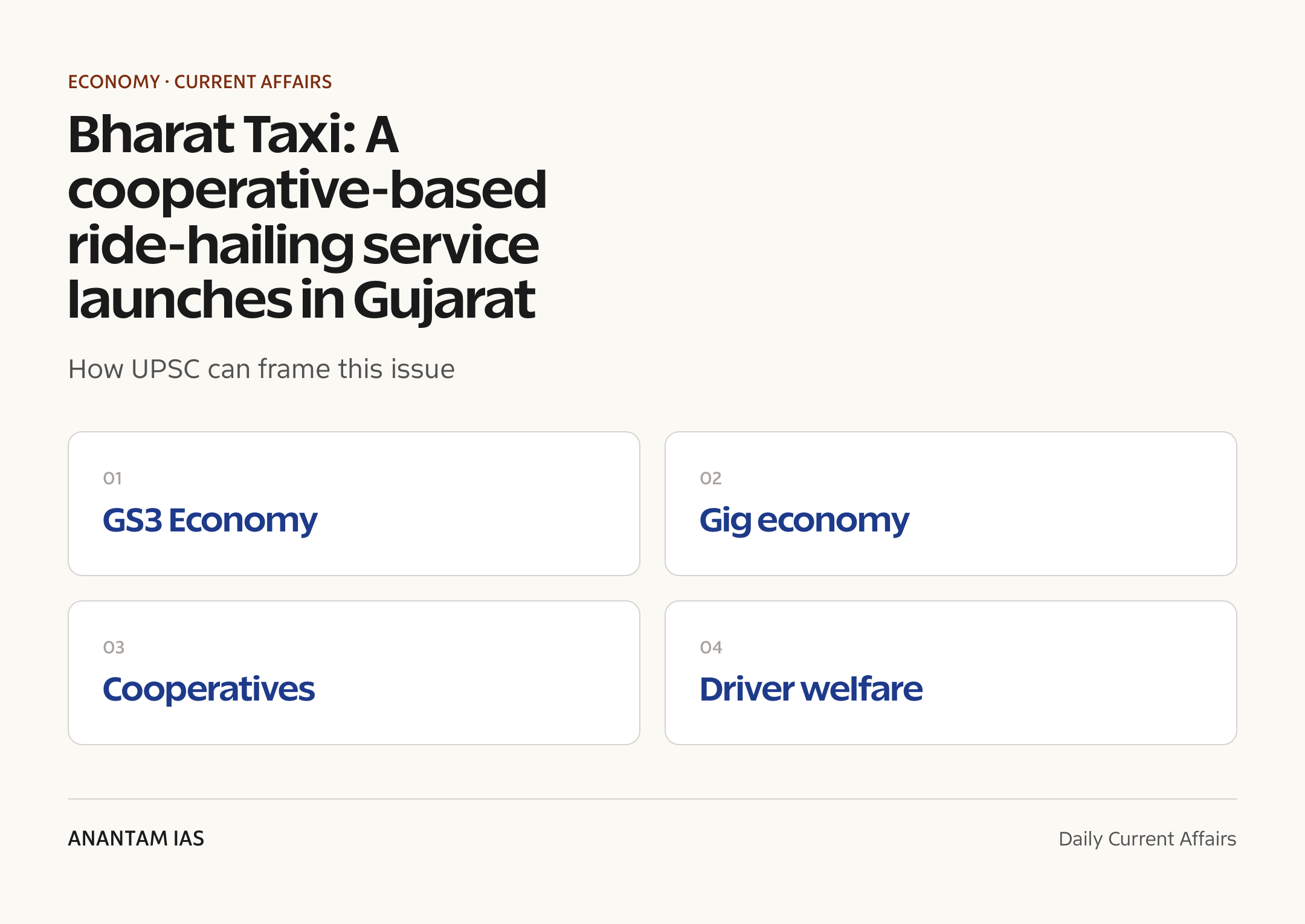
Prelims Relevance
- Ministry of Cooperation was created in 2021, separated from the Ministry of Agriculture, with the slogan ‘Sahkar se Samriddhi’.
- Bharat Taxi is operated by Sahakar Taxi Cooperative Limited, registered 6 June 2025, and supported by the Ministry of Cooperation.
- The idea was announced as Sahkar Taxi by Amit Shah in the Lok Sabha in March 2025; it covers two-wheeler taxis, autorickshaws and four-wheelers.
- A cooperative society is a member-owned, democratically governed body (one-member-one-vote) that distributes surplus among members rather than external investors.
- An aggregator is a digital platform that connects riders and drivers and typically charges a per-ride commission; Bharat Taxi’s distinction is its zero-commission claim.
- The 97th Constitutional Amendment Act, 2011 added Part IXB on cooperative societies and made forming cooperatives a fundamental right under Article 19(1)(c).
- Apex cooperatives linked to the project include AMUL/GCMMF, IFFCO, KRIBHCO, NAFED, NABARD, NDDB, NCEL and NCDC.
- Three recent national multi-state cooperatives — for exports (NCEL), organic produce (NCOL) and seeds (BBSSL) — were set up by the Ministry of Cooperation alongside this mobility push.
Mains Relevance
GS Paper 3
- Cooperatives as a model for inclusive growth and the gig economy: can a driver-owned, zero-commission platform compete with venture-funded aggregators on scale, technology and capital?
- Platform economy and labour welfare — how the cooperative structure addresses commission burden, surge pricing and social security gaps for gig workers.
GS Paper 2
- Role of the Ministry of Cooperation and the 97th Amendment in strengthening cooperative federalism and democratic, member-led governance of economic institutions.
Essay
- Prosperity through cooperation: whether member-owned enterprise can humanise the platform economy.
- Technology, ownership and dignity of labour in the age of app-based work.
Background and Context
What Bharat Taxi is and how it launched
A government-backed cooperative running cabs on a member-ownership model.
- Bharat Taxi is a ride-hailing platform operated by Sahakar Taxi Cooperative Limited, a multi-state cooperative society registered on 6 June 2025.
- The customer app went live as a soft launch on 1 December 2025, and Union Minister Amit Shah formally launched the service on 5 February 2026.
- Early operations are concentrated in Gujarat — notably Ahmedabad and Surat — and the National Capital Region, with reported expansion toward Vadodara.
- Drivers are enrolled as cooperative members rather than independent contractors, so they collectively own and govern the platform — the reason it is nicknamed the ‘Amul of cabs’.
- Reported scale includes around 6 lakh drivers nationwide, about 1 lakh in Gujarat, and over 35 lakh app downloads.
The cooperative model versus aggregators
Ownership and pricing set Bharat Taxi apart from Ola and Uber.
- An aggregator (Ola, Uber, Rapido) is an investor-owned platform that charges drivers a per-ride commission, often in the 20-30% range, and applies dynamic surge pricing.
- A cooperative is member-owned and democratically run, distributing surplus to members rather than external shareholders — the surplus stays with drivers.
- Bharat Taxi advertises zero commission, with ride earnings credited directly to driver accounts, and no platform fee or surge fee.
- Fares are quoted near Rs 17-18 per km against roughly Rs 30 per km on rival apps, with passengers reportedly saving on average fares.
- Drivers report a meaningful rise in take-home income because the intermediary cut is removed.
Ministry of Cooperation and 'Sahkar se Samriddhi'
A young ministry extending cooperatives into new sectors.
- The Ministry of Cooperation was created in 2021 by separating cooperative functions from the Ministry of Agriculture, with Amit Shah as the first minister.
- Its guiding slogan is ‘Sahkar se Samriddhi’ — prosperity through cooperation — aimed at strengthening the cooperative movement as a people-centric economic model.
- The ministry has launched national multi-state cooperatives for exports (NCEL), organic produce (NCOL) and seeds (BBSSL), plus reforms in PACS computerisation.
- Bharat Taxi marks the model’s entry into urban mobility, an area long dominated by private platforms.
- The Sahkar Taxi concept was first announced by Amit Shah in the Lok Sabha in March 2025, covering two-wheeler taxis, autos and four-wheelers.
Gig economy and the driver-welfare angle
The launch responds to long-standing gig-worker grievances.
- India’s gig and platform workforce is projected to reach roughly 2.35 crore by 2029-30 as estimated by NITI Aayog, making driver welfare a structural policy question.
- Gig drivers commonly face high commissions, unpredictable surge-linked earnings, and limited social security or bargaining power.
- The Code on Social Security, 2020 recognises gig and platform workers and envisages welfare schemes funded partly by aggregator contributions.
- By making drivers owner-members, the cooperative aims to convert workers into stakeholders with a voice in pricing and policy.
- Direct, commission-free payouts are pitched as a route to higher and steadier monthly incomes for drivers.
Significance
Why the experiment matters beyond a single app.
- If it scales, India could host one of the first large government-backed cooperative ride-hailing platforms in the world.
- It tests whether member-owned enterprise can hold its own against capital-rich aggregators in a technology-heavy sector.
- It channels the trust and reach of established cooperatives such as AMUL and IFFCO into a new consumer service.
- Success could create a template for cooperatives in other gig segments — delivery, logistics and home services.
- It reframes the platform debate around ownership and fair pay, not just price and convenience.
Challenges in scaling and technology
Cooperatives carry real execution risks.
- Aggregators are backed by deep capital and engineering teams; a cooperative must match app reliability, mapping, safety and customer support without burning investor money.
- Without surge pricing and commissions, the cooperative must find a sustainable revenue model to fund technology, insurance and operations.
- Cooperatives historically struggle with professional management, governance and political interference, the very weaknesses reform aims to fix.
- Building a critical mass of riders and drivers in each city — the classic two-sided network problem — is hard against entrenched incumbents.
- Passenger safety, grievance redressal and quality control at national scale will test the model far more than a pilot in two states.
Way Forward
Professional management
- Run the cooperative with arm’s-length, professional management and transparent governance to avoid the failures that have plagued older cooperatives.
- Invest in robust app technology, mapping, payments and a real-time safety and grievance system.
Financial sustainability
- Design a modest, transparent service charge that funds operations without reviving the high commissions it set out to abolish.
- Tap patient capital and credit from cooperative financial bodies like NABARD rather than relying on volatile private funding.
Driver and rider trust
- Bundle social security, insurance and training for member-drivers so ownership delivers tangible welfare, not just a label.
- Maintain consistent fares, vehicle quality and safety standards so riders choose the platform on merit, not novelty.
Phased, evidence-led scaling
- Expand city by city only after each market proves service quality and unit economics, rather than rushing a national rollout.
- Publish independent performance data on earnings, ride volumes and safety to build public confidence.
Conclusion
Bharat Taxi turns a slogan into a service: it asks whether drivers, organised as a cooperative, can run a modern ride-hailing platform that pays them fairly while charging riders less. By stripping out commissions and surge fees and making drivers owner-members, it directly targets the grievances that have long shadowed the platform economy.
The promise is real, but so are the risks. Capital, technology, governance and the network effects that favour incumbents will decide whether this is a durable model or a well-meaning pilot. If the Ministry of Cooperation can pair member-ownership with professional management and honest economics, Bharat Taxi could become a genuine proof of concept for ‘Sahkar se Samriddhi’ in urban India.
UPSC Practice Questions
Prelims MCQ 1
With reference to the cooperative sector in India, consider the following statements:
- The Ministry of Cooperation was established as a separate Union ministry in 2021.
- The 97th Constitutional Amendment added Part IXB on cooperative societies to the Constitution.
- Bharat Taxi is operated directly by a department of the Ministry of Cooperation rather than by a cooperative society.
How many of the above statements are correct?
(a) Only one (b) Only two (c) All three (d) None
Answer: (b) Only two
Explanation:
The Ministry of Cooperation was created in 2021 and the 97th Amendment added Part IXB, so the first two are correct. Bharat Taxi is run by Sahakar Taxi Cooperative Limited, a cooperative society, not directly by a government department, so the third is wrong.
Prelims MCQ 2
Which of the following best describes the key feature distinguishing Bharat Taxi from conventional ride-hailing aggregators such as Ola and Uber?
(a) It operates only electric vehicles (b) It is owned by foreign investors (c) Drivers are members and owners of the cooperative with a zero-commission model (d) It charges a higher platform fee to fund driver welfare
Answer: (c) Drivers are members and owners of the cooperative with a zero-commission model
Explanation:
Bharat Taxi is run by a cooperative in which drivers are owner-members, and it advertises zero commission with no surge or platform fee, unlike investor-owned aggregators that charge per-ride commissions.
UPSC Mains Questions
- The cooperative model is being extended from agriculture into the urban gig economy. Examine the potential and limitations of a driver-owned, zero-commission platform like Bharat Taxi in competing with private aggregators. (GS Paper 3)
- Discuss how the Ministry of Cooperation, backed by the 97th Constitutional Amendment, is reshaping the role of cooperatives in India’s economy. (GS Paper 2)
Source: PIB, Ministry of Cooperation.
Frequently Asked Questions
What is Bharat Taxi?
Bharat Taxi is a cooperative-based ride-hailing service backed by the Ministry of Cooperation and run by Sahakar Taxi Cooperative Limited. Drivers are enrolled as owner-members, and the platform advertises zero commission with no surge or platform fee.
How is Bharat Taxi different from Ola and Uber?
Ola and Uber are investor-owned aggregators that charge drivers a per-ride commission and apply surge pricing. Bharat Taxi is owned by its driver-members, credits earnings directly to drivers, and claims no commission, no surge fee and no platform fee, with fares quoted near Rs 17-18 per km.
Where is Bharat Taxi available?
Early operations are concentrated in Gujarat, especially Ahmedabad and Surat, and in the National Capital Region, with reported expansion toward cities such as Vadodara. The customer app first went live in a soft launch in December 2025.
What is the connection with ‘Sahkar se Samriddhi’ and Sahkar Taxi?
Sahkar Taxi was the concept Union Minister Amit Shah announced in the Lok Sabha in March 2025. Bharat Taxi is its working form, advancing the ‘Sahkar se Samriddhi’ (prosperity through cooperation) vision in the gig economy.
Which cooperatives support Bharat Taxi?
It is supported by the Ministry of Cooperation and apex cooperatives including AMUL (GCMMF), IFFCO, KRIBHCO, NAFED, NABARD, NDDB, NCEL and NCDC.
What constitutional backing do cooperatives have in India?
The 97th Constitutional Amendment Act, 2011 added Part IXB on cooperative societies and made forming cooperatives a fundamental right under Article 19(1)(c), giving the movement a stronger constitutional footing.