BharatNet Ring Topology: Keeping Rural Connections Working
Why in News?
On 1 October 2026, an agreement for Maharashtra’s Amended BharatNet Programme included a planned upgrade from linear to ring topology to improve rural network resilience.
- The State-led model will be implemented through MahaNet Digital Infrastructure Limited, with the Maharashtra government, Digital Bharat Nidhi, BSNL and MahaIT participating in the agreement.
- The planned linear-to-ring upgrade concerns existing Phase I Gram Panchayat connections; the agreement also covers network expansion and on-demand village connectivity.
- The release announces an implementation agreement, not a completed upgrade or measured improvement in service availability.
- Coverage asks whether a location is connected; resilience asks whether the connection can keep working when a component fails.
- Rural schools, health centres and public-service offices need usable connectivity, including working local links, power and timely fault repair.
UPSC Relevance
Prelims Relevance
- Linear and ring network topology
- Route redundancy and protection switching
- Backbone connectivity versus last-mile access
- Digital Bharat Nidhi under the Department of Telecommunications
Mains Relevance
GS Paper 3
- Infrastructure resilience and rural broadband service quality
- Maintenance and last-mile economics in digital inclusion
GS Paper 2
- Coordination between Union institutions, state agencies and service operators
Essay
- Digital inclusion depends on the reliability of access, not connection counts alone.
Background and Context
How a ring provides an alternate path
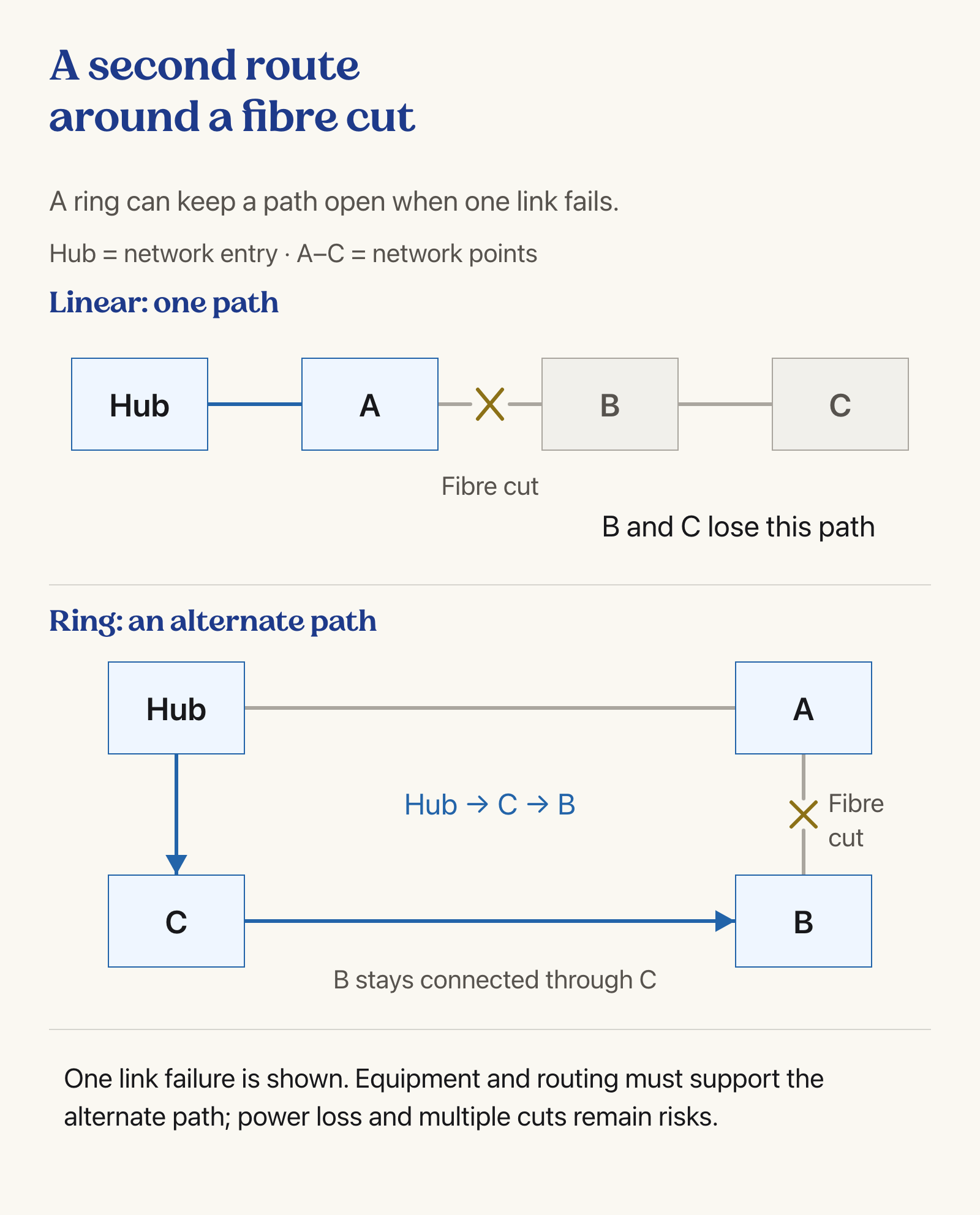
Topology describes how network points are connected. A ring adds a potential route around a failed link, but equipment must use it correctly.
- In a simple linear chain, a village downstream of a broken fibre segment can lose its route to the upstream network. The fault affects more than just the settlement beside the cut.
- A ring closes the chain into a loop. Between connected points, traffic can potentially travel around either side, providing an alternate route when one segment becomes unavailable and the rest remains operational.
- Protection switching or routing mechanisms must detect failure and direct traffic along the surviving path. Drawing a loop on a network map does not itself make the equipment deliver uninterrupted service.
- The ITU’s Ethernet ring protection standard illustrates this distinction between physical topology and protection mechanisms. It is explanatory context, not evidence that Maharashtra’s agreement specifies that particular protocol.
- Multiple cuts can isolate part of a ring. A shared power failure or failed essential network point can also interrupt service; alternate fibre paths do not remove every possible source of outage.
What the BharatNet upgrade would change
The agreement links an infrastructure design change with rural service expansion. Its results will depend on construction, commissioning and continuing operation.
- BharatNet is intended to strengthen rural broadband infrastructure. In Maharashtra, the announced programme combines upgrading existing links with coverage expansion, rather than treating every location as a completely new network build.
- Digital Bharat Nidhi, under the Department of Telecommunications, supports telecommunications access in underserved areas. This public-service role matters where the commercial return alone may not justify investment in dependable rural connectivity.
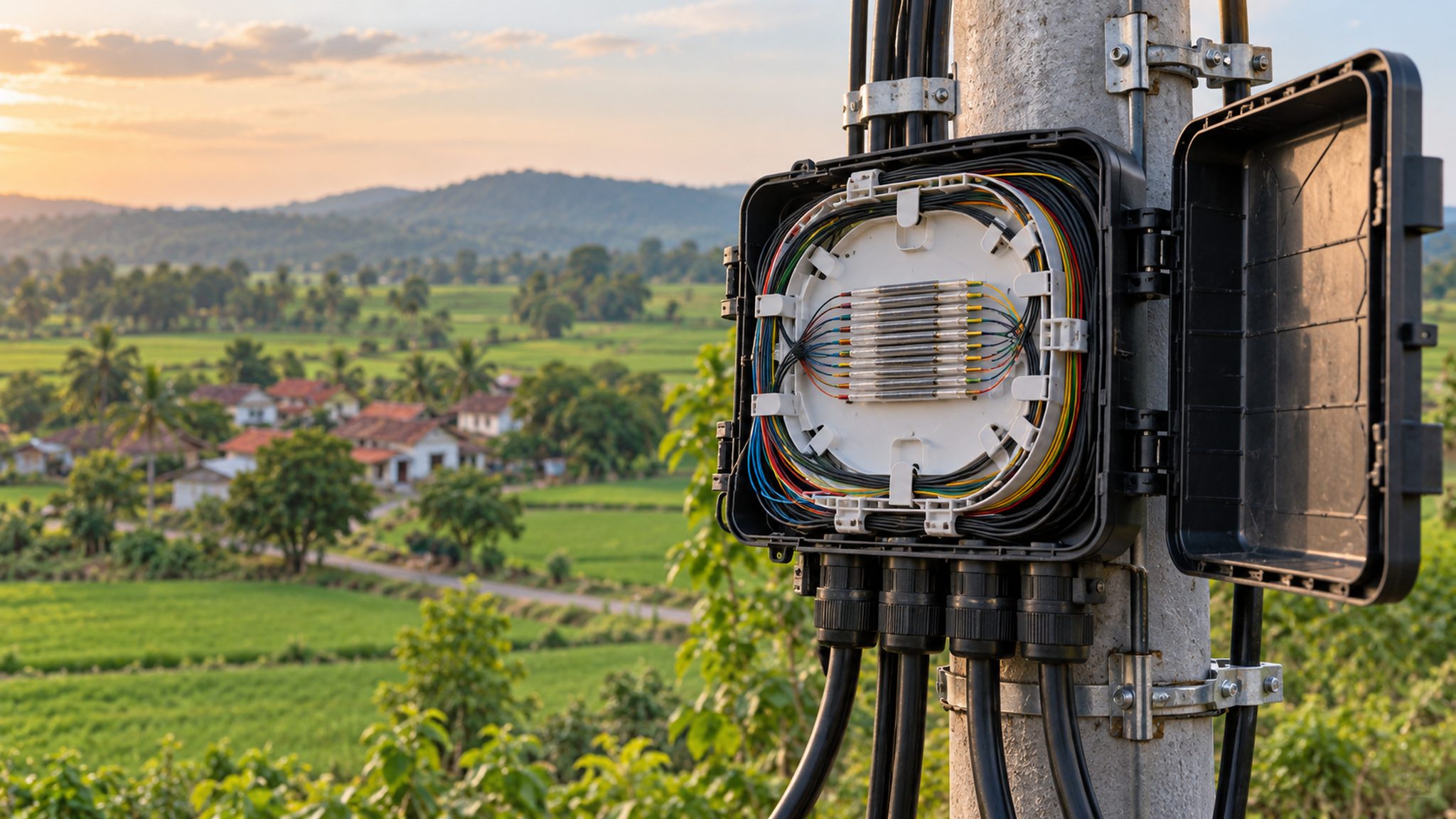
- Optical fibre carries signals between network points, while associated equipment connects and manages those links. Installing cable is only one part of making an operational connection available to public facilities or households.
- The last mile connects the local network to the actual user. A resilient upstream route cannot compensate for a disconnected school, an unavailable household connection or faulty equipment at the user’s premises.
- The release describes on-demand village connectivity and expected home connections. These are implementation intentions; they should not be reported as evidence that every household already receives reliable or affordable broadband service.
How to judge whether connectivity becomes reliable
A useful assessment follows the user’s service from the main network to the premises and checks how faults are handled.
- Route diversity should be assessed physically. Two apparent alternatives sharing a vulnerable trench or crossing can fail together, so a network diagram alone cannot establish protection against a real excavation or flood.
- Availability measures whether service works over time; cable length measures construction. Tracking outages and restoration time helps distinguish an installed asset from a connection that students or health workers can actually use.
- Power backup and equipment maintenance support the fibre network. Where local electronics stop functioning, a surviving cable route cannot by itself keep the affected access point available for users who depend on it.
- Operational responsibility needs clear allocation across participating institutions and service providers. Fault reporting, repair access and escalation should connect rather than leave a village waiting while agencies dispute which segment has failed.
- Affordability and adoption remain separate tests of inclusion. A technically resilient network may still be underused if local service is costly or suitable connections are unavailable; resilience improves supply without automatically ensuring effective use.
Way Forward
Test service continuity before counting success
- Run controlled fault tests before acceptance to check that alternate routing works under the planned equipment configuration and that essential services can recover.
- Monitor uptime and repair time alongside construction progress, with a clear service contact for schools, health centres and local public offices.
- Check shared vulnerabilities, including trenches, power and local equipment, and prioritise repairs that reduce recurring service interruptions.
- Assess last-mile availability and affordability separately from backbone completion so infrastructure expansion translates into usable connections.
Conclusion
- Ring topology strengthens rural connectivity by making an alternate path possible after a link failure. Its value depends on working protection mechanisms, operational equipment and timely maintenance, not merely the shape of the network.
- Use the Maharashtra agreement to explain the difference between coverage and service reliability. The upgrade is planned; judging its success requires evidence that connected users can continue accessing services during ordinary faults.
UPSC Practice Questions
Prelims MCQ 1
With reference to ring topology in a fibre network, consider the following statements:
- It can provide an alternate path around a failed segment.
- A ring eliminates all risks from multiple fibre cuts and power failures.
- Equipment and protection or routing mechanisms must support use of the alternate path.
How many of the above statements are correct?
(a) Only one (b) Only two (c) All three (d) None
Answer: (b) Only two
Explanation:
Statements 1 and 3 are correct. A ring provides route redundancy but cannot eliminate all multi-fault, power or equipment failures.
Prelims MCQ 2
Which observation best demonstrates a gap between backbone coverage and usable last-mile access?
(a) A village network point is connected, but its school lacks a working local connection. (b) Traffic uses an alternate route after a fibre cut. (c) Equipment detects a failed network segment. (d) A cable loop connects several network points.
Answer: (a) A village network point is connected, but its school lacks a working local connection.
Explanation:
Backbone connectivity does not automatically provide an operational connection at every user premises. The school’s local connection is a distinct service requirement.
UPSC Mains Questions
- Explain how ring topology can strengthen rural broadband resilience. Why does it not guarantee uninterrupted service?
- Discuss how public investment in rural fibre networks should be evaluated beyond coverage and construction targets.
Sources: PIB, Ministry of Communications and International Telecommunication Union.
Frequently Asked Questions
What is ring topology?
Ring topology connects network points in a loop. It can provide an alternate path around a failed segment when the remaining network, equipment and protection mechanisms support that path.
Has Maharashtra completed this BharatNet upgrade?
No. The 1 October release announces an implementation agreement covering a planned linear-to-ring upgrade and other expansion work. It does not establish that the upgrade is completed or its benefits measured.
Does ring topology prevent every outage?
No. Multiple fibre cuts, shared power failures, equipment faults or common physical vulnerabilities can still disrupt service. A ring provides a form of redundancy, not immunity from all failures.
How is the last mile different from the backbone?
The backbone carries connectivity between network points. The last mile reaches the actual user premises. A school or household needs a working local connection even when the upstream network is available.
Why is Digital Bharat Nidhi relevant?
Digital Bharat Nidhi, under the Department of Telecommunications, supports access in underserved areas. It participates in the Maharashtra agreement, connecting public investment with the objective of improving rural telecommunications infrastructure.