BHARATPOL portal: CBI launches national INTERPOL-interface for real-time cooperation
Why in News?
Union Home Minister to launch BHARATPOL portal developed by CBI on 07 January 2025 in New Delhi; portal aims to speed up international cooperation through INTERPOL and improve field-level police access to cross-border assistance.
- Launch event scheduled for 07 January 2025 at Bharat Mandapam, New Delhi by Union Home Minister; the portal is developed by CBI in its role as National Central Bureau (NCB-New Delhi) for INTERPOL.
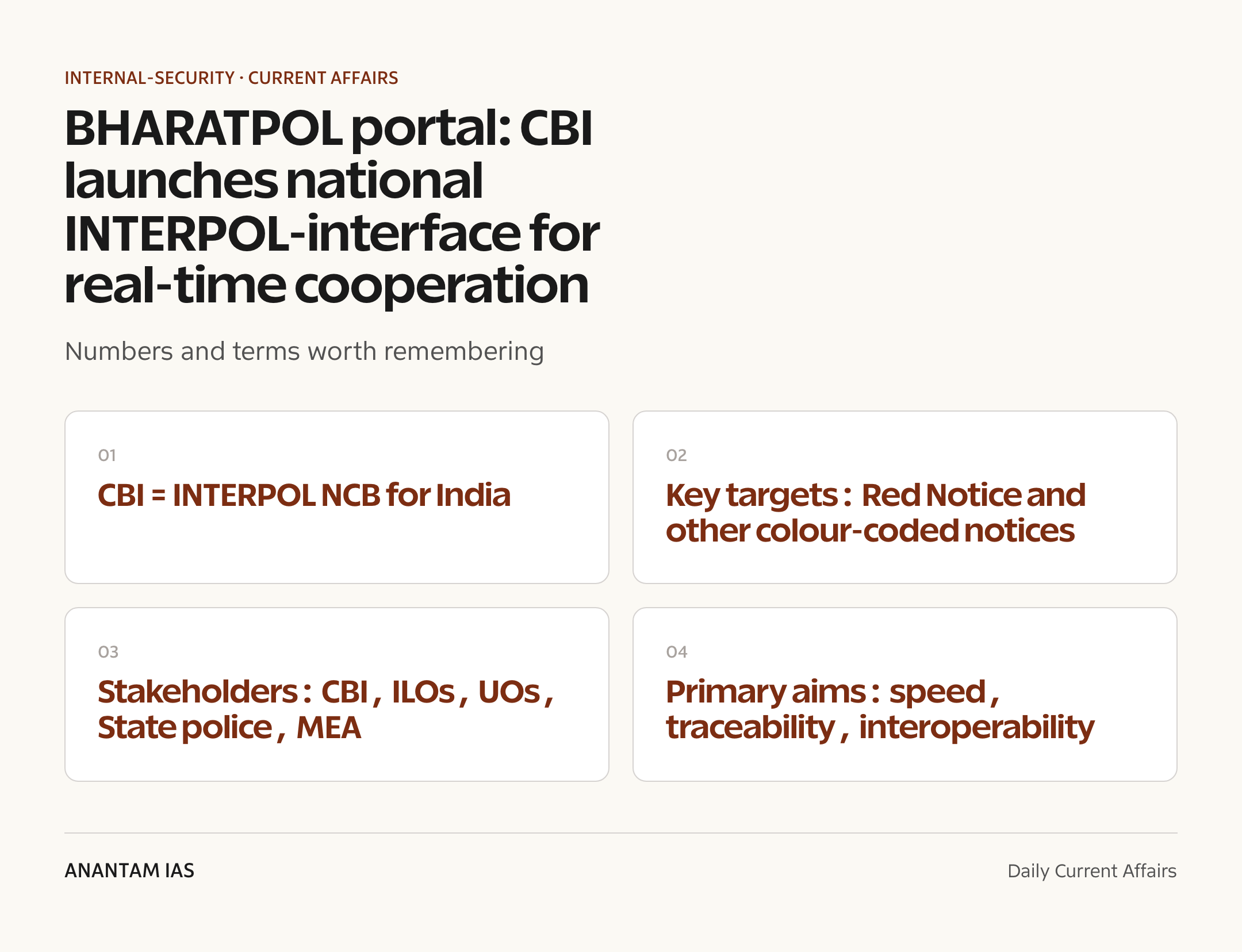
- Portal will replace slow, fragmented channels (letters, emails, faxes) with a single platform to process requests such as Red Notices and other colour-coded INTERPOL notices.
- Designed to support frontline officers through links between INTERPOL Liaison Officers (ILOs) and Unit Officers (UOs) at district and city levels, improving operational response to transnational crimes
- Affects investigative timelines, mutual legal assistance workflows, cyber-forensics cooperation and multi-agency coordination across Central, State and Union Territory police forces.
The development matters in the context of:
- CBI as INTERPOL NCB: CBI is designated as the National Central Bureau for INTERPOL in India and acts as the nodal point for international criminal cooperation.
- Transnational crime trends: Rising incidents of cybercrime, financial crime, drug trafficking, human trafficking and online radicalization require faster cross-border coordination and intelligence exchange.
- Current communications: Field-to-central communications for INTERPOL assistance presently rely on asynchronous methods such as letters, emails and faxes, causing delays in urgent cases.
- INTERPOL mechanisms: INTERPOL issues colour-coded notices (including Red Notices) and offers databases and secure communication channels for criminal data and alerts.
- Inter-agency footprint: Effective international cooperation requires alignment across CBI, State Police, Central Police Organisations, Ministry of External Affairs and judicial processes.
- Digital governance push: The central government is promoting digital platforms to increase speed, accountability and traceability in administrative and operational workflows.

UPSC Relevance
Prelims Relevance
- Role of CBI as National Central Bureau for INTERPOL in India.
- Types of INTERPOL notices, especially Red Notice and their purpose.
- Basic understanding of transnational crimes that necessitate international police cooperation.
- Difference between national police channels and international liaison mechanisms (ILOs and UOs).
Mains Relevance
GS2 Polity & Governance
- Discuss the impact of integrated digital platforms on inter-agency coordination and rule of law.
- Analyse challenges and safeguards required when operational policing systems handle international assistance requests.
- Assess the balance between operational efficiency and procedural safeguards in cross-border criminal investigations.
- Examine implications for federal-state relations when a centralised portal links State police to international mechanisms.
Essay
- Technology and governance: Role of digital platforms in strengthening public institutions.
- Law, justice and security: Demands of the 21st century on investigative agencies and transnational cooperation.
- Centre-state relations: Central initiatives that affect state policing and federal policing structures.
Background and Context
CBI and INTERPOL: institutional role
CBI serves as India’s interface with INTERPOL and coordinates international criminal assistance.
- Designated National Central Bureau (NCB-New Delhi) for INTERPOL; acts as the nodal agency for issuance and execution of INTERPOL notices for India.
- Maintains linkages with INTERPOL’s secure global policing communications networks and databases, including criminal records, stolen property and fugitives.
- Coordinates with the Ministry of External Affairs, State police and central investigative agencies for cross-border investigations.
- Houses INTERPOL Liaison Officers (ILOs) who are connected to Unit Officers (UOs) in state police organisations for operational work.
INTERPOL notices and international assistance
INTERPOL provides standardized mechanisms for cross-border alerts and cooperation.
- Colour-coded notices: Red Notices for wanted persons, Blue for identity, Green for warnings, and others for specific needs.
- Notices are requests for cooperation and do not replace extradition or legal processes under national law.
- INTERPOL also provides databases for fingerprints, stolen travel documents, and other forensic resources to member countries.
- Operational use requires correct legal grounds and coordination with national agencies to convert notices into apprehension or evidence sharing.
Operational gaps in existing practice
Current channels for international assistance are slow and fragmented at field level.
- Field officers often rely on local supervisors to escalate requests through letters, emails or faxes to ILOs or CBI units.
- Time-sensitive cases like cyber intrusions or terror financing suffer from delays in securing international data or action.
- Lack of a standardised digital trail reduces transparency on the status of requests and accountability for timelines.
- Variations in state-level procedures and capacity create uneven access to international mechanisms across India.
Why a national portal is needed
A unified digital gateway can reduce delays and increase operational reach of Indian policing.
- Real-time submission and tracking of international assistance requests will shorten investigative timelines.
- Standard templates and workflow controls can ensure completeness of requests, reducing rework and back-and-forth.
- Improves auditability: digital records provide timestamps, status updates and accountability across agencies.
- Field-level access empowers Unit Officers to initiate requests with pre-vetted formats while keeping ILOs and CBI in loop.
Data, security and legal concerns
Digital exchange of sensitive law-enforcement data raises risks that must be addressed.
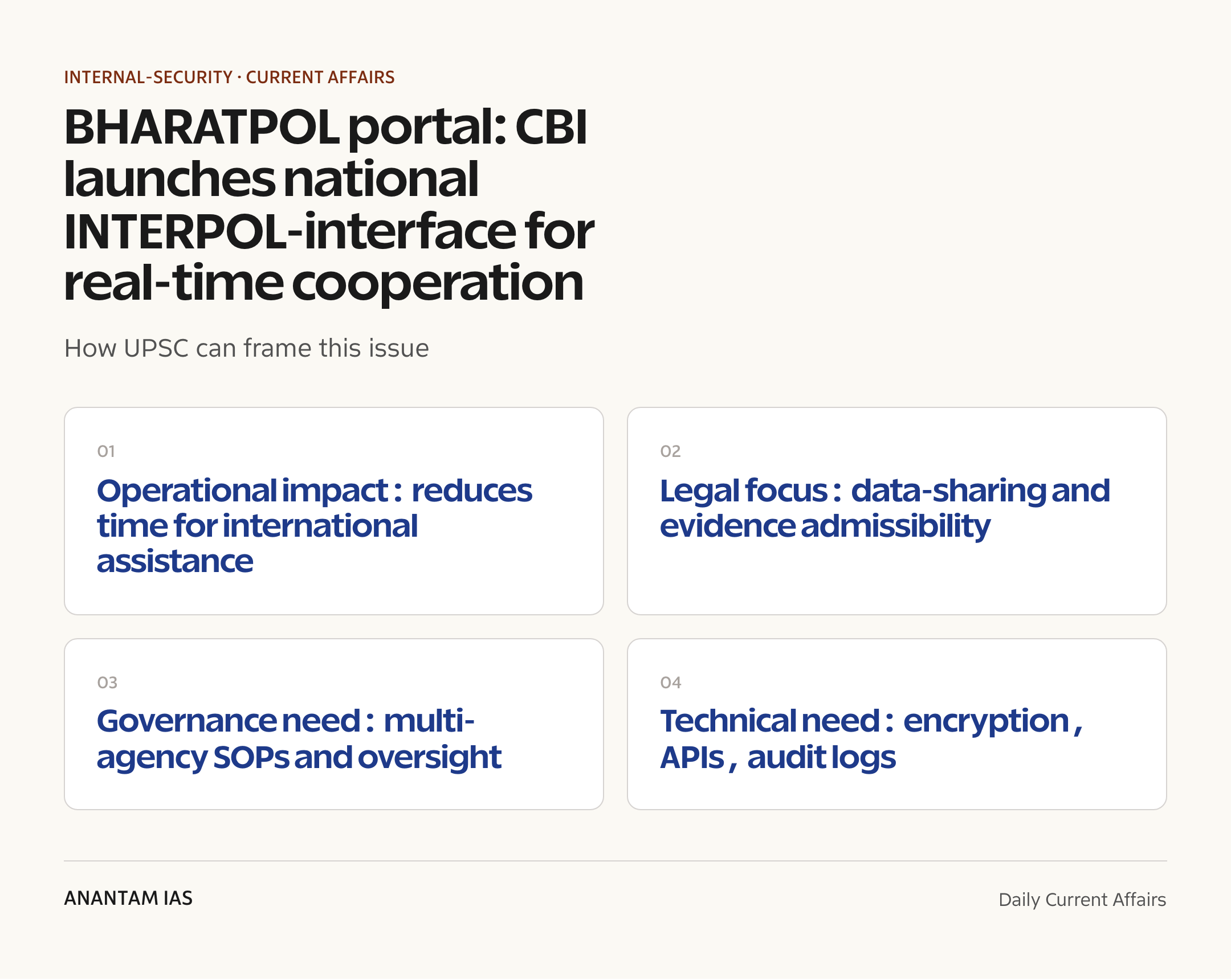
- Sensitive personal data and investigative material will flow through the portal requiring strong encryption and access controls.
- Legal safeguards needed for cross-border data transfer, retention periods and admissibility of digital evidence in courts.
- Potential for misuse or scope creep if access controls and audit logs are weak or undefined.
- Need for interoperability standards with INTERPOL systems and state police IT stacks while protecting sovereign data rights.
Governance and multi-agency coordination
Effective operation depends on defined roles and collaborative governance across stakeholders.
- Ministry of Home Affairs, CBI, Ministry of External Affairs and state police heads must agree on SOPs for portal usage.
- Training for frontline officers, ILOs and UOs is essential for correct classification of matters and efficient use.
- Performance metrics and service-level expectations (turnaround times for different notice types) should be set.
- Mechanisms for dispute resolution and escalation must be in place where states and central agencies differ.
Way Forward
Technical safeguards and standards
Secure, auditable and interoperable technical design to protect sensitive data.
- Implement end-to-end encryption, multi-factor authentication and role-based access controls for all users.
- Adopt logging, tamper-evident audit trails and regular penetration testing to detect and deter breaches.
- Use standardised APIs and data formats to enable interoperability with INTERPOL databases and state police systems.
- Define data retention and deletion policies aligned with legal requirements and human rights norms.
Legal and procedural framework
Clear rules to govern usage, admissibility and cross-border data sharing.
- Draft SOPs clarifying jurisdictional roles, thresholds for international requests and escalation mechanisms.
- Ensure compliance with domestic laws on interception, privacy and evidence, and international conventions where relevant.
- Provide guidelines on when digital records from the portal qualify as admissible evidence in courts.
- Include clauses to prevent mission creep and restrict use of portal data for unrelated administrative or intelligence purposes.
Capacity building and training
Operational effectiveness will depend on user competence across ranks and agencies.
- Conduct tiered training programs for Unit Officers, ILOs, CBI case handlers and state nodal officers.
- Develop quick-reference templates, checklists and simulated exercises for common transnational crime scenarios.
- Set up a central helpdesk and regional support cells to assist with technical or procedural queries.
- Incorporate performance-linked incentives for timely and accurate submission of requests.
Governance, oversight and performance measurement
Institutional arrangements to manage, monitor and review portal operations.
- Create a multi-stakeholder steering committee including MHA, CBI, MEA and state police representatives for policy-level oversight.
- Define KPIs such as turnaround times for Red Notice requests, percentage of digitally-complete submissions and incident response times.
- Publish periodic anonymised dashboards to foster transparency while protecting operational secrecy.
- Schedule independent third-party audits and privacy impact assessments at regular intervals.
Conclusion
BHARATPOL can materially improve India’s ability to secure timely international assistance and to prosecute transnational crimes if technical security, legal safeguards and multi-level governance are built into its rollout. Success will depend on training, interoperable standards and accountable oversight to prevent misuse while delivering operational gains for frontline policing.
UPSC Practice Questions
Prelims MCQ 1
Which agency in India functions as the National Central Bureau (NCB) for INTERPOL?
(a) National Investigation Agency (NIA) (b) Central Bureau of Investigation (CBI) (c) Ministry of Home Affairs (MHA) (d) Research and Analysis Wing (RAW)
Answer: (b) Central Bureau of Investigation (CBI)
Explanation:
CBI is designated as the National Central Bureau (NCB-New Delhi) for INTERPOL in India and serves as the nodal point for international police cooperation.
Prelims MCQ 2
A RED NOTICE issued by INTERPOL is primarily used to:
(a) Request the provisional arrest of a person pending extradition (b) Request location-based intelligence on cyber incidents (c) Serve as a binding international arrest warrant (d) Share ballistic fingerprints across member countries
Answer: (a) Request the provisional arrest of a person pending extradition
Explanation:
A Red Notice is an international alert to seek the location and provisional arrest of a person wanted for prosecution or to serve a sentence, but it is not a binding international arrest warrant; national laws determine action.
UPSC Mains Questions
- {‘question’: ‘Examine how a centralised digital portal for international police cooperation can affect federal relations between the Centre and states in India. Discuss measures to ensure balanced operational control and accountability.’, ‘model_answer_points’: [‘Centralised portal increases direct access of state police to international mechanisms, which can strengthen investigations but may raise concerns about central oversight and data control.’, ‘Potential tensions: states may fear loss of autonomy or unequal control over case-sensitive information if central agencies retain final authority over notices.’, ‘Measures: institutionalise joint governance structures with state representation, define SOPs that respect state policing jurisdiction, and allow state-level access controls and audit logs.’, ‘Legal clarity: specify thresholds for escalation to INTERPOL, preserve state consent for extradition-related actions and provide dispute resolution mechanisms.’, ‘Operational safeguards: capacity building in states, decentralised helpdesks, and transparent KPIs to build trust while maintaining national security needs.’]}
- {‘question’: ‘Assess the privacy and legal challenges posed by digital platforms that share sensitive law enforcement data internationally. Suggest a framework that balances operational necessity with rights protection.’, ‘model_answer_points’: [‘Privacy risks include unauthorized disclosure, mission creep and disproportionate retention of personal data which can harm individuals and investigations.’, ‘Legal issues: cross-border data transfer laws, admissibility of digital evidence, and compliance with domestic safeguards on surveillance and data protection.’, ‘Framework: enact clear data-sharing agreements that specify purpose limitation, retention periods, access rules and accountability mechanisms.’, ‘Technical controls: strong encryption, role-based access, and tamper-evident logs; periodic privacy impact assessments and independent audits.’, ‘Remedies: grievance redress mechanisms, judicial oversight for intrusive requests, and transparency reports that anonymise operational data.’]}
Source: PIB, Ministry of Home Affairs.
Frequently Asked Questions
q
a
q
a
q
a
q
a
q
a
q
a