BHAVYA Portal and Bharat Audyogik Vikas Yojana: 100 Plug-and-Play Industrial Parks Explained
On 9 June 2026, Union Commerce and Industry Minister Piyush Goyal launched the BHAVYA portal in New Delhi, the digital backbone of the Bharat Audyogik Vikas Yojana (BHAVYA, literally India’s Industrial Development Scheme). The scheme is a roughly Rs 33,660-crore programme to build 100 investment-ready, plug-and-play industrial parks across the country over six years. The portal itself is the operational layer: a single online window where states submit detailed project reports, the Centre appraises them, parks are selected competitively, and progress is monitored in real time. For UPSC, the news matters less for the website and more for what it signals about how India is trying to fix the oldest bottleneck in its manufacturing story — the absence of serviced, ready-to-occupy industrial land.
The headline number is the Rs 33,660-crore outlay tied to 100 parks, implemented by the National Industrial Corridor Development Corporation (NICDC), the same agency that runs the country’s industrial corridor programme. PIB framed it as a push for manufacturing-led growth and ease of doing business; reporting in Insights on India and across the trade press confirmed the same outlay, park count and the 51:49 Centre-State funding model. That convergence is the cross-paper relevance line: this is a GS3 economy story that also reads as a GS2 governance story about cooperative federalism and single-window delivery.
An examiner will not test the portal’s URL — they will test whether you can connect plug-and-play infrastructure to the manufacturing-share-of-GDP problem and to the older NICDP and Make in India framework.
Quick Facts
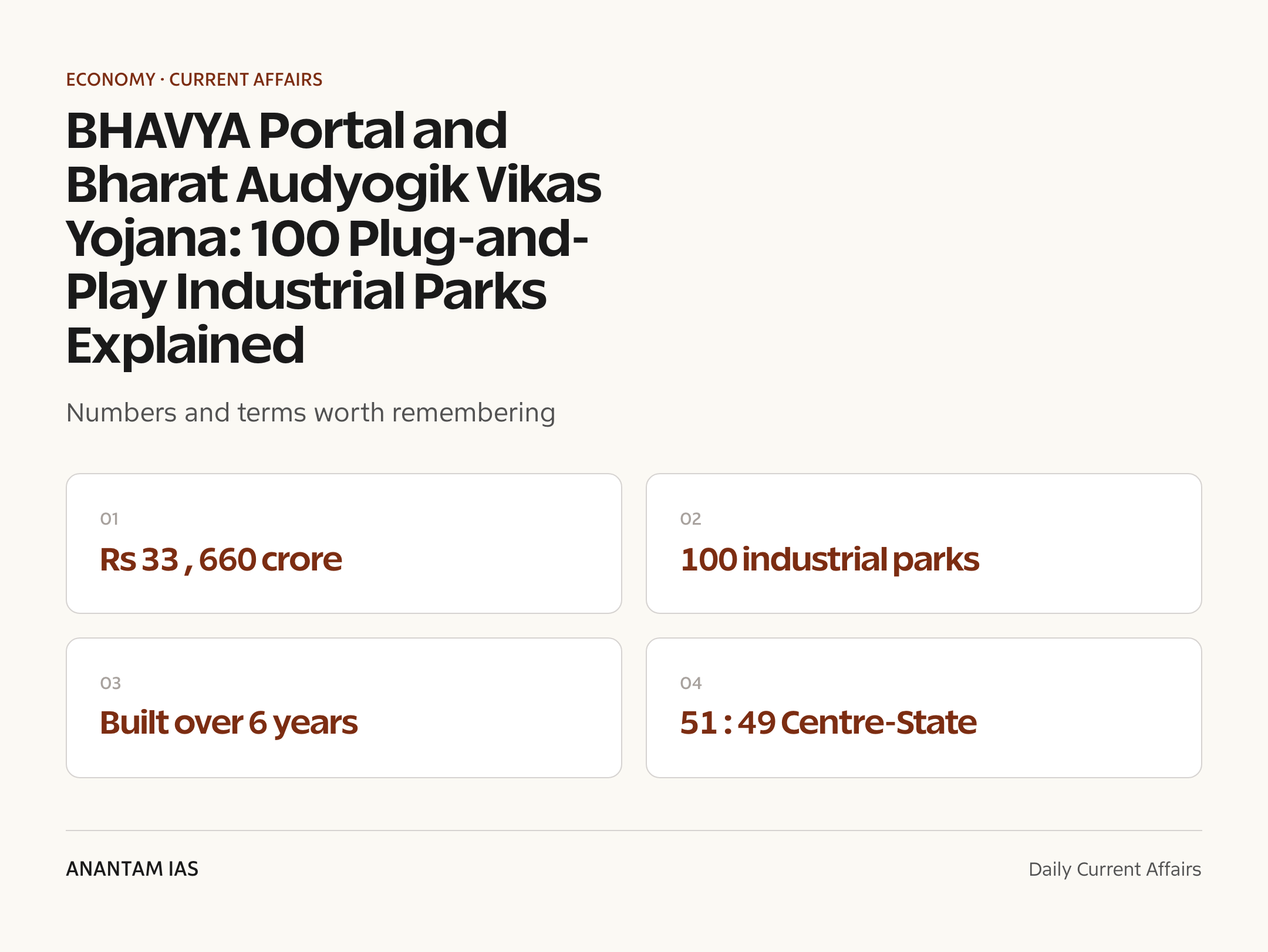
- Scheme: Bharat Audyogik Vikas Yojana (BHAVYA), launched 9 June 2026 in New Delhi.
- Outlay: approximately Rs 33,660 crore, approved by the Union Cabinet.
- Target: 100 investment-ready, plug-and-play industrial parks built over six years.
- Nodal ministry: DPIIT, Ministry of Commerce and Industry; implementing agency NICDC.
- Funding model: 51:49 Centre-State partnership, with states providing the land.
- Park sizes: about 25 acres in hilly or northeastern areas, 100-500 in mid states, up to 1,000 acres near cities.
- Selection: competitive framework where states bid with land, sectoral strength and investor interest.
- Anchor: built on the National Industrial Corridor Development Programme; aligned with Make in India and PM GatiShakti.
- Sources: PIB, Ministry of Commerce & Industry and Insights on India.
What Just Happened
Piyush Goyal launched the BHAVYA portal on 9 June 2026 as the delivery platform for the Bharat Audyogik Vikas Yojana, the Rs 33,660-crore scheme the Union Cabinet had cleared to create 100 industrial parks. The portal acts as a single digital window covering the full project lifecycle — submission of detailed project reports by states, technical appraisal, competitive selection, fund release, and real-time monitoring of construction. The intent is to remove the file-shuffling between state agencies and central ministries that has historically delayed industrial estates by years.
The parks are designed on a plug-and-play model. A plug-and-play park is one where common infrastructure is already built and serviced before a manufacturer arrives, so a unit can lease a plot and begin operations quickly instead of spending two to three years acquiring land, securing power and water, and chasing clearances. Under BHAVYA each park is to come with assured water and power supply, road, rail and air connectivity, digital single-window clearances, testing and quality infrastructure, worker housing, and social amenities, on land with clear titles.
NICDC, which runs the national industrial corridor programme, is the project management agency. The financing is structured on a 51:49 Centre-State split, with states contributing land and a share of cost while the Centre funds core infrastructure. Park sizes are deliberately flexible — roughly 25 acres for hilly regions, small union territories and the Northeast, 100 to 500 acres for mid-sized states, and up to 1,000 acres near urban centres — so the model fits both land-scarce and land-rich states. The competitive design means a state cannot simply demand a park; it has to make a case on land availability, sectoral potential and investor interest.
The competitive selection is the procedural heart of the scheme. Rather than a fixed quota of parks per state, BHAVYA invites states and union territories to submit detailed proposals showcasing land that is contiguous and clean-titled, the sectors they can anchor, existing investor commitments and the connectivity already in place. Proposals are appraised on the portal and ranked, so funding flows to the most investment-ready locations first. Reporting in the trade press, echoing the PIB note, described parks layered into three tiers of facilities — core infrastructure such as roads, drainage, power, water and ICT; value-added facilities like factory sheds, common testing labs and warehousing; and social amenities including worker housing — with space carved out for startups and deep-tech enterprises. The portal keeps every stage visible, which is itself the reform: an industrial estate that once moved through opaque, sequential approvals now sits on a tracked, time-bound pipeline.
Background and Context
India’s manufacturing sector has been stuck at roughly 17 per cent of GDP for years, well short of the 25 per cent target that Make in India set in 2014. The reasons are well documented — costly and contested land acquisition, unreliable power, weak last-mile connectivity, and a thicket of approvals. The National Manufacturing Policy of 2011 first tried to address this through National Investment and Manufacturing Zones; the 25 per cent goal has since been carried forward, with the National Manufacturing Mission of 2025 resetting the timeline to 2035. BHAVYA is the latest instrument aimed squarely at the land-and-infrastructure leg of that problem.
The scheme does not stand alone. It builds on the National Industrial Corridor Development Programme (NICDP), launched around the Delhi-Mumbai Industrial Corridor and now spanning multiple corridors, under which the Cabinet in 2024 approved 12 new industrial cities (smart industrial townships) worth about Rs 28,602 crore. NICDC, the implementing arm here, is the same special purpose vehicle that develops those greenfield cities. BHAVYA effectively extends the corridor logic — pre-built, serviced, plug-and-play land — to a wider set of 100 parks chosen competitively from across states rather than fixed along the corridor alignments.
The portal also sits inside the wider ease-of-doing-business and PM GatiShakti agenda. GatiShakti is the national master plan for multimodal connectivity that maps infrastructure on a single GIS platform; industrial parks built under BHAVYA are meant to plug into that network so factories get road, rail and port links by design rather than as an afterthought. The single-window clearance feature mirrors the National Single Window System and the broader regulatory-cholesterol reduction drive that has run through recent Economic Surveys.
To see why serviced land matters, it helps to read BHAVYA against the long arc of India’s industrial-estate experiments. State industrial development corporations have notified thousands of plots since the 1960s, yet a large share sat idle for want of trunk infrastructure, poor siting away from ports and highways, or buyers who never came. The Make in India decade then leaned heavily on demand-side and fiscal tools — liberalised foreign investment, then production-linked incentives that subsidise output in chosen sectors. Those moved some needles but left the physical bottleneck intact, which is why the manufacturing share of GDP barely shifted. BHAVYA is best read as the supply-side complement to incentives: where PLI pays a firm to produce, BHAVYA hands it a place to produce in. The two are meant to work together, alongside the National Manufacturing Mission’s broader 2035 roadmap, rather than substitute for one another.
Key Features of Bharat Audyogik Vikas Yojana
- Plug-and-play parks: common infrastructure is built and serviced before units arrive, cutting the typical two-to-three-year setup wait to weeks.
- Single digital window: the BHAVYA portal handles DPR submission, appraisal, selection, fund flow and real-time monitoring in one place.
- Core infrastructure assured: water, power, road-rail-air connectivity, ICT, drainage and effluent systems are guaranteed at park level.
- Value-added and social facilities: testing labs, warehousing, factory sheds, worker housing and amenities, plus space for startups and deep-tech firms.
- 51:49 cooperative model: states provide land and share cost; the Centre funds core infrastructure, making it a federal partnership not a central handout.
- Competitive, flexible design: states bid on merit and parks scale from about 25 acres in the Northeast to 1,000 acres near cities.
Why It Matters for UPSC
This is a high-yield topic because it ties a current development to durable syllabus themes.
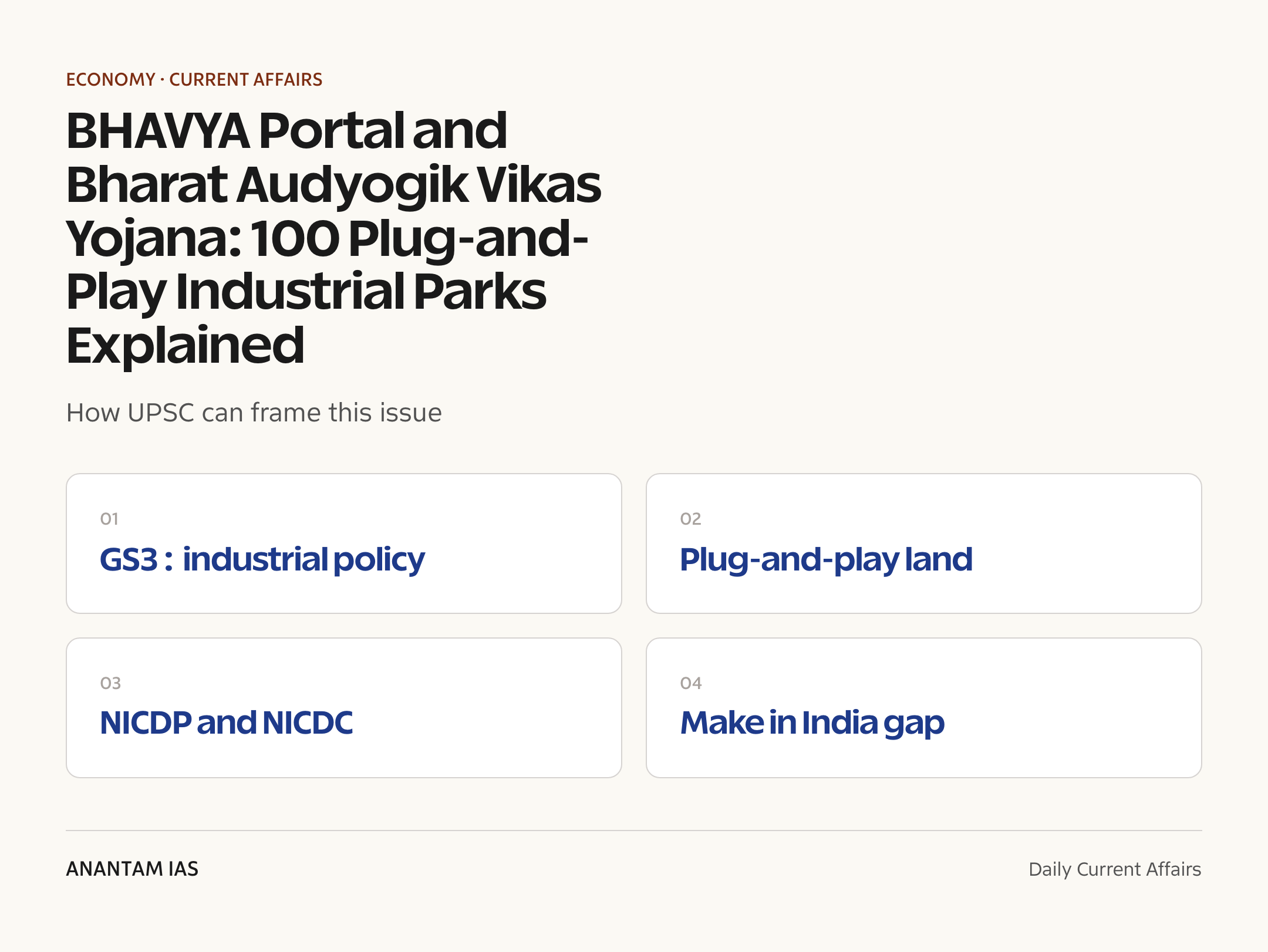
- GS3 economy and infrastructure: a direct case study on industrial policy, the manufacturing-share-of-GDP gap, and how serviced land and ease of doing business drive investment.
- Links current to static: connects a 2026 launch to the durable framework of NICDP, NICDC, Make in India, the National Manufacturing Mission and PM GatiShakti.
- Prelims angle: scheme name and full form, outlay, park count, implementing agency (NICDC) and nodal department (DPIIT) are all crisp, testable facts.
- GS2 governance and federalism: the 51:49 model and single-window portal illustrate cooperative federalism and the move from approvals to facilitation.
What It Means: Economy Lens
BHAVYA reframes industrial policy from incentives to infrastructure. For a decade the headline tools of Make in India were fiscal — tax cuts, then production-linked incentive subsidies. BHAVYA shifts the lever to the supply side of physical capacity: it accepts that no incentive offsets the cost of a manufacturer spending years assembling land, power and clearances. By pre-building serviced parks, the state absorbs the upfront coordination risk that markets price heavily, especially for first-time and mid-sized investors who cannot self-develop estates the way a large conglomerate can.
The 51:49 model is the structurally interesting part. Land is a state subject and the single biggest source of industrial delay, so a scheme that runs through central diktat would stall. By making states co-investors who must compete with credible proposals, BHAVYA aligns incentives — a state that wins a park has skin in the game to deliver clearances and connectivity, and the competitive bidding rewards genuine reform rather than political allocation. It is cooperative federalism used as an implementation device, not just a slogan.
The risk is that the binding constraint was never the portal. India already has thousands of notified industrial plots lying under-utilised because of poor location, missing trunk infrastructure or absent buyers. A digital window speeds approvals but does not by itself guarantee demand, quality construction, or that parks land where firms actually want to be. The scheme’s success turns on three things outside the portal — honest competitive selection, GatiShakti-grade connectivity, and whether global supply chains diversifying away from China actually choose Indian parks over Vietnam or Mexico.
There is also a federalism dividend worth weighing in the answer. Land, electricity distribution and local clearances are largely state and concurrent subjects, so the manufacturing problem has always been a coordination problem as much as a capital one. BHAVYA’s competitive, co-funded design quietly reshapes the centre-state bargain: a state that wants a park must do the reform homework — assemble land, fix power, simplify approvals — before the money arrives, and is then bound by its own proposal to deliver. That converts ease of doing business from a central exhortation into a state-level race. Whether the timeline holds is a fair question; building 100 serviced parks in six years is ambitious against India’s record on greenfield delivery. But the structural shift — from subsidising firms to building the platform they stand on, and from central allocation to competitive federalism — is the durable point an examiner is testing, and it is the reason this clipping deserves a place in the static notes on industrial policy.
Challenges and Concerns
- Land remains the hard constraint: states must aggregate clean-title land at scale, and acquisition disputes can stall even well-funded parks.
- Risk of repeating the under-utilised-estate problem if parks are sited by political bargaining rather than genuine demand and connectivity.
- Six-year timeline is ambitious for 100 parks given India’s record on greenfield industrial-city delivery under existing corridors.
- A portal streamlines approvals but cannot create investor demand; success depends on global supply-chain shifts choosing India.
- Centre-State cost sharing can strain weaker states, and quality of common infrastructure varies widely across implementing agencies.
Prelims Pointers
- BHAVYA stands for Bharat Audyogik Vikas Yojana, launched on 9 June 2026 in New Delhi.
- The scheme has an outlay of about Rs 33,660 crore approved by the Union Cabinet.
- It targets 100 investment-ready, plug-and-play industrial parks built over six years.
- The nodal department is DPIIT under the Ministry of Commerce and Industry.
- The implementing and project management agency is the National Industrial Corridor Development Corporation (NICDC).
- Funding follows a 51:49 Centre-State partnership model, with states providing land.
- Park sizes range from about 25 acres in hilly or northeastern areas up to 1,000 acres near cities.
- BHAVYA builds on the National Industrial Corridor Development Programme (NICDP).
- Plug-and-play infrastructure means common services are built before manufacturing units arrive.
- The BHAVYA portal is a single digital window for DPR submission, appraisal, selection and monitoring.
- India’s manufacturing share of GDP is around 17 per cent against a 25 per cent target.
- The scheme aligns with Make in India, the National Manufacturing Mission and PM GatiShakti.
Mains Practice Questions
- Plug-and-play industrial parks address India’s deepest manufacturing bottleneck better than fiscal incentives alone. Critically examine in the context of the Bharat Audyogik Vikas Yojana. (GS3, 15 marks)
- Discuss how the National Industrial Corridor Development Programme and schemes like BHAVYA seek to raise the manufacturing share of GDP, and assess the structural constraints they still face. (GS3, 15 marks)
- The 51:49 Centre-State model in industrial-park development reflects cooperative federalism as an implementation tool. Examine its strengths and limitations. (GS2, 10 marks)
- Ease of doing business depends as much on serviced infrastructure as on regulatory reform. Evaluate this statement using single-window industrial schemes in India. (GS3, 10 marks)
Way Forward
The portal must be backed by transparent, demand-driven site selection so parks land where firms want to invest, not where allocation is politically convenient.
Connectivity through PM GatiShakti, clean-title land banks at the state level, and credible single-window clearances will decide whether the six-year target is met.
BHAVYA should be read alongside the National Manufacturing Mission as part of a coherent push to move India’s manufacturing share toward 25 per cent of GDP.
Frequently Asked Questions
What is the BHAVYA portal?
BHAVYA is the digital single-window platform launched on 9 June 2026 to run the Bharat Audyogik Vikas Yojana. States use it to submit project reports, the Centre appraises and selects parks competitively, and implementation is monitored in real time. It turns a Rs 33,660-crore industrial-park scheme into a transparent, trackable pipeline rather than a paper trail.
What does Bharat Audyogik Vikas Yojana aim to do?
It aims to build 100 investment-ready, plug-and-play industrial parks across India over six years with an outlay of about Rs 33,660 crore. By giving manufacturers serviced land with power, water, connectivity and clearances ready, it targets the oldest drag on Indian factories — the years lost setting up a site before a single unit is made.
What is plug-and-play infrastructure?
Plug-and-play means a park’s common infrastructure — roads, power, water, drainage, ICT and single-window clearances — is built and serviced before any manufacturer arrives. A firm leases a plot and starts production in weeks rather than the two-to-three years usually spent acquiring land and chasing approvals. It shifts coordination risk from the investor to the state.
Which ministry and agency run BHAVYA?
The nodal department is the Department for Promotion of Industry and Internal Trade (DPIIT) under the Ministry of Commerce and Industry. The National Industrial Corridor Development Corporation (NICDC) is the implementing and project management agency, the same body that delivers India’s industrial corridor cities. So one experienced agency runs both corridors and these parks.
How is BHAVYA funded between Centre and states?
BHAVYA uses a 51:49 Centre-State partnership model. States provide the land and a share of the cost, while the Centre funds core infrastructure. The design makes states co-investors who must win parks through competitive proposals, giving them a direct stake in delivering clearances and connectivity. It is cooperative federalism used as an implementation tool.
How does BHAVYA connect to Make in India?
BHAVYA tackles the supply-side gap Make in India never closed — India’s manufacturing share is stuck near 17 per cent against a 25 per cent target. Where earlier policy leaned on incentives, BHAVYA builds physical capacity through serviced parks linked to NICDP and PM GatiShakti. Incentives attract firms; ready land lets them actually build.