Bhojshala Dispute: Supreme Court to List All Petitions Against the High Court Order
Why in News?
The Supreme Court agreed on July 13, 2026 to urgently list all petitions challenging the Madhya Pradesh High Court order that declared the disputed Bhojshala complex in Dhar district a temple dedicated to Goddess Saraswati. The Hindu reported that a Bench led by Chief Justice of India Surya Kant assured counsel that every connected petition would be taken up together on July 14.
The High Court’s May 15 ruling had also quashed the April 7, 2003 order of the Archaeological Survey of India (ASI) allowing Friday namaz inside the complex, and permitted the Muslim community to seek separate land in the district for a mosque. One appeal is by Qazi Moinuddin, caretaker of the Kamal Maula Mosque.
- Senior advocate Huzefa Ahmadi orally mentioned that several connected petitions were missing from the July 14 cause list; the CJI asked for details and said all would be listed together.
- The complex sits in Dhar district, Madhya Pradesh, as a centrally protected monument in ASI custody — the fact that decides which statutes govern the dispute.
- The Hindu community regards the 11th-century monument as a temple of Goddess Saraswati (Vagdevi); the Muslim side identifies it as the Kamal Maula Mosque.
- The High Court verdict displaced a two-decade-old 2003 ASI arrangement of time-shared worship — Tuesday puja for Hindus, Friday namaz for Muslims.
The development matters in the context of:
- The case is a live test of the Places of Worship (Special Provisions) Act, 1991 — specifically its exemption for ancient monuments covered by the AMASR Act, 1958 — and will shape similar disputes at Gyanvapi, Mathura and Sambhal.
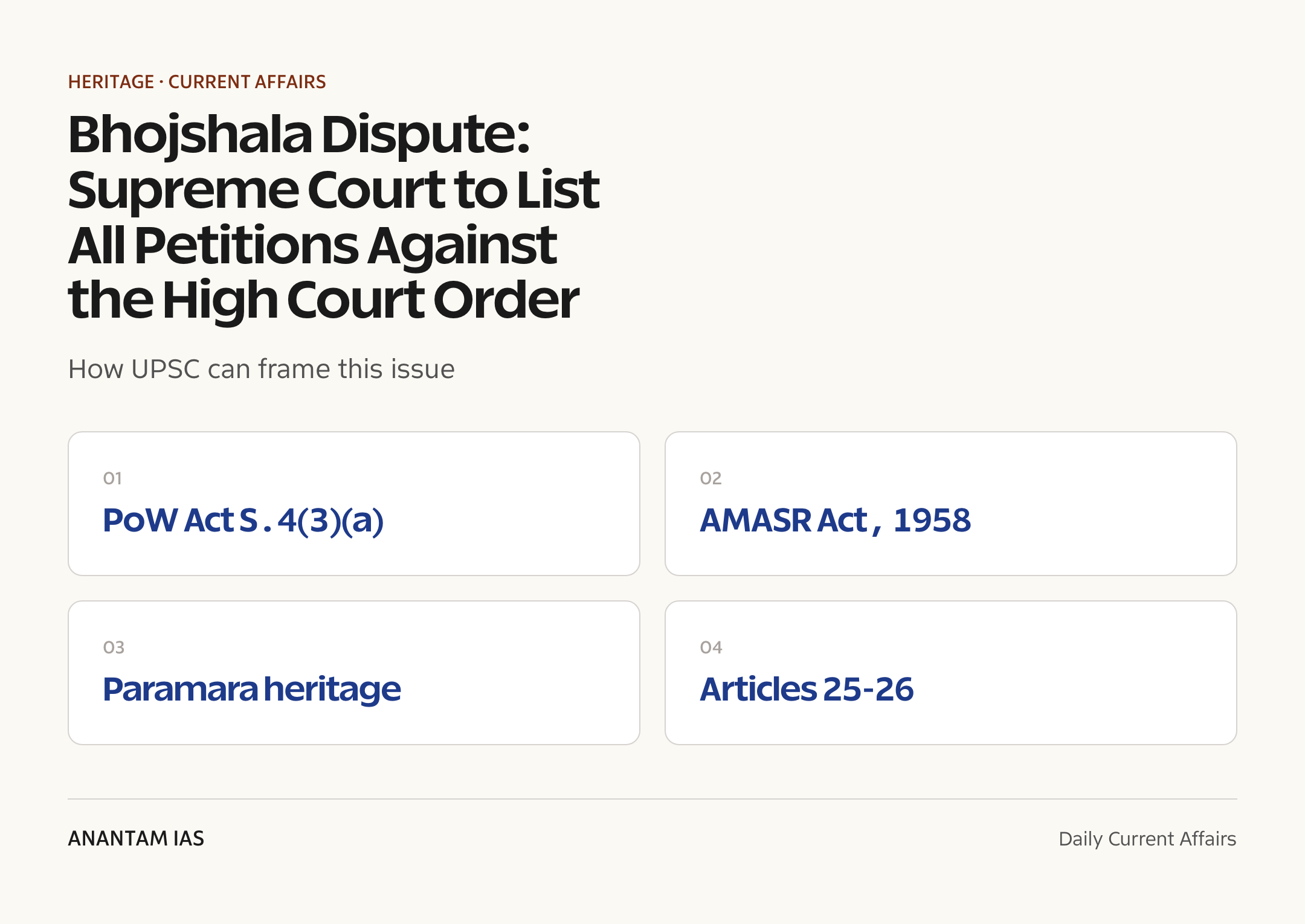
- It joins three UPSC threads: Paramara-era art and learning (GS1), religious freedom under Articles 25–26 (GS2), and the judiciary’s management of faith-heritage conflicts.
- How the Supreme Court handles the batch will signal its approach after its December 2024 nationwide freeze on fresh suits and survey orders in place-of-worship cases.
UPSC Relevance
Prelims Relevance
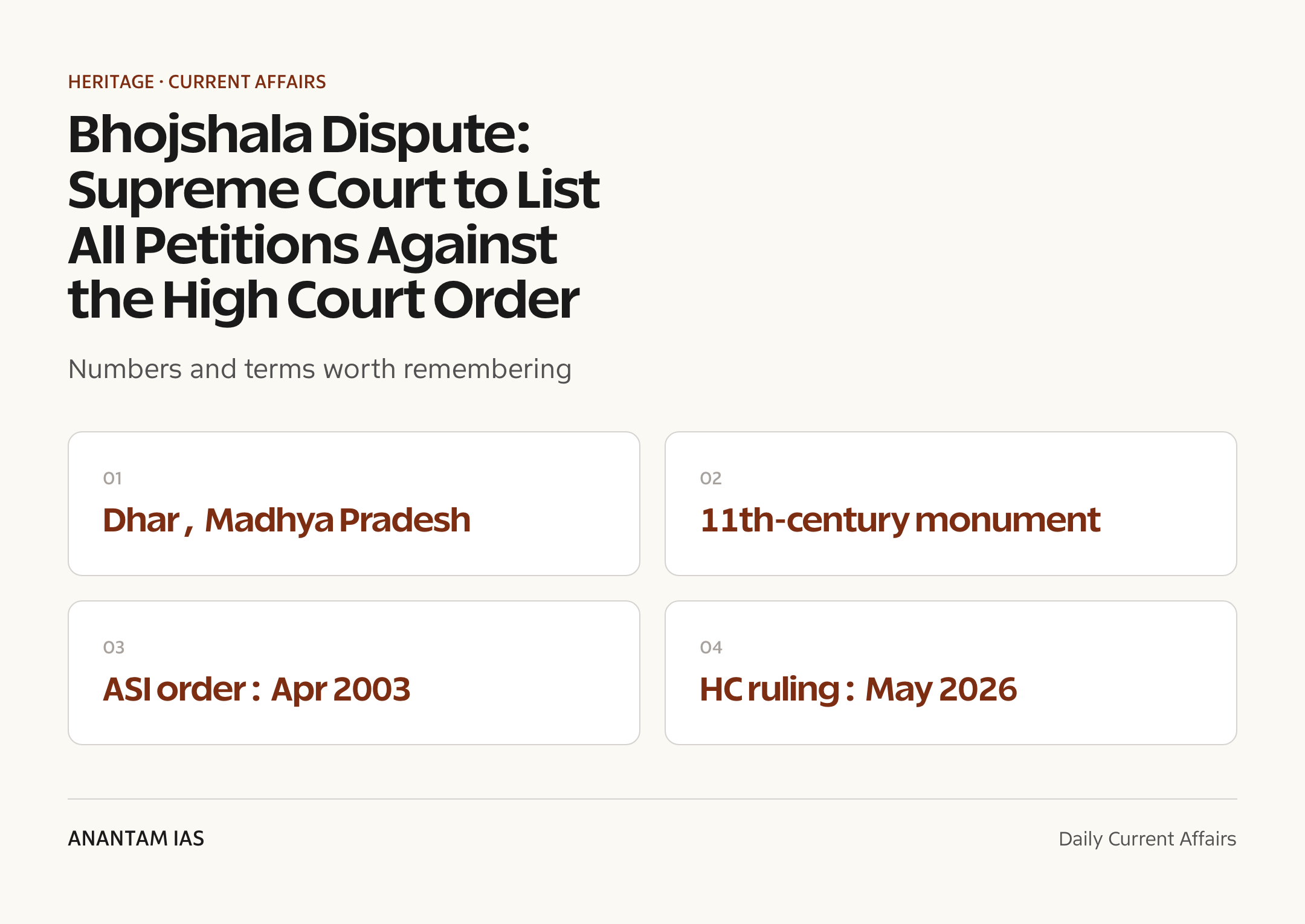
- Bhojshala–Kamal Maula complex: disputed 11th-century monument at Dhar, Madhya Pradesh; ASI-protected.
- Raja Bhoja (r. c. 1010–1055 CE): Paramara ruler of Malwa from Dhara (modern Dhar); credited with the Samarangana Sutradhara and Saraswatikanthabharana.
- Kamal Maula: Chishti Sufi saint Kamal al-Din, whose dargah adjoins the complex; the mosque structure is generally dated to the early 14th century.
- April 7, 2003 ASI order: Hindus worship on Tuesdays; Muslims offer namaz on Fridays (1–3 pm).
- Places of Worship Act, 1991: freezes religious character as on August 15, 1947 (Section 4); Section 4(3)(a) exempts monuments covered by the AMASR Act, 1958.
- AMASR Act, 1958: statute under which ASI protects centrally protected monuments.
- Vagdevi (Saraswati) image: a sculpture dated 1034 CE found at Dhar in the colonial era is now in the British Museum, London; its return is a long-standing demand.
- Basant Panchami: the day of peak Hindu worship (Saraswati Puja) at Bhojshala; friction rises when it falls on a Friday.
Mains Relevance
GS Paper 2
- Interplay of the Places of Worship Act, 1991 with the AMASR Act, 1958 — does the monument exemption open a judicial lane around the 1947 freeze?
- Judiciary as arbiter of faith-heritage conflicts: survey orders, interim arrangements, and the risk of conflicting High Court and Supreme Court directions.
- Secularism as part of the basic structure — the Ayodhya Constitution Bench (2019) read the 1991 Act as embodying non-retrogression.
GS Paper 1
- Paramara contribution to learning and architecture: Raja Bhoja, the Bhojshala tradition, sarpabandha grammar inscriptions and reused temple fabric.
- Layered sacred sites in medieval India: temple material in mosque construction and what it says about Indo-Islamic architecture.
Essay
- Heritage as a shared inheritance: can one monument carry two faiths?
- Law can freeze a building’s status, not a society’s memory — courts and the burden of history.
Background and Context
What Is the Bhojshala–Kamal Maula Complex?
One walled, ASI-protected compound in Dhar carries two names and two claims.
- The monument stands in Dhar town, western Madhya Pradesh, on the Malwa plateau — once Dhara-nagari, capital of the Paramara dynasty.
- The Hindu claim: it’s the Bhojshala (‘Hall of Bhoja’), a hall of learning and shrine of Vagdevi (Saraswati) associated with Raja Bhoja.
- The Muslim claim: it’s the Kamal Maula Mosque, named for the Chishti Sufi saint Kamal al-Din (Kamal Maula), whose dargah adjoins the compound; the mosque structure is generally dated to the early 14th century.
- It’s a centrally protected monument under the AMASR Act, 1958, in ASI custody since the colonial-era protection regime.
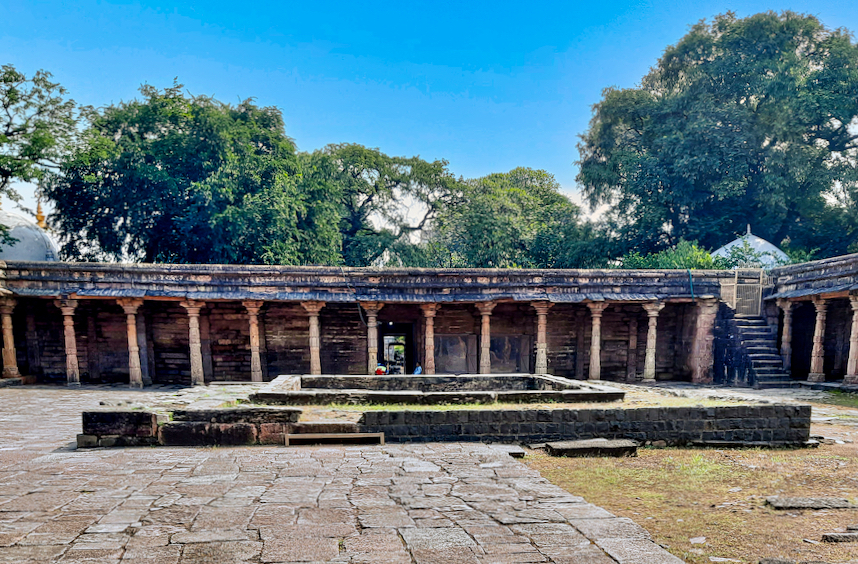
- Its fabric is visibly layered: a colonnaded hall of carved pillars and slabs, with serpentine (sarpabandha) inscriptions of Sanskrit–Prakrit grammar and slabs of the play Parijatamanjari from the court of Paramara king Arjunavarman.
- That layering lets both communities point at the same stones — see our note on Indo-Islamic architecture for how such reuse shaped Sultanate-era building.
Raja Bhoja and the Paramara Legacy
The dispute draws its emotional charge from the most celebrated king of Malwa.
- Raja Bhoja (r. c. 1010–1055 CE) of the Paramara dynasty was a rare philosopher-king — soldier, builder and prolific author.
- Works attributed to him include the Samarangana Sutradhara (a treatise on architecture and engineering) and the Saraswatikanthabharana (on poetics and grammar) — the basis of his image as a patron of Saraswati.
- Tradition holds that Bhoja endowed a great Sanskrit school at Dhar — the Bhojshala — where the goddess of learning was worshipped.
- A sculpture dated 1034 CE, found at Dhar in the colonial period, now sits in the British Museum; Hindu groups identify it as the Bhojshala’s Vagdevi and seek its return, though some art historians read the image differently.
- Basant Panchami (Saraswati Puja) is the high point of Hindu observance at the site; the calendar itself becomes a flashpoint when the festival falls on a Friday, the day of congregational namaz.
- For the wider canon this story sits in, see our guide to temple architecture in India.
The 2003 ASI Arrangement
For over two decades, access to Bhojshala ran on a timetable rather than a title.
- By an order dated April 7, 2003, the ASI fixed a time-share: Hindus perform puja on Tuesdays, Muslims offer namaz on Fridays (1–3 pm), with visitor access on other days.
- The arrangement settled usage, not ownership — it deliberately left the question of religious character undecided.
- It mostly held, with tension in years when Basant Panchami fell on a Friday and both communities claimed the same hours.
- The High Court’s May 15 ruling quashed this 2003 order — the first time the working compromise itself was displaced, which is why the appeals carry such urgency.
The Litigation Trail: 2022 to 2026
The present case built up over four years of survey orders, reports and appeals.
- 2022: the ‘Hindu Front for Justice’ moved the Indore Bench of the Madhya Pradesh High Court, challenging the 2003 arrangement and seeking full worship rights at the complex.
- March 2024: the High Court ordered a ‘scientific survey’ of the complex by the ASI, using ground-penetrating radar and photogrammetry.
- April 2024: the Supreme Court let the survey continue but barred any physical excavation altering the site’s character, and directed that no action be taken on the outcome without its leave.
- July 2024: the ASI filed a report running over 2,000 pages before the High Court, concluding that the existing structure incorporated parts of earlier temples of the Paramara period.
- May 15, 2026: the High Court declared the complex a Saraswati temple, quashed the 2003 ASI order, and allowed the Muslim community to seek separate land for a mosque.
- July 13, 2026: the Supreme Court agreed to list all challenge petitions for hearing on July 14.
Places of Worship Act, 1991 and the AMASR Exemption
The statutory heart of the case is one exemption clause inside the 1991 Act.
- The Places of Worship (Special Provisions) Act, 1991 bars conversion of any place of worship (Section 3) and freezes its religious character as it existed on August 15, 1947 (Section 4(1)).
- But Section 4(3)(a) carves out ancient monuments and archaeological sites covered by the AMASR Act, 1958 — and the Hindu side argues ASI-protected Bhojshala falls squarely within this exemption.
- The Muslim side contests that reading: an exemption meant to protect monuments as heritage can’t become a licence to re-litigate their religious character.
- Section 5 separately exempted only the Ram Janmabhoomi–Babri Masjid case; in the Ayodhya judgment (2019), a Constitution Bench described the 1991 Act as embodying secularism and the principle of non-retrogression.
- In December 2024, while the Act’s validity was under challenge, the Supreme Court restrained courts nationwide from registering fresh suits or ordering surveys in place-of-worship disputes — the backdrop against which the Bhojshala appeals now return to it.
- The constitutional anchors: Articles 25–26 (freedom of religion), Article 49 (State’s duty to protect monuments) and Article 51A(f) (duty to value the composite culture).
Why the Case Matters Beyond Dhar
Whatever the Supreme Court decides will echo far outside one Malwa town.
- It’s the first appellate test of whether the AMASR exemption lets courts adjudicate the religious character of an ASI monument despite the 1991 freeze — a question that shadows Gyanvapi (Varanasi), Shahi Idgah (Mathura) and Sambhal.
- It will define how much weight archaeological survey reports can carry in deciding questions of faith and title — evidence law meeting archaeology.
- It tests institutional roles: the ASI as neutral custodian, High Courts as fact-finders, the Supreme Court as stabiliser of communal peace.
- The outcome will show whether the Court’s December 2024 freeze was a pause or a doctrine — whether such disputes are to be decided or de-escalated.
Way Forward
For the courts
- Hear the batch together and settle the PoW Act–AMASR interplay authoritatively, so High Courts stop reaching divergent answers on the same clause.
- Protect the subject-matter meanwhile: a clear status-quo order on worship and custody keeps facts on the ground from outrunning the law.
- Ring-fence ASI surveys as evidence — expert findings on construction history aren’t automatic verdicts on religious character.
For heritage administration
- Keep the ASI’s mandate conservation-first: documentation, structural protection and transparent public reporting of any scientific study.
- Until final adjudication, administer access through published, predictable timetables in the spirit of the 2003 arrangement, with advance planning for Basant Panchami–Friday overlaps.
For social cohesion
- Activate district peace committees and interfaith dialogue in Dhar ahead of each hearing date and festival window.
- Political actors should resist turning court listings into mobilisation events — Ayodhya showed the value of calm around verdicts.
Conclusion
Bhojshala compresses a millennium into one compound: a Paramara king who wrote treatises on architecture, a Sufi saint whose dargah still draws devotees, a colonial-era protection order, and a courtroom asked to say what the stones mean. Hearing every petition together is the right procedural start — fragmentary orders are how such disputes fester.
The larger question is systemic. If the AMASR exemption becomes a general gateway for re-opening the character of protected monuments, the 1991 freeze loses much of its force; read narrowly, Bhojshala may become the case that shut the gate. Either way, the judgment will be studied wherever India’s medieval heritage and modern Constitution meet.
UPSC Practice Questions
Prelims MCQ 1
With reference to the Bhojshala–Kamal Maula complex, consider the following statements:
- It is located in Dhar district of Madhya Pradesh and is a centrally protected monument under the Archaeological Survey of India.
- Raja Bhoja, with whom the complex is traditionally associated, belonged to the Chandela dynasty.
- The Places of Worship (Special Provisions) Act, 1991 contains an exemption for ancient monuments covered by the AMASR Act, 1958.
How many of the above statements are correct?
(a) Only one (b) Only two (c) All three (d) None
Answer: (b) Only two
Explanation:
Statements 1 and 3 are correct. Raja Bhoja (r. c. 1010–1055 CE) was a Paramara ruler of Malwa with his capital at Dhara (modern Dhar), not a Chandela; the Chandelas ruled from Khajuraho–Mahoba.
Prelims MCQ 2
Under the Places of Worship (Special Provisions) Act, 1991, the religious character of a place of worship is to be maintained as it existed on:
(a) January 26, 1950 (b) August 15, 1947 (c) November 26, 1949 (d) The date of commencement of the Act in 1991
Answer: (b) August 15, 1947
Explanation:
Section 4(1) freezes the religious character of every place of worship as on August 15, 1947. The Ram Janmabhoomi–Babri Masjid case (Section 5) and monuments covered by the AMASR Act, 1958 (Section 4(3)(a)) are exempt.
UPSC Mains Questions
- The exemption for protected monuments under the Places of Worship Act, 1991 has turned heritage sites into fresh arenas of religious litigation. Discuss with reference to the Bhojshala dispute, and examine the judiciary’s role in balancing heritage protection with communal harmony.
- The Bhojshala–Kamal Maula complex reflects the layered character of medieval Indian sacred architecture. Examine what such monuments reveal about Paramara-era learning and patronage, and about the practice of reusing temple material in Sultanate-period construction.
- Archaeological evidence can establish how a structure was built, but courts must decide what it means. Critically analyse the role of ASI scientific surveys in adjudicating disputes over the religious character of monuments.
Source: The Hindu.
Frequently Asked Questions
What is the Bhojshala dispute?
It’s a contest over one ASI-protected 11th-century monument in Dhar, Madhya Pradesh. Hindus regard it as the Bhojshala, a Saraswati temple and hall of learning linked to Raja Bhoja; Muslims identify it as the Kamal Maula Mosque, attached to the dargah of a Chishti Sufi saint.
What did the Madhya Pradesh High Court decide?
By its May 15, 2026 order, the High Court declared the complex a temple dedicated to Goddess Saraswati, quashed the April 2003 ASI order that allowed Friday namaz inside it, and permitted the Muslim community to seek separate land in Dhar district for a mosque.
What has the Supreme Court done now?
On July 13, 2026, a Bench led by Chief Justice Surya Kant agreed to urgently list all petitions challenging the High Court order — including the appeal by mosque caretaker Qazi Moinuddin — and fixed July 14 for hearing the entire batch together.
What was the 2003 ASI arrangement at Bhojshala?
An ASI order of April 7, 2003 time-shared the monument: Hindus performed puja on Tuesdays, Muslims offered namaz on Fridays between 1 pm and 3 pm, and the site stayed open to visitors on other days. It settled usage without deciding ownership or religious character.
Does the Places of Worship Act, 1991 apply here?
That’s the central legal question. The Act freezes a shrine’s religious character as on August 15, 1947, but Section 4(3)(a) exempts ancient monuments covered by the AMASR Act, 1958. Since Bhojshala is ASI-protected, the parties dispute whether the freeze applies to it at all.
Who was Raja Bhoja?
Bhoja (reigned c. 1010–1055 CE) was the celebrated Paramara king of Malwa, ruling from Dhara, modern Dhar. A soldier-scholar, he’s credited with treatises such as the Samarangana Sutradhara on architecture, and tradition links him to the Bhojshala school of Sanskrit learning.