Big Tech’s AI Race and Its Steep Environmental Cost
Why in News?
A report in The Hindu explains how the artificial-intelligence race among the world’s largest technology firms is driving a sharp rise in the energy and water consumed by data centres, the physical backbone of AI. The training and running of large AI models needs vast fleets of power-hungry computer chips, and this compute demand is now colliding with global climate goals.
The concern is not abstract. Several Big Tech companies that had made ambitious net-zero pledges are reporting that their emissions have climbed rather than fallen, as they build out AI infrastructure. This links the AI boom directly to questions of carbon accounting, energy transition and water stress that are central to the sustainability debate.
- AI compute demand is rapidly expanding the electricity and water footprint of data centres.
- Firms such as Google, Microsoft and Amazon have reported rising emissions despite green pledges.
- The IEA projects that data-centre electricity use could roughly double by 2030.
- Cooling AI hardware consumes large volumes of freshwater, straining local supplies.
- The issue tests the credibility of corporate net-zero and carbon-free-energy targets.
The development matters in the context of:
- A data centre is a facility housing servers, storage and networking hardware that powers cloud computing and AI.
- Generative AI models need far more computing power to train and run than earlier internet services.
UPSC Relevance
Prelims Relevance
- Power Usage Effectiveness (PUE) — meaning and ideal value for data centres.
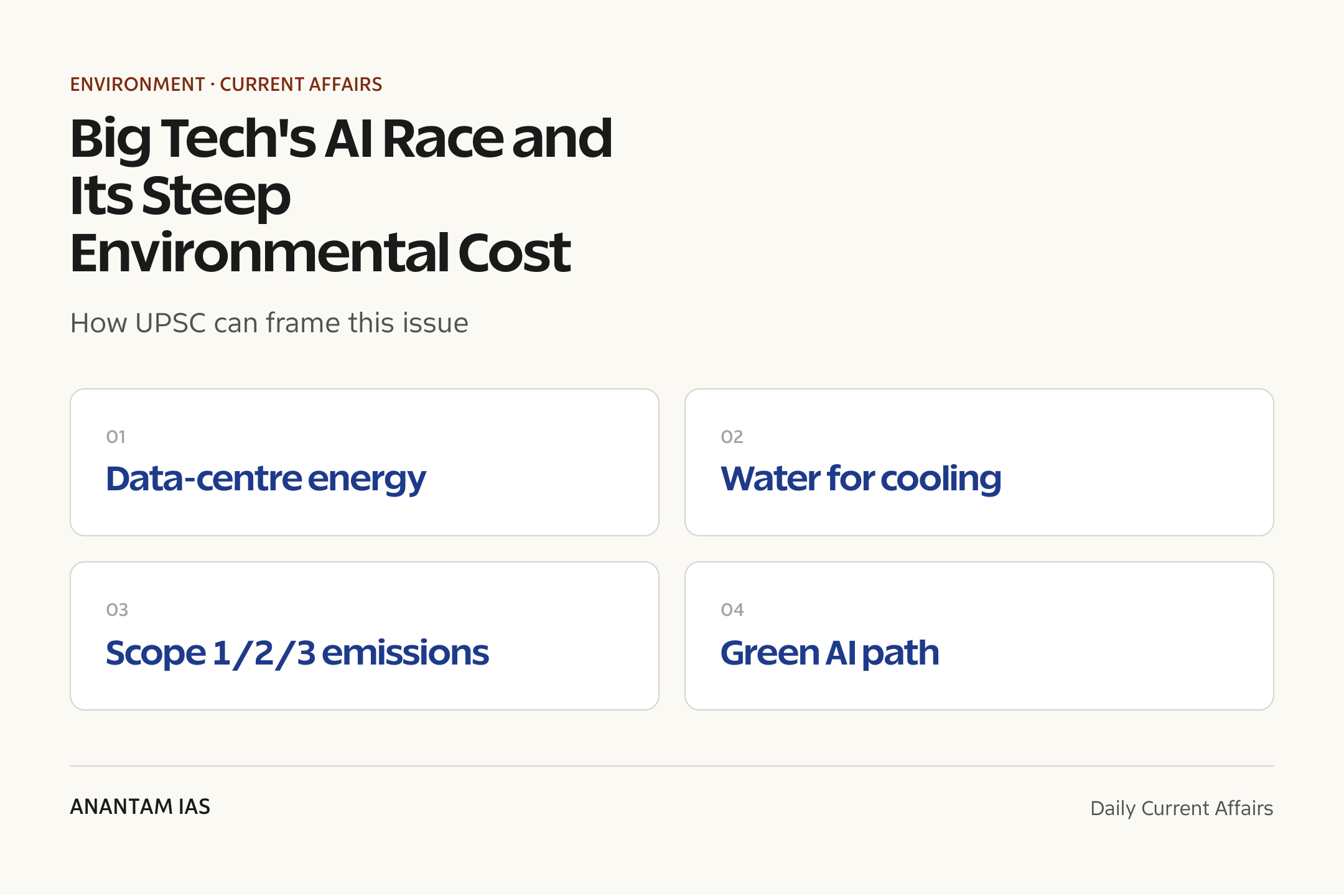
- Scope 1, 2 and 3 emissions classification under the GHG Protocol.
- IEA — mandate and its work on energy and AI.
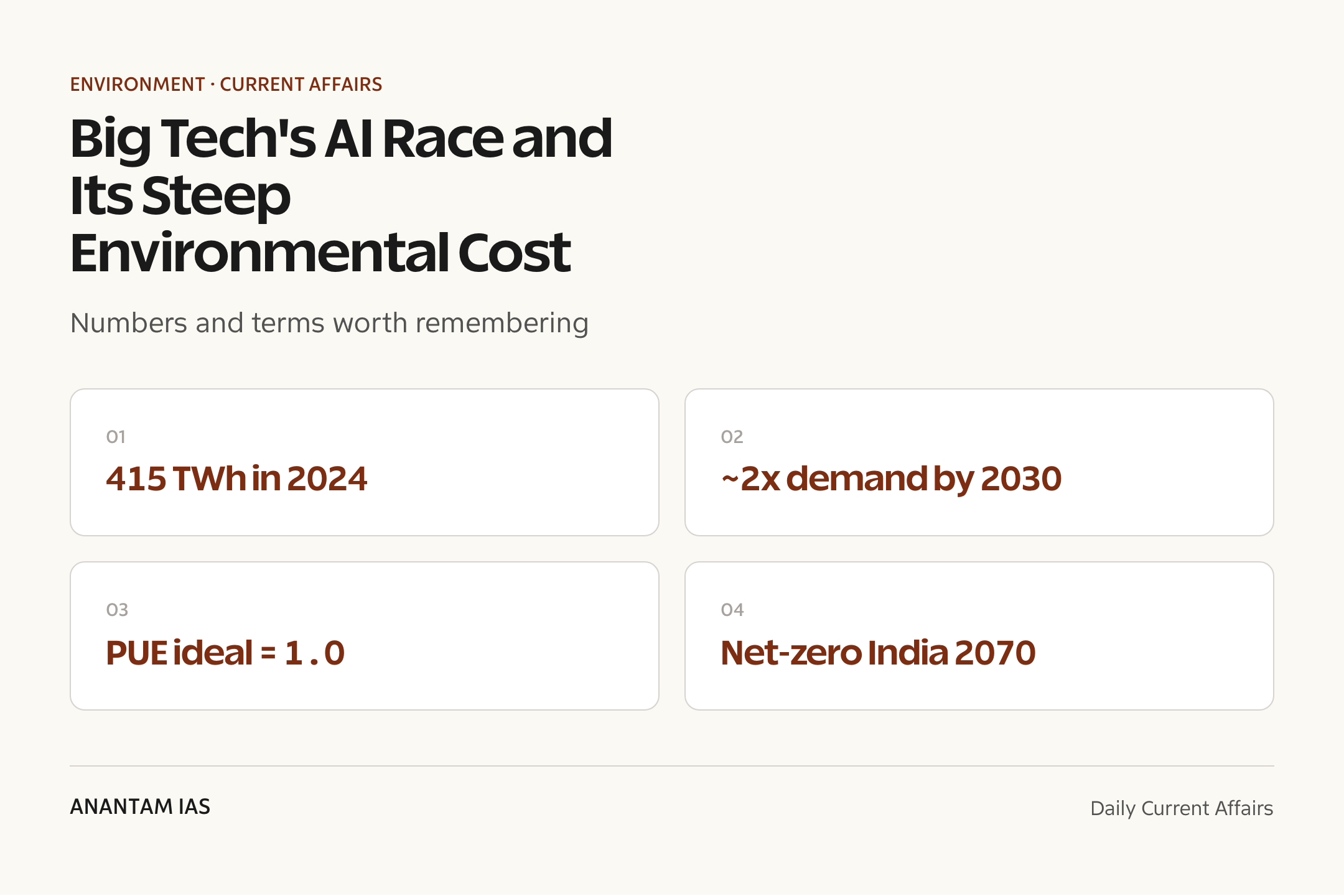
- India’s net-zero by 2070 target and 500 GW non-fossil capacity goal.
- E-Waste (Management) Rules, 2022 and Extended Producer Responsibility.
- Difference between carbon-neutral, carbon-negative and net-zero pledges.
- Infrastructure status for data centres in India.
- Concept of 24/7 carbon-free energy versus annual offsetting.
Mains Relevance
GS Paper 3
- Assess the environmental trade-offs of the AI boom, linking data-centre energy demand to India’s climate commitments.
- Examine how green data centres, energy-mix reform and water-efficient cooling can make digital growth sustainable.
Essay
- Technology must serve the planet, not consume it.
- Progress measured only in compute is progress that forgets the climate.
Background and Context
Why AI is so energy-hungry
The intelligence in modern AI is bought with electricity. Both training a model and answering user queries run on specialised chips that draw heavy, continuous power.
- Training a large model involves running thousands of chips for weeks, consuming megawatt-hours of electricity.
- Inference — every time a user asks an AI a question — also adds up across billions of daily queries.
- AI accelerators such as GPUs pack more power into each server rack, raising heat and cooling loads.
- A single AI query can use several times the energy of an ordinary web search, though exact figures vary and are debated.
- The result is a jump in the power density of data centres, straining local grids.
Data centres: the physical footprint
Data centres are the factories of the digital age. Two metrics capture their environmental cost — electricity and water.
- The IEA, in its 2025 Energy and AI analysis, estimates data centres used around 415 TWh of electricity in 2024, roughly 1.5% of the global total.
- It projects this could more than double to about 945 TWh by 2030, with AI the fastest-growing driver.
- Power Usage Effectiveness (PUE) measures efficiency: total facility energy divided by energy used by IT equipment. A perfect PUE is 1.0.
- Efficient hyperscale centres reach a PUE near 1.1-1.2, while older facilities run higher, wasting power on cooling.
- Cooling also needs water: many centres use evaporative systems that consume millions of litres, often drawn from stressed local sources.
Rising emissions despite green pledges
The headline worry is that companies which promised to cut carbon are reporting the opposite, as AI build-outs outpace their clean-energy purchases.
- Google, in its 2024 environmental report, said its total emissions had risen by roughly 48% since 2019, citing data-centre energy and supply-chain growth; it targets net-zero by 2030 with 24/7 carbon-free energy.
- Microsoft has reported that its emissions rose by around 30% since 2020, largely from Scope 3 value-chain sources tied to building AI infrastructure; it aims to be carbon-negative by 2030.
- Amazon, under its Climate Pledge, targets net-zero by 2040, but its scale of cloud and AI expansion keeps absolute emissions under scrutiny.
- These figures come from company sustainability reports; readers should treat them as reported disclosures, since methods and boundaries differ.
- The gap between pledges and outcomes fuels concern about greenwashing and the reliability of corporate carbon accounting.
Understanding Scope 1, 2 and 3 emissions
To read any company’s climate claim, one must know how emissions are classified under the widely used GHG Protocol.
- Scope 1 — direct emissions from sources a firm owns, such as on-site diesel backup generators.
- Scope 2 — indirect emissions from the electricity a firm buys to run its data centres.
- Scope 3 — all other value-chain emissions, including chip manufacturing, construction and hardware supply.
- For Big Tech, Scope 3 is often the largest and hardest slice to cut, as it lies outside direct control.
- Buying renewable power can lower Scope 2 on paper, yet real grid emissions depend on when and where clean power is available.
The India angle
India is emerging as a major data-centre hub, which makes the energy and water question a live domestic concern, not just a foreign one.
- India’s data-centre capacity has crossed the 1 GW mark and is expanding fast, drawing large global and domestic investment.
- Data centres enjoy infrastructure status in India, easing access to long-term finance.
- The strain is real because India’s electricity mix is still dominated by coal, so each new load can raise carbon intensity unless matched by clean power.
- Water-scarce states hosting clusters, such as Maharashtra and Tamil Nadu, face added pressure from evaporative cooling demand.
- India targets 500 GW of non-fossil capacity by 2030 and net-zero by 2070, so aligning digital growth with these goals is essential.
E-waste and the hidden hardware cost
Beyond running costs, the constant upgrade of AI chips and servers creates a fast-growing stream of electronic waste.
- Short hardware refresh cycles for AI accelerators shorten the useful life of expensive equipment.
- India is among the world’s largest generators of e-waste, much of it processed in the informal sector.
- The E-Waste (Management) Rules, 2022 introduced Extended Producer Responsibility to formalise recycling.
- Recovering critical minerals from discarded chips supports a circular economy and cuts fresh mining.
- Manufacturing new chips is itself carbon- and water-intensive, adding to the embodied emissions of AI.
Way Forward
Build green, efficient data centres
- Adopt renewable-powered and low-PUE designs, with liquid or free-air cooling to cut energy and water use.
- Locate centres in cooler regions or near clean-power sources to reduce cooling and grid strain.
Strengthen disclosure and accountability
- Mandate standardised, audited reporting of Scope 1, 2 and 3 emissions to curb greenwashing.
- Move corporate targets from annual offsetting toward genuine 24/7 carbon-free energy matching.
Align India's digital and climate goals
- Pair data-centre expansion with renewable procurement and water-recycling norms in state policies.
- Promote sustainable AI research on efficient models and reuse of waste heat.
Conclusion
The AI revolution rests on a physical foundation of chips, power and water, and that foundation carries a real environmental price. Rising emissions at firms that pledged to cut them show that clean-energy purchases have not kept pace with the speed of the AI build-out.
For India, the lesson is to grow its data-centre economy on a low-carbon, water-efficient path from the start. Efficient design, honest carbon accounting and a firm link between digital ambition and climate commitments can let the country reap AI’s gains without deepening its ecological stress.
UPSC Practice Questions
Prelims MCQ 1
With reference to data centres and their environmental footprint, consider the following statements:
- Power Usage Effectiveness (PUE) closer to 1.0 indicates a more energy-efficient data centre.
- Evaporative cooling systems in data centres consume freshwater.
- Emissions from the electricity a company purchases are classified as Scope 1 emissions.
How many of the above statements are correct?
(a) Only one (b) Only two (c) All three (d) None
Answer: (b) Only two
Explanation:
PUE near 1.0 means most energy powers IT equipment rather than overheads, so it is more efficient — statement 1 is correct. Evaporative cooling does consume freshwater — statement 2 is correct. Purchased-electricity emissions are Scope 2, not Scope 1 (which covers direct on-site sources) — statement 3 is wrong. So two statements are correct.
Prelims MCQ 2
The projection that global data-centre electricity demand could roughly double by 2030 is associated with which organisation?
(a) International Energy Agency (IEA) (b) World Trade Organization (WTO) (c) International Telecommunication Union (ITU) (d) Food and Agriculture Organization (FAO)
Answer: (a) International Energy Agency (IEA)
Explanation:
The IEA, in its 2025 analysis on energy and AI, estimated data centres used about 415 TWh in 2024 and projected this could more than double to roughly 945 TWh by 2030, with AI as a key driver. The other bodies do not produce such energy-demand projections.
UPSC Mains Questions
- The artificial-intelligence boom is deepening the energy and water footprint of data centres. Examine this trade-off and suggest how India can pursue digital growth without compromising its climate commitments. (GS Paper 3)
- “Corporate net-zero pledges are only as credible as their carbon accounting.” In light of rising Big Tech emissions, discuss the importance of standardised Scope 1, 2 and 3 disclosure. (GS Paper 3)
Sources: The Hindu and IEA – Energy and AI.
Frequently Asked Questions
What is a data centre and why does AI need it?
A data centre is a facility packed with servers, storage and networking hardware that powers cloud computing. AI models are trained and run on large fleets of power-hungry chips housed in these centres, making them the physical backbone of the AI economy.
What does Power Usage Effectiveness (PUE) measure?
PUE is the ratio of a data centre’s total energy use to the energy used only by its IT equipment. A perfect PUE is 1.0; efficient hyperscale centres reach around 1.1-1.2, while less efficient ones waste more power on cooling and overheads.
What are Scope 1, 2 and 3 emissions?
Scope 1 covers direct emissions from sources a firm owns, Scope 2 covers emissions from purchased electricity, and Scope 3 covers all other value-chain emissions such as chip manufacturing and construction. For Big Tech, Scope 3 is usually the largest share.
Why are Big Tech emissions rising despite net-zero pledges?
Companies such as Google and Microsoft have reported higher emissions as they rapidly build AI infrastructure, since data-centre energy and supply-chain growth have outpaced their clean-energy purchases. These figures come from their own sustainability reports and use differing methods.
Why does AI use so much water?
Many data centres use evaporative cooling to manage the heat from densely packed AI chips, consuming large volumes of freshwater, often from local sources already under stress. This adds a water dimension to AI’s environmental cost alongside electricity.
What is India’s stake in this issue?
India’s data-centre capacity is growing fast and enjoys infrastructure status, but its coal-heavy electricity mix and water-scarce host states raise sustainability concerns. Aligning this growth with the 500 GW non-fossil target and net-zero by 2070 is the key challenge.