Bihar Right to Public Grievances Act: Model for Time-Bound Redressal
Why in News?
A DARPG delegation studied Bihar’s implementation of the Right to Public Grievances Act 2015 and the Right to Public Services Act during a 3 January 2025 visit to assess best practices in statutory grievance redressal and service delivery.
- High-level study visit: A senior DARPG team led by the Secretary, DARPG, conducted a study tour to Bihar on 3 January 2025 to review implementation and impact.
- Focus areas: The visit examined statutory redressal mechanisms, CPGRAMS integration, call centres (SAMADHAN and JIGYASA), special campaigns to reduce pendency, and digital pensioner services.
- Institutional endorsement: Bihar’s model was showcased as a national best practice with quasi-judicial powers for Grievance Officers under the Act.
- Operational observation: The delegation observed hearing procedures at the District Grievance Redressal Office, Patna, and reviewed records management and appellate procedures.
The development matters in the context of:
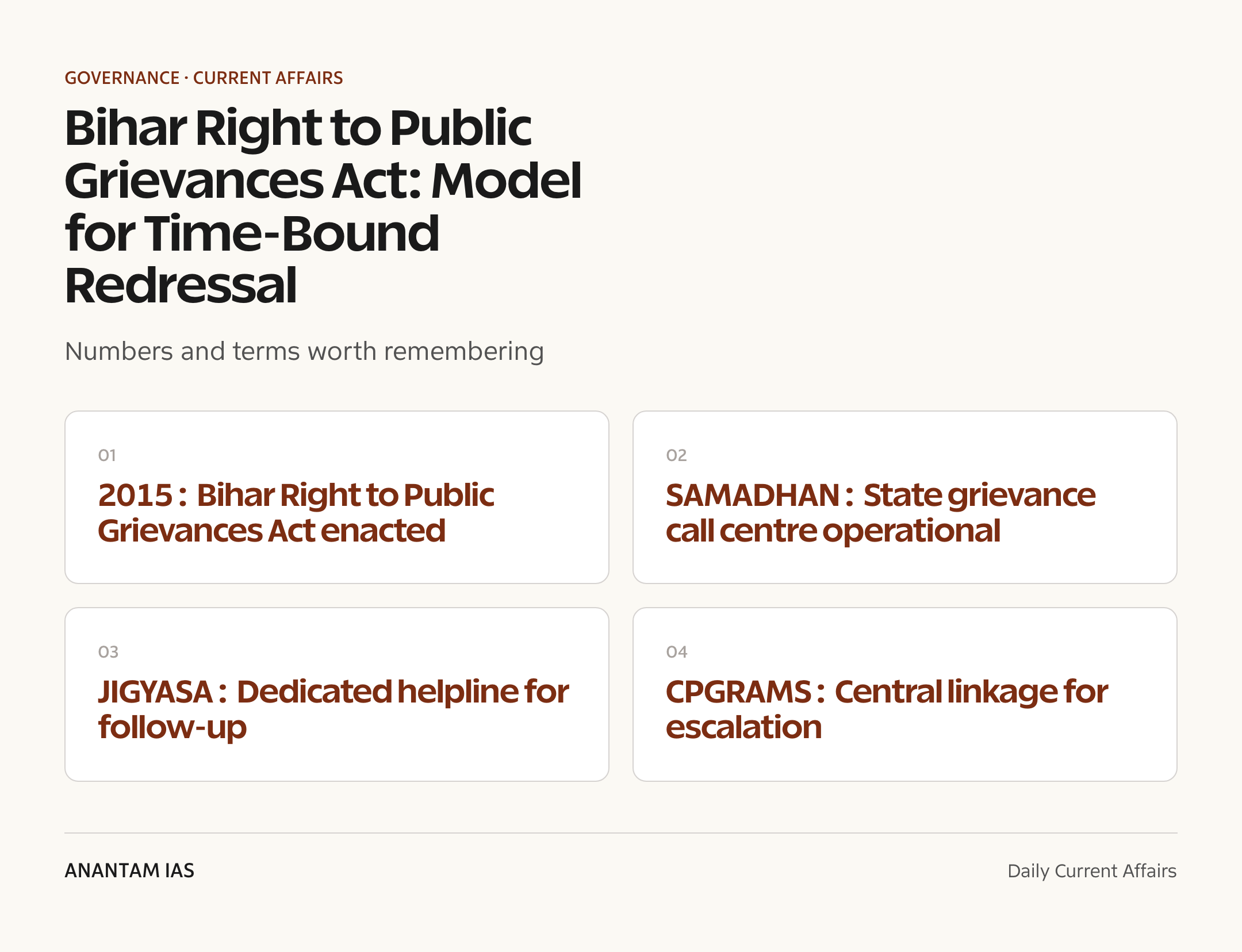
- Legal framework: Bihar enacted the Right to Public Grievances Redressal Act, 2015 to create a statutory regime for citizen grievance redressal with clear timelines and enforcement powers.
- Complementary law: The Bihar Right to Public Services Act provides service delivery guarantees with time limits and penalties for delay, supporting the grievances law.
- Technology integration: CPGRAMS linkage and dedicated state call centres (SAMADHAN, JIGYASA) help channel grievances and monitor resolution status.
- Decentralised hearings: District Grievance Redressal Officers and local hearing processes enhance access to redressal close to citizens.
- Quasi-judicial powers: Grievance Officers can summon project authorities, conduct hearings and issue reasoned orders to ensure compliance.
- Administrative reform lens: The Acts are part of Bihar Prashasanik Sudhar Mission efforts to improve records management, reduce pendency and strengthen accountability.

UPSC Relevance
Prelims Relevance
- Provisions and purpose of state-level public grievance laws and distinction from central mechanisms such as CPGRAMS.
- Features of the Bihar Right to Public Grievances Act, 2015: time-bound disposal, powers of Grievance Officers, appellate structure.
- Associated institutions: SAMADHAN and JIGYASA call centres, District Grievance Redressal Officers.
Mains Relevance
GS2 Governance
- Exam question material on administrative reforms, accountability and citizen-centric governance models at state level.
- Case study evidence for essays and answers on decentralisation of grievance redressal, statutory versus executive frameworks, and technology in governance.
- Discussion points on balancing quasi-judicial powers of administrative officers with procedural safeguards and administrative capacity.
Essay
- Use as an empirical example in essays on ‘Governance and Accountability’ and ‘E-Governance: Improving Service Delivery’.
- Illustrates institutional reforms for citizen empowerment and transparent administrative processes.
- Serves as evidence for arguments about the role of state innovation in replicable governance models.
Background and Context
Genesis and objectives of the Acts
Why Bihar enacted statutory regimes for grievance redressal and service delivery.
- Citizen-centric reform: Bihar sought a legal anchor to ensure time-bound grievance redressal and to make public servants accountable for delays.
- Complementarity: The Grievance Act works with the Right to Services Act to both provide services and remedy failures in delivery.
- Reduce pendency: A key objective was to address chronic backlog of service complaints and avoid escalation to courts.
- Restore trust: Structured hearings and reasoned orders aim to improve public trust in administrative processes.
- Administrative clarity: Statutory timelines and defined authorities reduce discretional ambiguity in redressal.
Key structural features of the Grievance Act
The Act’s main provisions that make it operationally distinct.
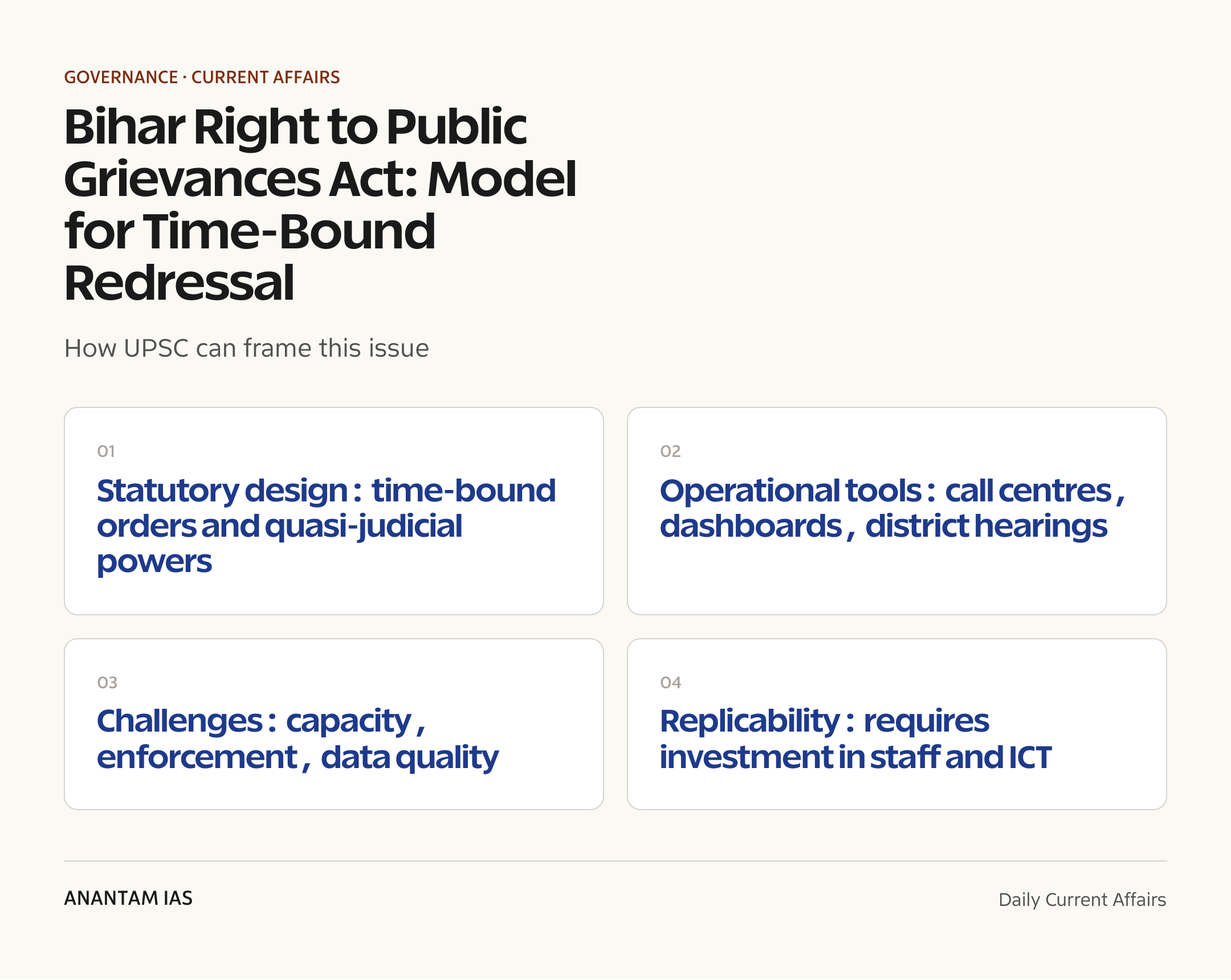
- Quasi-judicial powers: Grievance Officers can summon agencies, call witnesses and issue reasoned orders.
- Time-bound mandates: The law prescribes timelines for acknowledgement, hearing and final orders to prevent indefinite delays.
- Appellate mechanism: Provision for grievance appeal to higher state-level fora to ensure corrective review.
- Enforcement tools: Orders include directions that public agencies must carry out; failure can lead to administrative consequences.
- Record-keeping: Emphasis on improved records management to track cases and establish audit trails.
Operational ecosystem: SAMADHAN, JIGYASA and CPGRAMS
Technology and process infrastructure supporting frontline grievance work.
- SAMADHAN call centre: State-level intake hub for citizen complaints and initial triage.
- JIGYASA: Dedicated helpline for follow-up, guidance and case status updates to complainants.
- CPGRAMS linkage: Integration with the central CPGRAMS platform enables interoperability and escalation to central agencies.
- Dashboard monitoring: Digital dashboards provide pendency counts, resolution times and performance indicators for managers.
- Data-driven actions: Analytics used to identify systemic bottlenecks and target special campaigns for high-pendency categories.
Institutional arrangements and human resources
How Bihar staff and offices deliver the statutory scheme.
- District Grievance Redressal Officers: Frontline hearing officers who conduct in-person grievances hearings.
- State Public Grievance Receipt Centre: Central intake and coordination point for routing grievances to competent authorities.
- Training and capacity building: Staff familiarisation with legal powers, orders drafting and records management is prioritised.
- Mission structure: Bihar Prashasanik Sudhar Mission provides programmatic oversight and reform coordination.
- Inter-departmental coordination: Regular meetings with implementing agencies to ensure compliance with orders.
Interface with citizens and accessibility
Measures to improve access and transparency for complainants.
- Local hearings: District-level and office-level hearings reduce travel and cost for citizens.
- Information dissemination: Citizen charters and helpline information shared publicly to guide complainants.
- Digital-first intake with human touch: Online CPGRAMS registration is supplemented by call centre and in-person assistance.
- Reasoned orders: Issuing written orders with reasons improves transparency and provides remedies for appeal.
- Special outreach: Campaigns to inform marginalised groups about redressal rights and processes.
Challenges and learning constraints
Operational and legal challenges that arise when scaling statutory grievance models.
- Capacity limits: High case volumes can overwhelm Grievance Officers unless supported by adequate staff.
- Enforcement gaps: Implementing agency compliance with orders may require administrative sanctions or escalation routes.
- Quality of orders: Need for training to ensure decisions are legally sound and defensible.
- Data quality: Accurate records and consistent categorisation are needed for reliable monitoring.
- Replication hurdles: Other states may face resource and political economy barriers in adopting the model wholesale.
Way Forward
Strengthen institutional capacity
- Increase staffing: Recruit and train more Grievance Officers and support staff at district and state levels.
- Specialist training: Provide legal drafting, evidence handling and hearing management modules for officers.
- Performance incentives: Link resolution performance with career progression and rewards for timely, high-quality orders.
Improve enforcement and compliance
- Clear sanctions: Define administrative consequences for implementing agencies that repeatedly fail to comply with orders.
- Monitoring mechanisms: Use dashboards to flag non-compliance and trigger supervisory review by senior officials.
- Fast-track remedies: Introduce administrative review timelines to prevent avoidable appeals and delay.
Enhance technology and data use
- Interoperability: Deepen integration between state systems and CPGRAMS for seamless escalation and data exchange.
- Analytics: Use predictive analytics to prioritise high-risk grievance categories and allocate resources.
- User interfaces: Simplify complaint filing and status tracking for low-literacy users and multiple languages.
Scale citizen outreach and safeguards
- Awareness campaigns: Run targeted drives to inform vulnerable groups about grievance rights and processes.
- Legal aid linkages: Connect persistent or complex complainants with public legal aid or mediation services.
- Transparency practices: Publish anonymised case outcomes and compliance scores to build public confidence.
Conclusion
Bihar’s Right to Public Grievances Act 2015 shows how statutory design, backed by technology and procedures, can produce time-bound, accountable grievance redressal.
Operational success depends on adequate staffing, enforcement tools and continuous data-driven management to keep pendency low.
The model is replicable with adaptations, but scaling needs investments in capacity, monitoring and citizen outreach for sustained impact.
UPSC Practice Questions
Prelims MCQ 1
Which of the following is a feature of the Bihar Right to Public Grievances Act, 2015?
(a) A. It allows Grievance Officers to issue reasoned orders after summoning implementing agencies. (b) B. It abolishes the right to appeal against grievance orders. (c) C. It mandates that all grievances be decided by the State Administrative Tribunal. (d) D. It restricts grievance filing to only online CPGRAMS submissions.
Answer: A
Explanation:
The Act empowers Grievance Officers with quasi-judicial powers to summon agencies and issue reasoned orders. It does not abolish appeals, does not require the State Administrative Tribunal to decide all grievances, and allows multiple intake channels including call centres and in-person filing.
Prelims MCQ 2
SAMADHAN and JIGYASA in Bihar refer to:
(a) A. Special courts for service matters. (b) B. State call centres and helplines for grievance intake and follow-up. (c) C. Legislative committees overseeing grievance redressal. (d) D. Computerised case law repositories.
Answer: B
Explanation:
SAMADHAN and JIGYASA are operational call centre and helpline initiatives used by the State to receive grievances, provide assistance and follow up on case status. They are not courts, legislative committees or case law repositories.
UPSC Mains Questions
- {‘question’: ‘Examine how statutory grievance redressal mechanisms, such as the Bihar Right to Public Grievances Act, 2015, advance administrative accountability. Discuss strengths and limits with examples.’, ‘model_answer_points’: [‘Define administrative accountability and statutory grievance frameworks; explain how legal backing changes incentives for officials.’, ‘Strengths: time-bound disposal, quasi-judicial powers, transparency via reasoned orders, decentralised hearings and technology-enabled monitoring (SAMADHAN, CPGRAMS).’, ‘Limits: capacity constraints, enforcement gaps when implementing agencies do not comply, quality of orders needing legal training, data quality issues affecting monitoring.’, “Examples: Bihar’s use of Grievance Officers to summon project authorities; call centre-led triage reducing pendency in specific categories; need for sanctions and performance linkages.”, ‘Policy lessons: build staffing, enforcement sanctions, analytics for prioritisation, and strong outreach to ensure equitable access.’]}
- {‘question’: ‘Critically evaluate the role of technology in grievance redressal systems. How should states balance digital platforms with in-person accessibility?’, ‘model_answer_points’: [‘Discuss benefits of technology: faster intake, dashboard monitoring, interoperability with CPGRAMS, analytics for policy response.’, ‘Risks: digital divide, low-literacy barriers, poor data quality and over-reliance on online status without human follow-up.’, ‘Balanced approach: digital-first with assisted channels, multilingual interfaces, call centres like JIGYASA and on-ground outreach teams.’, ‘Institutional safeguards: data audits, integration with court and administrative records, training for staff to interpret digital reports.’, ‘Conclusion: Technology is an enabler, not a substitute for human processes; combining both yields better access and outcomes.’]}
Source: PIB, Ministry of Personnel, Public Grievances & Pensions.
Frequently Asked Questions
q
a
q
a
q
a
q
a
q
a
q
a