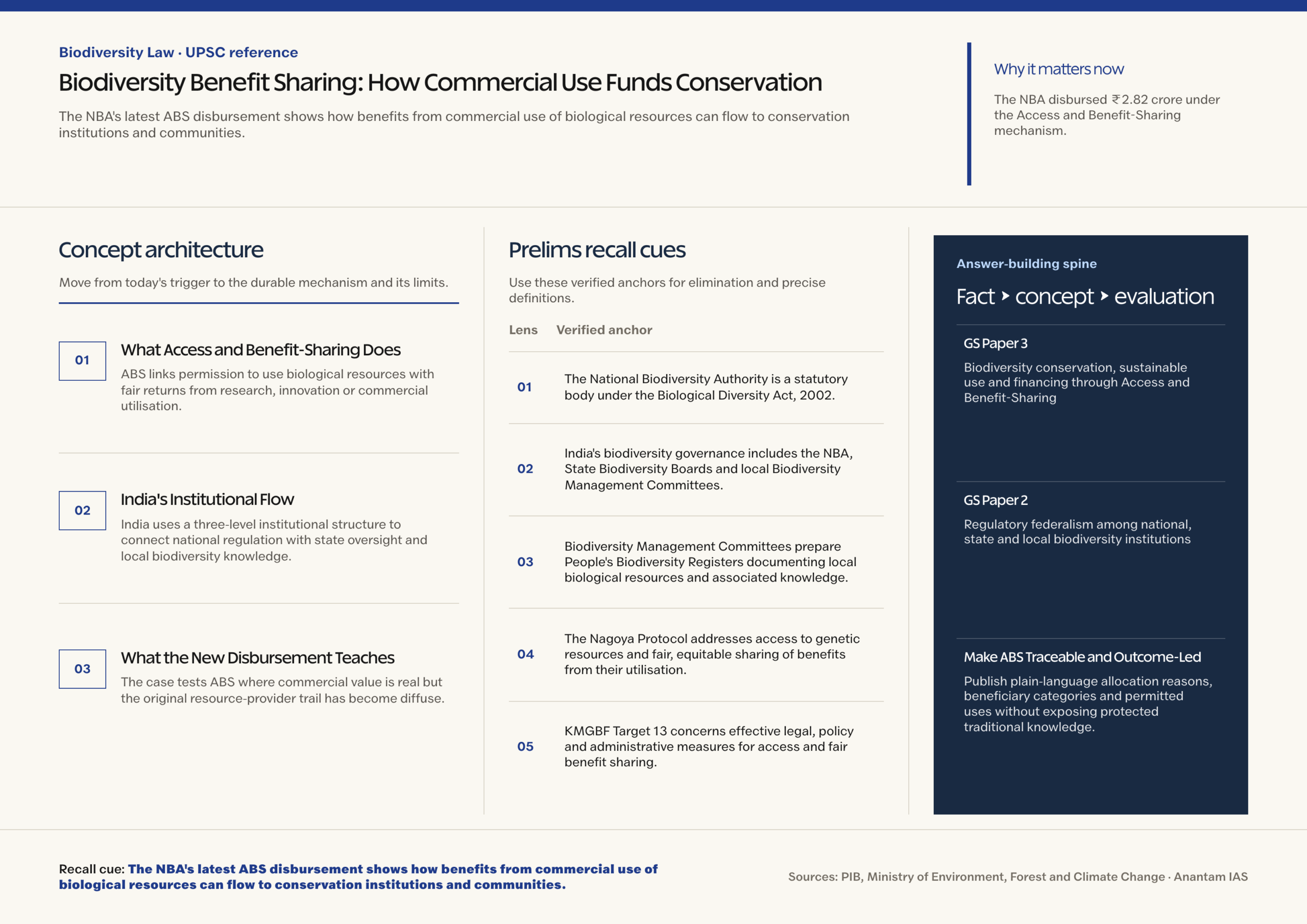
Biodiversity Benefit Sharing: How Commercial Use Funds Conservation
Why in News?
On 22 August 2026, the National Biodiversity Authority announced an Access and Benefit-Sharing disbursement arising from commercial use of India’s biological resources.
- The NBA disbursed ₹2.82 crore under the Access and Benefit-Sharing mechanism.
- Of this, ₹2.80 crore went to 27 State Biodiversity Boards and three Union Territory Biodiversity Councils.
- The commercial plant genetic resources could not be traced to specific farmers, communities or one geographic source after a corporate acquisition.
- An approved modality used the cultivation pattern of the concerned horticultural crops to distribute the benefit across states and Union Territories.
- A separate share went to ICAR-IIHR, the public research institution that supplied two microbial strains used for research and commercial purposes.
- ABS converts biodiversity from a free commercial input into a resource whose providers and stewards have a claim to fair benefits.
- The case demonstrates a fallback route when direct benefit claimers cannot be identified, preventing traceability gaps from defeating conservation finance.
- Disbursement is only the midpoint; utilisation, community participation and verifiable conservation outcomes determine whether benefit sharing becomes equitable.
UPSC Relevance
Prelims Relevance
- The National Biodiversity Authority is a statutory body under the Biological Diversity Act, 2002.
- India’s biodiversity governance includes the NBA, State Biodiversity Boards and local Biodiversity Management Committees.
- Biodiversity Management Committees prepare People’s Biodiversity Registers documenting local biological resources and associated knowledge.
- The Nagoya Protocol addresses access to genetic resources and fair, equitable sharing of benefits from their utilisation.
- KMGBF Target 13 concerns effective legal, policy and administrative measures for access and fair benefit sharing.
Mains Relevance
GS Paper 3
- Biodiversity conservation, sustainable use and financing through Access and Benefit-Sharing
- Institutional design for genetic resources, traditional knowledge and local stewardship
GS Paper 2
- Regulatory federalism among national, state and local biodiversity institutions
- India’s implementation of the CBD, Nagoya Protocol and Kunming-Montreal framework
Essay
- Fair benefit sharing turns conservation from an imposed restriction into a negotiated relationship between knowledge, commerce and ecological stewardship.
Background and Context
What Access and Benefit-Sharing Does
ABS links permission to use biological resources with fair returns from research, innovation or commercial utilisation.
- The access side regulates how biological resources and associated knowledge are obtained; the benefit side determines how gains from their utilisation are shared.
- Benefits may be monetary or non-monetary, including technology transfer, research collaboration, institutional capacity, conservation support or livelihood gains, depending on the applicable terms and regulation.
- The core equity principle is that commercial value often rests on ecosystems, crop diversity, community stewardship or public repositories that markets did not create by themselves.
- ABS also creates an incentive for documentation and sustainable use when resource custodians can see a credible route from utilisation to local ecological benefit.
- The Nagoya Protocol supplements the Convention on Biological Diversity by providing an international framework for legal certainty, compliance and fair sharing from genetic-resource utilisation.
India's Institutional Flow
India uses a three-level institutional structure to connect national regulation with state oversight and local biodiversity knowledge.
- The NBA administers national-level functions under the Biological Diversity Act, including approval and benefit-sharing roles for categories of access covered by the central authority.
- State Biodiversity Boards perform state-level regulatory and advisory functions, while Union Territory Biodiversity Councils provide the corresponding institutional channel in Union Territories.
- Local bodies constitute Biodiversity Management Committees, which support conservation, sustainable use and documentation of biological resources and associated knowledge through People’s Biodiversity Registers.
- When an identifiable provider or community is linked to the resource, benefit sharing should follow that connection; public research repositories can also be legitimate institutional beneficiaries.
- Section 27 provides for the National Biodiversity Fund, through which relevant receipts can support benefit claimers, conservation and socio-economic development consistent with the Act.
What the New Disbursement Teaches
The case tests ABS where commercial value is real but the original resource-provider trail has become diffuse.
- Plant genetic resources linked to commercial hybrids had entered through a company acquisition, so the NBA could not identify one farmer, community or geographic source as the direct claimant.
- An expert process recommended a distribution modality, and the Authority allocated the principal share using where the concerned horticultural crops are cultivated as a defensible proxy.
- Recipient boards and councils may use funds for People’s Biodiversity Registers, in-situ or ex-situ conservation, ecosystem restoration, Biodiversity Heritage Sites, committee capacity and community livelihoods.
- The public research-institution example follows a clearer chain: microbial strains came from ICAR-IIHR, so part of the benefit could return to the institution for repositories, research and conservation work.
- Both routes preserve the same principle: benefit sharing should follow traceable stewardship where possible and use a transparent, ecologically relevant modality when traceability fails.
Way Forward
Make ABS Traceable and Outcome-Led
- Publish plain-language allocation reasons, beneficiary categories and permitted uses without exposing protected traditional knowledge.
- Strengthen People’s Biodiversity Registers as living, community-validated records rather than one-time inventories.
- Track utilisation certificates alongside ecological and livelihood outcomes, not expenditure alone.
- Create clear fallback rules for acquisitions, mixed-origin resources and diffuse claimants while retaining meaningful community participation.
Conclusion
- The disbursement shows ABS in operation: commercial use creates a sharing obligation, institutions identify the beneficiary route, and funds are tied to conservation, sustainable use or associated livelihoods.
- For Mains, assess not only money collected but also traceability, participation, federal coordination and whether spending strengthens the communities and ecosystems that sustain biological resources.
UPSC Practice Questions
Prelims MCQ 1
With reference to India’s biodiversity governance, consider the following statements:
- The National Biodiversity Authority is a statutory body under the Biological Diversity Act, 2002.
- Biodiversity Management Committees are constituted at the local-body level.
- People’s Biodiversity Registers document local biological resources and associated knowledge.
How many of the above statements are correct?
(a) Only one (b) Only two (c) All three (d) None
Answer: (c) All three
Explanation:
India’s three-level biodiversity governance connects the statutory NBA and state boards with local Biodiversity Management Committees, which prepare People’s Biodiversity Registers.
Prelims MCQ 2
Kunming-Montreal Global Biodiversity Framework Target 13 is most directly associated with which one of the following?
(a) Equitable access and benefit sharing from genetic resources (b) Elimination of every invasive alien species (c) Universal legal rights for all ecosystems (d) Replacement of in-situ conservation by seed banks
Answer: (a) Equitable access and benefit sharing from genetic resources
Explanation:
Target 13 calls for effective measures to facilitate appropriate access and ensure fair and equitable sharing of benefits from genetic resources and digital sequence information, as applicable.
UPSC Mains Questions
- Explain how Access and Benefit-Sharing can align commercial use of biological resources with conservation and socio-economic justice.
- When direct biodiversity benefit claimers cannot be identified, what principles should guide allocation, participation and accountability?
Source: PIB, Ministry of Environment, Forest and Climate Change.
Frequently Asked Questions
What is Access and Benefit-Sharing?
ABS is the framework that regulates access to biological or genetic resources and shares benefits from their utilisation fairly with legitimate providers, custodians or conservation institutions.
Why did state boards receive the principal share in this case?
Specific farmers, communities or one source region could not be traced after a corporate acquisition, so an approved modality distributed funds using crop cultivation patterns.
What can recipient biodiversity institutions use ABS funds for?
Permitted uses include biodiversity documentation, habitat restoration, in-situ and ex-situ conservation, heritage-site support, committee capacity and community livelihood enhancement.
How is the Nagoya Protocol connected to ABS?
The Nagoya Protocol provides an international framework under the Convention on Biological Diversity for access, legal certainty, compliance and fair sharing of benefits from genetic-resource utilisation.
What is the main governance challenge after disbursement?
Authorities must verify that spending produces conservation and livelihood outcomes, includes legitimate stakeholders and does not reduce benefit sharing to a paper transfer between institutions.