Bioterrorism

Why in news:
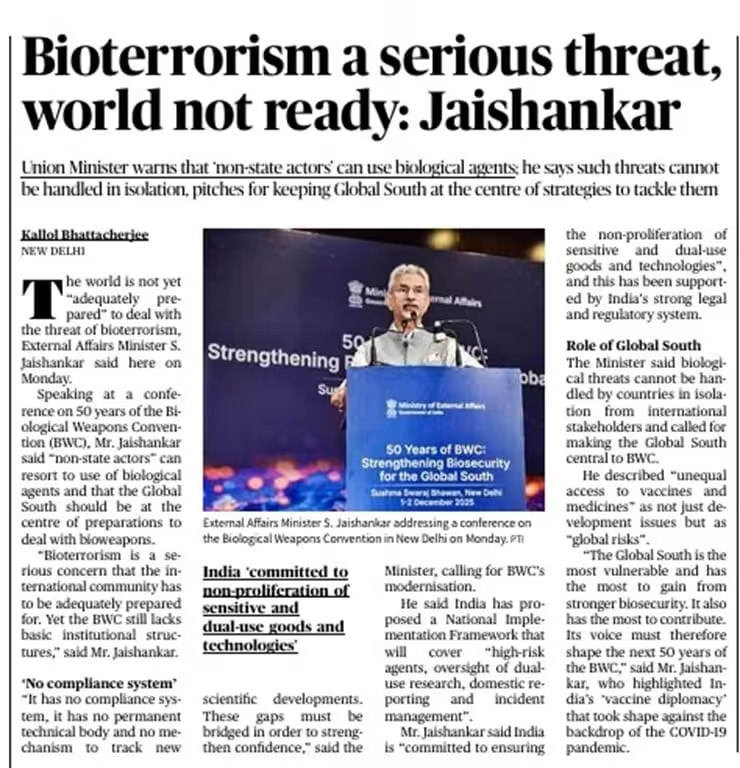
Statement by External Affairs Minister S. Jaishankar at a conference marking 50 years of the Biological Weapons Convention (BWC) in New Delhi (1 December 2025). Focus on global preparedness against bioterrorism and the need to strengthen the BWC.
UPSC Relevance:
International Relation, Science and Tech.
UPSC PYQ:
With reference to ‘Organization for the Prohibition of Chemical Weapons (OPCW)’, consider the following statements: (2016)
- It is an organization of the European Union in working relation with NATO and WHO.
- It monitors the chemical industry to prevent new weapons from emerging.
- It provides assistance and protection to States (Parties) against chemical weapons threats.
Which of the statements given above is/are correct?
(a) 1 only
(b) 2 and 3 only
(c) 1 and 3 only
(d) 1, 2 and 3
What is Bioterrorism?
Bioterrorism is the deliberate release of biological agents—such as viruses, bacteria, toxins—to cause illness, death, fear, economic disruption, or political instability.
These agents may be:
- Naturally occurring (e.g., anthrax, plague)
- Engineered in labs (dual-use research misuse)
- Genetically modified (e.g., enhanced spread, resistance)
Why Bioweapon is dangerous?
- Invisible, hard to detect
- Rapid spread
- Difficult attribution (who did it?)
- Cheap and easy to develop (small labs with minimal equipment)
- Can cause global pandemics
- Societal disruption
- Economic instability
Key Points from Jaishankar’s Speech:
At the 50th anniversary conference of the Biological Weapons Convention (BWC), EAM S. Jaishankar highlighted systemic global weaknesses:
A. World Not Adequately Prepared
- The Minister warned that global preparedness against bioterrorism is insufficient.
- Non-state actors (e.g., terrorist groups) pose increasing risks.
B. Gaps in the Biological Weapons Convention BWC
Jaishankar pointed out that the BWC:
- Has no compliance verification system
(No inspectors like the IAEA for nuclear weapons) - Has no permanent technical body
(No expert institution to monitor labs, research, outbreaks) - No mechanism to track new scientific biological developments
(Emerging tech like gene editing, synthetic biology, AI-driven bioengineering)
This means:
- No country can be held accountable for violations.
- No global authority can inspect suspicious labs.
- No system exists to check dual-use research (research that can be used for good or harm).
BWC vs Nuclear Treaties:
| Treaty | Has verification? | Institution? |
| NPT (Nuclear) | Yes | IAEA |
| CWC (Chemical) | Yes | OPCW |
| BWC (Biological) | ❌ No verification | ❌ No institution |
India’s Position and Proposed Actions:
A. Modernisation of BWC
- India calls for strengthening and updating the BWC to match modern biological threats.
B. India’s Proposed National Implementation Framework
Countries should adopt systems covering:
- High-risk agent regulation: Setting strict rules to control who can access, store, handle, or research dangerous biological agents (like deadly viruses or bacteria) so they don’t fall into the wrong hands
- Oversight of dual-use research: Monitoring and regulating research that can be used both for good and for harm — for example, genetic engineering that can help medicine but can also be misused to create harmful pathogens.
- Domestic reporting systems: Creating a system inside the country where laboratories, hospitals, or research institutions can quickly report unusual biological events, safety breaches, or suspicious activities to the government.
- Incident management mechanisms: Prepared plans and systems to respond quickly to biological emergencies — including detection, containment, public communication, and coordination between agencies.
C. India’s Commitment
- Strong legal and regulatory frameworks for preventing proliferation of dual-use goods and technologies.
- India supports global non-proliferation norms.
4. Need for Global Cooperation
A. Biological threats cannot be tackled in isolation
- Cross-border nature of pandemics and engineered pathogens requires:
- International cooperation
- Information sharing
- Equitable access to technologies
B. Role of the Global South
Jaishankar emphasized:
- Global South is most vulnerable to biothreats.
- It must be central to shaping BWC’s future.
Why?
- Unequal access to vaccines and medicines → a global risk, not just a development issue.
- Greater impact of pandemics on developing nations.
- Emerging scientific capabilities in Global South countries (India, Brazil, South Africa, etc.).
5. India’s Soft Power Example: Vaccine Diplomacy
- India provided vaccines during COVID-19 under Vaccine Maitri.
- Demonstrates:
- Importance of inclusive access to medicine
- Capacity to support global health security
- Leadership in South–South cooperation