Black Hole Jets: How Narrow Beams Can Heat a Galaxy’s Gas Reservoir
Why in News?
On 25 September 2026, the Ministry of Science and Technology reported research involving the Raman Research Institute that identified a possible mechanism connecting black-hole jets with energised gas surrounding galaxies.
- The researchers found a strong gas-emission signal along jet directions, although averaging measurements over all directions around the galaxies did not reveal a detectable signal.
- The reported signal was strongest near the stellar disk edge and the outer circumgalactic boundary, supporting an interpretation involving energy transfer where jets encounter surrounding gas.
- The study proposes a route for black-hole feedback: heating and disturbance can make gas less able to cool and clump into new stars.
- The circumgalactic medium is a diffuse gas reservoir around a galaxy; the finding concerns its interaction with jets, not matter escaping from inside a black hole.
- Galaxies need available gas to form stars, but gas availability and the ability of that gas to cool are different constraints.
- A small central region can affect much larger surroundings by transferring energy through jets; physical influence need not require swallowing all the affected gas.
UPSC Relevance
Prelims Relevance
- Circumgalactic medium: diffuse gas surrounding a galaxy.
- Plasma: a gas containing charged particles.
- Ionisation: formation of ions by adding or removing electrons.
- Accretion disk and jets exist outside the event horizon.
- Directional measurements can reveal a signal concealed by averaging.
Mains Relevance
GS Paper 3
- Indian research institutions and international cooperation in fundamental science.
- Using observations to distinguish a plausible astrophysical mechanism from a universal conclusion.
Essay
- The method used to observe a system can determine which patterns become visible.
Background and Context
The gas reservoir beyond the visible galaxy
A galaxy’s future star formation depends partly on gas beyond its bright stellar disk and on whether that gas can cool, condense and become available.
- The circumgalactic medium, or CGM, is the diffuse gaseous environment surrounding a galaxy. It is distinct from the bright collection of stars usually pictured as the galaxy and can supply material for later star formation.
- Cooling allows gas to lose thermal energy, making conditions more favourable for condensation and gravitational collapse. A gas reservoir is not automatically a reservoir of newly formed stars; its physical state matters.
- Heating and disturbance can interrupt this route to star formation. The question is how energy generated near a central supermassive black hole reaches gas distributed far beyond that small central region of the galaxy.
- The study reported by the science ministry examines jets as one energy-transfer route. It addresses a specific physical mechanism, rather than claiming that every quiet galaxy must have stopped forming stars for the same reason.
- Feedback here means that activity near the central black hole can influence the surrounding gas and the galaxy’s subsequent development. It does not mean that the black hole deliberately regulates stars or consumes them all.
How a narrow jet can influence distant gas
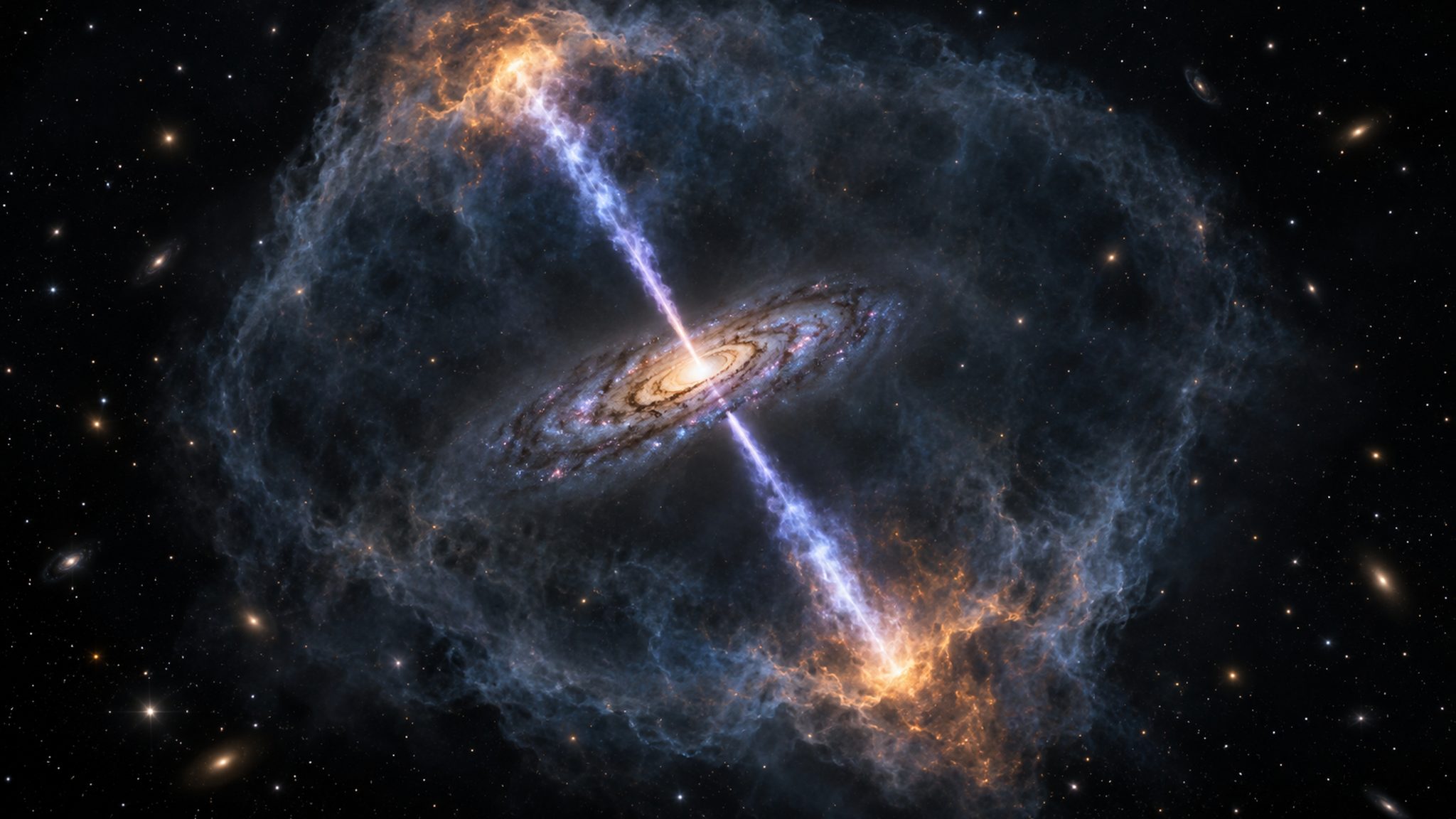
A jet transports energy away from the central environment; interactions along its path can energise gas far beyond the black hole’s immediate surroundings.
- A jet is a directed outflow of fast-moving plasma, rather than a solid object or an ordinary beam of light. Its interaction with surrounding material can transfer energy beyond the compact region that launches it.
- Plasma contains charged particles. When gas becomes ionised, atoms gain or lose electrons; emissions from energised gas provide observable clues that researchers can examine when testing whether a jet affects its surroundings.
- The reported interpretation is that the jet encounters circumgalactic gas and deposits energy through the interaction. Heating and disturbance along its route can hinder the cooling and clumping needed for subsequent star formation.
- The research identifies stronger signals near the disk edge and outer CGM boundary. These locations matter because they connect observed emission with proposed interactions, rather than merely noting that an active black hole exists nearby.
- NASA explains that jets involve material redirected in the accretion environment. They do not establish that matter escapes from inside the event horizon; the surrounding disk and the black hole’s interior are different physical regions.
Why the direction of observation changes the result
The key observational distinction is between combining every direction and examining the direction a jet actually follows through the surrounding gas reservoir.
- An all-direction average combines measurements around the galaxy. If an effect is concentrated along a narrow path, combining that path with many less affected directions can weaken its prominence in the resulting overall signal.
- The team reported no detected signal in the averaged measurements, but a strong signal along the jet direction. The contrast supports a directional interaction; it does not show equal heating throughout the whole surrounding reservoir.
- Non-detection in an averaged measurement is not automatically proof that no interaction exists. The result illustrates why an observational method should reflect the geometry of the physical process being investigated before conclusions are drawn.
- The evidence supports a possible feedback mechanism, not universal proof that jets control every galaxy. Avoid converting a directional gas-emission finding into a claim that the study measured the complete history of star formation.
- Separate observation, interpretation and implication: directional emission is observed; jet energy deposition explains it; reduced cooling offers a route to suppressed star formation. These statements have different roles in the scientific argument.
Way Forward
Test the mechanism across different conditions
- Compare jet-aligned and off-axis observations to test how far the heating interpretation accounts for the spatial distribution of emission.
- Study different galactic environments before treating one proposed mechanism as the explanation for every instance of reduced star formation.
- Present illustrations and observations separately: conceptual images can teach the relationship, but measured signals must carry claims about actual gas behaviour.
Conclusion
- Jets can connect central black-hole activity with distant gas, providing a possible explanation for how heating limits future star formation. The important chain is energy transfer, changed gas conditions and altered capacity to form stars.
- Direction matters in scientific measurement. This study’s useful lesson is both astrophysical and methodological: a focused interaction can become visible when observations follow its geometry, while the broader interpretation remains open to further testing.
UPSC Practice Questions
Prelims MCQ 1
With reference to black-hole jets and the circumgalactic medium, consider the following statements:
- The circumgalactic medium can supply gas for future star formation.
- Black-hole jets demonstrate that matter can escape from inside the event horizon.
- Heating can hinder the cooling and clumping of gas.
How many of the above statements are correct?
(a) Only one (b) Only two (c) All three (d) None
Answer: (b) Only two
Explanation:
The first and third statements are correct. Jet material is launched from the surrounding accretion environment, not from inside the event horizon.
Prelims MCQ 2
Why can an all-direction average fail to reveal a jet-related emission signal?
(a) The circumgalactic medium contains no gas. (b) Plasma never emits detectable radiation. (c) A narrow directional effect may be diluted when combined with other directions. (d) Averaging proves that jets cannot interact with matter.
Answer: (c) A narrow directional effect may be diluted when combined with other directions.
Explanation:
A directional interaction need not affect all surrounding gas equally. Combining many directions can reduce the prominence of the signal aligned with a jet.
UPSC Mains Questions
- Explain how black-hole jets may influence star formation through their interaction with circumgalactic gas.
- Using the reported jet study, discuss why observational geometry and cautious interpretation matter in scientific research.
Sources: PIB, Ministry of Science and Technology and NASA: Black-hole jets and accretion.
Frequently Asked Questions
What is the circumgalactic medium?
The circumgalactic medium is diffuse gas surrounding a galaxy beyond its bright stellar disk. It acts as a potential reservoir for future star formation, depending on whether the gas can cool and condense.
How might jets reduce star formation?
Jets can transfer energy to surrounding gas along their paths. Heating and disturbance may prevent some gas from cooling and clumping, limiting the material able to participate in future star formation.
Does a jet escape from inside a black hole?
No. Jets involve material in the accretion environment outside the event horizon. Their presence does not overturn the distinction between observable activity around a black hole and the region from which escape is impossible.
What made the reported observation distinctive?
The researchers detected a strong gas-emission signal along the jet direction, despite no detected signal in the all-direction average. The strongest reported signals occurred near the stellar disk edge and outer circumgalactic boundary.
Does this explain every galaxy with low star formation?
No. The research supports a possible mechanism linking jets and circumgalactic gas. It does not establish that every galaxy experiences the same interaction or that jets are the sole influence on star formation.